Mise en relation bénévole assistée par IA : comment ça marche

Demandez à n'importe quel responsable RSE de décrire son pire mardi, et vous obtiendrez probablement la même réponse : un tableur avec 400 noms, une pile de demandes d'associations qui ne correspondent pas aux compétences des équipes, et une échéance dépassée. Gérer manuellement la mise en relation, surtout sur plusieurs sites et fuseaux horaires, consomme un temps précieux qui devrait être consacré au développement du programme.
La mise en relation par IA résout ce problème en utilisant les données des collaborateurs (compétences, centres d'intérêt, disponibilités, localisation) pour recommander ou attribuer automatiquement les opportunités les plus pertinentes, tout en affinant ces suggestions au fil du temps.
Les données issues de la stratégie d'analyse Goodera AIX montrent qu'un responsable RSE assisté par l'IA peut déployer, gérer et coordonner des programmes de bénévolat 10 fois plus efficacement en automatisant les tâches logistiques, comme la planification, la coordination internationale et le reporting d'impact.
La suite de ce guide détaille le fonctionnement de cette technologie, les questions à poser avant de choisir un prestataire, et la place que doit conserver le jugement humain dans ce processus.
Qu'est-ce que la mise en relation par IA, exactement ?
Pour faire simple, la mise en relation par IA est un système qui associe automatiquement un collaborateur à une mission de bénévolat en croisant plusieurs variables, évitant ainsi à un coordinateur de traiter chaque demande manuellement. Au lieu de parcourir soixante opportunités en espérant trouver la bonne, le collaborateur se voit proposer une sélection restreinte basée sur son profil.
L'atelier de Goodera sur ce sujet résume bien l'objectif : plus la pertinence est élevée, moins il y a de friction, et plus les collaborateurs sont enclins à passer de l'intérêt à l'action.
Les points de données utilisés par un moteur de mise en relation
Un moteur de mise en relation efficace s'appuie généralement sur cinq catégories d'informations, chacune apportant un niveau de contexte différent à la recommandation finale.
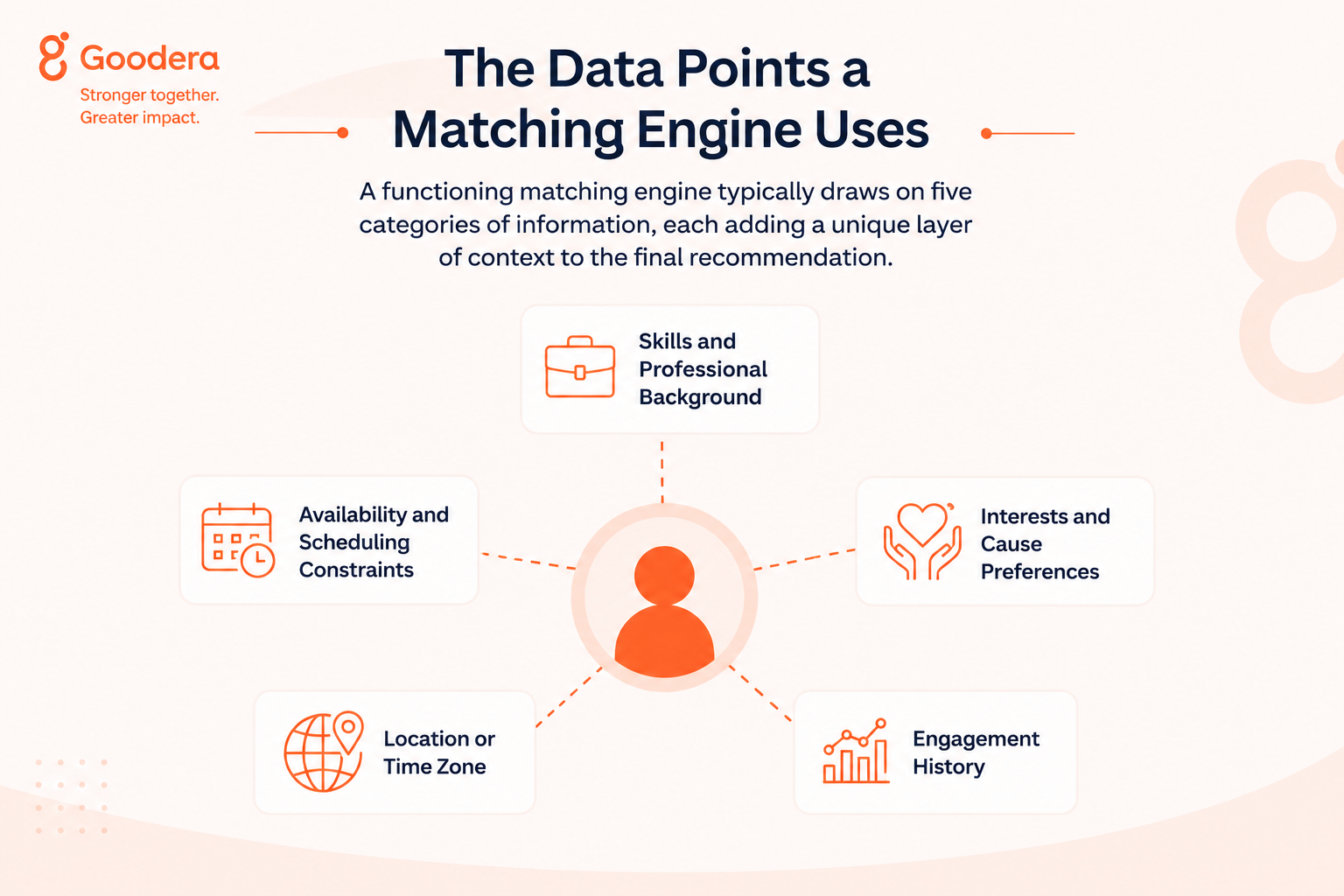
Signaux de données utilisés par un moteur de mise en relation
- Compétences et parcours professionnel
Il s'agit généralement de l'élément le plus déterminant, incluant la fonction, l'expérience sectorielle et les compétences spécifiques du collaborateur. C'est crucial pour le mécénat de compétences, où le projet d'une association dépend d'une expertise métier réelle.
- Centres d'intérêt et causes privilégiées
Les employés choisissent généralement les causes qui leur tiennent le plus à cœur, qu'il s'agisse de l'éducation, de l'environnement ou de la mobilité économique. Ces informations aident le système à prioriser les opportunités dans lesquelles un employé est susceptible de s'investir réellement, et pas seulement celles pour lesquelles il est techniquement qualifié.
- Disponibilités et contraintes d'emploi du temps
Une recommandation n'est pertinente que si l'employé peut réellement y répondre. Le système doit donc prendre en compte les heures de travail, les périodes d'indisponibilité et les limites de temps. Sans ces données, même une adéquation parfaite sur le plan des compétences peut échouer au moment de la planification.
- Localisation ou fuseau horaire
Pour les missions en présentiel, cela permet de restreindre les résultats à un rayon de déplacement raisonnable. Pour le travail virtuel, cela garantit que l'employé et l'association peuvent réellement coordonner des sessions en direct. Les programmes mondiaux dépendent fortement de ces données pour éviter de recommander une mission idéale qui serait logistiquement impossible à réaliser.
- Historique d'engagement
Certains systèmes prennent également en compte la manière dont une personne a réagi aux opportunités passées, c'est-à-dire ce à quoi elle s'est inscrite, ce qu'elle a terminé ou ce qu'elle a ignoré. Cela aide le modèle à comprendre ce qui a constitué une « bonne adéquation » pour cet individu par le passé, plutôt que de se fier uniquement aux préférences déclarées.
Frequently Asked Questions
1. Le jumelage bénévole par IA remplace-t-il notre coordinateur de bénévolat ?
Non. Il élimine les tâches répétitives de tri et de planification, mais le développement des relations avec les associations partenaires, la définition de projets complexes et la résolution de cas particuliers nécessitent toujours le jugement humain.
2. Quelle est la précision du jumelage par IA par rapport au jumelage manuel effectué par notre équipe RSE ?
La précision dépend davantage de la qualité des données que de la technologie elle-même. Un système disposant de données détaillées et actualisées sur les compétences et les intérêts surpassera systématiquement le jumelage manuel à grande échelle, tandis qu'un système basé sur des profils incomplets ou obsolètes sera moins performant qu'un coordinateur expérimenté.
3. Qu'advient-il des compétences et des données personnelles de nos employés une fois qu'elles sont intégrées dans le système de jumelage ?
Les plateformes réputées limitent la collecte aux champs qui servent directement au jumelage, tels que les compétences, les intérêts, la disponibilité et la localisation, et doivent offrir à votre organisation un contrôle clair sur la conservation et la suppression des données. Demandez à tout fournisseur un inventaire complet des champs de données avant de signer un contrat.
4. L'IA de mise en relation peut-elle gérer le bénévolat de compétences et le mécénat de compétences, ou est-elle réservée aux journées de bénévolat classiques ?
Elle peut gérer les deux, bien que la mise en relation pour le bénévolat de compétences et le mécénat nécessite des données plus granulaires et souvent une étape de validation humaine, compte tenu des enjeux plus importants.
5. Comment savoir si l'algorithme de mise en relation par IA est biaisé ?
Demandez au fournisseur s'il réalise des audits réguliers des résultats de mise en relation selon les données démographiques des employés et comment il réagit en cas de disparités. Le cadre de gestion des risques liés à l'IA du NIST est une référence utile pour les questions d'équité à soulever.
6. Combien de temps faut-il à un système de mise en relation par IA pour produire des résultats pertinents ?
La plupart des systèmes s'améliorent de manière significative au cours des premiers mois, à mesure que la boucle de rétroaction accumule des données réelles. Les programmes lancés avec peu de données de profil initiales doivent prévoir une courte période de montée en puissance avant que les recommandations n'atteignent leur niveau de qualité optimal.
7. Quelles questions poser à un fournisseur pour confirmer qu'il utilise une véritable IA et non de simples filtres ?
Demandez quels points de données spécifiques alimentent le score de correspondance, comment ce score est pondéré et à quelle fréquence le modèle est réentraîné. Exigez des indicateurs de taux de remplissage et de taux de complétion auprès des clients existants plutôt que de vous contenter d'affirmations générales sur l'engagement.
8. La mise en relation par IA peut-elle fonctionner dans plusieurs pays, langues et fuseaux horaires ?
Oui, à condition que la plateforme ait été conçue pour une utilisation mondiale et non adaptée à partir d'un modèle destiné à un marché unique. La compatibilité avec les fuseaux horaires et les nuances linguistiques doivent être intégrées directement dans le score de correspondance, au-delà de la simple pertinence des compétences.
9. Que faire si un employé n'est pas satisfait de la mise en relation suggérée par l'IA ?
Une plateforme crédible permet de signaler facilement une inadéquation et de demander une autre opportunité sans la moindre difficulté. Ce retour d'information doit être visiblement pris en compte dans les recommandations futures plutôt que de disparaître dans une file d'attente de support.
10. Les données de nos employés sont-elles utilisées pour entraîner les modèles d'IA du fournisseur ?
Cela varie selon le fournisseur et doit être explicitement stipulé dans votre contrat plutôt que supposé. Demandez directement si les données de votre organisation servent à entraîner un modèle partagé par l'ensemble de la clientèle du fournisseur ou si elles restent isolées au sein de votre propre programme.