AI-Powered Volunteer Matching: How It Works

Ask almost any CSR program manager to describe their least favorite Tuesday, and you will likely hear some version of the same story. A spreadsheet with 400 employee names, a stack of nonprofit requests that do not quite line up with anyone's skill set, and a deadline that arrived yesterday. Matching people to the right opportunity by hand, especially across multiple offices and time zones, eats hours that could go toward actually building the program.
AI-powered volunteer matching solves that exact problem by using employee data such as skills, interests, availability, and location to automatically recommend or assign the most relevant volunteer opportunity, then refining those recommendations as it learns from every match it makes.
Data from the Goodera AIX Strategy Analysis shows that an AI-empowered CSR leader can deploy, manage, and coordinate volunteering programs 10x more effectively by automating the "plumbing" of volunteering, such as scheduling, cross-border logistics, and automated impact reporting.
The rest of this guide breaks down exactly how the technology works, what questions to ask before trusting a vendor's claims, and where human judgment still belongs in the process.
What Is AI-Powered Volunteer Matching, Exactly?
At its simplest, AI-powered volunteer matching is a system that pairs an employee with a volunteer opportunity based on more than one variable at a time, and does so automatically rather than through a coordinator manually reviewing every request. Instead of an employee scrolling through sixty open opportunities hoping something fits, the system narrows that list to a small handful based on what it already knows about the person.
Goodera's workshop guidance on this topic describes the goal well: when relevance increases, friction decreases, and employees become more likely to convert interest into action.
The Data Points a Matching Engine Uses
A functioning matching engine typically draws on five categories of information, each contributing a different layer of context to the final recommendation.
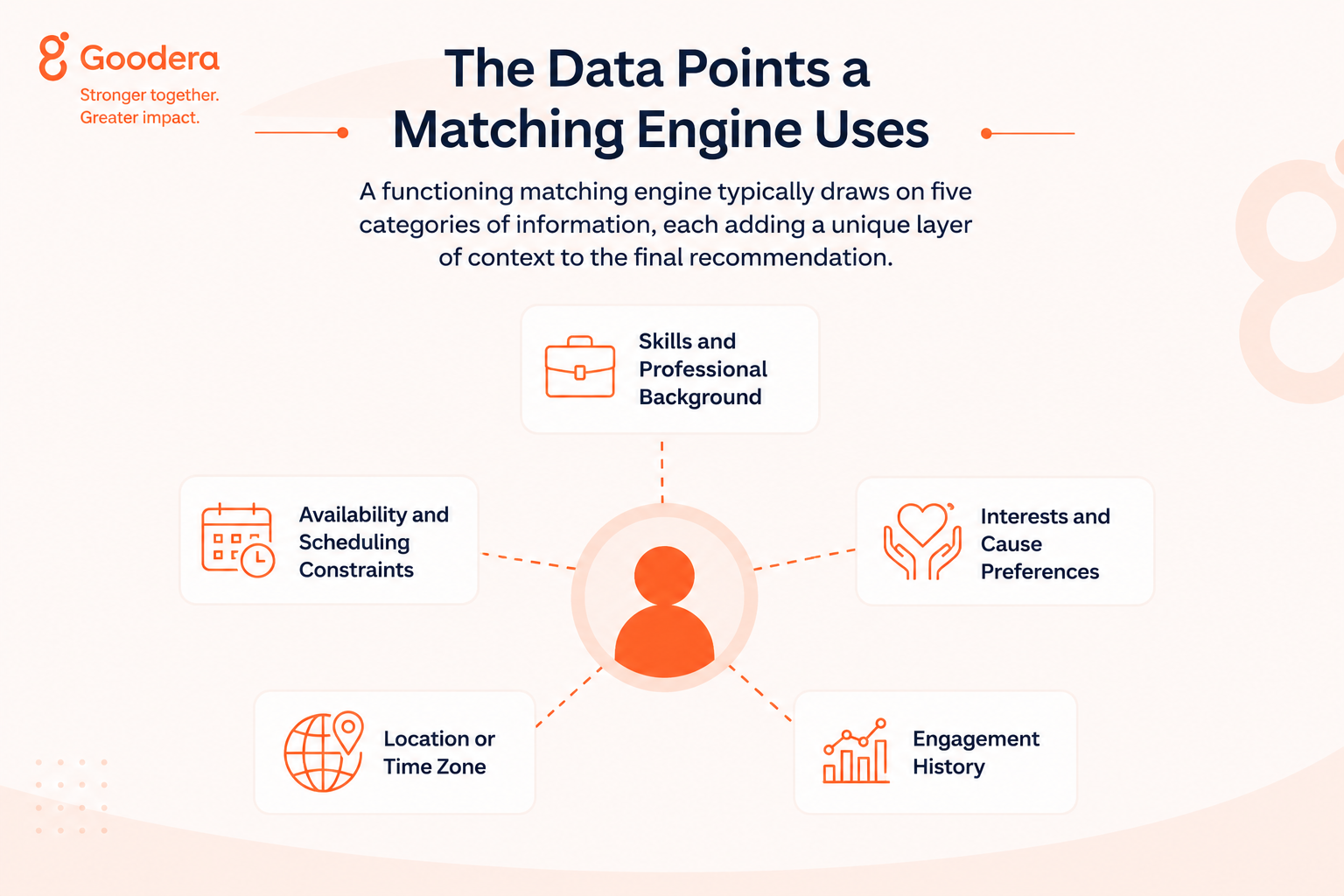
- Skills and Professional Background
This is usually the heaviest-weighted input, covering job function, industry experience, and specific competencies an employee brings to the table. It matters most for skills-based and pro bono matching, where a nonprofit's project depends on real subject-matter expertise.
- Stated Interests and Cause Preferences
Employees typically select the causes they care about most, whether that is education, environment, or economic mobility. This input helps the system prioritize opportunities an employee is likely to feel genuinely invested in, not just technically qualified for.
- Availability and Scheduling Constraints
A recommendation only matters if the employee can actually show up, so the system needs working hours, blackout dates, and time commitment limits. Without this input, even a perfectly skilled match can fall apart at the scheduling stage.
- Location or Time Zone
For in-person opportunities, this narrows results to a reasonable travel radius, and for virtual work, it confirms the employee and nonprofit can realistically coordinate live sessions. Global programs depend heavily on this input to avoid recommending a great match that simply cannot happen logistically.
- Engagement History
Some systems also factor in how a person has responded to past opportunities, meaning what they signed up for, completed, or skipped. This helps the model understand what "a good fit" has actually looked like for that individual before, rather than relying on stated preferences alone.
How This Differs From a Simple Keyword or Filter Search
A basic filter search asks an employee to select a cause area or a date range and then shows every opportunity that matches those exact tags. AI-powered matching instead weighs several factors simultaneously and ranks results by relevance rather than simply returning everything that technically qualifies.
The practical difference shows up immediately: a filter might return forty options, while a matching engine surfaces the three or four most likely to result in a completed, satisfying engagement.
How Does the Matching Algorithm Decide Who Gets Which Opportunity?
The short version is that the algorithm assigns a relevance score to each possible pairing and recommends the highest-scoring options first. That score is built from weighted inputs, meaning some factors, like a required professional skill for a pro bono project, carry more weight than a loosely stated interest in "community causes." Understanding this scoring logic matters, because it is the difference between a system that genuinely improves placement quality and one that simply automates a list.
1. Skills and Competency Scoring
For general volunteering, skills scoring can be fairly light, matching broad categories like communication or organization. For skills-based and pro bono work, the scoring needs to be far more precise.
2. Interest, Availability, and Location Signals
Skills alone do not make a good match. An employee with the perfect financial background will not show up for a project that conflicts with their working hours or sits outside a time zone they can reasonably join. Strong matching systems weigh interest and logistics alongside competency, since a technically qualified employee who cannot realistically attend the program represents a wasted recommendation rather than a successful one.
3. Learning From Past Matches: The Feedback Loop
The most valuable part of an AI matching system is what happens after the first recommendation. When an employee completes a project, provides feedback, or requests a different type of role, that data feeds back into the model and sharpens future recommendations for that person and for others with similar profiles. Over time, this feedback loop is what separates a genuinely adaptive system from a static list.
Why Corporate Volunteering Programs Are Adopting AI Matching Now
The honest answer is that manual matching simply cannot keep pace with the scale most corporate programs now operate at. Employee expectations have also shifted, since people increasingly assume that any digital platform they use, whether for shopping, streaming, or internal tools, will filter information down to what is actually relevant to them.
Goodera's research on AI in the workplace notes that when volunteering platforms stay static and generic, participation requires more cognitive effort from the employee, which quietly suppresses turnout.
The Scale Problem: Matching Thousands of Employees to Thousands of Nonprofits
A company running a program across twenty or more countries is not solving one matching problem; it is solving dozens of smaller ones simultaneously, each with its own language, nonprofit landscape, and cultural context.
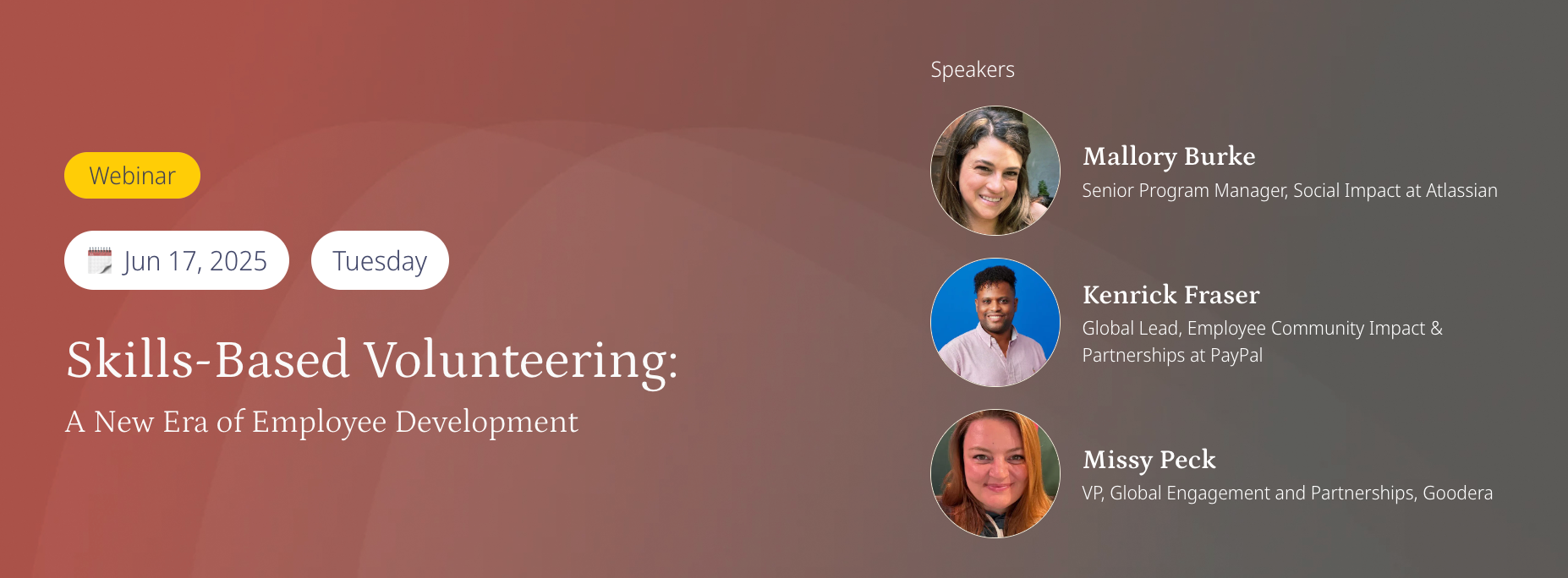
In Goodera's webinar, "Skills-Based Volunteering: A New Era of Employee Development," Kenrick Fraser, Global Lead of Employee Community Impact & Partnerships at PayPal, explained how the company coordinates nonprofit initiatives across 23 countries. PayPal centralizes the scoping of these projects while relying on local volunteer ambassadors for on-the-ground delivery.
AI matching becomes the connective layer that makes centralized scoping and local execution work together without requiring a program manager to personally review every pairing.
The Admin Burden AI Seamlessly Removes
Coordinators previously spent hours cross-referencing spreadsheets, sending eligibility follow-ups, and manually closing out projects once enough interest was confirmed. Automating that layer of work does not eliminate the coordinator's role, but it does free up meaningful time for higher-value work like nonprofit relationship building and program strategy. Goodera's guidance on this shift is clear: the goal is to automate selectively, using AI to reduce friction without eroding the trust that makes volunteering meaningful in the first place.
Does AI Matching Improve Volunteer Engagement and Retention?
Generally, yes, though the mechanism is worth understanding rather than taking on faith. A well-matched employee is more likely to complete a project, rate the experience positively, and return for a second engagement, which compounds into stronger program-wide participation over time.
Data tracked over six years by the Boston College Center for Corporate Citizenship proves that this alignment directly stabilizes teams, uncovering a 36 percent reduction in corporate attrition among professionals who participate in specialized, skills-based volunteering. This long-term retention effect relies heavily on upfront placement quality, as proper skill alignment ensures initial participation transforms into sustained corporate loyalty.
Fill Rates and Completion Rates As the Success Metrics
The clearest way to evaluate whether matching is working is not satisfaction surveys alone, but two operational numbers: fill rate, meaning the percentage of open opportunities that get claimed, and completion rate, meaning the percentage of claimed opportunities that are actually finished.
A matching system that produces high fill rates but low completion rates is surfacing opportunities that look appealing on paper but do not hold up once someone commits. Tracking both numbers together gives a far more honest picture than either one alone.
Consider a nonprofit posting twenty micro-volunteering slots for a resume-review event. If the matching engine fills eighteen of those twenty slots within a week, that is a strong fill rate and a good early signal. The completion rate tells a different part of the story: if only twelve of those eighteen matched employees actually show up and finish the session, something in the scheduling or expectation-setting stage needs attention, even though the fill rate looks healthy.
What Happens When a Match Goes Wrong
No matching system gets every pairing right, and a credible platform should make it simple for an employee to flag a mismatch and request a different opportunity without friction or judgment. What matters most is what happens next: does that feedback actually reach the model, or does it disappear into a support ticket queue? A system worth trusting treats every mismatch as training data, not just a customer service issue to close out.
Can AI Matching Handle Skills-Based and Pro Bono Engagements Apart From General Volunteering?
Yes, though it requires a more rigorous matching model than general volunteering does. A single mismatched park cleanup volunteer is a minor inconvenience, while a mismatched pro bono engagement, say a finance professional assigned to a project requiring marketing expertise, can cost a nonprofit partner weeks of wasted planning.
Skills-based matching engines typically require more granular data inputs and often add a verification or application step precisely because the stakes of a bad match are higher.
Matching for Technical and Professional Competencies
For pro bono and skills-based work, the algorithm needs structured data on specific competencies, not just broad job titles. A "finance professional" tag is not precise enough for a nonprofit that needs someone with grant compliance experience specifically, so the strongest systems ask employees to detail sub-competencies during profile creation.
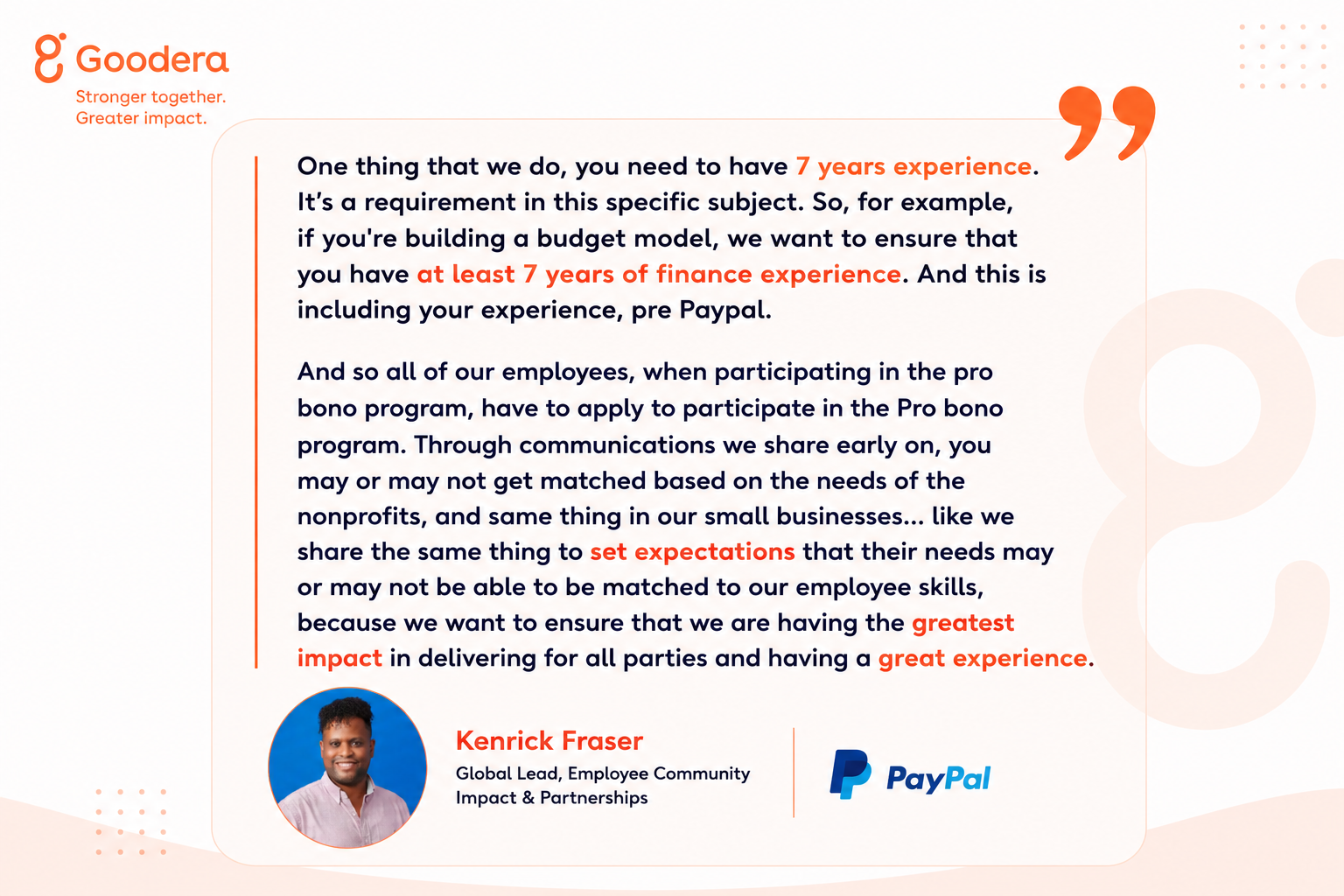
This is also where minimum experience thresholds, like the seven-year requirement PayPal applies to its pro bono projects, become part of the scoring logic rather than a manual afterthought.
For example, a grassroots nonprofit receives a federal community development block grant but lacks the technical expertise to track compliance. If the CSR team queries the database for general "Finance Managers," the system might match a corporate tax accountant who has never worked with public funds.
To solve this, advanced skills-based models use deep profiling. Rather than matching on broad job titles alone, the profile layer prompts employees to tag sub-competencies (like “Federal Grant Compliance”) and log experience milestones.
The system's matching layer can then filter out general applicants, automatically shortlisting only senior auditors who possess the exact technical background the nonprofit needs on day one.
Ensures Human Review Still Belongs in the Process
Even the most sophisticated matching engine benefits from a human checkpoint before a high-stakes skilled engagement is finalized. Goodera's guidance on responsible AI use in volunteering programs is clear that AI should pre-screen alignment before human review, shortening the matching cycle while keeping oversight intact rather than removing it entirely.
This hybrid approach tends to produce the strongest outcomes for skilled engagements specifically, since it combines algorithmic speed with a program lead's contextual judgment.
For example, an enterprise software development firm launches an initiative to revamp a local food bank's inventory tracking system. The CSR platform's AI engine successfully pre-screens and identifies three senior database architects who possess the precise technical coding certifications required for the build.
However, before the system automatically sends the final match notification, the corporate program lead steps in for a human checkpoint. The lead reviews the candidates and flags that one of the engineers recently mentored that exact food bank's executive director through a separate board-readiness program.
Leveraging this unique interpersonal context, the human lead overrides the baseline rank to assign that specific engineer, deepening an existing stakeholder partnership that an algorithm could not detect on paper.
Is the Matching Data Safe? Addressing Privacy and Security Questions
This is one of the first questions any CSR or IT security team raises before adopting a matching platform, and it deserves a direct answer. Reputable volunteer matching platforms collect only the data needed to generate a relevant recommendation, store it securely, and give the company control over retention and deletion. Any vendor unwilling to explain exactly what is collected and why should be treated as a caution flag rather than a minor detail to skip past.
What Employee Data Gets Collected
Typically, this includes professional skills, stated interests, availability, general location, and a history of past volunteering activity within the platform. It should not extend into unrelated personal data, and a program lead evaluating a vendor is well within reason to ask for a full data field inventory before signing a contract. Transparency about what is collected, and why each field is necessary for matching quality, is a reasonable baseline expectation.
Compliance Considerations for Global Workforces
Most U.S. companies with any international footprint end up navigating more than one privacy standard at once, and it helps to keep the major ones straight.
- California Consumer Privacy Act (CCPA): Applies to companies handling data belonging to California-based employees or users, in effect since January 2020.
- State-level U.S. privacy laws: A growing number of states beyond California, including Virginia, Colorado, and Connecticut, have passed their own data privacy statutes with varying requirements.
- General Data Protection Regulation (GDPR): Governs how personal data is collected and processed for anyone operating in or employing people within the European Union, in effect since May 2018.
Global programs often need a platform built to honor the strictest applicable standard across every region rather than applying different rules by country, since inconsistent data handling creates both compliance risk and employee trust issues.
How Do You Prevent Bias in AI-Driven Volunteer Matching?
Bias prevention starts with acknowledging that any system trained on historical data can inherit patterns from that history, including patterns that unintentionally favor certain employee groups over others. The National Institute of Standards and Technology's AI Risk Management Framework, released in January 2023, identifies fairness and harmful bias management as core characteristics of a trustworthy AI system.
That framework has become a widely referenced baseline for organizations evaluating AI vendors. A matching platform worth adopting should be able to speak directly to how it addresses this, not treat the question as an inconvenience.
Common Sources of Bias in Matching Models
Recognizing where bias tends to creep in is the first step toward correcting for it deliberately rather than assuming a system is neutral by default.
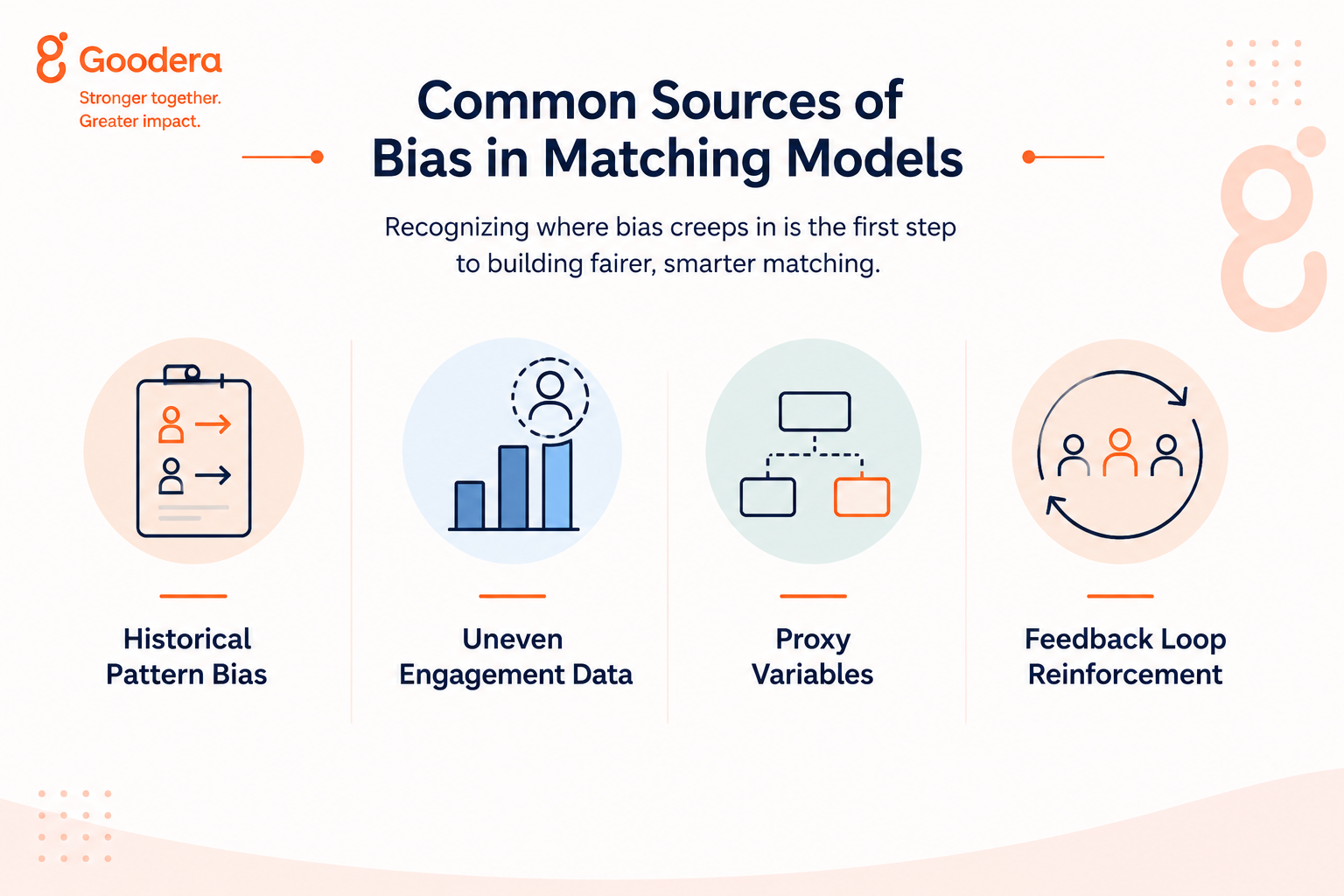
- Historical pattern bias: A system trained on past matching decisions can inherit patterns of who tended to get routed toward leadership-track opportunities versus more routine ones.
- Uneven engagement data: Certain employee groups may engage with the platform less frequently, giving the model thinner data to work with and, in turn, weaker recommendations for those individuals.
- Proxy variables: Data points that seem neutral, like job title or office location, can indirectly correlate with demographic factors and quietly skew outcomes.
- Feedback loop reinforcement: If early matches favor certain groups, the model can treat that pattern as a signal of success and keep repeating it unless it is actively checked.
Building Fairness Checks Into the System
Practical safeguards tend to fall into a few concrete categories:
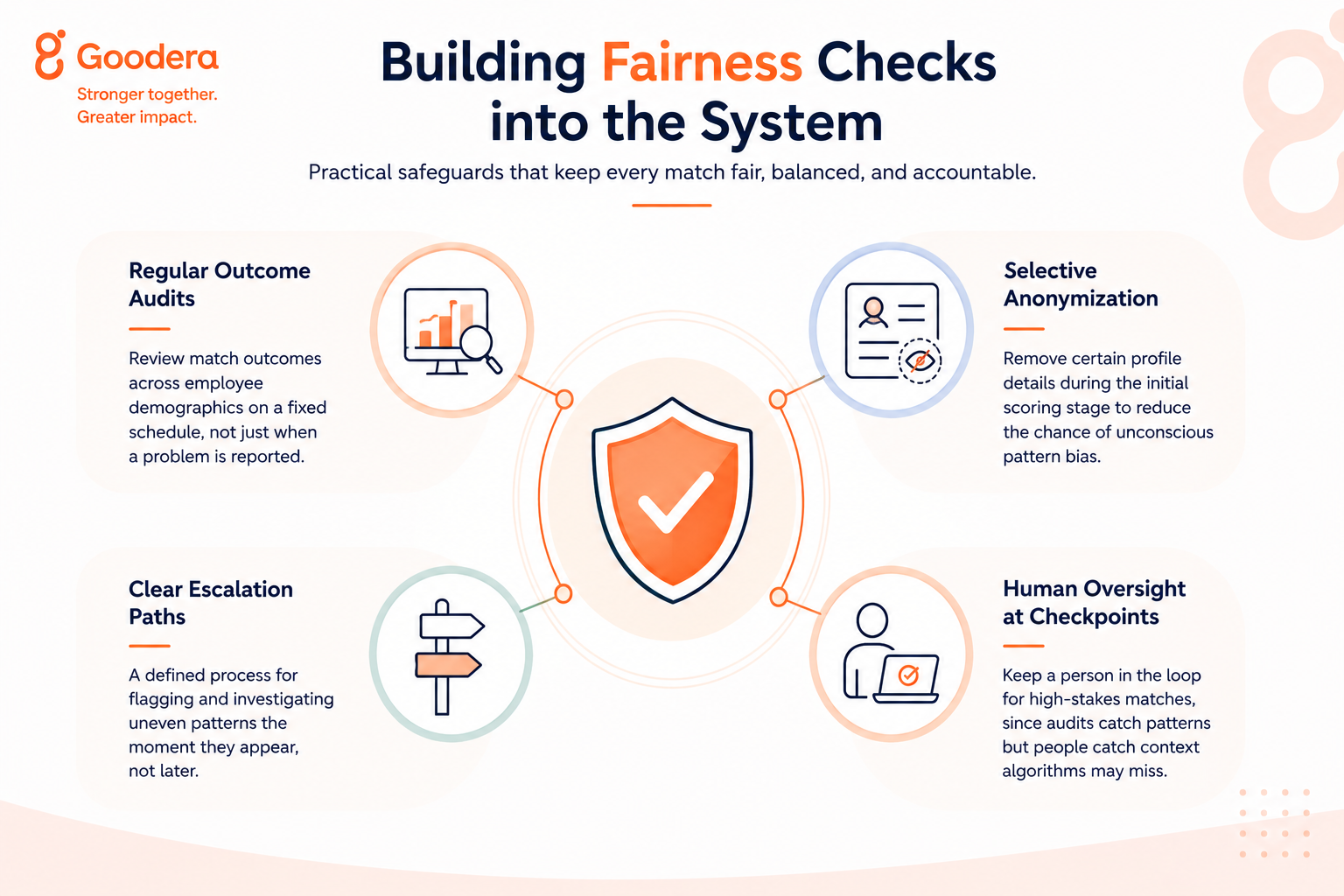
- Regular outcome audits: Reviewing match outcomes across employee demographics on a fixed schedule, not just when a problem is reported.
- Selective anonymization: Removing certain profile details, such as name or photo, during the initial scoring stage to reduce the chance of unconscious pattern bias.
- Clear escalation paths: A defined process for flagging and investigating uneven patterns the moment they appear, rather than waiting for a formal complaint.
- Human oversight at checkpoints: Keeping a person in the loop for high-stakes matches, since audits catch patterns but a person catches context an algorithm may miss.
Goodera's guidance on responsible AI adoption in this space is consistent: regular audits mitigate bias in matching or recommendations, and human oversight is treated as foundational rather than optional. Programs that build these checks in from the start avoid the far more difficult task of retrofitting fairness into a system already in production.
Does AI Replace the Volunteer Coordinator or CSR Manager?
No, and this is worth stating plainly because it is one of the most common concerns raised by program leads considering the technology. AI matching handles the repetitive, high-volume sorting work that used to consume a coordinator's day, but it does not build nonprofit relationships, negotiate project scope, or make the judgment calls that a high-stakes pro bono engagement requires.
Goodera captures this well: AI functions as infrastructure that manages complexity in the background so that human actors can focus on what creates meaning, and the goal is co-volunteering with AI rather than automation replacing the relational core of the work.
What Should You Ask a Vendor Before Trusting Their AI Matching Claims?
Not every platform that markets "AI-powered matching" is actually running a learning system behind the scenes, and a short list of pointed questions can quickly clarify what you are evaluating. Asking a vendor to walk through their scoring logic in plain language, rather than accepting a marketing summary, tends to surface the real answer fast. A vendor confident in their technology will welcome the question rather than deflect it.
Questions Worth Asking About Accuracy and Transparency
A short, direct list tends to surface more useful answers than a general "tell us about your AI" prompt.
- What data points feed the matching score?
A vendor should be able to name them specifically, not describe the process in vague terms.
- How is that score weighted?
Ask which factors carry more influence, such as verified skills over stated interests, for skills-based projects specifically.
- How often does the model retrain on new outcome data?
This reveals whether the system genuinely learns or stays static after launch.
- Can they show fill rate and completion rate benchmarks from existing customers?
Real numbers from real clients are worth far more than a general engagement claim.
- What happens operationally when an employee reports a poor match?
Vague answers here, or answers that pivot quickly to unrelated features, are worth treating as a signal to dig further.
Signs You’re Looking at a Rebranded Filter, Not Real AI
A handful of behaviors reliably separate genuine matching intelligence from a filter wearing an AI label.
- Identical results for every employee with the same tag
If everyone who selects "environment" sees the exact same ranked list, that is static filtering, not personalized scoring.
- No visible change after feedback
A true learning system should show recommendations improving over time as mismatches get reported and resolved.
- Vague answers about what happens after a mismatch
A vendor who cannot explain this step is likely not feeding that data back into anything.
- Marketing language without technical specifics
If "AI-powered" is never followed by a concrete explanation of scoring or weighting, it is worth asking directly whether the term is functioning as a description or a label.
Measuring Whether AI Matching Is Working for Your Program
Once a platform is live, the work shifts from evaluation to ongoing measurement, and the right metrics look different from general program-wide engagement numbers. The goal here is isolating what the matching layer specifically contributes, separate from broader participation trends the company may already be tracking. Reviewing these numbers on a fixed monthly cadence, rather than only at year end, catches problems early enough to fix them.
Key Metrics To Track Month Over Month
A small, consistent set of numbers, reviewed on a fixed cadence, gives a program lead a genuinely diagnostic view rather than a single vanity metric.
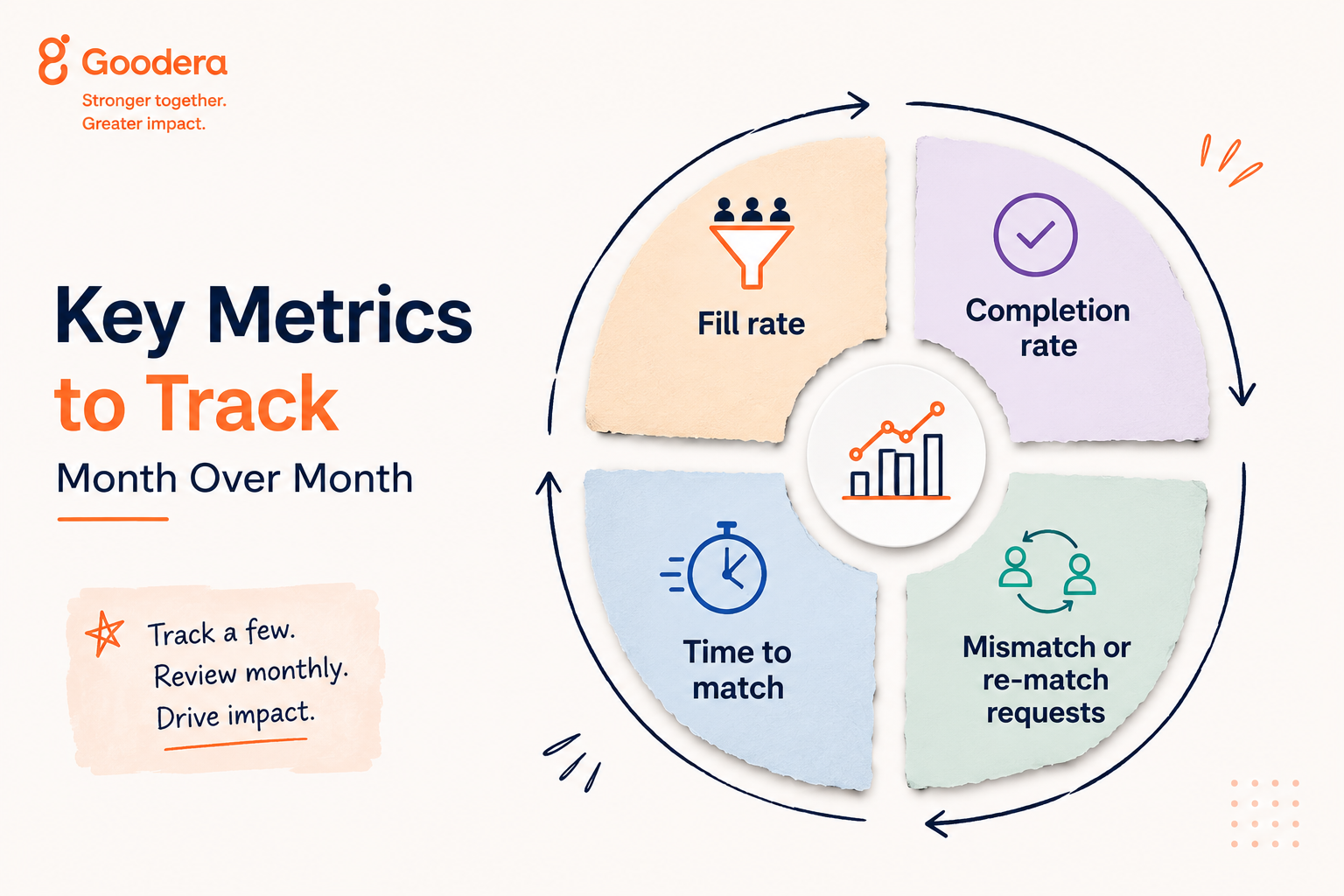
- Fill rate
The percentage of open opportunities claimed within a set window, signaling whether recommendations are reaching the right people at all.
- Completion rate
The percentage of claimed opportunities actually finished, which catches problems which the fill rate alone will miss.
- Time to match
How long it takes an employee to receive a relevant recommendation after expressing interest.
- Mismatch or re-match requests
Tracked as a percentage of total matches, a rising trend here over consecutive months is usually the clearest early warning that the underlying data feeding the model needs attention.
Tying Matching Quality Back to Program ROI
Strong matching quality connects directly to program return on investment, since higher completion rates mean fewer wasted nonprofit hours and higher employee satisfaction scores that support retention arguments. A program with a completion rate climbing steadily quarter over quarter has a much easier case to make in a budget review than one relying purely on participation headcount. Framing matching quality as a business input, not just an operational nicety, tends to resonate strongly with finance and executive stakeholders.
What Does Strong AI Matching Look Like at Global Scale?
At scale, strong matching means the system performs consistently whether an employee is in Austin, Singapore, or São Paulo, without requiring separate manual processes for each region. This is where the difference between a platform built for global operation and one adapted after the fact becomes obvious quickly. Programs evaluating vendors for a multi-country rollout should ask specifically how the matching engine handles regional variation, rather than assuming a system built for one market will scale cleanly.
Multi-Language and Multi-Time-Zone Matching
A genuinely global matching engine needs to process interest and skill data across languages without losing nuance in translation, and needs to weigh time zone compatibility as seriously as it weighs skill relevance. A recommendation that technically fits an employee's skill set but falls at three in the morning their local time is not a usable match, regardless of how high it scores on paper. This is a detail that separates platforms genuinely built for global corporate programs from those retrofitted from a single-market design.
Coordinating Across Thousands of Nonprofit Partners
Matching quality is only as good as the nonprofit-side feeding data into it, which means keeping thousands of partner project listings current, accurately scoped, and tagged with the right competency requirements.
Goodera's infrastructure, built around partnerships with more than 50,000 nonprofits across more than 100 countries, illustrates the scale this kind of coordination requires when done well. Programs relying on a smaller, less actively maintained nonprofit network will naturally see thinner, less relevant matches regardless of how strong the underlying algorithm is.
Wrapping It Up
AI-powered volunteer matching has moved well past the experimental phase, and the programs seeing the strongest results are the ones treating it as infrastructure rather than a novelty feature. Understanding what data actually drives a match, asking vendors precise questions instead of accepting marketing language, and keeping human judgment in the loop for high-stakes engagements are the habits that separate a program getting real value from one that adopted the technology and stopped there.
The technology itself will keep improving. What determines whether that improvement translates into better outcomes for employees and nonprofit partners alike is how thoughtfully a CSR team implements and monitors it from day one.
Frequently Asked Questions
1. Does AI-powered volunteer matching replace our volunteer coordinator?
No. It removes repetitive sorting and scheduling work, but relationship building with nonprofit partners, scoping high-stakes projects, and resolving edge cases still require a person making judgment calls.
2. How accurate is AI matching compared to manual matching by our CSR team?
Accuracy depends heavily on data quality rather than the technology alone. A system with detailed, current skill and interest data will consistently outperform manual matching at scale, while a system built on thin or outdated profiles will underperform even an experienced coordinator.
3. What happens to our employees' skills and personal data once it enters the matching system?
Reputable platforms limit collection to fields that directly support matching, such as skills, interests, availability, and location, and should give your organization clear control over retention and deletion. Ask any vendor for a full data field inventory before signing a contract.
4. Can AI matching handle skills-based and pro bono volunteering, or is it only for general volunteer days?
It can handle both, though skills-based and pro bono matching requires more granular data and often a human review step given the higher stake
5. How do we know if the AI matching algorithm is biased?
Ask the vendor whether they conduct regular audits of match outcomes across employee demographics and how they respond when patterns look uneven. The NIST AI Risk Management Framework is a useful reference point for the kinds of fairness questions worth raising.
6. How long does it take for an AI matching system to start producing good matches?
Most systems improve meaningfully within the first few months as the feedback loop accumulates real outcome data. Programs launching with thin initial profile data should expect a short ramp-up period before recommendations reach their strongest quality.
7. What questions should we ask a vendor to confirm they're using real AI and not just filters?
Ask what specific data points feed the matching score, how that score is weighted, and how often the model retrains. Ask for fill rate and completion rate benchmarks from existing customers rather than accepting general engagement claims.
8. Can AI matching work across multiple countries, languages, and time zones?
Yes, provided the platform was built for global operation rather than adapted from a single-market design. Time zone compatibility and language nuance both need to factor directly into the matching score, not just skill relevance.
9. What do we do if an employee is unhappy with their AI-suggested match?
A credible platform makes it simple to flag a mismatch and request a different opportunity without friction. That feedback should visibly feed back into future recommendations rather than disappearing into a support queue.
10. Is our employee data used to train the vendor's AI models?
This varies by vendor and should be addressed explicitly in your contract rather than assumed. Ask directly whether your organization's data trains a shared model across the vendor's client base or stays isolated to your own program.