AI-Powered Volunteer Matching: How It Works

Ask almost any CSR program manager to describe their least favorite Tuesday, and you will likely hear some version of the same story. A spreadsheet with 400 employee names, a stack of nonprofit requests that do not quite line up with anyone's skill set, and a deadline that arrived yesterday. Matching people to the right opportunity by hand, especially across multiple offices and time zones, eats hours that could go toward actually building the program.
AI-powered volunteer matching solves that exact problem by using employee data such as skills, interests, availability, and location to automatically recommend or assign the most relevant volunteer opportunity, then refining those recommendations as it learns from every match it makes.
Data from the Goodera AIX Strategy Analysis shows that an AI-empowered CSR leader can deploy, manage, and coordinate volunteering programs 10x more effectively by automating the "plumbing" of volunteering, such as scheduling, cross-border logistics, and automated impact reporting.
The rest of this guide breaks down exactly how the technology works, what questions to ask before trusting a vendor's claims, and where human judgment still belongs in the process.
What Is AI-Powered Volunteer Matching, Exactly?
At its simplest, AI-powered volunteer matching is a system that pairs an employee with a volunteer opportunity based on more than one variable at a time, and does so automatically rather than through a coordinator manually reviewing every request. Instead of an employee scrolling through sixty open opportunities hoping something fits, the system narrows that list to a small handful based on what it already knows about the person.
Goodera's workshop guidance on this topic describes the goal well: when relevance increases, friction decreases, and employees become more likely to convert interest into action.
The Data Points a Matching Engine Uses
A functioning matching engine typically draws on five categories of information, each contributing a different layer of context to the final recommendation.
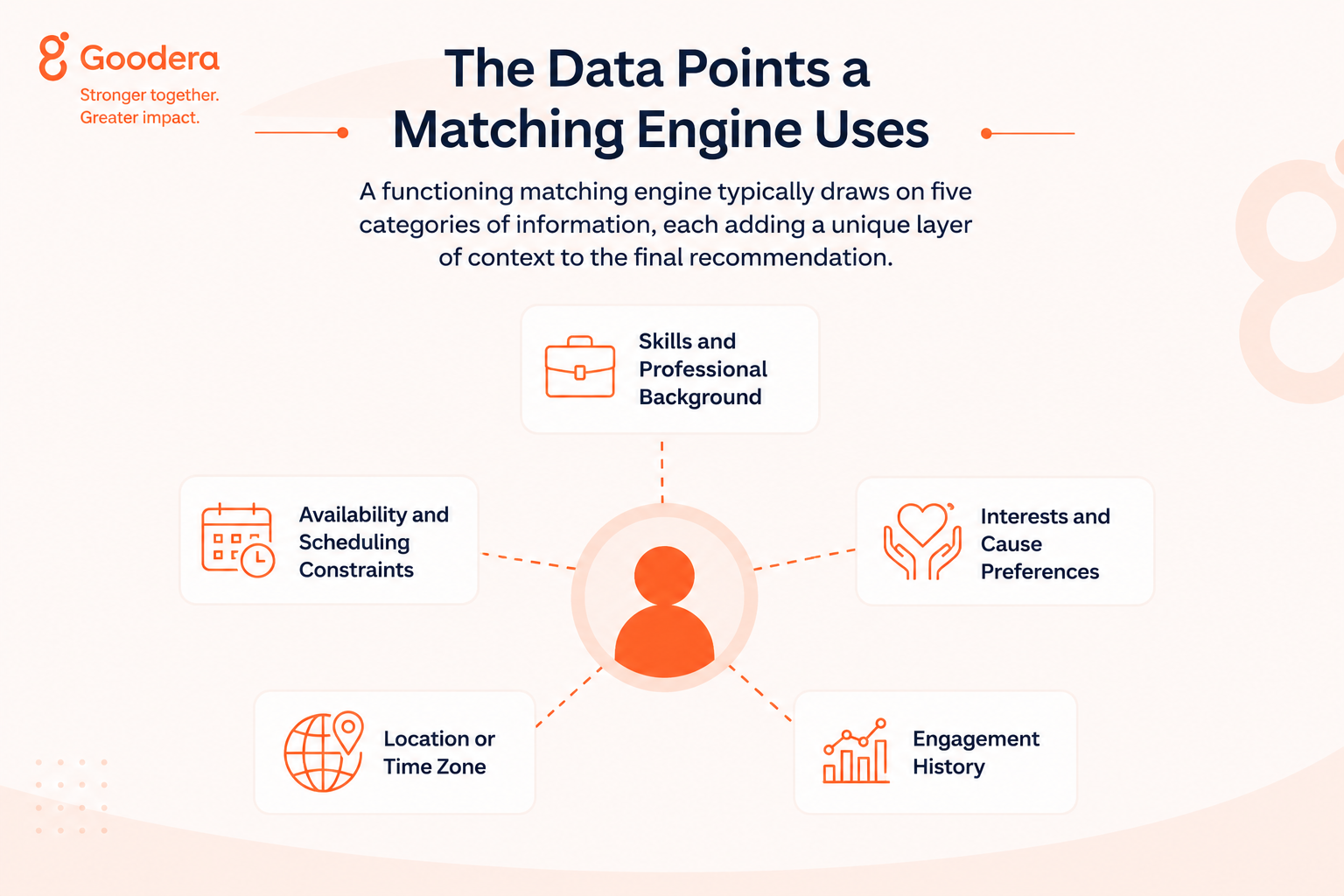
Data signals used by a matching engine
- Skills and Professional Background
This is usually the heaviest-weighted input, covering job function, industry experience, and specific competencies an employee brings to the table. It matters most for skills-based and pro bono matching, where a nonprofit's project depends on real subject-matter expertise.
- Stated Interests and Cause Preferences
Employees typically select the causes they care about most, whether that is education, environment, or economic mobility. This input helps the system prioritize opportunities an employee is likely to feel genuinely invested in, not just technically qualified for.
- Availability and Scheduling Constraints
A recommendation only matters if the employee can actually show up, so the system needs working hours, blackout dates, and time commitment limits. Without this input, even a perfectly skilled match can fall apart at the scheduling stage.
- Location or Time Zone
For in-person opportunities, this narrows results to a reasonable travel radius, and for virtual work, it confirms the employee and nonprofit can realistically coordinate live sessions. Global programs depend heavily on this input to avoid recommending a great match that simply cannot happen logistically.
- Engagement History
Some systems also factor in how a person has responded to past opportunities, meaning what they signed up for, completed, or skipped. This helps the model understand what "a good fit" has actually looked like for that individual before, rather than relying on stated preferences alone.
How This Differs From a Simple Keyword or Filter Search
A basic filter search asks an employee to select a cause area or a date range and then shows every opportunity that matches those exact tags. AI-powered matching instead weighs several factors simultaneously and ranks results by relevance rather than simply returning everything that technically qualifies.
The practical difference shows up immediately: a filter might return forty options, while a matching engine surfaces the three or four most likely to result in a completed, satisfying engagement.
How Does the Matching Algorithm Decide Who Gets Which Opportunity?
The short version is that the algorithm assigns a relevance score to each possible pairing and recommends the highest-scoring options first. That score is built from weighted inputs, meaning some factors, like a required professional skill for a pro bono project, carry more weight than a loosely stated interest in "community causes." Understanding this scoring logic matters, because it is the difference between a system that genuinely improves placement quality and one that simply automates a list.
1. Skills and Competency Scoring
For general volunteering, skills scoring can be fairly light, matching broad categories like communication or organization. For skills-based and pro bono work, the scoring needs to be far more precise.
2. Interest, Availability, and Location Signals
Skills alone do not make a good match. An employee with the perfect financial background will not show up for a project that conflicts with their working hours or sits outside a time zone they can reasonably join. Strong matching systems weigh interest and logistics alongside competency, since a technically qualified employee who cannot realistically attend the program represents a wasted recommendation rather than a successful one.
3. Learning From Past Matches: The Feedback Loop
The most valuable part of an AI matching system is what happens after the first recommendation. When an employee completes a project, provides feedback, or requests a different type of role, that data feeds back into the model and sharpens future recommendations for that person and for others with similar profiles. Over time, this feedback loop is what separates a genuinely adaptive system from a static list.
Why Corporate Volunteering Programs Are Adopting AI Matching Now
The honest answer is that manual matching simply cannot keep pace with the scale most corporate programs now operate at. Employee expectations have also shifted, since people increasingly assume that any digital platform they use, whether for shopping, streaming, or internal tools, will filter information down to what is actually relevant to them.
Goodera's research on AI in the workplace notes that when volunteering platforms stay static and generic, participation requires more cognitive effort from the employee, which quietly suppresses turnout.
The Scale Problem: Matching Thousands of Employees to Thousands of Nonprofits
A company running a program across twenty or more countries is not solving one matching problem; it is solving dozens of smaller ones simultaneously, each with its own language, nonprofit landscape, and cultural context.
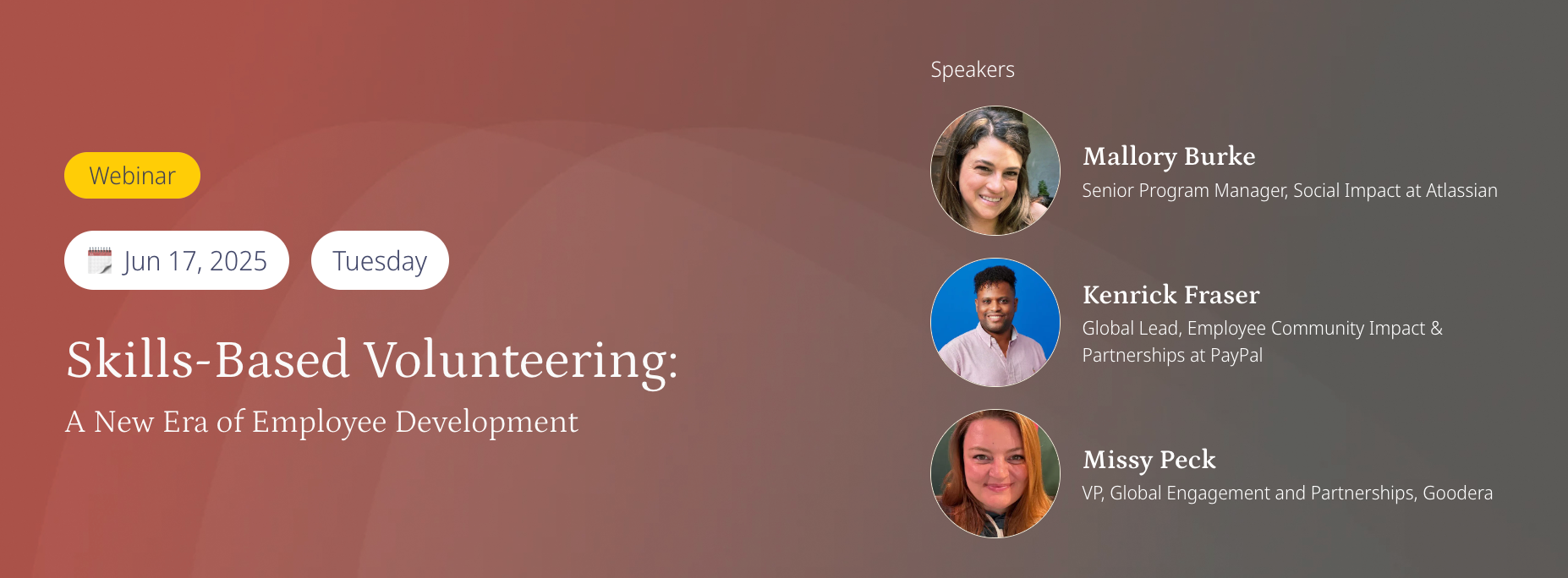
In Goodera's webinar, "Skills-Based Volunteering: A New Era of Employee Development," Kenrick Fraser, Global Lead of Employee Community Impact & Partnerships at PayPal, explained how the company coordinates nonprofit initiatives across 23 countries. PayPal centralizes the scoping of these projects while relying on local volunteer ambassadors for on-the-ground delivery.
AI matching becomes the connective layer that makes centralized scoping and local execution work together without requiring a program manager to personally review every pairing.
The Admin Burden AI Seamlessly Removes
Coordinators previously spent hours cross-referencing spreadsheets, sending eligibility follow-ups, and manually closing out projects once enough interest was confirmed. Automating that layer of work does not eliminate the coordinator's role, but it does free up meaningful time for higher-value work like nonprofit relationship building and program strategy. Goodera's guidance on this shift is clear: the goal is to automate selectively, using AI to reduce friction without eroding the trust that makes volunteering meaningful in the first place.
Frequently Asked Questions
1. Does AI-powered volunteer matching replace our volunteer coordinator?
No. It removes repetitive sorting and scheduling work, but relationship building with nonprofit partners, scoping high-stakes projects, and resolving edge cases still require a person making judgment calls.
2. How accurate is AI matching compared to manual matching by our CSR team?
Accuracy depends heavily on data quality rather than the technology alone. A system with detailed, current skill and interest data will consistently outperform manual matching at scale, while a system built on thin or outdated profiles will underperform even an experienced coordinator.
3. What happens to our employees' skills and personal data once it enters the matching system?
Reputable platforms limit collection to fields that directly support matching, such as skills, interests, availability, and location, and should give your organization clear control over retention and deletion. Ask any vendor for a full data field inventory before signing a contract.
4. Can AI matching handle skills-based and pro bono volunteering, or is it only for general volunteer days?
It can handle both, though skills-based and pro bono matching requires more granular data and often a human review step given the higher stake
5. How do we know if the AI matching algorithm is biased?
Ask the vendor whether they conduct regular audits of match outcomes across employee demographics and how they respond when patterns look uneven. The NIST AI Risk Management Framework is a useful reference point for the kinds of fairness questions worth raising.
6. How long does it take for an AI matching system to start producing good matches?
Most systems improve meaningfully within the first few months as the feedback loop accumulates real outcome data. Programs launching with thin initial profile data should expect a short ramp-up period before recommendations reach their strongest quality.
7. What questions should we ask a vendor to confirm they're using real AI and not just filters?
Ask what specific data points feed the matching score, how that score is weighted, and how often the model retrains. Ask for fill rate and completion rate benchmarks from existing customers rather than accepting general engagement claims.
8. Can AI matching work across multiple countries, languages, and time zones?
Yes, provided the platform was built for global operation rather than adapted from a single-market design. Time zone compatibility and language nuance both need to factor directly into the matching score, not just skill relevance.
9. What do we do if an employee is unhappy with their AI-suggested match?
A credible platform makes it simple to flag a mismatch and request a different opportunity without friction. That feedback should visibly feed back into future recommendations rather than disappearing into a support queue.
10. Is our employee data used to train the vendor's AI models?
This varies by vendor and should be addressed explicitly in your contract rather than assumed. Ask directly whether your organization's data trains a shared model across the vendor's client base or stays isolated to your own program.