AI and Volunteering
Use AI to automate coordination, reduce manual work, and scale volunteering.


Why Teams Come to This Workshop
AI is advancing faster than most volunteering programs can meaningfully apply it, raising questions about value, responsibility, and readiness.
Without intentional design, AI becomes either underused or misused in volunteering. This workshop helps define where AI fits, how it can be used responsibly, and what it takes to launch impactful AI-enabled volunteering programs.
How It Works
We co-create a plan tailored to where you are, helping you move from intent to real community impact.
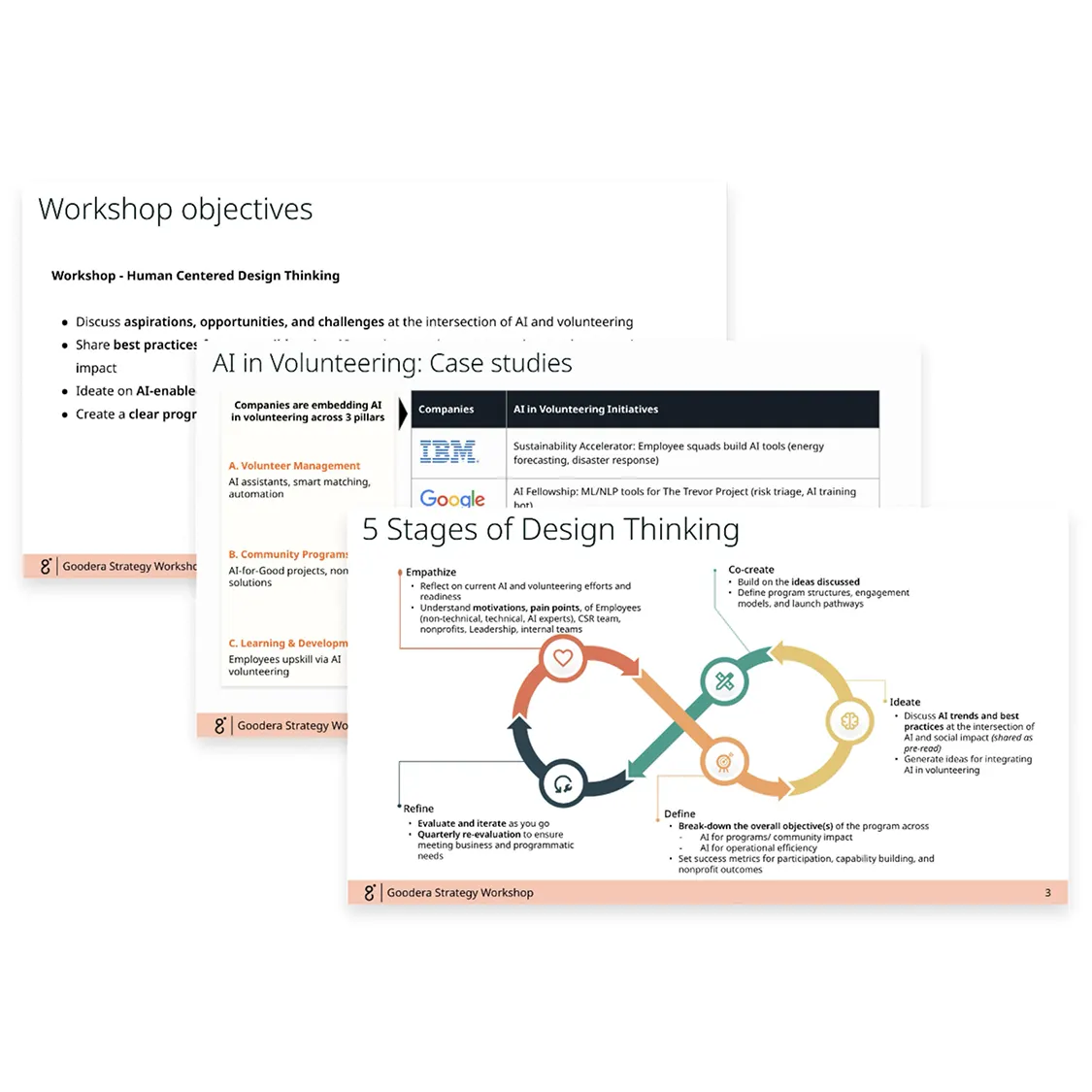
Diagnose
01

Assess current experimentation, team readiness, operational capacity, and potential use-cases where AI could enhance volunteering responsibly.
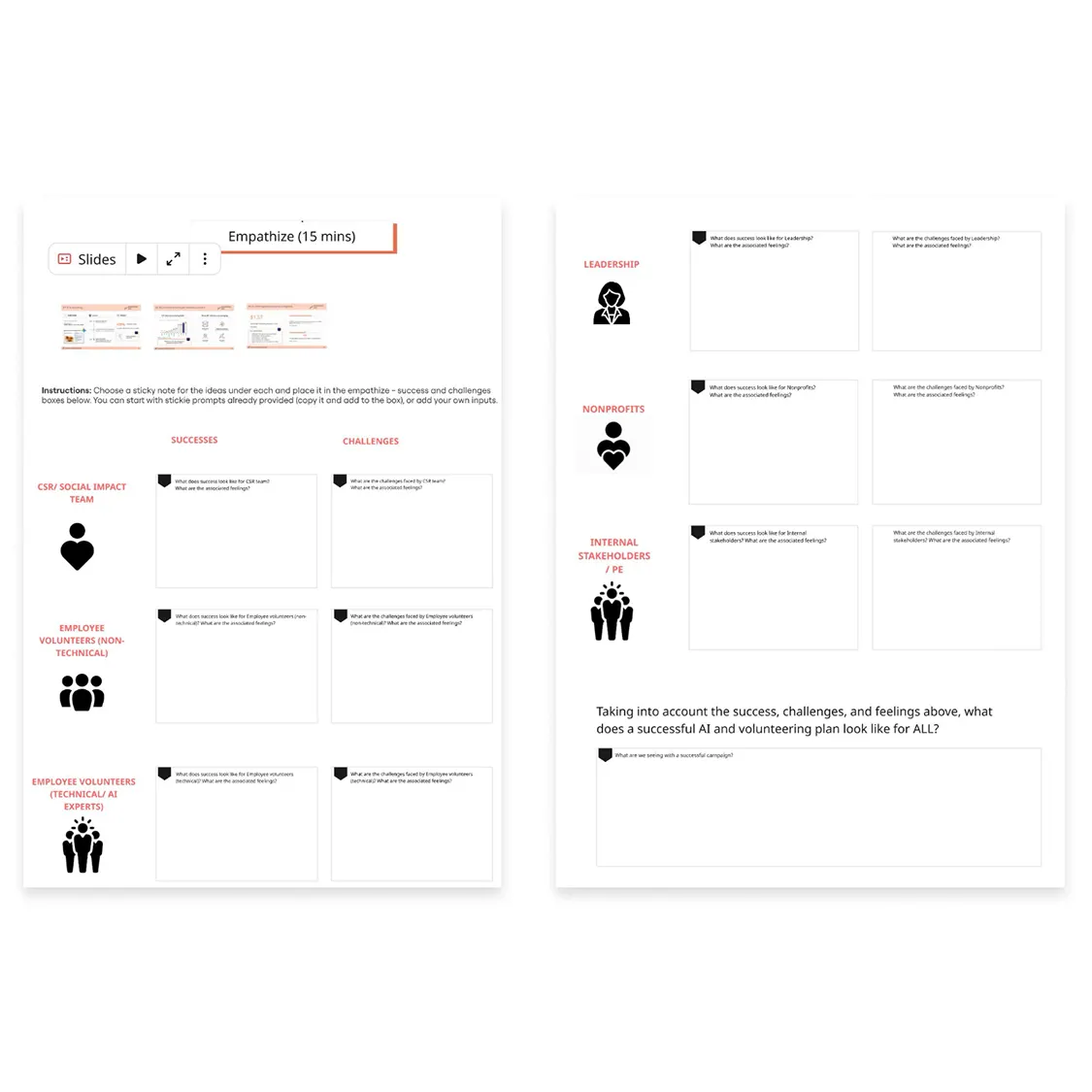
Define Responsible Application
02
Synthesize insights into clear problem statements that clarify where AI adds value, what risks must be managed, and what responsible use looks like.
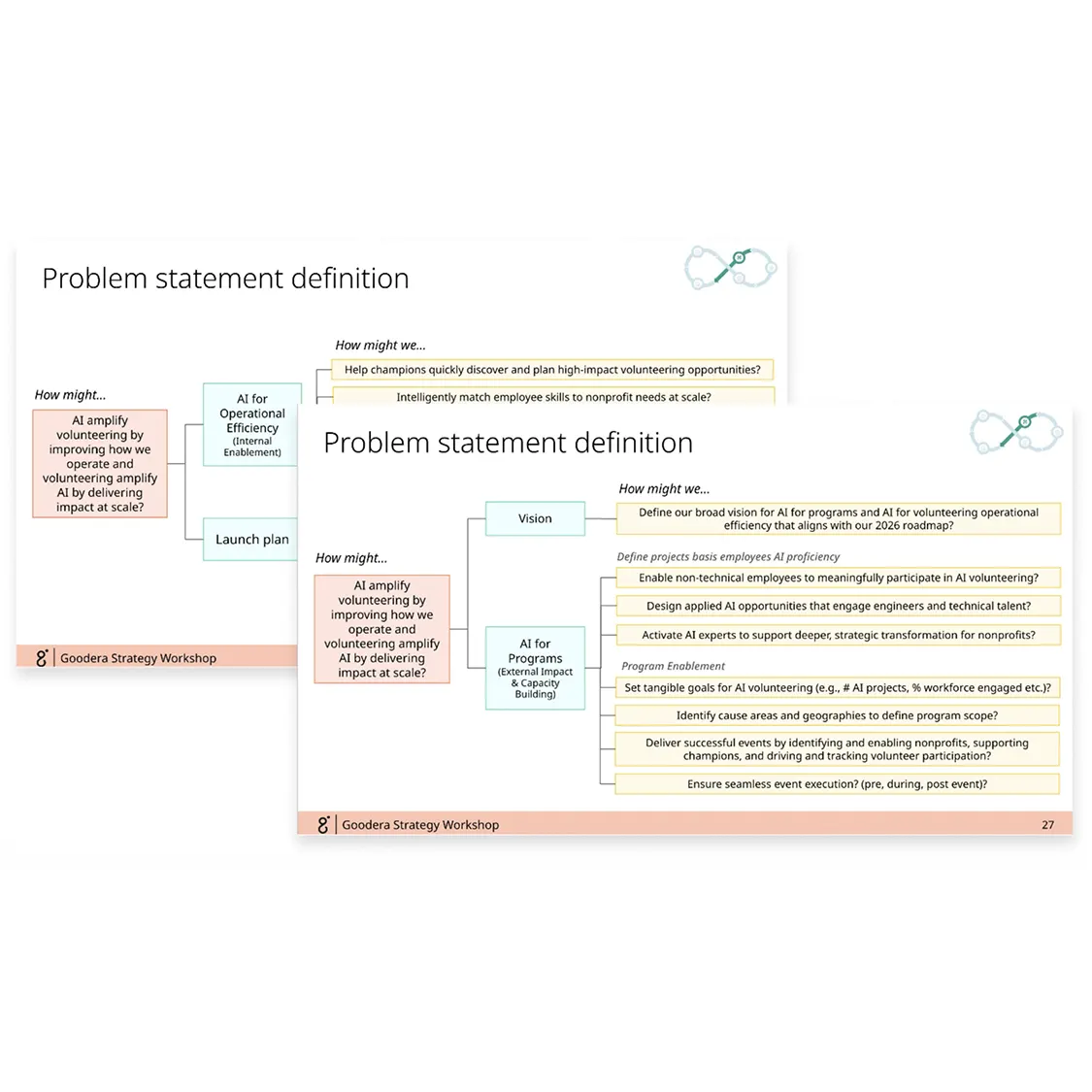
Design the AI-Enabled Volunteering Model
03
Co-create scalable AI-enabled formats, governance guardrails, and a practical roadmap to pilot and expand responsibly.
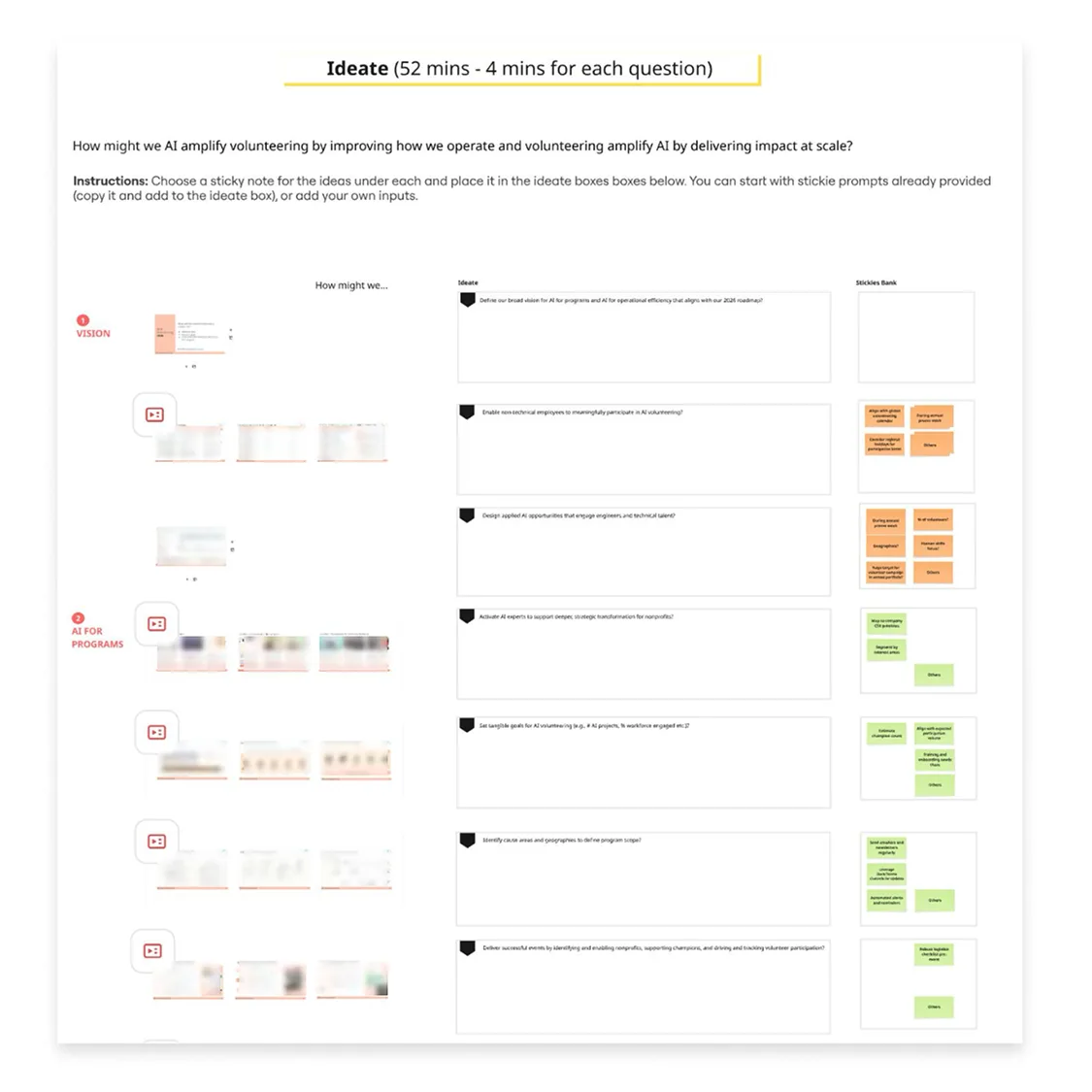
Examine Core Enablers
04
Assess the role of technology and champion networks in supporting participation, scale, and consistency.
Co-create the Next Actionable Plan
05
Align on a clear ambition for the year ahead and outline the foundations needed to support it.
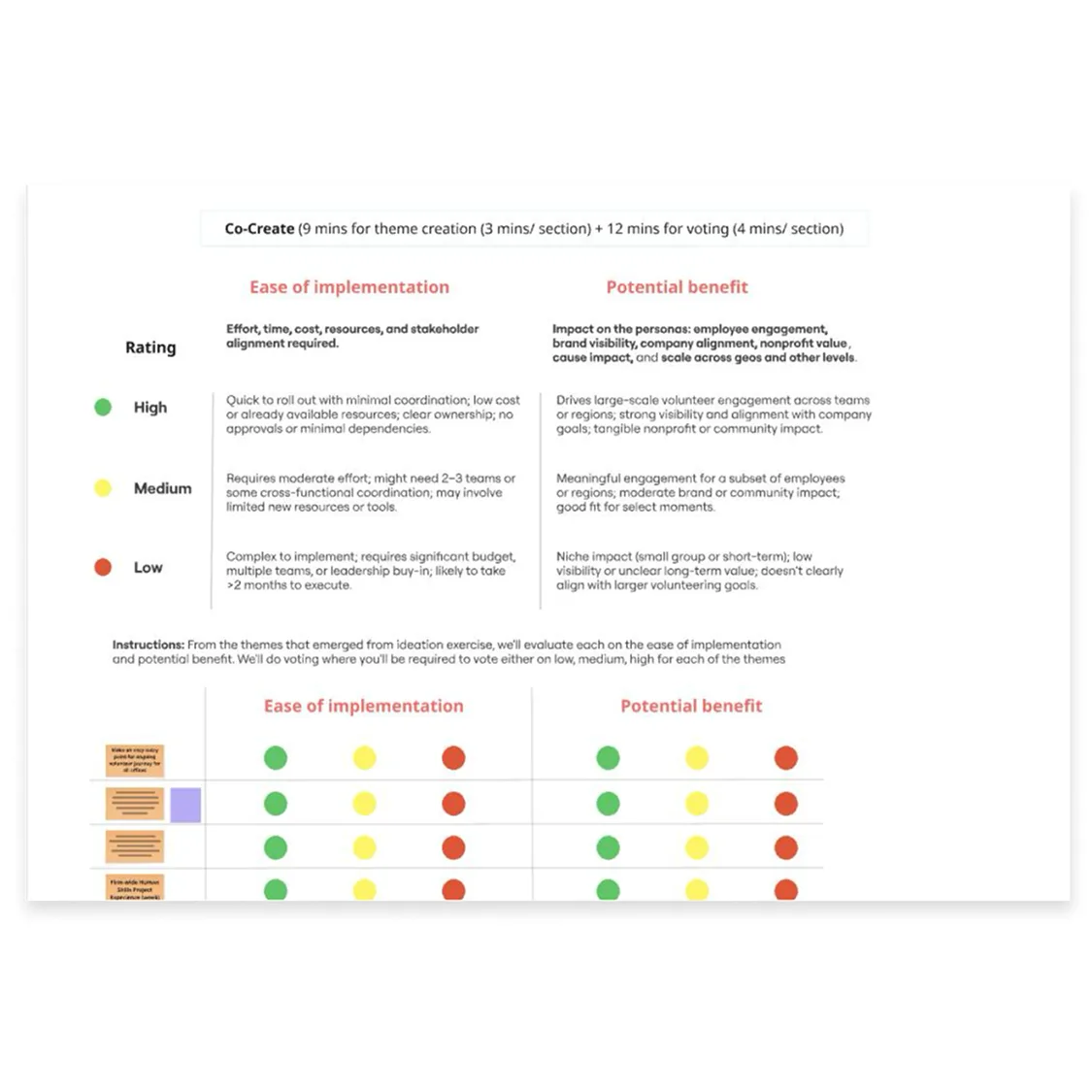
A Peek into the Knowledge

Artificial intelligence is no longer experimental. It is embedded in how organizations plan, communicate, analyze data, and make decisions. From predictive analytics to automated workflows, AI is reshaping operational infrastructure across nearly every function.
Employee volunteering programs are not exempt from this shift.
As programs expand across geographies, operate in hybrid environments, and face increasing expectations around measurable ESG outcomes, AI has naturally entered the conversation. But the question is not whether AI should be used in volunteering. The more important question is how it should be used.
Volunteering derives its value from human connection, trust, and lived experience. Introducing automation into this space requires careful design. Used thoughtfully, AI can reduce operational strain and increase access. Used carelessly, it risks creating distance in a space that depends on proximity.
Clarity, not enthusiasm or resistance, is what this moment demands.
Why AI Is Entering the Volunteering Conversation Now
Employee volunteering programs today operate in a fundamentally different environment than they did a decade ago.
Participation expectations have grown. Skills-based volunteering has increased in prominence. Reporting requirements tied to ESG frameworks are more rigorous. Employees expect personalized experiences that align with their skills, interests, and availability. Meanwhile, CSR and social impact teams remain lean.
This structural imbalance is one of the primary drivers of AI exploration in volunteering.
When a small team supports a workforce of thousands across time zones, the coordination burden becomes significant. Administrative tasks, communication cycles, participation tracking, and reporting workflows accumulate quickly. What once felt manageable through spreadsheets and email threads now strains capacity.
AI enters this landscape not as a replacement for volunteering itself, but as a potential response to operational overload.
However, adoption is uneven.
The AI Literacy Divide in CSR and Employee Volunteering
One of the most important but under-discussed dynamics shaping AI adoption in volunteering programs is the AI literacy divide.
In our recent AI literacy survey conducted across CSR and employee volunteering professionals, we found a wide spectrum of familiarity and comfort with AI tools. A minority of respondents reported actively experimenting with AI to improve workflows. A significant portion expressed curiosity but lacked structured guidance. Others reported hesitation rooted in uncertainty around risk, ethics, or technical understanding.
This divide matters.
When AI literacy is low, experimentation stalls. When literacy is uneven within a team, implementation becomes inconsistent. When leaders lack confidence in understanding AI’s capabilities and limitations, decision-making becomes reactive rather than strategic.
The result is fragmentation. Some programs over-automate without guardrails. Others avoid useful tools altogether.
Bridging this divide requires education, not evangelism. It requires practical clarity about what AI can and cannot do in the context of human-centered volunteering. We explore this further in our related piece on AI literacy in CSR, which examines how organizations can build foundational understanding before pursuing large-scale implementation.
Without literacy, adoption becomes risky. With literacy, it becomes intentional.
Also Read: THE AI LITERACY DIVIDE IN VOLUNTEERING
Where AI Adds Real Value in Employee Volunteering Programs
AI delivers the most value when it strengthens the operational backbone of volunteering programs rather than attempting to replace the human elements that make them meaningful.
The goal is not to automate volunteering. It is to remove friction around volunteering.
When implemented thoughtfully, AI can support three high-impact areas: operational efficiency, intelligent matching, and strategic insight generation.
1. Reducing Administrative Friction and Operational Overload
In many organizations, the majority of CSR team capacity is absorbed by coordination rather than strategy. Administrative tasks multiply quickly, especially during campaign cycles.
AI can meaningfully reduce this load through targeted automation.
Practical use cases include:
- Automatically generating calendar invitations and reminders once employees register
- Sending personalized follow-ups based on attendance status
- Drafting post-event recap summaries using participation data
- Consolidating sign-ups from multiple channels into a unified dashboard
- Flagging incomplete registrations or missing waivers
Example scenario:
During a global volunteering week, a CSR team manages 45 events across 12 regions. Instead of manually drafting reminder emails and compiling participation spreadsheets, an AI-powered workflow tool automates reminders, confirms attendance, and generates a consolidated participation report within minutes.
The result is not just time saved. It is cognitive space regained. Instead of reacting to logistics, the team can focus on nonprofit alignment, storytelling quality, and participant experience.
In this context, AI does not replace human coordination. It reduces repetitive strain so humans can operate at a higher level of impact.
2. Improving Opportunity Discovery and Skills Matching
One of the most persistent barriers to participation is relevance. Employees may be interested in volunteering but hesitate when opportunities feel misaligned with their expertise, schedule, or location.
AI-driven recommendation systems can address this challenge by intelligently filtering and prioritizing opportunities.
AI-supported matching can consider:
- Professional skills extracted from employee profiles
- Stated causes of interest
- Past participation history
- Geographic location or remote accessibility
- Availability patterns
Example scenario:
An employee in finance based in Singapore expresses interest in climate-related initiatives. Instead of browsing a generic list of 60 open opportunities, an AI system surfaces three relevant options: a virtual financial literacy workshop, a climate NGO budgeting advisory session, and a local sustainability hackathon aligned with their schedule.
When relevance increases, friction decreases. Employees are more likely to convert interest into action.
This is particularly powerful in skills-based volunteering programs, where scoping and matching complexity often slow scaling efforts. AI can pre-screen alignment before human review, significantly shortening the matching cycle while maintaining oversight.
3. Generating Actionable Insights from Participation Data
Most employee volunteering programs collect data. Far fewer extract meaningful insights from it.
AI-supported analytics tools can identify patterns that would otherwise require manual analysis across multiple spreadsheets and reporting cycles.
Use cases include:
- Detecting declining participation in specific regions
- Identifying high-retention volunteer cohorts
- Surfacing participation gaps across departments
- Predicting peak engagement periods
- Highlighting nonprofit partnerships generating repeat engagement
Example scenario:
An organization notices stable overall participation numbers but declining repeat engagement. AI-driven analysis reveals that while first-time participation remains strong, second-cycle return rates drop sharply in regions where managers do not publicly acknowledge involvement.
This insight shifts strategy. Instead of launching new campaigns, the organization focuses on manager engagement and recognition mechanisms. AI becomes a diagnostic tool, not a directive authority. The value lies in surfacing signals that inform human decisions.
4. Supporting Communication Consistency at Scale
Communication gaps are a common source of participation drop-off. Messages are delayed, tone varies by region, and follow-up storytelling often gets deprioritized.
AI can assist in drafting structured communications that teams then refine.
Applications include:
- Drafting multilingual invitations for global teams
- Generating recap summaries based on participation metrics
- Creating tailored nudges for employees who showed interest but did not register
- Summarizing impact metrics for leadership briefings
Example scenario:
After a regional service day, AI compiles participation numbers, hours contributed, and nonprofit impact data into a draft recap. The CSR lead edits for tone and context before distribution. What once took two days now takes one hour.
The human voice remains. The drafting burden decreases.
5. Increasing Accessibility and Reducing Participation Barriers
Accessibility is often overlooked in volunteering program design. Employees may struggle to identify opportunities that fit their workload, caregiving responsibilities, or time zones.
AI-enabled systems can:
- Suggest micro-volunteering options for employees with limited availability
- Recommend virtual engagements for remote teams
- Offer translated summaries for multilingual workforces
- Provide adaptive reminders based on calendar patterns
Example scenario:
An employee working flexible hours receives tailored suggestions for short, virtual mentoring sessions instead of full-day service events. Participation becomes feasible rather than aspirational.
When AI reduces logistical mismatch, participation becomes more inclusive.
The Strategic Principle: AI as Enabler, Not Decision-Maker
Across all these applications, a consistent principle emerges.
AI adds value when it operates in the background, handling pattern recognition, administrative automation, and data organization. It should not determine values, replace relationship-building, or override human interpretation.
In employee volunteering programs, the most sustainable use of AI is infrastructural. It strengthens clarity, reduces friction, and enhances visibility.
It does not define purpose.
When AI is positioned correctly, it does not make volunteering more mechanical. It makes it more manageable. And when volunteering becomes more manageable, it becomes more scalable without losing its humanity.
Where AI Should Not Lead
AI can reduce friction, but it should not replace human judgment in areas where empathy, ethics, and relational nuance are central.
1. Cause Prioritization and Values Alignment
- Decisions about which causes to support reflect organizational identity and stakeholder commitments.
- These choices require leadership dialogue, cultural awareness, and long-term vision.
- Algorithmic trend analysis can inform discussions, but it should not determine strategic direction.
Cause selection is not a data optimization exercise. It is a values conversation.
2. Nonprofit Relationship Management
- Strong nonprofit partnerships are built on trust, credibility, and mutual understanding.
- Long-term collaboration requires context sensitivity and responsiveness to evolving needs.
- Automation can support scheduling and reporting, but it cannot replace relational depth.
Trust is earned through consistency and empathy, not efficiency alone.
3. Volunteer Experience Design
- Experiences should feel meaningful, not mechanically optimized.
- Over-automation risks creating interactions that feel scripted or transactional.
- Communities served are stakeholders with lived realities, not inputs in a system.
Design decisions must protect dignity, authenticity, and human connection.
4. Interpreting Impact Beyond Metrics
- Quantitative indicators such as hours volunteered and participation rates provide visibility, not full understanding.
- Qualitative outcomes such as community benefit, employee growth, and long-term change require discernment.
- AI can surface patterns, but humans must interpret meaning and context.
The Core Principle: When AI functions as a support system, it strengthens programs. When it functions as a decision-maker, programs risk becoming efficient but hollow.
Employee volunteering is ultimately relational work. Technology can enhance it, but it should not define it.
Co-Volunteering With AI: A More Balanced Model
The most constructive path forward is not automation for its own sake. It is co-volunteering with AI.
In this model, AI operates as infrastructure. It manages complexity in the background so that human actors can focus on what creates meaning.
CSR teams gain time to design better experiences instead of managing logistics. Employees encounter fewer barriers to participation and clearer pathways to engagement. Nonprofit partners experience more consistent coordination. Leaders receive stronger insights without increased reporting burden.
The technology becomes quieter. The human experience becomes stronger.
This approach also mitigates risk. When AI remains embedded in operational layers rather than strategic decision-making, oversight is easier to maintain.
Designing AI-Supported Volunteering Responsibly
Responsible integration begins with diagnosis.
Before introducing AI tools, organizations should assess where friction truly exists. Is the primary challenge administrative overload? Is it low participation due to poor opportunity visibility? Is it fragmented data limiting reporting accuracy?
AI should be introduced only where it addresses clearly defined pain points.
Equally important is governance. Transparency about how AI is used builds trust among employees. Clear data policies protect privacy. Regular audits mitigate bias in matching or recommendations.
AI literacy training also plays a central role. Teams must understand not only how to use tools, but how to question outputs. Human oversight is not optional. It is foundational.
When literacy, governance, and intentional design converge, AI strengthens programs rather than destabilizing them.
The Future of Volunteering in an AI-Enabled Workplace
AI will continue to evolve. Employee expectations will continue to rise. CSR teams will continue to operate under pressure to demonstrate measurable impact.
The organizations that succeed will not be those that automate most aggressively. They will be those that automate selectively.
They will use AI to reduce friction without eroding trust. They will treat data as insight, not authority. They will invest in AI literacy before investing in AI scale.
Most importantly, they will remember that volunteering is not an operational problem to be optimized. It is a human experience to be designed.
The Bottom Line: Technology Should Expand Humanity, Not Replace It
AI does not create meaning in volunteering. People do.
But when AI removes unnecessary complexity, clarifies participation pathways, and surfaces actionable insight, it strengthens the conditions under which meaningful volunteering can occur.
The goal is not to make volunteering more automated.
It is to make it more accessible, more sustainable, and more human in a world where work itself is increasingly shaped by machines.
Webinars and Podcasts















Related Blogs







Frequently Asked Questions

This workshop is designed for CSR, ESG, People, and Social Impact teams exploring how AI can responsibly support volunteering and nonprofit impact.
No. The workshop is focused on use-cases, design, and decision-making, not technical implementation.
The session covers AI applications in volunteer operations, skills-based engagement, capacity-building support, and program enablement.
Teams work through ethical considerations, governance questions, data privacy, and risk mitigation alongside opportunity identification.
Teams leave with a clear set of AI volunteering use-cases, guiding principles for responsible use, and a practical plan to pilot initiatives.
Yes. The workshop considers regional, cultural, and regulatory differences when designing AI-enabled volunteering programs.
Yes. The content is adapted to your organization’s goals, maturity, and constraints.
