12 Corporate Volunteer Programs Driving Meaningful Impact Around the World

Corporate volunteer programs are transforming how businesses engage with society. Instead of just making donations, companies are empowering employees to use their time and skills to support causes that benefit communities and the environment. Activities range from mentoring students to disaster recovery and sustainability efforts.
These programs not only drive social good but also enhance employee engagement, strengthen workplace culture, and build trust with local communities. As corporate citizenship expectations grow, more companies are implementing structured volunteer initiatives that align with their values.
Did you know?💡
A Deloitte survey found that 91% of participants believe volunteering enhances their connection to their employer, with previous volunteers citing a sense of purpose (56%) and pride in their employer (49%) as key motivators.
This guide showcases inspiring examples from global brands leading purposeful volunteer efforts. Whether starting a new program or enhancing an existing one, these real-world stories provide practical ideas for your organization.
If you’re exploring how corporate volunteer programs can strengthen workplace culture, check out this guide on using employee volunteering to rebuild team morale and deepen employee engagement.
Also Read: How to Rebuild Team Morale Through Employee Volunteering
What Are Corporate Volunteer Programs and Why Do Companies Invest in Them?
Corporate volunteer programs are structured initiatives that enable employees to volunteer their time and skills for social or environmental causes with company support, while also strengthening engagement, culture, and community impact. These programs go beyond one-time charity events and are designed to create sustained, measurable outcomes for both society and the business.
In practice, these programs can include in-person service projects, virtual opportunities, skills-based initiatives, and long-term nonprofit partnerships. Through this approach, corporate volunteer work allows employees to contribute in meaningful ways that align personal values with organizational goals.
At their best, corporate volunteer programs create value for three key groups:
- Communities and nonprofits can address real, on-the-ground needs
- Employees are offered purposeful ways to give back and grow
- Businesses can reinforce culture, trust, and reputation
Companies invest in employee volunteer programs because they see clear returns in both people outcomes and social impact. When employees are given opportunities to volunteer, they often feel more connected to their workplace and more motivated by the company’s mission. Over time, this sense of purpose translates into stronger engagement and loyalty.
Common reasons companies prioritize employee volunteering programs include:
- Higher employee engagement and morale
- Stronger employer brand and reputation
- Improved teamwork, communication, and leadership skills
- Deeper relationships with local communities
- Progress toward CSR and ESG commitments
For many organizations today, employee volunteer programs are no longer optional add-ons. They have become a core part of how companies with employee volunteer programs build purpose-driven cultures and demonstrate long-term commitment to social responsibility.
What Makes Corporate Volunteer Programs Successful?
Successful corporate volunteer programs are built around clarity, accessibility, and measurable impact. The most effective programs make it easy for employees to participate, connect volunteering to real community needs, and show how those efforts create tangible outcomes over time.
Rather than focusing on one-off activities, strong programs are designed as long-term initiatives that evolve alongside employee interests and organizational priorities.
- Clear impact goals: Programs focus on specific causes, enabling corporate volunteer work to drive meaningful outcomes.
- Leadership involvement: When leaders participate, employees see volunteering as part of the company culture.
- Easy participation: Simple sign-ups and flexible options increase engagement.
- Trusted nonprofit partners: Strong partnerships ensure relevant, well-run activities.
- Impact measurement: Tracking hours, participation, and outcomes helps improve employee volunteering programs over time.
If you want a deeper understanding of how they work and how to design them from the ground up, check out this comprehensive guide on corporate volunteerism.
Read: A Complete Guide to Corporate Volunteerism
12 Inspiring Examples of Corporate Volunteer Programs
From building climate resilience to empowering underserved communities, these impactful corporate volunteer programs show how businesses are turning purpose into action, one meaningful initiative at a time.
1. GAP INC.
EVP Goal: Equity and Inclusivity, Sustainability

Gap Inc. is one of the companies that offer volunteer programs focused on advancing diversity, equity, and inclusion across workplaces and communities. Its flagship P.A.C.E. (Personal Advancement & Career Enhancement) initiative, launched in 2007, empowers women garment workers and underrepresented groups through life skills education, technical training, and career-focused skill-building.
To date, the program has reached over 1 million women across supply chains and communities, supporting both equity and long-term sustainability goals. This impact is strengthened by a robust employee volunteer program, in which Gap Inc. employees mentor, host workshops, and support community-based efforts that promote inclusion and social justice.
Campaign Spotlight: P.A.C.E. + RISE for Gender Equality
As part of its RISE for Gender Equality in Supply Chains campaign, Gap Inc. has integrated P.A.C.E. into a majority of its strategic factories, enabling large-scale training for women workers. The campaign focuses on building safe, equitable, and inclusive workplaces while expanding access to education and economic opportunity.
By combining employee volunteering with global gender equity initiatives, Gap Inc.’s corporate volunteer program shows how corporate volunteer work can create a measurable impact while actively engaging employees.
Looking for meaningful ways to volunteer with your team? Goodera could help you plan and execute the entire engagement.

Must Read: Importance and Scope of CSR for Businesses
2. Home Depot
EVP Goal: Community outreach, veteran support, disaster relief

The Home Depot exemplifies corporate social responsibility through Team Depot, its associate-led employee volunteer program focused on community service, disaster response, and veteran support. The program aligns closely with the company’s CSR commitments while offering employees meaningful ways to give back.
In 2024 alone, Team Depot completed nearly 2,500 volunteer projects, with more than 56,000 associates participating to revitalize neighborhoods, schools, and community centers across the U.S. Since 2011, The Home Depot Foundation has invested over $550 million to improve 65,000+ homes and facilities for U.S. veterans, making veteran housing one of the program’s most impactful focus areas.
Beyond local service, Team Depot volunteers are mobilized for immediate disaster relief and long-term rebuilding in communities affected by natural disasters. Altogether, the program has logged more than 2.5 million volunteer hours since 2011, including infrastructure improvements in underserved areas.
By combining large-scale participation with focused cause areas, Team Depot sets a strong benchmark for how corporate volunteer programs can deliver measurable impact while driving high employee engagement.
3. Adidas
EVP Goal: Sustainability

Adidas has set an inspiring example for all organizations committed to ESG through their “How to Think and Act Sustainably” employee volunteer program. Through this initiative, employees inspire communities to embrace sustainable living by sharing resources, conducting educational workshops, and driving virtual engagement. Since 2008, Adidas has also built 75+ global Green Teams—groups of employee volunteers who lead by example to advance the brand’s sustainability goals.
These teams work on continuous improvements across energy, environment, health & safety, and facility management, while also crowdsourcing innovative ideas to help Adidas become a more sustainable company from the bottom up. These initiatives are standout volunteer campaign examples of how corporate volunteer work can align with sustainability goals while fostering employee engagement.
This employee volunteer program has also contributed to impactful projects like Adidas’ Environmental Footprint tool, which measures carbon emissions at every stage of the product lifecycle—from manufacturing to the disposal of their carbon-neutral shoes.
4. Verizon
EVP Goal: Community Outreach
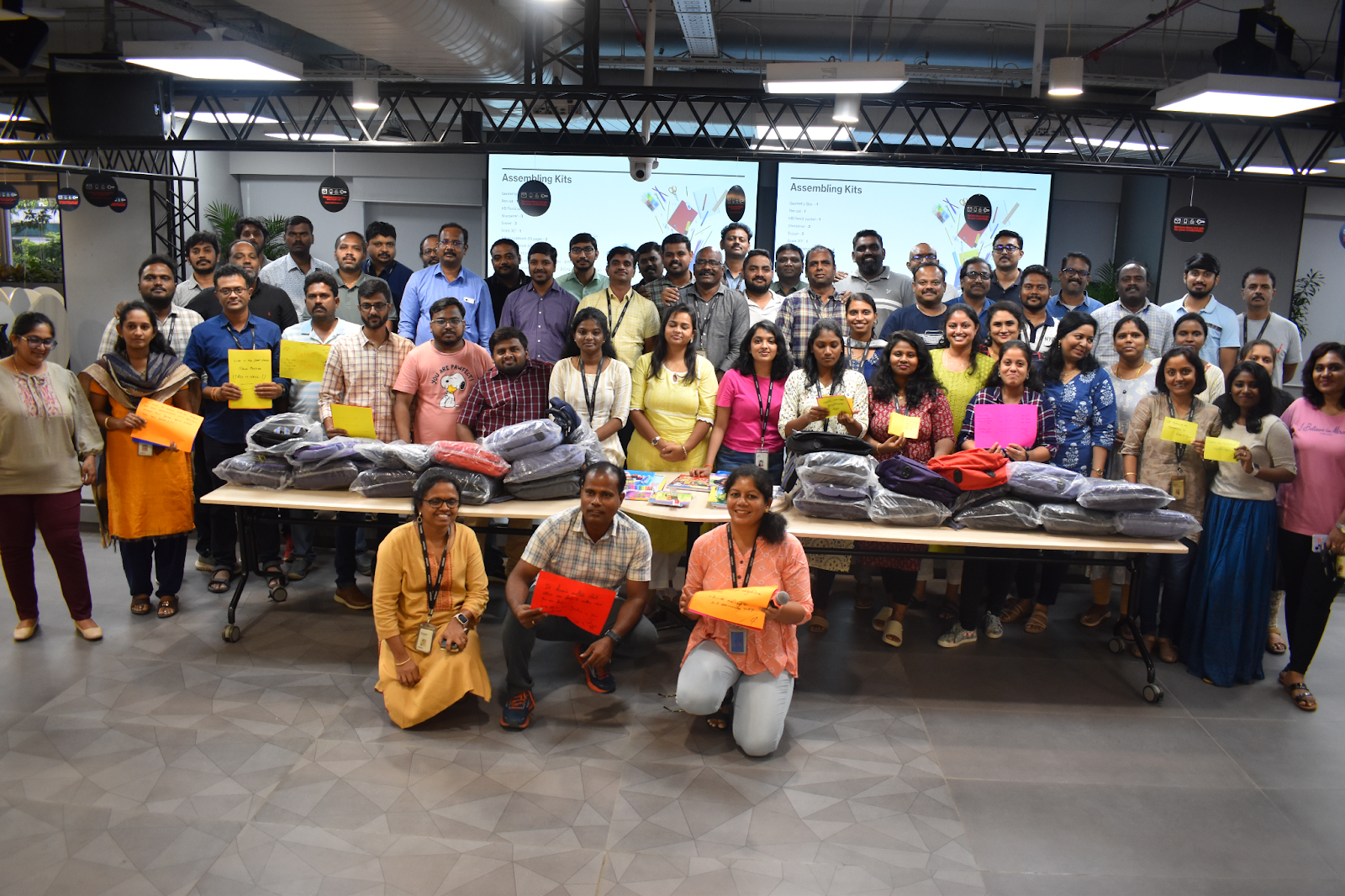
Verizon’s Citizen Verizon Volunteers employee volunteer program focuses on expanding access to education and connectivity through tutoring, digital literacy, and skills-based volunteering. Employees support students through one-on-one academic coaching and help older adults build confidence using technology, addressing two critical barriers to opportunity.
As part of its partnership with UPchieve, Verizon pledged 1,000 volunteers to serve as Academic Coaches on the platform, where employees tutor students in homework, test preparation, and college planning through virtual classrooms. These efforts sit within Verizon’s broader digital inclusion strategy.
The program continues to demonstrate strong momentum. By late 2025, Verizon had met and exceeded its 2.5 million volunteer hours goal, with over 89,000 employees participating since 2020. In addition to tutoring, employees contribute to expanded STEM mentoring and tech training for seniors, where a large majority of participants report improved confidence and reduced feelings of isolation.
Alongside volunteering, Verizon sustains $10M+ in annual charitable giving, reinforcing long-term nonprofit partnerships and community impact. Together, these efforts show how a well-designed employee volunteer program can scale corporate volunteer work while delivering measurable outcomes.
5. Starbucks
EVP Goal: Promote diversity and equity

Starbucks advances diversity and equity through employee-led efforts, training programs, and community partnerships that encourage partners (employees) to actively participate in building more inclusive workplaces and communities. These efforts commonly focus on education, advocacy, and leadership development as core pillars of the company’s broader equity strategy.
Partners engage in learning experiences around racial equity topics such as implicit bias and inclusive practices, and work with local and national organizations to support initiatives that promote equity in the workplace and beyond. Employees are also encouraged to contribute ideas and lead internal actions that help ensure all partners feel respected and represented.
Complementing these employee-led efforts, Starbucks has committed significant resources to racial equity at scale. By 2025, the company launched a $100 million Community Resilience Fund to support small businesses in BIPOC communities and expand access to education through partnerships with organizations such as the Smithsonian. Starbucks has also implemented anti-bias training, achieved pay equity milestones, and set representation goals, including 30% BIPOC representation at corporate levels.
Together, these initiatives illustrate how companies with employee volunteer programs can connect internal engagement with broader investments to advance racial equity and social justice.
6. Walmart
EVP Goal: Community outreach and sustainability
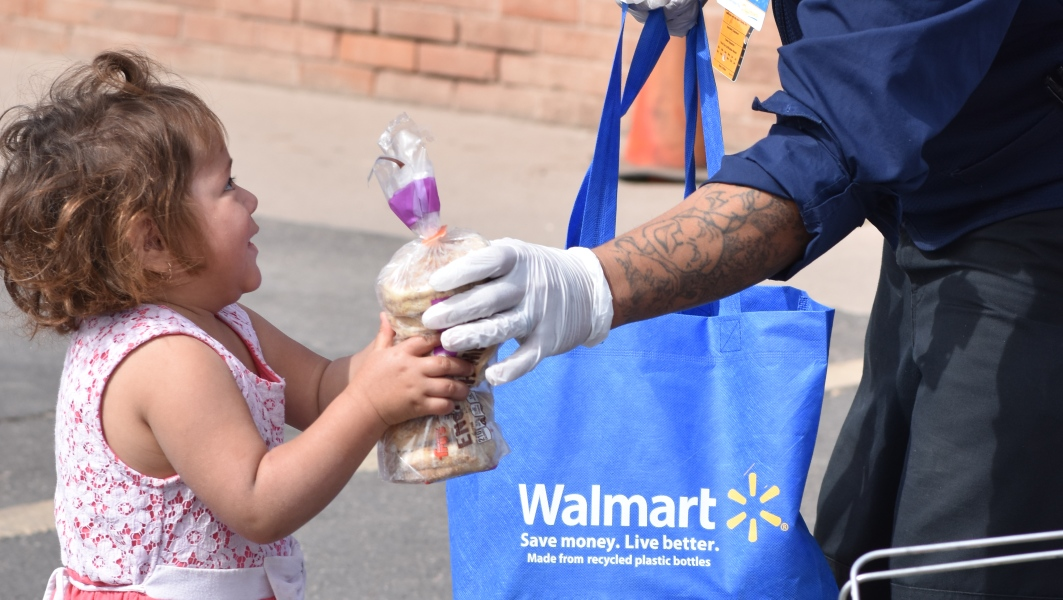
Walmart supports employee volunteering through its Spark Good platform, a centralized hub that brings together Associate and Community Engagement programs to make volunteering simple, accessible, and trackable for employees. The platform allows associates to find local opportunities, log volunteer hours, and trigger grant donations to nonprofits based on their participation.
Through Spark Good, employees take part in activities such as park and beach cleanups, tree and flower planting, supporting local schools, and volunteering at food banks. The platform also provides resources and guidance to help associates engage in environmental initiatives and community service.
In FY2025, 20,400 U.S. Walmart associates reported 295,000 volunteer hours through Spark Good, generating grants for nonprofits via programs like Volunteerism Always Pays (VAP), which awards funding based on hours volunteered. Employee volunteering across Walmart and Sam’s Club has also driven significant local impact, with Sam’s Club associates logging 13,000+ volunteer hours and supporting $5.2 million in local grants.
These efforts are further amplified by Walmart.org’s $2 billion in global giving in FY2025, including hundreds of millions of pounds of food donated worldwide, showing how companies that offer volunteer programs can combine technology, employee action, and philanthropy to scale impact.
7. Best Buy
EVP Goal: Community Outreach

Best Buy's flagship 'Gift of Time' employee volunteer program is one of the most successful corporate social responsibility volunteer programs in the world.
Best Buy’s employee volunteer program, often referenced through initiatives such as Gift of Time, encourages employees to support causes they care about while strengthening community connections. Employees can choose opportunities ranging from volunteering at food banks to mentoring students, and they are also encouraged to organize their own donation drives or service projects.
Volunteer hours are logged through internal portals and can unlock volunteer grant incentives, where Best Buy provides funding to nonprofits based on employee participation. Through programs such as TagTeam Awards, Best Buy has historically generated millions of dollars in nonprofit support, including reports of $3 million in a single fiscal year from more than 125,000 employee volunteer hours.
Best Buy’s employee volunteering programs have supported initiatives like Junior Achievement mentoring and local grantmaking of up to $65,000 per market, helping build long-term relationships with community organizations. These efforts demonstrate how CSR volunteering can combine employee choice, recognition, and incentives to drive sustained impact.
8. Wells Fargo
EVP Goal: Environmental sustainability
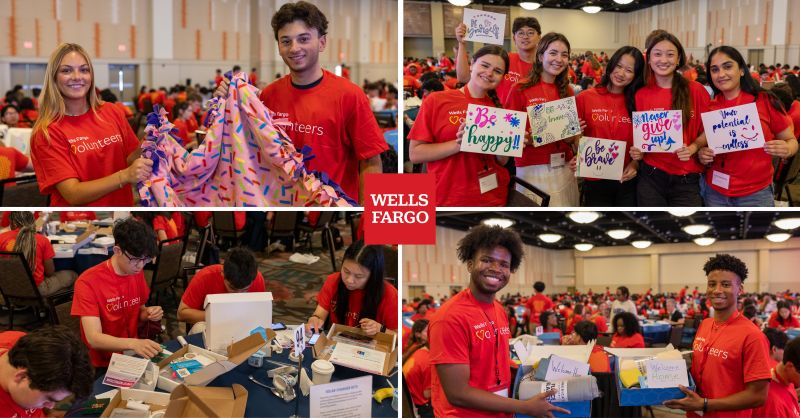
Wells Fargo supports employee volunteering through its broader philanthropy and community investment efforts, which focus on housing stability, small business growth, financial health, and environmental sustainability. Rather than operating a single named “Global Community Investment Program,” the company integrates volunteering into its overall ESG and foundation-led initiatives.
Employees are encouraged to participate in team-based service projects and environmental activities, with volunteer efforts often supported through Dollars for Doers–style grants, in which Wells Fargo donates to nonprofits based on employee volunteer hours (for example, grants of up to $1,500 per employee for 25+ hours).
In addition to volunteering, the Wells Fargo Foundation distributes hundreds of millions of dollars annually in community grants to nonprofits and community development organizations, helping amplify the impact of employee engagement. Together, these efforts show how companies with employee volunteer programs can connect philanthropy, volunteering, and sustainability goals to drive long-term community and environmental outcomes.
9. United Way
EVP Goal: Health & wellness outreach

United Way supports health and wellness initiatives through its local chapters and community partnerships, including long-standing efforts related to HIV/AIDS prevention, education, and access to care. Since the 1990s, many United Way affiliates have helped fund and coordinate services through programs such as Ryan White–supported initiatives, working with local nonprofits to reach individuals and families in need.
Volunteers across United Way’s network contribute to health-focused activities such as awareness campaigns, prevention education, and community outreach, as well as supporting services like meal distribution, transportation assistance, and linkage-to-care. These efforts are typically coordinated at the local level and are part of broader community-wide health strategies rather than a single, centralized employee volunteer program.
Through its volunteer platforms, United Way connects individuals and corporate partners to a wide range of health and social impact opportunities, including HIV prevention and wellness initiatives. Together, these locally driven efforts illustrate how companies with employee volunteer programs can engage with United Way chapters to support critical public health priorities and strengthen community well-being.
10. Decathlon
EVP Goal: Refugee and crisis support

Decathlon’s Decathlon Solidarity (Decathlon Solidarité Internationale) program supports people affected by major crises, including armed conflicts, natural disasters, and displacement. Launched around 2022 in partnership with the King Baudouin Foundation, the fund channels resources toward emergency relief and long-term support for vulnerable populations.
Through the Decathlon Foundation (established in 2005), employees, known as “Decathletes”, are encouraged to take part in local solidarity projects that use sport as a tool for inclusion, well-being, and skills development. These initiatives often support displaced people and youth at risk by improving access to sports activities that foster confidence, community connection, and emotional resilience.
Decathlon has also contributed to refugee support through broader solidarity initiatives, including donations to support people displaced by the war in Ukraine and the provision of essential gear for refugee camps. Together, these efforts show how companies that offer volunteer programs can engage employees in hands-on, values-driven corporate volunteer work focused on humanitarian relief and inclusion.
11. Meta
EVP Goal: Network building and community outreach

Meta supports broad employee volunteering through internal platforms that enable employees to donate, share skills, and participate in service activities for causes such as medical research, access to education, disaster relief, and racial justice. These efforts are often paired with matching grants and nonprofit partnerships, allowing employees to extend the impact of their contributions.
Employees also participate in community-based projects that support food security, environmental stewardship, and neighborhood well-being. Examples shared by corporate volunteering platforms and partners highlight employee involvement in activities such as maintaining community gardens and supporting local food banks. These initiatives reflect Meta’s broader commitment to community outreach and sustainability, even though specific program names and large-scale figures are not publicly standardized.
Together, these efforts illustrate how companies with employee volunteer programs can offer flexible, employee-driven opportunities that support a wide range of social causes while fostering a culture of giving.

12. IBM
EVP Goal: Development outreach
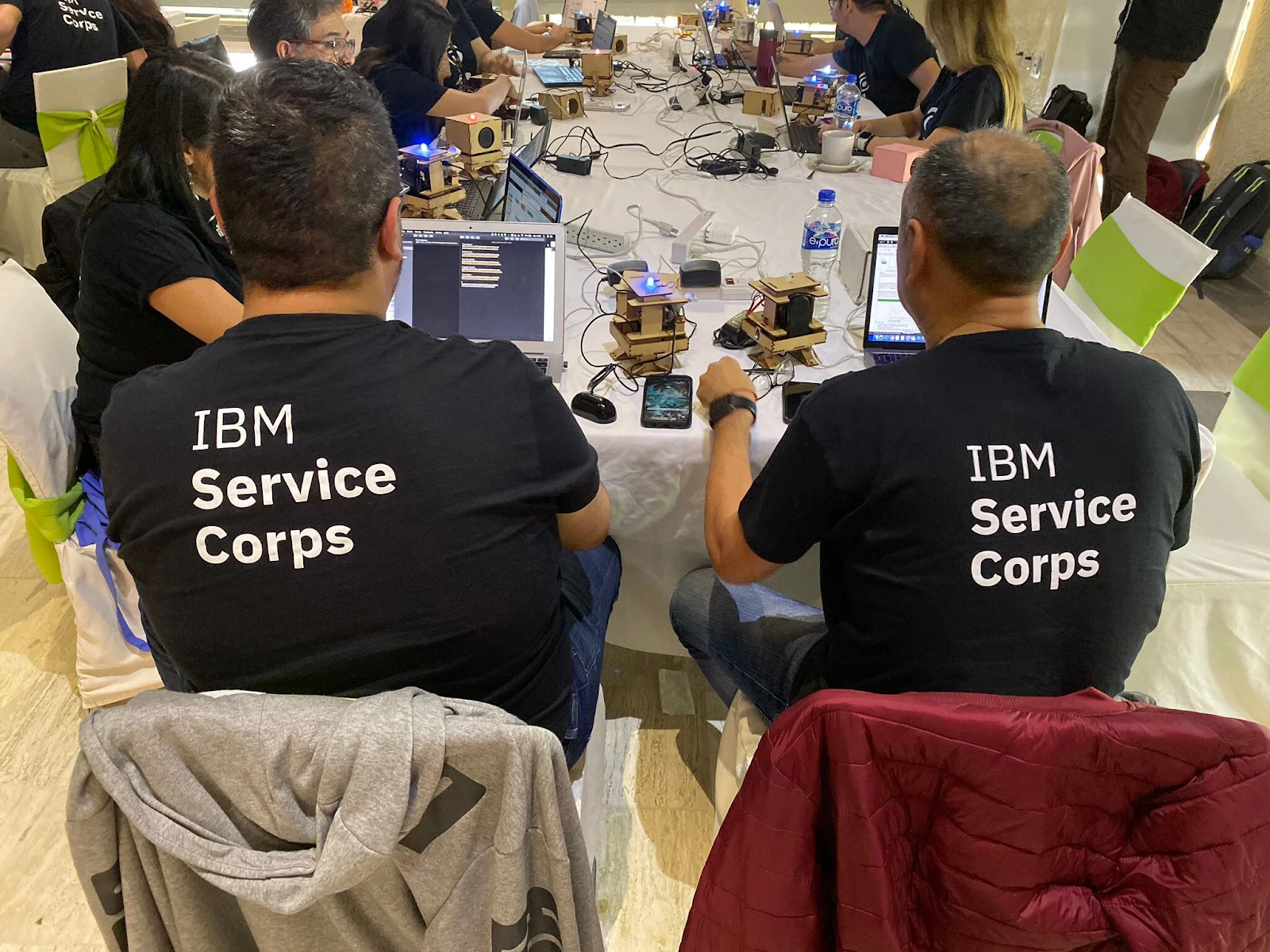
IBM Service Corps employees collaborating on a skills-based volunteering project
IBM’s Corporate Service Corps (CSC), now commonly referred to as IBM Service Corps, is a well-documented employee volunteer program launched in 2008 that deploys high-potential IBM employees to work alongside local organizations in developing countries.
Teams of typically 10–15 IBM employees collaborate on 2–4 week, on-site projects focused on four core areas: economic development, education, health, and environment. Activities range from developing business and growth plans to teaching classes, designing health programs, and supporting sustainability initiatives.
IBM fully funds participant travel, lodging, and project materials, and provides extensive preparation and post-service mentoring. By 2018, the program had engaged 4,000+ employees across 1,300+ projects in 40 countries, generating an estimated $100 million+ in value for host communities.
IBM Service Corps demonstrates how companies with employee volunteer programs can use skills-based corporate volunteer work to drive global community impact while developing future leaders.
Read next: Guide to Maximizing Your Impact with Corporate Volunteering Programs
What Can We Learn from These Volunteer Campaign Examples?
Successful volunteer campaign examples show that the most effective corporate volunteer programs are intentional, employee-centered, and built for long-term impact. While each company takes a different approach, the strongest programs share a common foundation that makes them scalable and sustainable.
Key lessons across these examples include:
- Programs align with the company’s mission:
When corporate volunteer work reflects business values, it feels authentic and gains stronger internal support. - Employees are given choice and flexibility:
Companies with employee volunteer programs offer a mix of virtual, in-person, and skills-based opportunities so more people can participate. - Impact is clearly measured:
Tracking volunteer hours, participation, and outcomes helps organizations understand what’s working and improve employee volunteering programs over time. - Partnerships are built for the long term:
Ongoing relationships with nonprofits lead to a more profound impact than one-off events. - Leadership visibly supports volunteering:
When leaders participate in and discuss volunteering, engagement across the organization increases.
Together, these patterns show how corporate volunteer program examples can move beyond good intentions and become powerful drivers of social change.
If you want to understand how to measure volunteering outcomes and turn them into meaningful impact reports, this guide walks through frameworks, metrics, and best practices for tracking social impact.
Read: How to Create Effective Impact Reports
How Do You Start an Employee Volunteer Program?
Starting an employee volunteer program begins with clear goals, a simple structure, and opportunities that align with employees' interests. You don’t need a large budget or complex systems to begin; many successful corporate volunteer programs start small and grow over time.
Here’s a practical way to get started:
- Define priority causes: Choose 2–3 focus areas that align with your company’s values and business goals.
- Ask employees what interests them: Surveys or quick polls help shape relevant volunteer campaign examples.
- Identify nonprofit partners: Look for organizations with precise needs and strong community presence.
- Choose from a mix of in-person, virtual, and skills-based corporate volunteer opportunities.
- Launch a pilot program: Test a small set of opportunities before scaling.
- Track results and feedback: Measure participation, hours, and employee satisfaction.
With consistent effort, small beginnings can grow into strong employee volunteering programs that create lasting value for both communities and your business.
Turning Purpose Into Action Through Corporate Volunteering
Corporate volunteer programs have evolved into powerful engines for social impact and employee engagement. As the examples in this guide show, companies with employee volunteer programs are finding meaningful ways to align business values with community needs, whether through skills-based projects, virtual volunteering, or long-term nonprofit partnerships.
The most effective corporate volunteer work is intentional, inclusive, and measurable. When employees are given accessible opportunities to contribute, and leaders actively support those efforts, volunteering becomes part of everyday culture rather than a one-time activity. Over time, this creates stronger teams, deeper community relationships, and more resilient organizations.
If you’re looking to build or scale your own employee volunteer program, start small, stay focused, and learn from these examples. With the proper structure and partners, volunteering can become one of the most impactful parts of your company’s purpose-driven strategy.
Ready to create volunteering experiences that inspire your workforce and drive real change? Goodera can help you design and execute employee volunteering programs that deliver measurable impact for your business and the communities you serve.
Goodera provides end-to-end support for companies that offer volunteer programs, including planning, nonprofit sourcing, execution, and impact tracking. Organizations use Goodera to run both virtual and in-person volunteering experiences across multiple cause areas.
Frequently Asked Questions
1. What is a Corporate Social Responsibility activity?
A Corporate Social Responsibility (CSR) activity is any initiative undertaken by a company to positively impact society, the environment, or the communities they serve. These activities can range from employee volunteering and sustainability efforts to philanthropic donations and ethical labor practices. CSR activities are usually aligned with the company’s values and designed to contribute to long-term social good while engaging employees and stakeholders meaningfully.
2. What are the activities included in CSR?
CSR activities can vary widely based on the organization’s goals and impact areas. Common activities include:
- Environmental sustainability programs (e.g., reducing carbon emissions, zero-waste initiatives)
- Community volunteering and service days
- Charitable donations to nonprofits or disaster relief funds
- Employee wellness programs
- DEI (Diversity, Equity & Inclusion) initiatives
- Ethical sourcing and fair labor practices
- Education and mentorship programs for underserved communities
3. What is corporate social responsibility for employees?
For employees, CSR is an opportunity to contribute to causes they care about through their workplace. It can mean participating in volunteer days, donating to company-matched campaigns, or taking part in workplace initiatives that support the community or the environment. A strong CSR program can also enhance employee engagement, boost morale, and give people a sense of purpose in their work.
4. How can you contribute to CSR as an employee?
Employees can contribute to CSR by participating in company-organized volunteering events, joining CSR or ESG committees, proposing new initiatives aligned with their passions, and encouraging colleagues to get involved. Some employees also take the lead in grassroots movements, starting fundraisers, sustainability drives, or awareness campaigns that the company later supports.
5. Which company is best in CSR?
Several companies are recognized globally for their CSR leadership. Examples include:
- Patagonia – for its commitment to environmental activism and ethical manufacturing.
- Ben & Jerry’s – for its social justice and climate advocacy.
- Salesforce – known for its 1-1-1 model (donating 1% of equity, product, and time).
- Unilever – for embedding sustainability into its global supply chain.
While “best” can be subjective, these companies have consistently demonstrated transparency, innovation, and measurable impact through their CSR efforts.
6. Why is CSR important for businesses?
CSR strengthens brand reputation, builds stakeholder trust, and attracts purpose-driven talent. More than ever, consumers and employees are looking to align with companies that prioritize people and the planet, not just profits. A strong CSR strategy can also reduce risks, improve employee retention, and contribute to long-term financial performance.
7. How does CSR differ from ESG?
CSR refers to the voluntary initiatives a company undertakes to give back to society, while ESG (Environmental, Social, and Governance) refers to measurable criteria investors and stakeholders use to evaluate a company’s ethical and sustainability performance. CSR is more internally driven, while ESG is broader and often tied to risk, compliance, and long-term business sustainability.
8. How do companies measure the success of Corporate Volunteer Programs?
The strongest programs track four data layers: participation rate (percent of eligible employees who logged at least one hour), total volunteer hours, dollar value of skills contributed, and nonprofit-reported outcomes. Leaders also monitor employee engagement scores and retention deltas between volunteers and non-volunteers. CECP's annual Giving in Numbers report provides industry benchmarks companies use as reference points.
9. What is the difference between skills-based and traditional Corporate Volunteering?
Traditional volunteering deploys employees for hands-on tasks like packing meals, painting classrooms, or planting trees. Skills-based volunteering matches professional expertise in areas like legal, marketing, engineering, or finance to nonprofit challenges, delivering pro-bono consulting worth far more per hour. IBM's Corporate Service Corps and Deloitte's Impact Day are skills-based examples, while UPS Neighbor to Neighbor blends both formats within a single program.
10. Can Corporate Volunteer Programs work for remote and hybrid teams?
Yes, virtual volunteering has become a core pillar since 2020, with formats like online mentoring, remote tutoring, digital-skills coaching, and virtual team challenges that connect distributed employees to global causes. Async options such as recorded read-aloud sessions or crowdsourced translation let time-zone-diverse teams contribute equally. Well-designed hybrid formats maintain participation rates comparable to in-person events while cutting logistics costs.