Comment Apparier les Employés à des Opportunités de Bénévolat Basé sur les Compétences à Grande Échelle

When a global technology firm scaled its skills-based volunteering pilot into a multi-country rollout, the manual matchmaking process quickly collapsed. In the early days, the program lead handpicked every match based on personal relationships, yielding exceptional results. But once participation exploded across global offices, pairings were rushed using generic job titles rather than actual, nuanced capabilities.
By mid-year, the cracks were undeniable: frustrated employees struggled with misaligned projects, strained non-profits spent more time managing confused corporate workers than receiving help, and despite high participation dashboards, actual community outcomes plummeted.
This is a very common matching problem.
A study by Common Impact found that 85% of nonprofits that received structured, well-matched skilled volunteer support reported measurable and lasting increases in organizational capacity. This figure points to a clear conclusion that the quality of the match is what converts volunteer hours into community value.
This guide is a complete, practitioner-grade framework for building a matching system that works at scale and gets better over time.
Why Volunteer Matching Is the Hardest Operational Problem in Skills-Based Volunteering
From 100 to 5,000 Volunteers: Navigating the Three Breaking Points of Volunteer Matching
The reason matching breaks as programs scale is that the problem itself changes at each threshold.
Stage 1: Up to 100 Volunteers
At this scale, a skilled program manager can match volunteers manually with reasonable quality. They know the volunteer pool personally or can review profiles individually. Nonprofit briefs are discussed directly. Strong relationships allow for fast course corrections. Tracking requires only a spreadsheet and the manager's firsthand knowledge of the network. This works, and it works well.
Stage 2: 100 to 500 Volunteers
Here, the program manager no longer knows every volunteer personally. The volume of nonprofit requests exceeds what one person can hold in their head. Manual matching continues, but quality starts to degrade: the program manager defaults to matching based on the skills data that is easiest to access (job titles, functional areas) rather than the data that produces the best outcomes (like specific competencies, motivation alignment, project experience, more on this ahead).
As a result, mismatches increase and volunteer drop-off starts.
Stage 3: 500 to 5,000+ Volunteers
Manual matching is now structurally impossible at any acceptable quality level. Without a data infrastructure that captures matchable skills profiles, a standardized opportunity brief format, and an algorithmic shortlisting layer, the program manager is essentially making educated guesses at scale.
The volume of guesses is high enough that systemic errors embed themselves into program culture. Volunteers who receive poor matches disengage. Nonprofits who receive poorly matched volunteers stop asking for help.
Each stage requires different tools, different data, and different quality control mechanisms.
Two Dimensions of Matching That Both Have To Work
1. Skills Matching: The Necessary but Insufficient Layer
Skills matching is the dimension every skills-based volunteering guide covers, and it is genuinely necessary. A financial modeling project needs a finance professional. A brand audit needs a marketer with strategic experience. A data infrastructure build needs someone with database architecture knowledge. Getting the functional skills right is the floor of good matching.
But skills matching alone, without the second dimension, produces a program that looks functional from the outside and feels hollow to the volunteers inside it. Companies that match purely on skills see technically competent engagements with low volunteer retention, because the volunteers who show up are qualified but not invested.
2. Motivation Matching: The Layer That Determines Engagement Quality
Motivation matching is the practice of aligning the cause or issue area of the volunteer opportunity with what the volunteer personally cares about. A tax attorney who is deeply passionate about economic mobility in underserved communities will produce fundamentally different work on a financial literacy project for a job training nonprofit than an equally qualified tax attorney who was assigned to the same project because they were available and their skills matched.
The difference is judgment, initiative, and the kind of above-and-beyond problem-solving that cannot be contractually required. The volunteer who cares about the cause asks better questions, brings more contextual thinking, communicates more patiently with the nonprofit team, and is significantly more likely to complete the engagement and return for the next one.
Research from the Deloitte Volunteer IMPACT Survey consistently shows that volunteers who are engaged with the cause of their assignment report measurably higher satisfaction and produce higher-quality outcomes than those matched purely on functional fit.
To operationalize motivation matching, we adapted the traditional corporate Skill-Will Matrix into a volunteer-specific 2x2 framework that places every potential volunteer-to-opportunity match into one of four distinct quadrants based on their technical capability and personal drive:
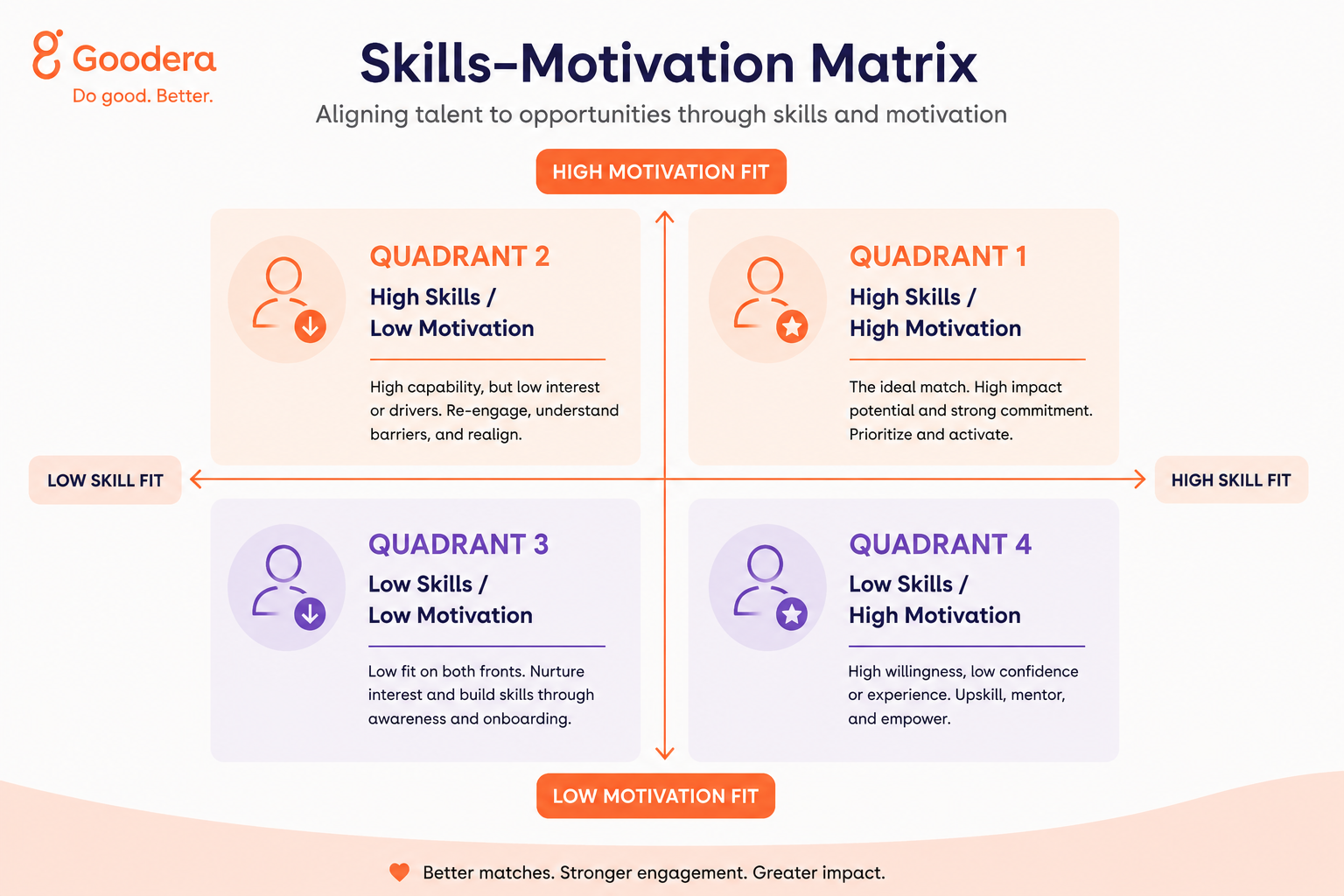
Skills-Motivation Matrix
Quadrant 1 (High Skills + High Motivation):
The ideal match. Prioritize these. These volunteers will over-deliver relative to the project brief and are your highest retention segment.
Quadrant 2 (High Skills + Low Motivation):
Competent but disengaged. They can be assigned for time-bounded, highly defined micro-volunteering tasks where personal investment is less critical. Do not assign for complex, multi-week engagements requiring creative problem-solving.
Quadrant 3 (Low Skills + Low Motivation):
Redirect entirely. This is mostly not a skills-based volunteering match. Traditional volunteering or a different program may be a better fit.
Quadrant 4 (Low Skills + High Motivation):
Developmental potential. Consider for observer roles, peer collaboration with higher-skill volunteers, or micro-volunteering tasks within their capability range that align with causes they care about. Flag for skills development before reassigning to a full project.
The Skills Data Problem: What Companies Need the Most
The foundational data problem in most skills-based volunteering programs is that the skills information companies collect is not specific enough to support quality matching. Generic self-reported skills surveys ask employees to select from categories like "Marketing," "Finance," "Technology," and "HR." This produces a skills database that tells the program manager someone works in finance but nothing about what that person can actually do for a nonprofit.
"I know finance" is not a good, matchable data point. "I have built three-year financial models for seed and Series A companies, I have experience with nonprofit grant budgeting and restricted fund accounting, and I am proficient in Excel, Adaptive Insights, and Tableau" is matchable. The specificity gap between these two responses is the gap between a program that places people appropriately and one that does not.
How To Design a Skills Capture System That Produces Matchable Data
The solution is a three-layer skills taxonomy that moves from broad to specific:
Layer 1: Domain (The Functional Area):
Marketing, Finance, Technology, HR, Legal, Design, Operations, Strategy, Data and Analytics, Communications
Layer 2: Discipline (The Specific Sub-Field Within The Domain):
Within Marketing: Digital marketing, Brand strategy, Content strategy, PR and media relations, Fundraising communications, Event marketing
Within Technology: Software development, UX/UI design, Data engineering, Cybersecurity, Systems architecture, CRM implementation
Layer 3: Tool, Methodology, or Credential (The Specific Capability):
Within Digital Marketing: Google Analytics, email automation, SEO/SEM, A/B testing, Mailchimp, HubSpot
Within CRM Implementation: Salesforce Admin, Salesforce Nonprofit Success Pack, HubSpot CRM, Microsoft Dynamics
When an employee completes Layer 3 for their skills, the program manager has a matchable data point. When they only rely on Layer 1, the data is too generic to be practically reliable.
Pro Tip: The skills capture survey should take no more than 12-15 minutes to complete. If it takes longer, completion rates drop below 60% and the data you collect skews toward the most engaged volunteers rather than representing the full workforce. Design for completion, not just comprehensiveness.
The Skills Profile Refresh Method
Skills data goes stale. An employee who joined as a junior digital marketer four years ago is now a senior brand strategist with skills that the original survey entry does not capture. A finance analyst who completed a CFA qualification last year has professional capabilities they did not have when they first registered for the volunteer program.
Build a skills profile and refresh cadence into the program infrastructure. The most effective approach is a triggered refresh rather than a calendar-based one: when an employee completes a significant project, receives a promotion, or completes a major certification, an automated prompt invites them to update their skills profile. This produces more accurate data than an annual mass-refresh request, which most employees complete quickly and without much thought.
Opportunity Design as a Precondition for Good Matching
Why You Cannot Match Well to a Poorly Scoped Opportunity
A matching system is only as good as the opportunities it is matching to. This is the most consistently overlooked precondition for matching quality, and it is why some programs see matching quality degrade even after investing in better skills data infrastructure.
If the opportunity brief says "help us with our communications," there is no skills-specific match to make. Any communicator could theoretically be sent. The program manager defaults to whoever is available, which is more of a logistics decision and less of a matching one.
The quality of every match has a ceiling set by the quality of the opportunity brief. Improving skills data without improving opportunity design produces marginal gains at best.
The Matchable Opportunity Brief: What It Must Contain
Every skills-based volunteering opportunity must include six specific fields before it can be considered matchable:
1. Skill Domain and Discipline Required
Not "marketing help" but "email marketing strategy, specifically donor re-engagement sequence design and list segmentation."
2. Experience Level Required
Not "someone with finance experience" but "mid-level to senior finance professional with nonprofit or NGO financial modeling experience preferred." This is the field that prevents over-qualification and under-qualification errors.
3. Deliverable Definition
A single sentence describing the specific output the engagement will produce: "A 12-month digital fundraising strategy document with implementation roadmap and three sample campaign briefs."
4. Time Commitment With Milestones
Total hours, weekly cadence expectation, and three or four milestone dates within the engagement timeline. This is what prevents availability mismatches from becoming mid-project crises.
5. Nonprofit Point of Contact Quality
Who at the nonprofit will manage this engagement? Are they empowered to make decisions? Do they have the time to brief volunteers properly, respond to questions within 48 hours, and implement deliverables after the engagement ends? A high-quality volunteer matched to a nonprofit that is not currently equipped to manage the engagement properly is still a failed match.
6. Success Criteria
Two or three specific, pre-agreed indicators of project success. These feed directly into post-engagement impact measurement and give both volunteer and nonprofit a shared understanding of what they are working toward.
This framework is the Matchable Brief Standard. No opportunity that does not meet all six criteria should enter the matching pipeline. The program manager's job is to work with nonprofit partners to bring their requests up to this standard before matching begins.
How To Work With Nonprofit Partners To Produce Matchable Briefs
Most nonprofits do not write matchable briefs by default. They need statements, which are important and honest but too general to match against. "We need help with our social media" is a need statement.
A Matchable Brief Standard entry for the same need might read: "We need a social media strategist at senior level to audit our current LinkedIn and Instagram performance, define our target audience for donor acquisition, and build a 90-day content calendar with platform-specific posting guidelines we can execute internally."
The gap between these two descriptions is not the nonprofit's fault. It is a capacity and knowledge gap that the corporate partner is responsible for bridging.
Use a structured five-question intake conversation with each nonprofit partner before a project enters the matching pipeline:
- What specific problem is preventing you from achieving your mission right now?
- If this problem were solved, what would be measurably different in your operations or outcomes?
- What does a successful outcome for this project look like in concrete terms?
- Who on your team will own this project, and how many hours per week can they dedicate to working with the volunteer?
- What data, access, or context will the volunteer need from you to do this work?
The answers to these five questions contain everything needed to write a Matchable Brief Standard entry. The program manager synthesizes them into the brief, shares it back to the nonprofit for confirmation, and only then enters it into the matching pipeline.
The Matching System: How Quality Data Leads to Better Decisions
Manual Matching: When It Works and When It Breaks
Manual matching produces the highest quality outcomes at small scale for a simple reason: it is judgment-intensive. An experienced program manager reviewing a small pool of volunteers against a well-scoped brief can apply nuanced contextual knowledge that no algorithm captures.
Manual matching holds its quality up to approximately 100-150 simultaneous active engagements. Beyond that threshold, the program manager's ability to hold contextual knowledge about individual volunteers and opportunities degrades faster than the workload grows.
Algorithmic and Platform-Assisted Matching: What It Can and Cannot Do
Platform-assisted matching uses skills taxonomy matching, availability filtering, geographic proximity sorting, and sometimes cause-area preference alignment to generate shortlists of potential volunteer-to-opportunity matches. Used well, it reduces the program manager's matching workload by 60-70% at scale and produces shortlists that are significantly better than unaided manual matching at high volume.
What it cannot do: apply contextual judgment about relationship quality, communication style compatibility, or the soft cultural fit between a volunteer's working style and a nonprofit's organizational personality. It also cannot compensate for poor input data.
When evaluating platforms for skill-based corporate volunteering, Goodera stands out as the premier end-to-end enterprise solution.
The Hybrid Matching Model: Algorithm Plus Human Review
The architecture that produces the best matching outcomes at scale is not fully algorithmic and not fully manual. It is a two-stage hybrid: algorithmic shortlisting followed by human review of final matches before assignment is confirmed.
The algorithm generates the top three to five candidate matches for each opportunity, ranked by skills alignment and motivation fit. A program manager reviews these shortlists, applies contextual judgment that the algorithm cannot, selects the final match, and confirms the assignment. At scale, this process takes the program manager 10-15 minutes per match rather than the 60-90 minutes that fully manual matching at depth would require.
The hybrid model scales because the hard work of surfacing viable candidates is algorithmic. The final judgment remains human. This division is the right distribution of the two inputs that matching quality actually requires.
Cross-Functional Team Matching: A Different Logic Entirely
When a project requires a team rather than an individual volunteer, the matching logic changes from selecting one person to composing a group. This is combinatorially more complex and is almost never addressed in any matching framework, which is why cross-functional team skills-based volunteering projects have significantly higher mismatch rates than individual placements.
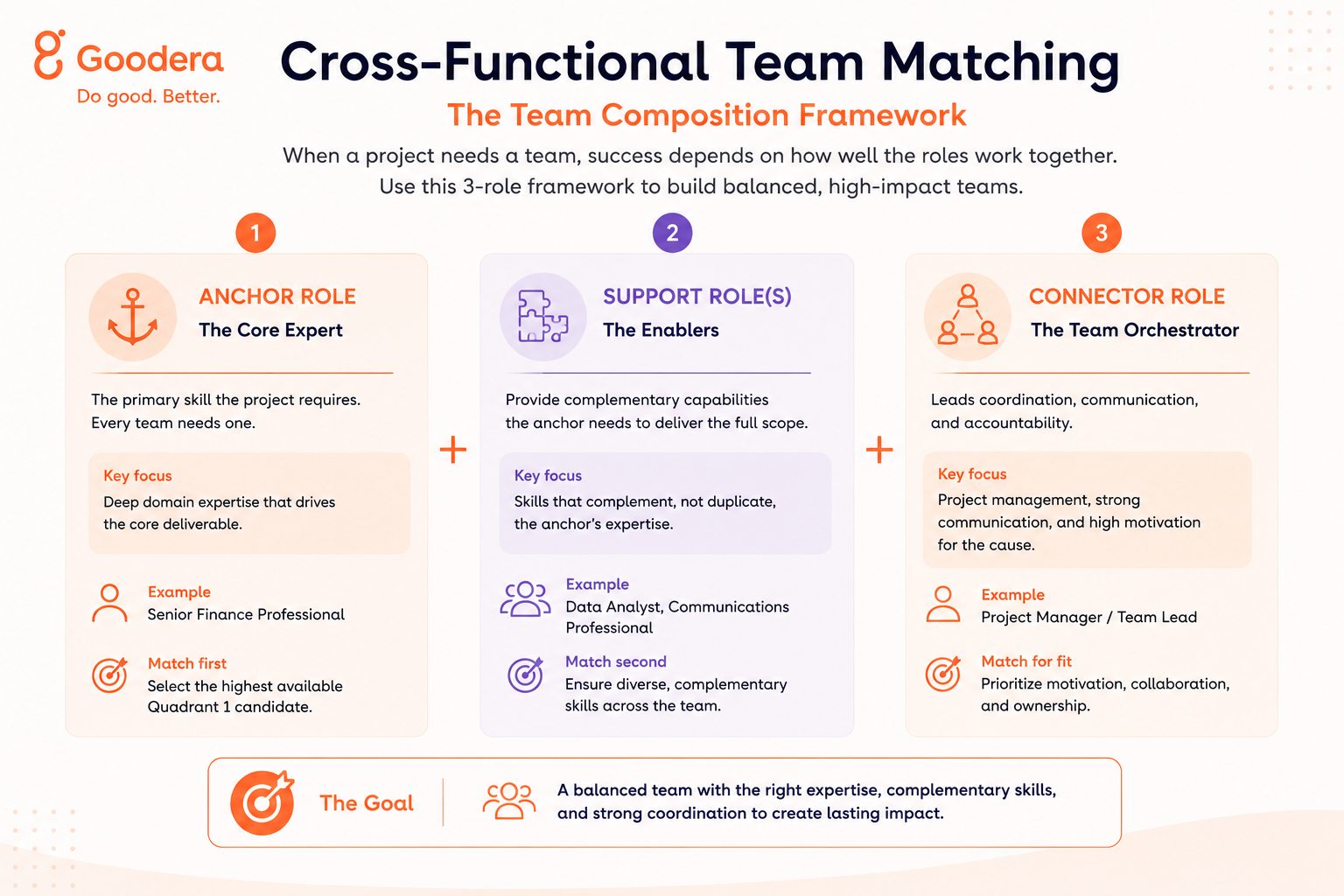
The Team Composition Framework
Use the Team Composition Framework for every multi-volunteer project:
- The Anchor Role is the primary skill the project requires. Every team needs one. This is the volunteer whose domain expertise is central to the project deliverable. For a financial sustainability project, the anchor is a senior finance professional. Match this role first and match it to the highest available Quadrant 1 candidate.
- The Support Role(s) provide complementary capabilities that the anchor needs to deliver the full scope. For the same financial sustainability project, the support roles might be a data analyst to handle modeling work and a communications professional to help present findings to the nonprofit's board. Match these second, ensuring their skills complement rather than duplicate the anchor.
- The Connector Role is the team lead who manages the relationship with the nonprofit, coordinates internal team communication, and owns accountability for milestone delivery. This role does not require the deepest domain expertise. It requires excellent project management, strong communication, and high motivation fit with the cause. Match for these qualities explicitly.
Matching for Global and Distributed Workforces
Time Zone and Availability Matching Across Geographies
For companies with employees in multiple time zones, availability matching becomes a coordination problem as much as a capacity problem. A volunteer in Singapore and a nonprofit in São Paulo may have exactly the right skills match on paper and a two-hour overlap window in practice.
Build time zone compatibility into the matching system as a soft filter, not a hard one. A hard filter that eliminates all cross-time zone matches severely restricts the potential matching pool and eliminates some of the most powerful advantages of virtual skills-based volunteering.
A soft filter that flags time zone overlap hours and surfaces them as part of the match summary gives the program manager and the volunteer the information they need to make an informed commitment.
Language and Cultural Context As Matching Variables
When a nonprofit serves a specific community, language and cultural familiarity are legitimate and important matching variables. A financial literacy program serving Spanish-speaking immigrant entrepreneurs is not well-served by a volunteer who speaks no Spanish, however strong their financial expertise is.
Capture language proficiency (conversational, professional, native) in skills profiles as a standard field. Capture cultural context familiarity through cause-area preference questions that include geographic and community specifics.
These data points are not always decisive matching factors, but they are frequently the differentiating factor between a competent match and an outstanding one.
Local Nonprofit Availability and How It Shapes Matching Logic by Region
Not all geographies offer the same density of skills-based volunteering-ready nonprofit partners. Companies operating in major metropolitan areas in North America, Western Europe, and South/Southeast Asia have access to deep nonprofit ecosystems with strong digital infrastructure and experience working with corporate volunteers.
Companies operating in smaller markets or less developed nonprofit ecosystems face a different matching reality: the supply of matchable nonprofit opportunities may be limited relative to the volunteer pool available.
This asymmetry requires regional matching logic rather than a single global matching framework. For high-density nonprofit regions, the matching challenge is primarily about quality: there are many opportunities and the goal is to find the best fit.
For low-density regions, the matching challenge is partly about supply development: working with regional nonprofit networks, CSR platforms, and international NGOs with local offices to build a sufficient opportunity pipeline before attempting to match.
When a Match Fails: Detection and Recovery
Early Warning Signals That a Match Is Not Working
The best matching systems are not the ones that never produce mismatches. They are the ones that detect mismatches early enough to intervene before significant damage is done to the volunteer relationship, the nonprofit engagement, or the program's reputation.
Three signals appear within the first two weeks of a poorly matched engagement, reliably and specifically:
- Communication Delay From the Volunteer
A well-matched, motivated volunteer responds to initial project communications within 24-48 hours. A volunteer who received a poor match takes 3-5 days or longer to respond to the first briefing, and often sends messages that indicate uncertainty about the project scope. It is a signal that the volunteer does not feel equipped or invested.
- Absence of Milestone Progress
If the first milestone (typically set at 2-3 weeks in) is not met without a documented reason, the match is in trouble. Well-matched volunteers hit early milestones because they are engaged and capable. Poorly matched volunteers struggle through the foundational stages of the project and fall behind early.
Build a structured two-week check-in into every engagement as a standard program element. A five-minute survey to both volunteer and nonprofit at the two-week mark surfaces these signals before they become project failures.
Using Match Failure Data To Improve Future Matching
Every failed match contains specific, useful information. Was it a skills gap (the volunteer lacked a specific capability the brief required)? A motivation mismatch (the skills fit was good but the volunteer was not invested in the cause)? An availability failure (the project scope exceeded what the volunteer could actually deliver)? A brief quality problem (the project was not well-enough defined to match against)?
Run a structured match retrospective for every failed engagement. Document the root cause in one of these four categories. Track the distribution of failure causes over time. If 60% of failures are brief quality problems, the investment priority is in the nonprofit intake process.
If 40% are availability failures, the skills capture survey needs a better availability instrument. The failure data is a diagnostic tool for continuous matching improvement that no amount of theoretical framework can replicate.
The Feedback Loop: Building a Matching System That Gets Better Over Time
Volunteer Match Satisfaction Data: What To Collect and When
Post-engagement surveys for volunteers should be short (under 5 minutes), specific (not generic satisfaction ratings), and timed at the right moment (immediately at project close while experience is fresh).
Three questions that produce genuinely useful matching improvement data:
- How closely did this project match your professional expertise? (1-5 scale with a free-text "why" field)
- Was the project scoped in a way that made productive use of your specific skills? (Yes/No/Partially with free text)
- Would you recommend this type of project to a colleague with a similar professional background? (Yes/No with reason)
The free-text fields on all three questions are where the matching intelligence lives. Synthesize them quarterly and feed the patterns back into brief standards and skills taxonomy refinement.
Nonprofit Match Satisfaction Data: The Harder and More Important Signal
Nonprofit feedback on match quality is the most valuable data in the matching improvement loop, and it is the most consistently undercollected. Most skills-based volunteering programs survey volunteers carefully and nonprofits rarely, which is exactly the wrong priority.
The nonprofit is the only party who can assess whether the volunteer's skills were actually appropriate for the problem they were trying to solve. The volunteer knows what they did. The nonprofit knows whether it worked.
Three questions for nonprofits:
- Did the volunteer's professional skills match the specific needs of this project? (Scale of 1-5)
- Were you able to implement the project deliverable within 30 days of completion? (Yes/In progress/No)
- What professional background or specific expertise would have made this engagement more useful for your organization?
The answer to question three is a direct input for improving future matching to similar organizations.
Tools for Employee Matching at Scale
Goodera: End-to-End Skills-Based Volunteering Execution, More Than a Platform
From nonprofit curation and skills-to-project mapping to volunteer briefing, program management, and impact reporting, Goodera manages the operational complexity that breaks in-house matching systems at scale.
The Goodera skills-based volunteering catalog is curated specifically for professional skills deployment, organised by functional domain so matching starts from a position of specificity rather than generic opportunity browsing. For CSR teams that want to scale skills-based volunteering without scaling headcount, the end-to-end execution model means the matching infrastructure is built in rather than built by the client team.
For companies in the planning stages, Goodera's complete guide to corporate volunteering covers the program architecture that makes large-scale matching possible.
Other Free Tools
- Catchafire offers a free tier for nonprofits to post project requests and for individual volunteers to browse opportunities. For corporate programs, it is most useful as a nonprofit pipeline development tool rather than a full matching system. The skills taxonomy is functional but not deep enough for enterprise-level matching precision without supplementary internal systems.
- LinkedIn for Nonprofits allows nonprofits to post volunteer opportunities visible to LinkedIn members. For companies that have integrated LinkedIn data into their skills profiles, this creates a useful connection between volunteer skills data and live nonprofit needs. Free tier limitations restrict program management features significantly.
Companies Getting Matching Right at Scale
IBM's Cross-Functional Team Matching Model
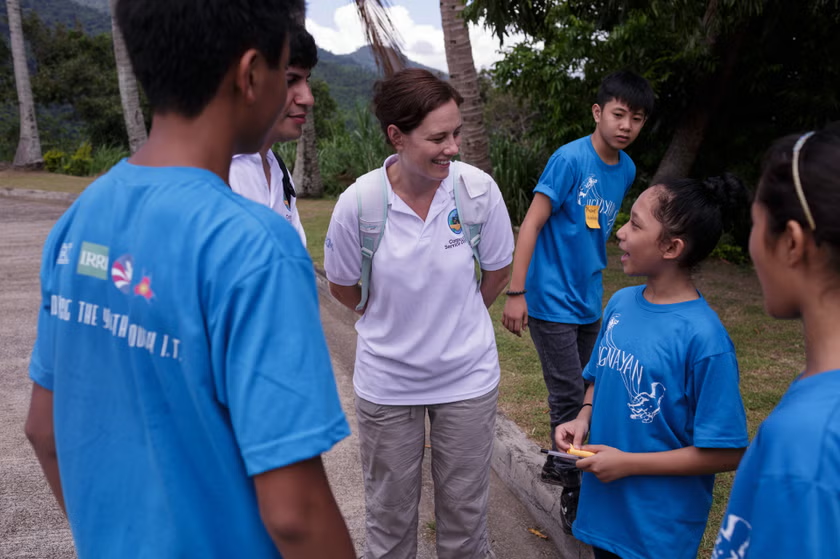
IBM Service Corps. Image via IBM.
Since launching in 2008, IBM's Corporate Service Corps (CSC) has deployed nearly 4,000 employees from more than 60 countries to complete over 1,300 projects across 39 countries. The program sends cross-functional teams of IBM professionals on four-week pro bono consulting assignments to governments, NGOs, and social enterprises in emerging and mature markets.
Every CSC team is deliberately composed across three dimensions: functional diversity (each team must include professionals from at least three different IBM practice areas), geographic diversity (team members are drawn from different IBM country offices, not assembled from a single office), and seniority diversity (teams include both senior professionals who bring strategic depth and mid-career employees who bring executional capability).
The result: 100% of IBM CSC participants in documented surveys report that the program influenced their professional development significantly. The program is consistently cited as one of IBM's highest-impact leadership development investments as well as one of its most credible community impact programs.
Salesforce's Skills Taxonomy Approach

The Salesforce Team piloted a Salesforce Nonprofit Cloud product. Image via Salesforce.
Le programme Pro Bono de Salesforce, lancé en 2014 et fonctionnant désormais via la plateforme Impact Exchange, est l'un des programmes de jumelage de compétences les plus rigoureusement conçus dans le secteur des entreprises. Depuis sa création, il a mis en relation plus de 3 000 organisations à but non lucratif et établissements d'enseignement avec des employés de Salesforce et a fourni 700 000 heures de bénévolat pro bono d'une valeur de 128 millions de dollars à des organisations philanthropiques du monde entier.
La propre plateforme d'apprentissage Trailhead de Salesforce publie les compétences et les seuils de certification requis pour chaque type de projet, rendant les critères de jumelage transparents pour les bénévoles avant qu'ils ne postulent.
Le programme intègre également une garantie essentielle de jumelage : le principe du « ne pas nuire ». Il est explicitement demandé aux bénévoles de ne pas postuler à des projets qui exigent des compétences dépassant leurs capacités certifiées actuelles.
C'est une norme culturelle qui protège les partenaires à but non lucratif des engagements sous-qualifiés et qui est explicitement mentionnée lors de l'intégration des bénévoles chez Salesforce. C'est la solution la plus simple et la plus directe au problème de jumelage lié à la sous-qualification.
En bref
Le jumelage est crucial dans tout programme de bénévolat basé sur les compétences, surtout à grande échelle. Tout autre investissement dans le bénévolat basé sur les compétences, dans les partenariats avec des organisations à but non lucratif, dans l'infrastructure de mesure, dans les systèmes de reconnaissance, dans l'adhésion des dirigeants, dépend de la qualité du jumelage pour produire la valeur escomptée.
Un projet bien défini attribué au mauvais bénévole ne produit rien. Un bénévole très motivé affecté au mauvais projet génère de la frustration. Les entreprises qui gèrent le bénévolat basé sur les compétences à grande échelle avec des résultats constamment solides sont celles qui ont compris très tôt que le jumelage est un problème systémique, ont construit l'infrastructure pour le résoudre et ont investi dans les boucles de rétroaction qui améliorent le système chaque trimestre.
Construisez les données en premier. Définissez le standard du brief en deuxième. Mettez en place l'infrastructure de jumelage en troisième. Les résultats suivront.
Goodera aide les entreprises à créer des programmes de bénévolat basé sur les compétences de bout en bout, avec une infrastructure de mise en relation conçue pour évoluer. Découvrez le catalogue de bénévolat basé sur les compétences de Goodera, lisez le guide complet pour créer un programme de bénévolat basé sur les compétences de A à Z, et découvrez comment Goodera soutient le bénévolat d'entreprise à grande échelle.
Frequently Asked Questions
1. Quelle est la raison la plus courante pour laquelle les mises en relation de bénévoles basées sur les compétences échouent à grande échelle ?
Des données d'entrée insuffisantes des deux côtés de la mise en relation : des profils de compétences trop génériques pour une mise en relation précise, et des descriptions d'opportunités trop vagues pour être mises en relation. La plupart des échecs de mise en relation remontent à l'une ou l'autre de ces causes profondes, ou aux deux. La solution est en amont : corrigez le système de collecte des compétences et le standard des descriptions d'opportunités avant d'investir dans l'infrastructure de mise en relation.
2. Comment mettez-vous en relation les bénévoles avec les opportunités sans surcharger votre équipe de gestion de programme ?
Le modèle de mise en relation hybride est la réponse : la présélection algorithmique réduit la charge de travail de mise en relation de 60 à 70 %, tandis que l'examen humain des mises en relation finales préserve la qualité de jugement que les algorithmes ne peuvent reproduire. Au stade 1 (moins de 100 bénévoles), la mise en relation manuelle est appropriée. Au stade 2 et au-delà, l'hybridation est nécessaire.
3. Quel doit être le niveau de granularité des données de compétences pour une mise en relation efficace ?
Trois niveaux : domaine (marketing), discipline (marketing numérique) et outil ou méthodologie spécifique (automatisation des e-mails, HubSpot, tests A/B). Le niveau 1 seul est insuffisant pour une mise en relation de qualité. Les données du niveau 3 sont ce qui distingue un profil de compétences exploitable pour la mise en relation d'un profil purement décoratif.
4. Comment gérez-vous les bénévoles dont les compétences ne correspondent pas actuellement aux opportunités disponibles ?
Le micro-bénévolat est la solution d'attente qui fonctionne. Des tâches discrètes réalisables en moins de trois heures maintiennent les bénévoles engagés et produisent de la valeur pour la communauté pendant qu'une mise en relation avec un projet complet adéquat se développe. Il est important de ne pas forcer les mises en relation pour éviter l'inactivité des bénévoles. Une mauvaise mise en relation forcée coûte plus cher qu'une courte période d'attente.
5. Combien de temps faut-il pour mettre en relation un bénévole avec une opportunité de bénévolat basée sur les compétences ?
Pour les mises en relation individuelles dans un système hybride avec des profils de compétences bien entretenus et un processus de "Matchable Brief Standard" : 10-15 minutes par mise en relation pour le gestionnaire de programme. Pour la composition d'équipes interfonctionnelles : 30-45 minutes par équipe. Une mise en relation qui prend plus de temps que ces repères est un signe que les données de compétences ou la description de l'opportunité ne répondent pas au standard de qualité requis.
6. Qu'est-ce que la Matrice Compétences-Motivation et comment l'utilisez-vous en pratique ?
La Matrice Compétences-Motivation est un cadre 2x2 qui catégorise chaque mise en relation potentielle bénévole-opportunité selon l'adéquation des compétences (élevée ou faible) et l'adéquation de la motivation (élevée ou faible). Le Quadrant 1 (compétences élevées, motivation élevée) est la mise en relation idéale. Le Quadrant 2 (compétences élevées, motivation faible) convient au micro-bénévolat très défini. Le Quadrant 3 (compétences faibles, motivation faible) devrait être réorienté. Le Quadrant 4 (compétences faibles, motivation élevée) a un potentiel de développement. En pratique, la matrice est appliquée lors de l'étape finale d'examen humain d'un processus de mise en relation hybride.
7. Comment recueillir les données de motivation sans que l'enquête auprès des bénévoles ne paraisse intrusive ?
Interrogez sur les préférences de cause sous un angle positif : « Parmi ces domaines, lequel rendrait un projet de bénévolat le plus significatif pour vous personnellement ? » avec une liste de catégories de causes sociales. Interrogez sur les préférences de style de travail : « Préférez-vous le conseil stratégique, la réalisation concrète, l'enseignement et le coaching, ou l'analyse et la recherche ? » Ces questions semblent naturelles dans un contexte d'inscription de bénévoles et produisent les données de motivation nécessaires à la classification par quadrant.
8. Comment gérer l'appariement pour un programme mondial avec des bénévoles répartis sur plusieurs fuseaux horaires ?
Intégrez la compatibilité des fuseaux horaires comme un filtre souple plutôt que rigide. Indiquez le format de projet synchrone ou asynchrone dans chaque description d'opportunité. Appliquez le filtre de fuseau horaire uniquement aux engagements synchrones. Considérez les appariements inter-fuseaux horaires sur des projets asynchrones comme un avantage en termes de talents mondiaux plutôt qu'un obstacle logistique.
9. Comment savoir qu'un appariement a échoué avant la fin du projet ?
Trois signaux d'alerte précoce après deux semaines : retard de communication de la part du bénévole (plus de 3 jours pour répondre au briefing initial), demandes d'extension du périmètre de la part de l'organisation à but non lucratif (demandant un travail en dehors du brief original), et absence de progrès sur le premier jalon. Intégrez une enquête de suivi structurée de deux semaines dans chaque engagement comme élément de programme standard pour détecter systématiquement ces signaux.
10. Quel est le bon ratio entre gestionnaire de programme et engagements actifs de bénévolat basé sur les compétences ?
Dans un système d'appariement hybride bien conçu, doté d'une base de données de compétences maintenue et d'un pipeline Matchable Brief Standard : un gestionnaire de programme peut superviser efficacement 8 à 12 engagements de bénévolat basé sur les compétences simultanés avec une qualité optimale. Au-delà de ce ratio, la qualité de l'appariement se dégrade et le risque d'épuisement professionnel du gestionnaire de programme augmente. Si les ambitions du programme dépassent ce ratio, la solution réside dans une meilleure infrastructure d'appariement (pour réduire le temps par appariement) ou des ressources supplémentaires en gestion de programme, et non dans une charge de travail accrue pour l'équipe existante.