International Day of Women and Girls in Science: Date, Theme, and How To Take Action

Picture a 14-year-old finishing a physics worksheet she enjoyed. She has never met an engineer or a scientist, so by next year she will have decided science is for someone else.
The International Day of Women and Girls in Science, observed every February 11, exists to change that. It is a United Nations observance that recognizes women and girls in science, technology, engineering, and mathematics (STEM) and pushes for equal access to scientific careers. The 2026 theme was “Synergizing AI, Social Science, STEM and Finance: Building Inclusive Futures for Women and Girls.” The next observance is Thursday, February 11, 2027.
The numbers show where girls step off the path. Only one in three researchers worldwide is a woman, according to the UN Secretary-General’s 2026 message.
A company can be the place a student meets her first woman in STEM, and interest in this work is growing. Goodera’s VQ Report 2026 found that child welfare and education rose from 32% to 43% of all volunteering events in a year.
Here is when the day falls, what it means, and seven ways your team can take part.
When Is International Day of Women and Girls in Science?
Every year on February 11. In 2027 that is a Thursday, which is good news for planners, because your team will be at work and can take part without giving up a weekend.
The UN General Assembly proclaimed the day on December 22, 2015, and the first observance ran in 2016. So it is young as UN days go, which also means most companies have not built a tradition around it yet. There is room to be early.
One more thing worth knowing before you book a date. February 11 sits three weeks before International Women’s Day on March 8, and Women’s History Month runs all of March. Plan the three together and you get six connected weeks instead of three separate events that each need their own launch.
What Is the International Day of Women and Girls in Science?
It is the one day a year the world is asked to look at who does science and who gets left out. The day celebrates what women and girls contribute to STEM, and then asks the harder question: why are they still a minority in so much of it?
The United Nations Educational, Scientific and Cultural Organization (UNESCO) and UN Women lead the observance, with an assembly at UN headquarters in New York and a program at UNESCO headquarters in Paris. The real work, though, happens in schools, labs, and offices like yours.
Why Did the United Nations Create the Day?
Because the barriers show up everywhere, not just in one place. Girls hear stereotypes in school. Women get smaller research grants. Fewer of them reach leadership. No single policy fixes all of that, so the UN created a day to keep the whole chain in view.
On December 22, 2015, the General Assembly adopted Resolution 70/212, declaring February 11 the International Day of Women and Girls in Science. The resolution called for full and equal access to science for women and girls.
What makes the day useful for a company is how practical the UN’s own framing is. Its observance page talks about scholarships, internships, and mentorships, which are exactly the things an employer can offer without waiting for anyone else.
Is Women in Science Day the Same Observance?
Yes. “Women in Science Day” is just the short version people use in conversation, and “International Women and Girls in Science Day” is another one you will see. All three mean February 11.Our advice: use the full UN name in anything formal, and the short one in a Slack message where everyone already knows what you mean.
What Was the Theme in 2026, and What About 2027?
The 2026 theme was “Synergizing AI, Social Science, STEM and Finance: Building Inclusive Futures for Women and Girls.” A mouthful, but the idea underneath is clear. AI gives science new tools. Social science shows how to get those tools to women and girls. Finance pays to scale what works. And STEM ties the three together.
The warning inside the theme is the part we would underline. If nobody acts deliberately, new technology repeats old gaps. The UN’s own numbers show it already is, with women at 26% of data and AI roles.
UNESCO’s Paris event ran under a companion banner, “From Vision to Impact: Redefining STEM by Closing the Gender Gap,” and swapped recommendations for examples of things already working. That shift suits companies well, because you are in the business of doing, not recommending.
No 2027 theme had been announced when we wrote this. The UN observance page and the UNESCO page publish it first, usually in January. Check both before you print anything.
What Do the Numbers Say About Women in Science
They say the meeting-room count is not a coincidence. Women are one third of the world’s researchers, and the share shrinks in the fields growing fastest.
The UN Secretary-General’s 2026 message put it at one in three researchers globally, with women holding 26% of jobs in data and artificial intelligence and 12% in cloud computing. UNESCO reports that women make up 35% of STEM graduates, so the drop happens after graduation as much as before it.
A few more from the UN observance page:
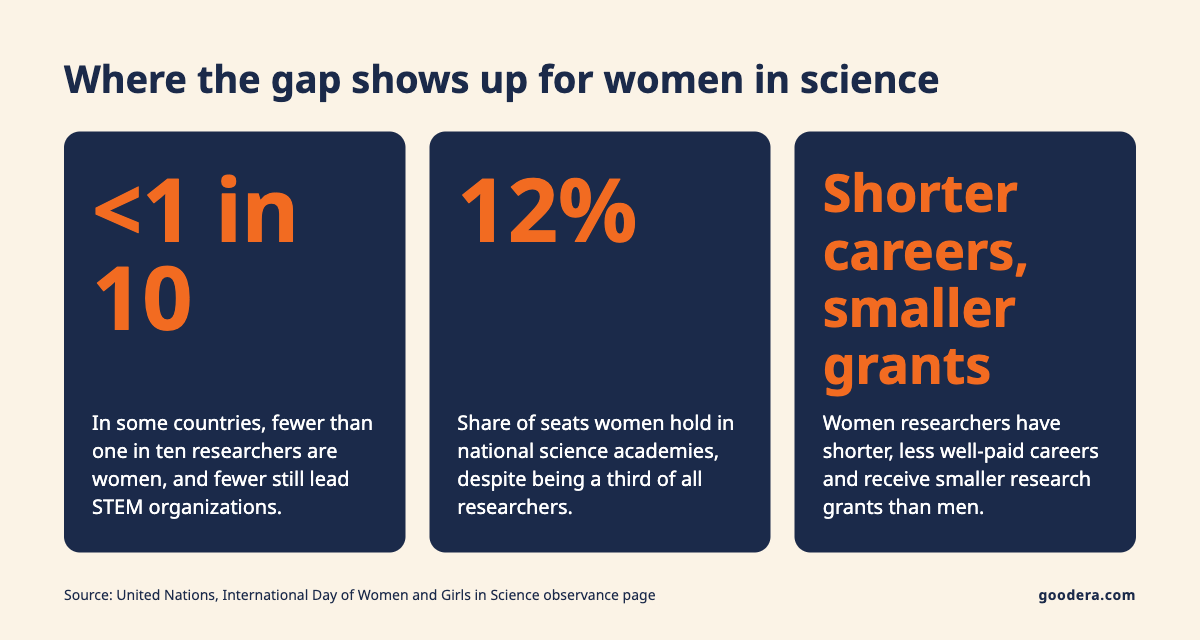
- In some countries, fewer than one in ten researchers are women, and fewer still lead STEM organizations.
- Women hold about 12% of seats in national science academies, despite being a third of researchers.
- Women researchers have shorter, less well-paid careers and get smaller grants than men.
Here is why the pattern matters for your plan. The gap does not sit at one spot on the path. It shows up in school, in degree choices, in hiring, in funding, in promotion. A school, a nonprofit, and a company can each fix a different link, and a company’s two strongest links are exposure for girls and support for women already in research.
Did You Know These Facts About Women in Science?
A few facts that work well as icebreakers for a career panel, discussion starters for a student session, or lines on a STEM career card.
- The day is younger than most people think. The UN proclaimed it on December 22, 2015, and the first observance ran in 2016, so a company starting now is still early.
- One scientist holds a record nobody has matched. Marie Curie is the only person to win Nobel Prizes in two different sciences: Physics in 1903 and Chemistry in 1911.
- The first computer program predates the computer. In 1843, Ada Lovelace published what is widely considered the first algorithm written for a machine, a century before the first electronic computers were built.
- Fewer than 30 women have ever won a Nobel Prize in physics, chemistry, or medicine. That is out of several hundred laureates since 1901, which is the gap in one sentence.
- Quantum is the newest frontier, and the gap is already there. The UN reports that fewer than 2% of applicants for jobs in the quantum sector are women, about one in 54.
- Some famous discoveries had a woman’s work inside them. Rosalind Franklin’s X-ray image of DNA, taken in 1952, was central to working out its structure. The 1962 Nobel Prize went to three men; she had died in 1958 and was never nominated.
Pick two or three for your event. Students remember a name and a story far longer than a percentage.
Why Does STEM Exposure Matter for Girls?
It matter because a career you have never seen up close does not feel like an option. A student can love math and still never picture herself as an engineer if she has never met one.
A twenty-minute conversation with a woman engineer changes that. So does a robotics session where the textbook diagram turns into something she built. So does a mentor who answers the questions a classroom never gets to.
Exposure will not close the whole gap on its own. It is, though, the part most companies can offer by next week, with people already on the payroll.
Our guide to STEM volunteer opportunities covers the formats that work for employee teams, from classroom sessions to coding and robotics workshops. And if you want a longer view for students, our guide to [women who have shaped science and innovation](URL needed: Women’s History Month Figures blog) gives them names to look up after the session ends.
How Can Companies Celebrate the International Day of Women and Girls in Science?
You do not need all seven ideas below. One, done well, is enough to start. Choose the idea that matches what your partner school or nonprofit needs, then check that your team has the skills to deliver it. Each one works for in-office, remote, or hybrid teams, and each one sets up the next, so a single February activity can grow into a program over the year.
Host a Women in STEM Career Panel
The simplest start, and the one with the biggest surprise factor. Invite women from engineering, medicine, data science, environmental science, research, and mathematics to speak to employees or to students from a partner school.
Skip the polished highlight reel. Ask them how they got in, what nearly pushed them out, what their Tuesday afternoon looks like, and what they would tell a 15-year-old who likes physics. The setbacks are what students remember.
Organize STEM Mentoring for Girls
A panel is a spark. Mentoring is what keeps it lit. Partner with a school or nonprofit to pair employees with girls around STEM subjects, career exploration, coding, science projects, or college readiness.
Our guide to volunteer opportunities for women covers STEM mentorship opportunities for girls alongside other ways employees can support women’s education. Goodera’s Women’s History Month catalog also has a mentoring activity where volunteers talk to young girls about STEM careers, which runs just as well in February.
Run a Hands-On STEM Volunteering Activity
Nobody remembers a lecture. Everyone remembers the thing they built. Organize employees around robotics, coding, engineering challenges, science experiments, environmental science, or problem-solving workshops.
Goodera’s Women’s History Month activities include packing STEM activity kits for underserved school girls, creating online safety guides for young girls, and recording audiobooks about women trailblazers. Any of them can move to February.
Volunteer Your Professional Skills
Not everyone on your team is a scientist, and that is fine. Nonprofits working with girls need designers, marketers, finance people, developers, and HR teams just as much.
Employees could help with curriculum development, a website rebuild, communications, data analysis, fundraising, or program design. Smaller nonprofits in particular need this kind of expertise and cannot hire for every project.
Our guide to skills-based volunteering benefits, examples, and best practices explains how to scope a project, and our list of Top 18 Education Nonprofits is a good place to find a partner.
Create STEM Career Cards or Learning Resources
This one scales. Ask employees, in the office or remote, to each write a short profile of a woman in a STEM career: her name, her field, what she works on, how she got started, one thing she wishes she had known at 15, and her advice for a student.
The finished set becomes a resource for a nonprofit, school, or youth program. Profiles can feature colleagues who volunteer, or women from history drawn from the figures guide above. Either way, a student ends up holding a stack of proof that people like her did this.
Support Women Researchers
Girls entering STEM are half the story. The other half is what happens when they become researchers, and the data says they get smaller grants and shorter careers.
Companies can support women in science through scholarships, research funding, mentorship, recognition programs, or partnerships with organizations that back women researchers. UNESCO’s For Women in Science program, run with L’Oréal since 1998, is one established model, recognizing women from early-career fellows to international laureates. Universities, scientific institutions, and foundations near you will have their own.
Make Women in Science Part of Your Year-Round Calendar
February 11 is the first of three dates, and the other two are close behind. International Women’s Day is March 8. Women’s History Month runs all of March.
Our guide to Women’s History Month workplace activities has ideas around STEM, career readiness, and digital literacy, and our International Women’s Day activities page lists formats for in-person and remote teams. Put all three on the calendar now, so the mentoring you start in February has somewhere to go in March.
How Do You Make a Women in Science Program Work for Students?
A STEM activity can be fun and still miss. Five questions, asked before you plan, keep it pointed at what students need rather than what looks good in a recap post.
- Who are we supporting? A middle-schooler exploring science and a university student heading into research need different things.
- What does the partner need? Ask the school or nonprofit first. Do not design an activity and then ask them to fit it.
- Can employees bring real expertise? Match the engineer to the engineering session, not to the registration desk.
- Can students see what comes next? One workshop sparks curiosity. Mentoring and ongoing contact show the path.
- What happens after the event? If February 11 lands well, plan now to make it recurring.
What Happens After February 11?
The day takes an afternoon. The gap it points to takes years. One well-run session, one partner, and a plan that carries into March will do more than a bigger one-off ever could.
Goodera’s VQ Report 2026 shows the difference a plan makes. Companies with volunteering fully embedded in their culture reach 70% employee participation. Companies running mostly ad hoc initiatives see 7.1%.
Paid time off helps too. 65% of companies now have a defined volunteer time off (VTO) policy, and those companies see 1.4x higher participation.
Here is a simple way to begin:
- Find your women in STEM. Ask employees in technical, research, and scientific roles whether they would speak on a panel or mentor a student. You will find more volunteers than you expect.
- Pick one partner. Choose a school or nonprofit working with girls and ask what they need before choosing an activity.
- Set the date and decide how you’ll track results. Book the week of February 8. Then decide what you will check afterward: employees who took part, students reached, and sign-ups for the March activities.
- Plan past the day. Put International Women’s Day and Women’s History Month on the calendar now.
Go back to that meeting-room count one more time. The way it changes is one student at a time, starting with the ones your team meets this February.
If you want help building the plan, our team works with 50K+ nonprofits across 100+ countries through Goodera’s CSR volunteering solutions. Our VTO policy guide and the VQ Report 2026 show what has worked for other companies.
Frequently Asked Questions
1. When Is International Day of Women and Girls in Science, and When Is the Next One?
The International Day of Women and Girls in Science is observed every year on February 11. The 2026 observance fell on a Wednesday. The next one is Thursday, February 11, 2027, so most employees will be at work and can take part during the day. Many companies run their activity in the week of February 8 and connect it to International Women’s Day on March 8 and Women’s History Month through March. Starting your plan by December leaves time to find speakers, book a school or nonprofit partner, and promote the event.
2. What Is Women in Science Day, and Is It the Same Observance?
Women in Science Day is a shorter name for the International Day of Women and Girls in Science, the United Nations (UN) observance held on February 11. “International Women and Girls in Science Day” is another common variant. All of them refer to the same day. The official UN name is the long form, so use it in formal communications and the short form internally where people already know the context.
3. What Is the International Day of Women and Girls in Science Theme for 2027?
The United Nations (UN) had not announced a 2027 theme at the time of writing. The UN observance page and the United Nations Educational, Scientific and Cultural Organization (UNESCO) page are where it appears first, usually in January, so check both before quoting a theme. The 2026 theme was “Synergizing AI, Social Science, STEM and Finance: Building Inclusive Futures for Women and Girls.” Your plan does not need to wait for the 2027 theme, since mentoring, career panels, and hands-on science activities fit any year.
4. Who Started International Women and Girls in Science Day?
The United Nations (UN) General Assembly started the day when it adopted Resolution 70/212 on December 22, 2015, declaring February 11 the International Day of Women and Girls in Science. The first observance took place in 2016. The United Nations Educational, Scientific and Cultural Organization (UNESCO) and UN Women lead the observance, with a yearly assembly at UN headquarters in New York and a program at UNESCO headquarters in Paris.
5. Why Are Women Still Underrepresented in Science?
The barriers appear at every stage rather than at one point. Girls meet fewer female role models and more gender stereotypes at school, women make up about 35% of science, technology, engineering, and mathematics (STEM) graduates, and the share drops again in research careers, where only one in three researchers is a woman. Women researchers also receive smaller grants and have shorter, less well-paid careers on average, and hold about 12% of seats in national science academies. The gap is widest in fast-growing fields such as artificial intelligence and cloud computing.
6. How Can Employees Take Part in Women in Science Day at Work?
Employees can speak on a women in science, technology, engineering, and mathematics (STEM) career panel, mentor a student through a partner school or nonprofit, or lead a hands-on activity such as a coding or robotics session. Those outside technical roles can contribute professional skills, such as designing learning materials, improving a nonprofit’s website, or helping with communications. Employees can also create career cards featuring women in STEM for a youth program. If the company offers paid volunteer time off (VTO), the week of February 11 is a good time to use it.
7. How Can Companies Support Women Already Working in Science?
Companies can fund scholarships and research grants, sponsor recognition programs, offer mentorship and career development to early-career researchers, and partner with organizations that back women in science. The United Nations Educational, Scientific and Cultural Organization (UNESCO) For Women in Science program, run with L’Oréal since 1998, is one established model. Companies can also look inward: reviewing hiring, promotion, and funding decisions in their own research and technical teams is often the most direct contribution they can make.
8. What Are Examples of Women and Girls in Science Activities for Teams?
Team activities include women in science, technology, engineering, and mathematics (STEM) career panels, student mentoring, coding and robotics workshops, science experiments, STEM kit packing for underserved schools, and creating career cards or learning guides. Virtual options work well for distributed teams, such as recording audiobooks about women in science or building online safety guides for girls. In-person options include classroom sessions and hands-on engineering challenges. The best choice starts with what your school or nonprofit partner says it needs.
9. Which UN Sustainable Development Goals Connect to Women in Science?
The United Nations (UN) ties the day most directly to Sustainable Development Goal (SDG) 5 (Gender Equality), since equal participation in science is part of that goal. It also connects to Goal 4 (Quality Education), Goal 8 (Decent Work and Economic Growth), Goal 9 (Industry, Innovation, and Infrastructure), and Goal 10 (Reduced Inequalities). The UN’s 2026 theme framed science and technology as drivers of all three pillars of sustainable development: economic, social, and environmental. That makes the day a useful hook for companies that already report against the SDGs in their corporate social responsibility (CSR) or environmental, social, and governance (ESG) work.
10. Is International Day of Women and Girls in Science a Public Holiday?
No, the International Day of Women and Girls in Science is a United Nations (UN) observance, not a public holiday, so workplaces stay open and schools run as usual. That makes it easy for companies to mark the day during working hours with a career panel, a mentoring session, or a volunteering activity with a partner school. Some companies add paid volunteer time off (VTO) for the occasion. Whatever you choose, announce it early so employees can plan around it.