Empowering Communities through Skill-Based Volunteering

Imagine using your professional expertise in design, marketing, HR, or technology to help a nonprofit amplify its mission. That’s the essence of skills-based volunteering, a movement redefining how individuals and companies contribute to society.
Unlike traditional volunteering, which often focuses on manual or event-based tasks, skills-based volunteering (SBV) leverages your unique professional talents to solve real challenges faced by nonprofits and community organizations. Whether it’s designing a marketing campaign, conducting financial planning workshops, or providing tech training, it’s about giving what you’re best at, your skills, insights, and experience, to make a lasting difference.
Did you know? According to CECP’s Giving in Numbers Report (2024), over 70% of Fortune 500 companies now include skills-based volunteering as part of their CSR strategies, a clear sign that businesses see it as more than charity; it’s a strategic investment in both talent and community growth.
Insights from Goodera’s webinar, Skills-Based Volunteering: A New Era of Employee Development, echo this trend. Leaders from PayPal and Atlassian shared how aligning employee expertise with nonprofit needs has transformed workforce development and community impact. Programs like PayPal’s Small Business Digital Accelerator empower employees to mentor entrepreneurs while honing leadership and communication skills, a win for both the volunteer and the community.
Today, forward-thinking organizations are embracing corporate volunteering and virtual volunteer opportunities not merely as goodwill gestures but as catalysts for stronger corporate community engagement, deeper employee connection, and purpose-driven brand loyalty.
What is Skills-Based Volunteering?
Skills-based volunteering is when professionals use their job-related expertise, in fields such as finance, strategy, technology, communication, or design, to help nonprofits and community organizations achieve long-term impact. Unlike traditional volunteering, this approach focuses on knowledge transfer and sustainable growth rather than one-time assistance.
For example:
- A marketing manager could design a nonprofit’s digital campaign strategy.
- A financial analyst might create a simple budgeting or forecasting tool.
- An HR professional could develop a recruitment or onboarding framework for a social enterprise.
Did you know? A Taproot Foundation study found that every hour of pro bono service through skills-based volunteering can deliver up to $150 in value to nonprofits, significantly amplifying their operational efficiency and community reach.
Insights from Goodera’s Skills-Based Volunteering: A New Era of Employee Development webinar reinforce this. Speakers from Atlassian and PayPal noted that structured corporate volunteering programs centered on professional skills not only enhance nonprofit capacity but also boost employee satisfaction and leadership growth. Atlassian, for instance, aligns its SBV programs with its company value “Be the change you seek,” ensuring employees’ professional strengths directly fuel social progress.
By emphasizing sustainability, scalability, and measurable outcomes, skills-based volunteer opportunities help nonprofits continue thriving long after a project ends, creating impact that lasts well beyond the volunteer engagement itself.
Why is Skills-Based Volunteering Important for Companies?
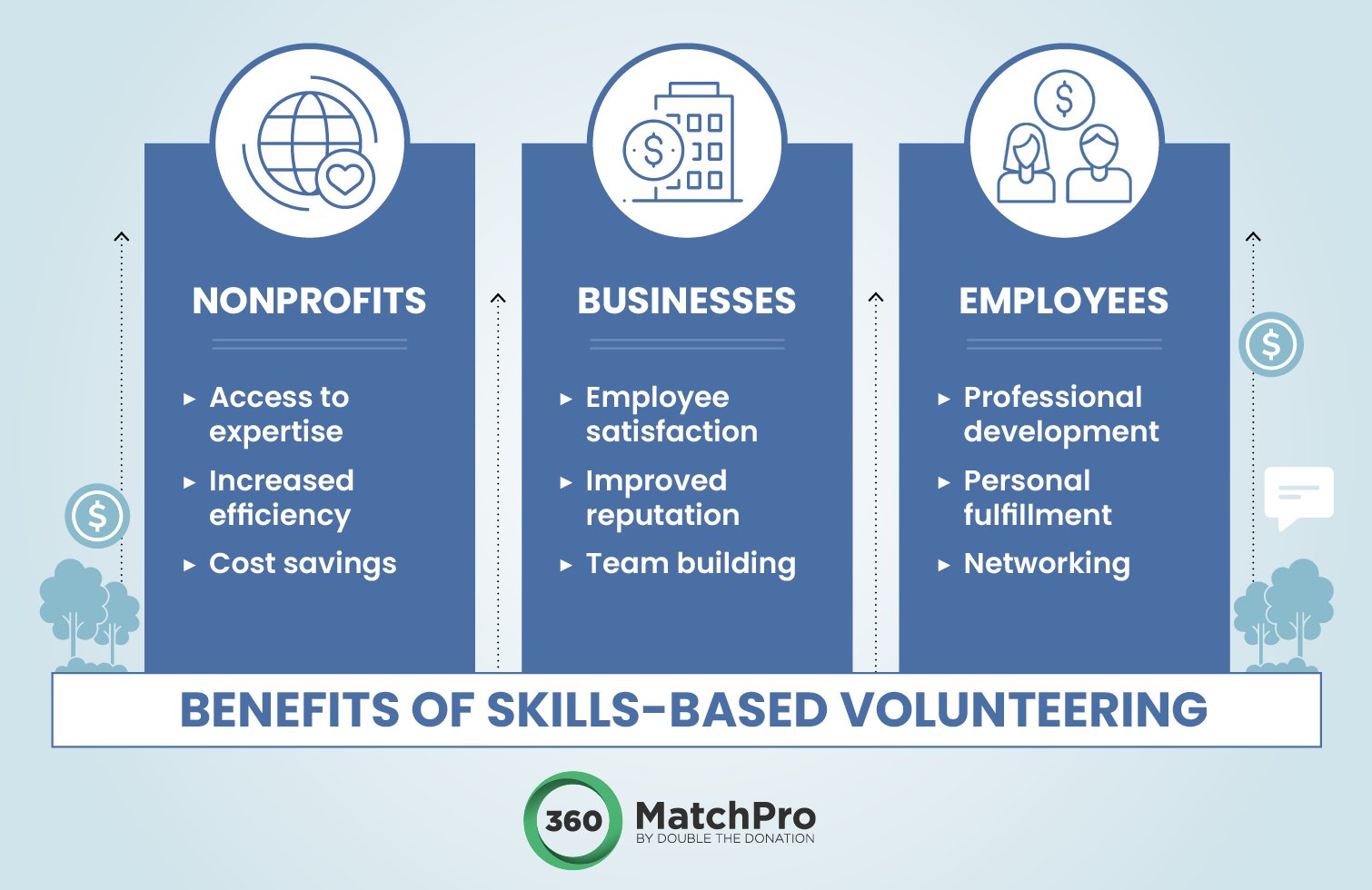
By aligning with broader corporate community engagement and CSR (Corporate Social Responsibility) goals, skills-based volunteering helps companies build meaningful relationships with the communities they operate in. Employees lend their knowledge and experience to nonprofits, and in return, companies see tangible improvements in engagement, retention, and brand loyalty.
Here’s a closer look at why it matters:
1. Deeper Employee Engagement and Satisfaction
When employees contribute their professional strengths to causes they care about, they develop a stronger emotional connection to their work. Skills-based volunteering allows individuals to see the real-world impact of their contributions, whether it’s helping a nonprofit streamline its finances or mentoring students online.
According to Goodera’s Empowering ERGs webinar, employee resource groups that participate in structured volunteering programs report 30% higher engagement compared to those that don’t. This emotional fulfillment translates directly into increased motivation and productivity.
2. Enhanced Employer Brand and Reputation
Today’s workforce, particularly Gen Z and millennials, is drawn to organizations that stand for something meaningful. A company known for robust corporate volunteering programs positions itself as socially responsible and future-focused. This not only attracts top talent but also builds customer trust. A Cone Communications study found that 78% of consumers are more likely to buy from a purpose-driven brand. By weaving volunteering into brand storytelling, companies differentiate themselves in both the talent and consumer markets.
3. Skill Growth and Leadership Development
Volunteering outside the office environment challenges employees to solve problems creatively, adapt to new settings, and collaborate with diverse teams. For example, a project manager volunteering with a nonprofit learns stakeholder management in resource-constrained environments, a skill that translates powerfully back to the workplace. Insights from Goodera’s Skills-Based Volunteering: A New Era of Employee Development webinar show that employees participating in SBV programs report faster leadership development and improved cross-functional collaboration.
4. Stronger Ties with Local and Global Communities
Skills-based volunteering builds authentic, lasting partnerships between companies and communities. It’s not just about donating hours; it’s about co-creating solutions that drive change. Whether through virtual volunteer opportunities or on-ground projects, these engagements enhance a company’s social license to operate and reinforce its global citizenship values.
Did you know? According to CECP’s 2024 report, 84% of global companies now integrate volunteering into their core business and social strategies. This growing trend highlights how purpose-driven engagement has become essential for talent retention and organizational resilience.
Insights from Goodera’s C-Suite and Engagement: Mobilizing Senior Leaders for Social Impact webinar support this shift. Senior leaders from PayPal and Dropbox noted that when executives actively participate in skills-based volunteer opportunities, employee participation rates increase by nearly 40%, proving that impact starts from the top.
Ultimately, skills-based volunteering is not just an altruistic endeavor; it’s a business strategy that aligns purpose with performance. By empowering employees to use their expertise for good, companies foster deeper loyalty, stronger communities, and a workplace culture built on empathy, innovation, and shared growth.
7 Benefits of Skills-Based Volunteering
Skills-based volunteering is transforming how professionals and businesses contribute to social good. Rather than just giving time, employees give expertise, helping nonprofits strengthen their systems, scale impact, and build lasting capacity. It’s a powerful blend of purpose, performance, and partnership.
Here are seven powerful benefits of skills-based volunteer opportunities that show why this model is gaining traction across leading companies worldwide.
1. Amplifies Impact
Skills-based volunteering allows employees to create long-term, sustainable impact for nonprofits. When professionals apply their specialized knowledge, whether in IT, design, strategy, or finance, nonprofits receive targeted solutions that directly strengthen their operations.
For example, a data analyst might automate a charity’s reporting system, or a marketing team could develop a campaign that doubles donor engagement. These aren’t one-off contributions; they create systems that continue to deliver value long after the volunteer has stepped away.
Did you know? According to True Impact, 85% of nonprofits said that skills-based volunteers helped them increase their organizational capacity and long-term effectiveness. This shows that applying professional skills doesn’t just help communities; it builds stronger, more resilient nonprofits.
2. Strengthens Employee Engagement
Engaged employees are the heart of a thriving organization. When people use their skills for a cause they believe in, they feel connected to something bigger than their job. Corporate volunteering offers that sense of purpose; it’s a way for employees to see tangible outcomes of their expertise while bonding with colleagues over shared values.
Employees who participate in structured volunteering programs are more motivated, collaborative, and loyal. A Volunteerism Impact Study found that 89% of employees believe companies with robust volunteering programs have a more positive work culture.
3. Encourages Personal Growth
Volunteering builds not only communities, but people. When employees step outside their professional comfort zones, they grow in confidence, adaptability, and empathy. Working with nonprofits challenges them to apply their skills in unfamiliar settings, often with limited resources and diverse teams, making them better problem-solvers and communicators.
Did you know? The Boston College Center for Corporate Citizenship found that 89% of employees who engage in skills-based volunteering reported improved social awareness and emotional intelligence. These qualities are essential for leadership and collaboration, especially in diverse, global organizations.
By fostering empathy and perspective, companies also cultivate future-ready leaders who can navigate complexity with compassion and clarity.
4. Broadens Perspective
When employees work in communities outside their typical environment, they gain a deeper understanding of social challenges, from education gaps to environmental sustainability. This expanded worldview helps them approach their work with greater empathy and creativity.
Imagine a finance professional helping a small nonprofit manage grants and, in the process, learning how resource scarcity drives innovation. That kind of insight can reshape how they approach efficiency and decision-making at work.
According to the IBM Corporate Service Corps Report, 84% of employees who engaged in global volunteering reported a “broader understanding of cultural and social issues,” improving collaboration across teams and geographies.
This exposure builds not just better professionals, but more conscious global citizens.
5. Accelerates Professional Development
Skills-based volunteering doubles as a real-world learning lab. Employees gain practical experience that sharpens leadership, strategic thinking, and problem-solving skills, all while serving meaningful causes.
Leading organizations like Salesforce and Unilever integrate volunteering into professional development programs, allowing employees to apply their expertise in new, impact-driven contexts. The result? More confident, agile, and purpose-oriented leaders.
Salesforce integrates volunteering through its famous 1-1-1 model, dedicating 1% of its equity, products, and employee time to social causes. Every employee gets 56 hours of paid volunteer time off to work on causes they care about. The company also promotes skills-based volunteering, where employees use their professional expertise, like marketing, coding, or data analysis, to support nonprofits. Programs such as the Philanthropy Cloud and Volunteer Time Off (VTO) help employees connect their skills to real impact, while recognition systems make volunteering part of performance and culture.
Unilever takes a similar approach through initiatives like the Unilever Future Leaders Programme (UFLP) and its Sustainable Living Plan. Employees participate in projects tied to sustainability and community well-being, such as hygiene awareness campaigns or mentoring local entrepreneurs. Many of these are built into training programs, blending professional growth with hands-on social experience.
According to CECP’s Giving in Numbers 2024, companies that embed volunteering into learning and development initiatives see up to 25% faster leadership growth. For employees, it’s a chance to showcase initiative and innovation, both critical career accelerators.
6. Delivers a Deep Sense of Fulfillment
At its core, skills-based volunteering satisfies a fundamental human desire: the need to make a difference. Employees who see the direct impact of their skills on a nonprofit’s success report higher happiness and well-being.
Goodera’s Season of Giving webinar highlighted this beautifully, showing how year-round volunteering programs help sustain joy, gratitude, and meaning among employees long after the holidays.
When people find purpose in what they do, their energy and creativity multiply, benefiting everyone around them.
7. Strengthens Corporate Reputation
In an era where consumers and employees value authenticity, corporate community engagement is no longer optional; it’s expected. Companies that actively invest in social causes earn stronger trust, brand loyalty, and media visibility.
Did you know? According to Cone Communications, 78% of consumers prefer to buy from companies that invest in social impact initiatives. Moreover, the Edelman Trust Barometer found that 64% of global employees consider a company’s societal contribution a key factor in choosing where to work.
A well-structured volunteering strategy demonstrates a company’s values in action, not just on paper. It shows customers, partners, and employees that the organization is committed to being a force for good.
Skills-based volunteering is the intersection of passion, purpose, and professional excellence. It helps employees grow while making a measurable impact in communities, and helps companies align business success with social responsibility. Through corporate volunteering and virtual volunteer opportunities, organizations can build stronger cultures, inspire innovation, and create shared value for all. Ultimately, when businesses harness their employees’ skills for good, they unlock something powerful, a ripple effect of empathy, growth, and impact that transforms both people and the planet. So, to all corporate changemakers: your expertise is your superpower. Use it to uplift communities, drive progress, and redefine what it means to succeed with purpose.
What Are Some Popular Skills-Based Volunteer Opportunities?
Skills-based volunteering gives professionals the chance to use their expertise, not just their time, to drive meaningful change. Unlike traditional volunteering, which often involves physical or event-based tasks, these opportunities allow employees to directly apply their talents to strengthen nonprofit capacity, improve systems, and accelerate growth.
Here are some of the most popular and high-impact categories of skills-based volunteering that companies can offer, both onsite and through virtual volunteer opportunities.
1. Marketing & Communications
Strong storytelling can make or break a nonprofit’s visibility and fundraising success. Professionals in marketing, PR, or communications can help nonprofits amplify their reach and connect with audiences more effectively.
Volunteers might:
- Develop digital marketing strategies to attract donors or volunteers.
- Conduct social media training for nonprofit staff to improve online engagement.
- Design awareness campaigns for fundraising or advocacy efforts.
- Revamp a nonprofit’s branding and messaging to better reflect its mission.
For example, a volunteer from a global ad agency could design a low-cost, high-impact social media campaign that helps an animal welfare nonprofit double its online donations. These projects not only strengthen the nonprofit’s external communication but also boost volunteer morale; they see their creativity directly fueling real-world change.
When done right, marketing-based volunteering turns ideas into impact stories that resonate, inspire, and mobilize communities.
2. IT & Data
Technology is one of the most powerful enablers of impact, and skilled IT volunteers are in high demand among nonprofits. Many social organizations struggle with digital transformation due to budget and expertise gaps; this is where skills-based volunteering can make an enormous difference.
Volunteers in IT, software engineering, or data analytics might:
- Build or redesign nonprofit websites to improve accessibility and donor engagement.
- Create databases or CRM systems to track beneficiaries and volunteers.
- Develop dashboards for monitoring social impact metrics in real time.
- Conduct cybersecurity audits to protect sensitive donor and beneficiary data.
Did you know? According to TechSoup Global Network, nonprofits that integrate skilled technology volunteers see up to 40% higher operational efficiency and stronger fundraising results.
For example, a team of volunteer data scientists could create a dashboard that helps a food bank optimize distribution routes, saving time, money, and resources. These technology-driven contributions bring long-term sustainability to nonprofit operations, making IT volunteering one of the most transformative areas of corporate engagement.
3. Finance & Strategy
Financial planning and strategic thinking are critical for nonprofit growth, yet many small organizations lack access to this level of expertise. Professionals in finance, management consulting, or business analytics can bridge that gap through skills-based volunteer opportunities.
Volunteers might:
- Offer pro bono consulting to streamline budgeting and accounting processes.
- Build forecasting models to help nonprofits make data-backed decisions.
- Train nonprofit leaders in financial literacy and long-term planning.
- Conduct performance audits to identify inefficiencies and cost-saving opportunities.
For instance, an employee from a consulting firm might help a youth nonprofit design a three-year strategic plan that aligns resources with measurable goals. Such contributions don’t just fix short-term issues; they empower nonprofits to scale their operations and sustain their missions long after the volunteering project ends.
When finance and strategy professionals step in, they create ripple effects of clarity, stability, and confidence across entire organizations.
4. HR & Leadership Development
People are the heart of every organization, and for nonprofits, nurturing talent is often a challenge. HR professionals and leadership coaches can help nonprofits create systems that empower staff, volunteers, and beneficiaries alike.
Volunteers might:
- Conduct workshops on effective leadership and team management.
- Develop HR frameworks for recruitment, onboarding, or retention.
- Lead sessions on diversity, equity, and inclusion (DEI).
- Mentor nonprofit leaders to build resilient, purpose-driven teams.
For example, an HR team from a global tech company could collaborate with a nonprofit to design a mentorship program for women in leadership. The result? Stronger talent pipelines, empowered employees, and better community representation.
This area of corporate volunteering is powerful because it doesn’t just deliver immediate results; it builds the human infrastructure that drives sustained impact.
5. Creative Design
Design is how nonprofits tell their stories visually, and creative professionals can help them do that with clarity and emotion. Graphic designers, illustrators, photographers, and videographers bring a unique edge to skills-based volunteering, turning data and mission statements into compelling visuals that move people to action.
Volunteers might:
- Design logos, brochures, or educational materials for nonprofits.
- Create infographics to simplify impact data for donors and stakeholders.
- Produce short videos that document success stories and inspire giving.
- Build visual toolkits to help organizations maintain consistent branding.
Imagine a volunteer team creating an animated explainer video that helps a healthcare nonprofit secure new funding. These creative outputs elevate nonprofits’ ability to connect with supporters and scale their advocacy.
Design-driven volunteering reminds us that sometimes, the most powerful form of giving back is helping others tell their story beautifully.
6. Education & Training
One of the fastest-growing areas in corporate community engagement is education-based volunteering, where professionals teach what they know to uplift others. From teaching coding to mentoring entrepreneurs, employees can directly transfer knowledge that opens doors for underserved communities.
Volunteers might:
- Teach digital literacy to youth or senior citizens.
- Conduct financial planning sessions for low-income families.
- Offer resume-building or job-readiness workshops for job seekers.
- Provide business mentoring to social entrepreneurs or nonprofits.
For example, a group of accountants could teach small NGOs how to maintain transparent financial records, improving their credibility with donors and grantmakers.
These learning-based initiatives empower communities to become more self-sufficient, while employees experience the satisfaction of watching their expertise spark transformation.

7. Project Management & Operations
Efficient project management is critical for any organization’s success. Volunteers with skills in operations, logistics, or project management can help nonprofits execute their programs more effectively.
Volunteers might:
- Create workflows or standard operating procedures (SOPs).
- Develop tracking systems to monitor project timelines and outcomes.
- Train nonprofit teams in agile or lean management practices.
- Help improve supply chain and logistics for programs like food distribution or disaster relief.
For example, a project manager from a logistics company could help a disaster relief nonprofit streamline its resource allocation process, reducing delivery times by 30%.
This kind of structured volunteering creates order out of chaos, helping nonprofits function with the same operational excellence as world-class corporations.
How Can Companies Launch a Skills-Based Volunteering Program?
Launching a successful skills-based volunteering (SBV) program takes more than enthusiasm; it requires structure, clarity, and consistent alignment between corporate goals and community needs. The best SBV programs blend empathy with strategy, creating opportunities that are meaningful for employees and impactful for nonprofits.
Here’s how your organization can get started:
1. Identify Community Needs
The first step is understanding where your expertise is needed most. Instead of deciding internally which causes to support, engage directly with nonprofits to learn about their priorities and challenges. Many nonprofits struggle with capacity issues, not passion or purpose. They may need a communications expert to improve outreach, a data analyst to streamline reporting, or a strategist to strengthen long-term planning.
When companies collaborate with nonprofits early in the process, they build mutual trust and ensure that volunteering efforts produce real, measurable change. For example, a software company might partner with an education nonprofit to create digital tools that help teachers track student progress, a project that could benefit thousands.
Tip: Conduct “needs assessments” or listening sessions with partner organizations. This approach ensures volunteering is rooted in genuine community requirements rather than corporate assumptions.
2. Map Employee Skills and Interests
Once community needs are identified, the next step is matching them with internal capabilities. Every workforce holds a wealth of diverse expertise, from marketing and IT to project management and leadership development. Conduct surveys or skill-mapping workshops to understand where employees want to contribute.
This mapping not only helps nonprofits get the right kind of help but also boosts employee engagement. Companies that match volunteer projects to employees’ professional skills experience 67% higher participation rates.
Example: A financial services firm discovered that 40% of its employees wanted to mentor youth on financial literacy. The company then partnered with nonprofits to launch virtual mentorship programs, combining business acumen with social purpose.
By aligning skills with causes, you make volunteering both meaningful and effective, ensuring long-term participation.
3. Offer Flexible Formats
Flexibility is key to inclusivity. To make your program accessible to everyone, offer both onsite and virtual volunteer opportunities.
- On-site volunteering: Employees work directly with nonprofits, such as mentoring, conducting workshops, or leading community events. These in-person experiences foster team bonding and provide a tangible sense of impact.
- Virtual volunteering: Enables employees to contribute remotely, from creating marketing materials to providing pro bono consulting or hosting online skill-building sessions.
Did you know? According to a VolunteerMatch survey (2023), 65% of corporate volunteers prefer virtual opportunities due to convenience and flexibility. By offering hybrid options, you make it easier for remote workers, parents, and global teams to get involved.
When employees can choose how and where they give back, participation increases, and so does the program’s reach.
4. Recognize and Reward Volunteers
Recognition is a vital part of sustaining any corporate volunteering culture. Employees who feel appreciated for their contributions are far more likely to stay engaged and encourage others to join.
Organizations can recognize volunteers in many ways, featuring them in company newsletters, offering “Volunteer of the Month” awards, or celebrating achievements during all-hands meetings. Some companies even provide small grants or donation credits to nonprofits chosen by active volunteers.
Pro Tip: Pair recognition with storytelling. Share impact stories, such as how an employee’s mentorship led a student to college, to humanize the data and inspire future participation.

5. Measure and Communicate Impact
To sustain leadership buy-in and continuous improvement, you need to measure both the social and business outcomes of your skills-based volunteer opportunities. Track participation metrics (hours, employees involved), social metrics (number of nonprofits supported, people helped), and emotional metrics (employee satisfaction, community testimonials).
Quantitative data shows scale, but stories show soul. Combining both creates a holistic narrative that resonates with executives and employees alike. For instance, pairing “5,000 volunteer hours donated” with “mentorship programs that helped 200 students find jobs” lends meaning to the numbers.
Did you know? The Deloitte Volunteer Impact Survey found that 77% of companies measuring impact are better able to align CSR investments with core business objectives.
Pro Tip: Platforms like Goodera simplify every stage, from discovering vetted nonprofits to tracking measurable outcomes, helping companies turn purpose into progress with ease.
How Does Virtual Volunteering Expand Skills-Based Volunteering?
The digital era has unlocked a new dimension of skills-based volunteering, one where impact is no longer limited by geography. With the rise of digital collaboration tools, professionals can now use their expertise to support nonprofits across the world without ever leaving their homes or offices.
Virtual volunteering combines the power of technology with the passion for social good. It allows employees to lend their skills, from marketing and design to mentoring and IT support, through virtual volunteer opportunities that are flexible, inclusive, and highly scalable.
1. Breaking Barriers with Technology
Virtual volunteering breaks down the physical and logistical barriers that once restricted employee participation. Professionals can now share their expertise with nonprofits anytime, anywhere, whether it’s a designer in Seattle helping a youth nonprofit in Nairobi rebrand, or an HR specialist in New York leading a global diversity workshop online.
This digital model allows companies to create global networks of impact, connecting employees with causes aligned to their interests and values. It’s especially powerful for organizations with distributed or remote workforces.
TechSoup’s Global Nonprofit Trends Report (2024), reflects that over 70% of nonprofits worldwide now rely on virtual skilled volunteers to support digital transformation, data management, and marketing needs. This shift reflects how online collaboration has become essential to modern social impact.
2. Making Skills Go Further
Virtual skills-based volunteer opportunities amplify efficiency and scale. Instead of being limited by location or time zones, employees can collaborate asynchronously, reviewing materials, hosting webinars, or offering pro bono consulting sessions via video calls.
This approach also ensures that no valuable expertise goes unused. Employees with niche skills, such as UX design, cybersecurity, or data visualization, can now find global nonprofits that need exactly those abilities.
For example:
- A software engineer can help a climate nonprofit automate carbon tracking tools.
- A communications manager can train NGOs in online storytelling strategies.
- A data analyst can set up dashboards to measure the social return on investment (SROI) for a global education program.
These digital collaborations enable nonprofits to operate more effectively while allowing employees to expand their professional experience in cross-cultural contexts.
3. Driving Business and Social Impact Simultaneously
Virtual volunteering delivers measurable benefits not just for nonprofits, but also for corporations. It fosters employee volunteering at scale, enhances brand reputation, and embeds a sense of purpose into hybrid work environments.
Employees who engage virtually report higher satisfaction, improved collaboration skills, and increased loyalty. For businesses, this means higher retention and stronger morale, especially in remote-first organizations.
Pro Tip: Encourage teams to integrate volunteering into existing digital workflows, such as dedicating one day each quarter to virtual pro bono projects. Tools like Goodera help companies curate opportunities, manage participation, and measure global impact, making the process seamless and rewarding.
Virtual volunteering proves that distance doesn’t diminish impact, it expands it. When professionals share their expertise across borders, they turn the internet into a global classroom for empathy, learning, and change.
👉 Download “The Big Book of Virtual Volunteering” to explore creative, impactful ways to engage employees online.

How Does Skills-Based Volunteering Strengthen Corporate Community Engagement?
At its core, corporate community engagement is about building meaningful, lasting partnerships between businesses and the communities they serve. While donations and sponsorships have long been part of CSR, skills-based volunteering takes engagement to a deeper level, creating relationships rooted in collaboration, capacity building, and shared growth.
Instead of focusing on one-time contributions, SBV transforms companies into strategic allies for nonprofits. By providing professional expertise in finance, HR, IT, or communication, corporations help strengthen community organizations from within, empowering them to become self-sufficient and sustainable.
1. From Giving Back to Building Forward
Traditional volunteering often focuses on immediate impact, planting trees, serving meals, or hosting events. While valuable, these activities typically address short-term needs. Skills-based volunteering, on the other hand, creates long-term value by equipping nonprofits with the tools and knowledge to solve complex problems independently.
For example, a company might help a nonprofit build a donor management system or develop a multi-year business strategy. These contributions have lasting effects, helping nonprofits scale their operations, improve efficiency, and ultimately serve more beneficiaries.
In this way, corporate volunteering evolves from a charitable act to a partnership model, one that invests in the future of communities, not just their present needs.
2. Empathy as the Bridge Between Business and Community
Skills-based volunteer opportunities also humanize the corporate world. When employees work closely with nonprofits, they see the real impact of their work, the students gaining access to education, the families receiving healthcare, the communities thriving through empowerment.
This exposure fosters empathy, cultural understanding, and humility. Employees return to their jobs with renewed motivation and perspective, often becoming stronger leaders and collaborators.
A Boston College Center for Corporate Citizenship study found that 88% of employees who participated in SBV reported improved teamwork and communication skills, thanks to the empathy and perspective gained from volunteering.
This shared understanding between corporations and communities transforms volunteering into a two-way street, both sides grow, learn, and evolve.
3. Leadership as the Catalyst for Engagement
For SBV to truly strengthen community engagement, leadership involvement is key. When senior executives champion volunteering, it signals that social responsibility is embedded in company culture.
In Goodera’s C-Suite and Engagement: Mobilizing Senior Leaders for Social Impact webinar, executives from PayPal and Ford shared that their direct participation in corporate volunteering initiatives increased overall employee engagement by nearly 40%. Leadership participation not only boosts numbers, it legitimizes purpose-driven work as part of professional success.
Pro Tip: Encourage leaders to share their volunteering experiences internally. When employees see executives dedicating time to causes, they’re more likely to follow suit, creating a ripple effect of empathy-driven engagement across all levels.
4. From CSR Initiative to Shared Legacy
When done well, skills-based volunteering shifts corporate community engagement from a compliance-driven CSR initiative to a legacy-building partnership. It turns impact into a shared narrative, one that both employees and nonprofits can own with pride.
This approach also deepens community trust. When companies consistently contribute knowledge and resources rather than just funds, they become embedded partners in societal progress. Communities no longer see corporations as outsiders but as collaborators driving long-term change.
Did you know? According to CECP’s Global Impact Report (2024), companies that prioritize community partnerships over one-time giving see 30% higher public trust scores and significantly greater employee loyalty.
5. The Future of Community Engagement
As workplaces evolve and social expectations shift, corporate volunteering will continue to redefine how businesses engage with communities. The future lies in collaboration, in empowering local leaders, sharing expertise, and co-creating sustainable impact.
Skills-based volunteering is the model that bridges this future. It proves that business success and social progress are not separate goals; they are intertwined outcomes of a purpose-driven strategy.
When companies invest their talent, not just their capital, they move from corporate citizen to community partner. And that’s how real, lasting change happens, not through one act of giving, but through an ongoing commitment to build better together.
Real-World Examples of Skills-Based Volunteering
The true power of skills-based volunteering is best understood through the companies that have made it part of their DNA. Across industries, global organizations are proving that when employees use their expertise to solve community challenges, the results are transformative, for both business and society.
Here are three standout examples of corporate volunteering done right:
1. Deloitte’s Impact Day, Empowering Change Through Expertise
Every year, Deloitte dedicates an entire day, known as Impact Day, to putting professional skills into action for good. Thousands of employees around the world step away from their desks to provide consulting, digital transformation, and marketing support to nonprofit organizations.
From helping small nonprofits develop financial planning models to assisting educational organizations with digital outreach, Deloitte’s employees apply their skills based volunteer opportunities to create lasting social change. These projects go beyond one-time service, they strengthen nonprofit operations and equip leaders with the tools to sustain growth.
Deloitte’s model demonstrates how structured, purpose-driven employee volunteering can unite global teams while amplifying community impact.
2. IBM’s Corporate Service Corps, Technology for Global Good
IBM’s Corporate Service Corps (CSC) is one of the world’s most celebrated examples of skills-based volunteering at scale. The program sends multi-disciplinary teams of IBM professionals to developing countries to work alongside local governments, businesses, and NGOs. Their goal? To co-create tech-driven solutions to pressing social and environmental challenges.
Whether it’s improving water management systems in Africa, designing digital infrastructure for education programs in Latin America, or developing mobile health platforms in Asia, IBM’s corporate volunteering efforts emphasize collaboration and sustainable capacity building.
Since its inception, the CSC has engaged over 4,000 employees across 40 countries, contributing millions of hours of pro bono consulting to drive community development. The program not only enhances global social impact but also fosters leadership and cross-cultural empathy among IBM employees.
This is corporate community engagement at its finest, empowering local communities through innovation while nurturing globally conscious professionals.
3. Goodera’s Skill Connect Programs, Bridging Purpose and Professionalism
Through its Skill Connect Programs, Goodera provides companies with seamless access to skills-based volunteer opportunities that align employee expertise with nonprofit needs. From mentoring women entrepreneurs to digitizing NGOs or hosting online training workshops, these programs make volunteering efficient, measurable, and meaningful.
For instance, in a recent project, Goodera partnered with a global tech firm to train underprivileged students in coding and digital literacy. The result was not only improved employability for participants but also stronger engagement among employees who reported feeling a renewed sense of purpose.
Virtual volunteer opportunities under Goodera’s platform have enabled companies to engage global teams at scale, offering flexibility and inclusion while maintaining deep impact. With built-in tools to measure social outcomes, companies can track both the reach and results of their volunteering initiatives, ensuring accountability and transparency.
Goodera’s programs showcase how technology and empathy can intersect to make corporate community engagement more scalable and results-oriented.
Conclusion: Turning Skills into Sustainable Impact
Skills-based volunteering is redefining what it means for companies to create change, shifting the focus from giving back to building forward. When organizations invest their employees’ expertise into solving real-world challenges, they do more than strengthen nonprofits; they nurture purpose-driven professionals and resilient communities. Through corporate volunteering initiatives, both onsite and virtual volunteer opportunities, businesses are proving that social impact and business success can thrive together.
In an era where communities need innovation as much as compassion, skills-based volunteer opportunities serve as a bridge, connecting knowledge with need, passion with purpose, and talent with transformation. By embedding corporate community engagement into everyday work culture, companies aren’t just empowering others; they’re inspiring a global movement of changemakers who believe that doing good and doing well are two sides of the same mission.
So, as the future of work and impact continues to evolve, one thing remains clear: the greatest contribution any organization can make isn’t just what it gives, but how it shares what it knows. Your team’s skills are your superpower, and the world is waiting for you to use them.
Turn your professional skills into real impact. Volunteer with Goodera

Frequently Asked Questions About Skills-Based Volunteering
1. What is skills-based volunteering, and how is it different from traditional volunteering?
Skills-based volunteering (SBV) involves professionals using their job-related expertise, such as finance, marketing, HR, or technology, to help nonprofits strengthen their operations and achieve long-term goals.
Unlike traditional volunteering, which often focuses on manual or short-term tasks like event organization or community cleanups, SBV emphasizes knowledge transfer and capacity building. For instance, an HR specialist might design a recruitment strategy for a nonprofit, or an IT expert could automate donor management systems. This creates sustainable, measurable impact that extends far beyond a single event.
Did you know? According to the Taproot Foundation, every hour of pro bono skilled volunteering can deliver up to $150 in value for nonprofits, making it one of the most impactful forms of corporate support.
2. Why should companies invest in skills-based volunteering programs?
For forward-thinking organizations, corporate volunteering is no longer a “nice-to-have”, it’s a strategic imperative. Skills-based volunteering enhances employee engagement, builds leadership capabilities, and strengthens company culture by aligning business purpose with community needs.
Employees who engage in SBV report higher motivation, stronger collaboration, and deeper loyalty. From a business perspective, these programs also improve employer branding, customer trust, and community credibility. A Deloitte Global Human Capital Trends study found that companies with robust volunteering programs enjoy 57% higher retention rates than those without.
By integrating skills-based volunteer opportunities into core CSR and HR strategies, companies transform purpose into performance, driving social impact and business growth in tandem.
3. What are some examples of skills-based volunteer opportunities?
Skills-based volunteering can take many forms, onsite, hybrid, or virtual volunteer opportunities. Some of the most common categories include:
- Marketing & Communications: Designing awareness campaigns or improving nonprofit branding.
- IT & Data: Building websites, CRMs, or data dashboards for impact measurement.
- Finance & Strategy: Offering pro bono consulting or creating budgeting tools.
- HR & Leadership: Conducting mentorship programs, DEI workshops, or leadership training.
- Education & Training: Teaching digital skills, financial literacy, or entrepreneurship to underserved groups.
Leading examples include Deloitte’s Impact Day, IBM’s Corporate Service Corps, and Goodera’s Skill Connect Programs, all of which demonstrate how structured SBV initiatives create tangible community and business outcomes.
4. How does virtual volunteering support global impact?
Virtual volunteering has revolutionized corporate social responsibility by making participation more inclusive and borderless. With digital tools and collaboration platforms, employees can now lend their expertise to nonprofits anywhere in the world, without the constraints of geography or time zones.
For example, a designer in New York can create marketing materials for a nonprofit in Kenya, while a financial consultant in London can mentor youth entrepreneurs in India. This flexibility not only widens access to impact but also engages remote, hybrid, and international teams equally.
According to TechSoup’s Global Nonprofit Trends Report (2024), over 70% of nonprofits worldwide now rely on virtual skilled volunteers to support operations, digital transformation, and fundraising efforts. Virtual volunteering ensures that no skill, and no volunteer, goes untapped
5. How can companies measure the success of their skills-based volunteering programs?
Measuring success in corporate community engagement goes beyond counting hours, it’s about understanding outcomes. Leading organizations track both social and business metrics to assess the true value of their programs.
Key performance indicators (KPIs) might include:
- Volunteer participation rate and retention.
- Nonprofit capacity improvements (efficiency, reach, sustainability).
- Employee engagement scores and skill development metrics.
- Community stories and qualitative impact testimonials.
Pro Tip: Platforms like Goodera help companies simplify measurement through built-in dashboards that track hours, participation, and real-time impact data. These insights allow businesses to quantify ROI, strengthen CSR reporting, and continuously improve their volunteering strategy.
6. How can employees get involved in skills-based volunteering?
Employees can start by identifying the causes they’re passionate about and the skills they’d like to contribute. Many organizations provide opportunities through internal CSR teams, corporate volunteering platforms, or partnerships with impact facilitators like Goodera, which connect professionals to curated nonprofit projects worldwide.
Employees can participate individually or as part of team challenges, through onsite workshops, mentorship programs, or virtual volunteer opportunities that fit into their schedules. Getting involved not only makes a difference for communities but also enhances personal growth, professional visibility, and leadership readiness.
7. What’s the future of skills-based volunteering?
The future of skills-based volunteering lies in integration, embedding purpose-driven work into everyday business operations. As companies embrace hybrid work models and global collaboration, SBV will become a key component of workforce engagement, ESG reporting, and leadership development.
Emerging trends include:
- AI-powered matching: Pairing employee skills with nonprofit needs for maximum impact.
- Micro-volunteering: Bite-sized projects employees can complete in hours, not days.
- Cross-company collaboration: Multiple organizations pooling talent for large-scale community projects.
The next frontier of corporate community engagement will be defined not by how much time companies give, but by how intelligently and sustainably they give it.
8. How does skills-based volunteering benefit nonprofits and communities?
Nonprofits often lack access to professional expertise due to limited budgets. Through skills-based volunteer opportunities, they gain access to world-class talent, from financial planning to digital transformation, at no cost.
This not only boosts operational capacity but also builds long-term resilience. Communities benefit from stronger institutions, better services, and faster progress toward social goals. A study by True Impact found that 85% of nonprofits receiving skilled volunteer support reported higher efficiency and scalability.
In essence, SBV empowers communities from within, creating self-reliant, sustainable change rather than short-term relief.
Frequently Asked Questions
1. What is Skills-Based Volunteering and how does it work?
Skills-Based Volunteering (SBV) is a form of corporate volunteering where professionals apply their job-related expertise, such as finance, marketing, HR, technology, or design, to solve specific challenges for nonprofits. Unlike hands-on service, SBV delivers long-term strategic impact through scoped projects like building a budgeting tool, redesigning a website, or developing an onboarding framework.
2. How is Skills-Based Volunteering different from traditional volunteering?
Traditional volunteering focuses on hands-on activities like packing meals, planting trees, or painting shelters. Skills-Based Volunteering instead channels professional expertise into deliverables a nonprofit could not otherwise afford. According to the Taproot Foundation, an hour of pro bono service is worth roughly $150 to $500 in equivalent professional services, making SBV significantly higher-value per hour contributed.
3. Why should companies invest in Skills-Based Volunteering programs?
Skills-Based Volunteering strengthens both community impact and workforce capability. Employees gain leadership experience, cross-industry exposure, and a stronger sense of purpose, while nonprofits receive high-value expertise sustainably. Per CECP Giving in Numbers 2024, more than 70% of Fortune 500 companies now embed SBV into their CSR strategies, reflecting its role as a talent development and social impact multiplier.
4. What are some real-world examples of Skills-Based Volunteering projects?
Common examples include a marketing manager designing a digital campaign for a nonprofit, a financial analyst building a budgeting tool for a social enterprise, an HR professional creating an onboarding framework, or a developer improving a nonprofit's website. Programs like the PayPal Small Business Digital Accelerator mobilize employees to mentor entrepreneurs, demonstrating how expertise translates into measurable community outcomes.
5. What are the key benefits of Skills-Based Volunteering for employees?
Employees participating in Skills-Based Volunteering gain accelerated skill development, hands-on leadership practice, and mentorship exposure they may not access in day-to-day roles. Working with nonprofits also fosters cross-industry learning, empathy, and a renewed sense of purpose. These experiences often translate into stronger engagement, improved retention, and readiness for stretch assignments back inside the organization.
6. How do nonprofits benefit from Skills-Based Volunteering partnerships?
Nonprofits gain access to high-value professional support they typically cannot afford, from technology upgrades to strategic planning. Beyond individual deliverables, Skills-Based Volunteering enables sustainable knowledge transfer, so internal teams can maintain and build on the work. Multi-year corporate partnerships also expand a nonprofit's network, unlocking introductions, funding pathways, and cross-sector expertise that fuel long-term mission growth.
7. How can organizations measure the impact of Skills-Based Volunteering?
Impact is best measured through a mix of output and outcome metrics: hours contributed, deliverables completed, dollar value of pro bono services, nonprofit satisfaction scores, and employee feedback on skill growth. Tracking downstream indicators, such as the nonprofit's program reach or fundraising uplift after the project, converts activity data into tangible social impact reporting for leadership and stakeholders.
8. What are the best practices for running a Skills-Based Volunteering program?
Effective Skills-Based Volunteering programs match employee skills to genuine nonprofit needs, scope projects clearly across three to five sessions or single-session workshops, and train employees on the nonprofit context before starting. Programs should measure outcomes through deliverables, hours, and feedback, then sustain multi-year partnerships so knowledge compounds rather than resetting with each engagement cycle.
9. What are common mistakes companies make with Skills-Based Volunteering?
The most frequent pitfall is treating Skills-Based Volunteering as a one-off skills-sharing session without follow-through, which leaves nonprofits with incomplete deliverables. Other mistakes include mismatching skills to needs, undefined project scope, skipping nonprofit context training, and failing to measure outcomes. Sustainable impact requires clear governance, committed timelines, and a partnership mindset rather than transactional engagement.
10. How can Goodera help companies launch Skills-Based Volunteering at scale?
Goodera designs and manages end-to-end Skills-Based Volunteering programs, matching employees to vetted nonprofits based on functional expertise across marketing, finance, HR, technology, and design. Scoped project templates, facilitator support, and impact dashboards make it easy to run virtual or in-person engagements globally, while multi-year partnership models ensure deliverables translate into sustained nonprofit capacity.