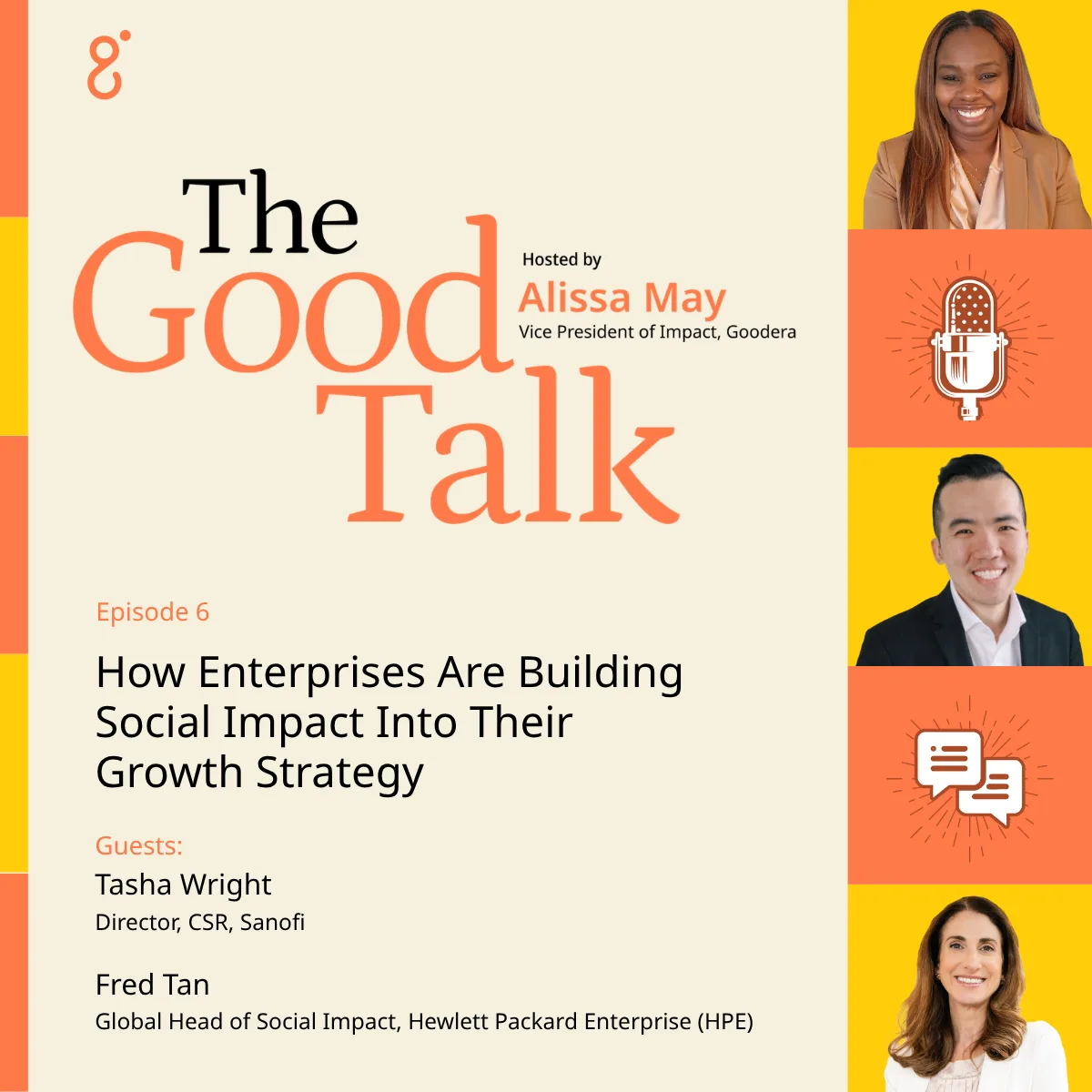
How Enterprises Are Building Social Impact Into Their Growth Strategy


In this episode, Alissa May sits down with Tasha Wright, Director of U.S. Volunteer Programs and Community Relations at Sanofi, and Fred Tan, Global Social Impact leader at Hewlett Packard Enterprise (HPE), to explore what it takes to move corporate social impact from a standalone function into a strategic business asset. Drawing on their very different paths into the field, the conversation examines how impact leaders can connect their work to business priorities while staying grounded in the needs of communities.
Fred shares how his experiences growing up with limited resources shaped his commitment to addressing power imbalances and ultimately led him into social impact. He explains how HPE approaches impact by starting with a fundamental question: what does the business need, what do customers and communities need, and what is the company uniquely equipped to deliver? He shares examples of how HPE's impact team builds relationships with organizations that the business has not previously reached, creating trust that can open new opportunities while also piloting AI solutions that respond to real market needs.
Tasha discusses her own journey from manufacturing and finance into corporate social responsibility and explains how her personal experiences shaped her commitment to giving back. She explores how Sanofi has evolved its employee volunteering strategy from measuring participation and volunteer hours to identifying community problems and matching them with employees' skills and expertise. She also shares the story behind The Air We Share, Sanofi's signature STEM initiative focused on the connection between environmental conditions, respiratory health, and community education, including its work with youth and community partners to explore solutions to air quality challenges.
The conversation also examines how companies are changing the way they think about social impact investment. Fred explains why measuring impact through brand awareness and employee engagement alone is no longer enough, with leaders increasingly looking for connections to revenue, business performance, and strategic value. Tasha emphasizes the importance of measuring meaningful community outcomes, changes in knowledge and behavior, employee engagement, and long-term impact rather than relying solely on participation numbers or social impressions. Together, they discuss why breaking down organizational silos and treating social impact as a long-term business capability can lead to stronger results.
A key theme throughout the episode is the importance of partnership and community-led solutions. Tasha argues that effective programs must be built with communities rather than delivered to them, while Fred explores the limitations of philanthropy alone and the need for economic models that can make impact scalable and sustainable. Fred also introduces the idea of "strategic empathy," describing the balance between optimizing for business value and understanding who bears the cost of business decisions, while remaining transparent and accountable to partners and communities.
Looking ahead, the conversation turns to AI, evolving expectations from customers and communities, and the growing importance of cross-company collaboration. Fred predicts that organizations will face increasing expectations around how AI affects people, communities, and the environment, while partnerships across companies and ecosystems could become a competitive advantage. Tasha reflects on both the opportunities and risks of AI, particularly the possibility of becoming overly dependent on technology.
The episode closes with an optimistic vision for the next decade. Tasha hopes to see a future where social impact work has created enough lasting change that some of today's interventions are no longer needed. Fred imagines a world where responsible business is not separate from impact, but embedded into products, pricing, deployment, and the broader economic model itself. Together, they make the case that the future of social impact lies in connecting purpose, community needs, and business strategy in ways that create lasting value for everyone involved.
Alissa May:
Hello, I am Alissa May. Over the last many years, I've been working across nonprofits, companies, and consulting, helping teams build programs and create real connection and real outcomes. In my role as the Vice President of Impact at Goodera, we're building the future of corporate volunteering, making it accessible, engaging, and impactful for every employee on the planet. Just a small, small goal there.
I could not be more excited about the two people who are here with me today on the podcast.
Tasha Wright is the Director of U.S. Volunteer Programs and Community Relations at Sanofi, where she's created The Air We Share, an initiative connecting respiratory health, the environment, and health equity. What I love about Tasha's story, and we'll get into it in a moment, is that she came up through Sanofi's finance and operations side.
Fred Tan leads Global Social Impact at Hewlett Packard Enterprise, otherwise known as HPE, where he stewards a portfolio north of $100 million spanning health, disaster response, climate, AI, and human rights. His path into this role runs through government, consulting, and impact investing, and it really shows in how he approaches his work.
Tasha, Fred, welcome to The Good Talk.
Tasha Wright:
Thank you. Thanks so much for having us.
Fred Tan:
Thanks for having us.
Alissa May:
We're going to start off with something that we call Goody Sparks. This is meant to get your synapses going and get things loose before we get into the podcast. We're going to do some rapid-fire questions.
Tasha, starting with you and then Fred. What's one ritual or tradition that matters to you?
Tasha Wright:
It's getting together for Christmas. I keep telling my boys, I don't care how old you get or how your families expand, we will always spend Christmas Eve and Christmas Day together. So that's a tradition that has stayed and will continue to stay.
Alissa May:
How about you, Fred?
Fred Tan:
The ritual that matters a lot to me is my morning ritual: waking up at the same time, showering at the same time, having my breakfast, and walking my dog with my partner.
There's something really grounding for me about doing that every single day that I absolutely love. Seeing the same people around the neighborhood and having great conversations with them is something I really enjoy.
Alissa May:
So it's kind of like a grounding exercise, but also an exercise in community too, like the people that are around you. I love that.
Talking about breakfast, what is your go-to comfort food?
Fred Tan:
Really easy. Fried chicken. If I'm having a bad day, fried chicken. If I'm having a great day, fried chicken. It doesn't matter.
Alissa May:
How about you, Tasha?
Tasha Wright:
For me, my comfort food is French fries. It's always going to be French fries. Any type of French fry. Waffle fries, potato fries. Give me a fry. I don't even need ketchup with it most of the time. Just give me a good old fry and I'm good.
Alissa May:
What are your thoughts on hot honey and fried chicken?
Fred Tan:
I'm not the biggest hot honey person. I don't hate it, but I won't go out of my way to order it.
Tasha Wright:
I love hot honey on my pepperoni pizza. I recently got introduced to hot honey on plain Lay's potato chips. It's a game changer. If you're into hot honey and you like a plain potato chip, you'll never be able to eat plain potato chips again.
Alissa May:
What's the lesson in your career you have to keep learning and relearning?
Tasha Wright:
Excellence is always the goal, but perfection will not always get us there. I always want to strive to be excellent and at the top of anything that I'm doing. But making peace with knowing that that's not always going to be a nice, smooth road, that it's going to have some bumps along that journey, is something that I have to constantly keep telling myself.
Alissa May:
Fred, how about you?
Fred Tan:
There are two things that I keep trying to learn and relearn. The first is always to listen and to get better at listening to folks around me, and to not assume that I know stuff or know what to do.
The second is becoming more comfortable with who I am. Folks can describe you in a lot of ways: strategic, smart, transformational, visionary. What I want to be described as is kind. I just want to be known as being kind.
That's something that I have to always learn and relearn. What does kindness look like in different situations, and how can I learn to be kinder each day?
Alissa May:
What's your favorite productivity hack or tool?
Fred Tan:
For me personally, I plan my days. I plan my week actually at least two weeks in advance, down to every single half hour. That just keeps me really on track. I know what's coming up and I know what I need to do.
Tasha Wright:
Mine is similar, but not as impressive. I need a calendar. If it's not on my calendar, it does not exist.
With so many competing priorities and so many things going on constantly, it helps keep me grounded and helps me plan my day. I also use ChatGPT and other AI tools. It really allows me to focus and helps make me a lot more efficient.
Alissa May:
In the next decade, the enterprises that excel will be the ones that...
Tasha Wright:
I think it will be the ones that embed communities and patients at the heart of every decision, turning that shared purpose into shared progress.
Fred Tan:
For me, really similar to what Tasha said. The enterprises that excel with their impact will be the ones that connect impact with what their customers need and what the business does.
Alissa May:
I'd love to begin with your stories. The pathways that led you to this work are always really interesting to hear.
Fred, you've gone from government and consulting to running enterprise impact at a Fortune 100 company. How did you end up here today, and how did that path shape how you think about your work?
Fred Tan:
Part of it is intentional, a big part of it is unintentional, and then it's a happy surprise.
I grew up in a family that was blue collar to start. Because of the right opportunities that came along our way, we were able to make a really good life for ourselves. But I remember a time in my life where we had a plain piece of white bread for breakfast, a plain piece of white bread for lunch, and a plain piece of white bread for dinner.
My mom would cut it up into little strips, and we would pretend that it was French fries. I actually thought it was French fries.
I absolutely appreciate what my parents did to give us kids a normal life. But I always remembered that time when we didn't have much, and I remembered the people that we used to know when we didn't.
I always knew I wanted my career to be focused on rewriting the power imbalances in the world. I thought I was going to be a diplomat, but it didn't work out. Saying yes to the right things at the right time has brought me to where I am today.
In a very real way, the experiences of my family and later experiences in my life that were hard have shaped not just what I do, but how I do it and how I try to show up.
Alissa May:
How did you get here, Tasha? What has shaped you to today?
Tasha Wright:
I come from very humble beginnings as well. My mom was a single mom, and it was my mother and my three sisters. I watched my mom hustle to take care of us and provide for us, and it instilled that hustle mentality.
My mother is the absolute best person I know because when times weren't great, she prayed, but she also always instilled in us that we needed to pay it forward.
I was a mom at a very early age, at 17, and I had to hustle. It was hard, and it wasn't easy. People were so kind, though. I've had to go to food banks to get food. I've relied on the kindness of others. That just stayed with me.
My mom taught us that we needed to pay it forward, and then I got to see it in real time. So I've made up my mind that this needs to be who I am as well.
Professionally, before this role, I worked on our manufacturing team and had a role in finance. That gave me the opportunity to help people on their career journeys, which was great because I always say people are my passion.
In finance, I led our people development program, which led to this role in corporate social responsibility that I've been in for the last three and a half years.
I don't think there could be a better fit for me with the type of work that I'm getting to do. It aligns completely with my passions and my values, and I'm beyond grateful to be able to give back to our communities in a very meaningful and impactful way.
Alissa May:
Fred, at HPE, you describe transforming social impact from a cost center to a strategic business asset. That's a phrase a lot of people would love to be able to say authentically in their work.
What did that transformation actually require in your approach to the work and the structures that you put in place?
Fred Tan:
Every industry, every team, every organization seems to adopt an approach and a methodology. You'll see that in government, consulting, nonprofits, and think tanks. For the age that we're in, if we want to solve problems, we're going to need to start doing things a little differently and find different ways to work.
In terms of transforming impact from a cost center to driving business value, I think the key questions are: What does the business need? What do our customers and communities need? What is the business most well equipped to deliver because of its differentiated capabilities?
You're trying to think about what job the business needs to get done that it cannot currently do, and how you can leverage the resources and relationships you have to help the company do that exact job.
The picture is going out and solving problems for the business. It's solving questions that the business hasn't been able to figure out yet.
Maybe it's a question of how we access new markets or how we access a customer base that has previously been locked out. How do we increase our share of voice in the marketplace? These are questions that the business has, which we can solve, and in doing so connect the work we drive to tangible business value down the line.
Alissa May:
Do you have an example where you've been able to do that?
Fred Tan:
At HPE, we've heard that we want more examples of how AI is making the world a better place and changing organizations. We've also heard that there are potential customers our company has not been able to reach.
Our impact team is well placed to develop relationships with organizations that the company has had no relationship with in the past. We build those relationships and goodwill, and eventually we can open the door for the business when that trust has developed.
If we develop the right trust, we get to a point where potential customers ask us, "Tell me more about what your company does." You don't have to pitch or sell anything. If you do your job right, they're going to ask you to tell them more.
The second thing is that because of those relationships, we've piloted ways in which AI can be deployed in really interesting use cases. These are things that the market is asking for, not just HPE. The world wants to know how AI can be used to transform work.
We can be a pipeline of innovation and demonstrate the power of AI. These are two ways we're helping solve problems that the company has right now.
Alissa May:
That's a great success indicator. Tasha, you've done a tremendous job weaving business value together with the programs you've built.
You've evolved We Volunteer from event-based participation into a skills-based, impact-driven model, and you built The Air We Share from the ground up. What changed for employees and for the business when you started treating volunteering as intertwined with business strategy rather than as a standalone, feel-good moment?
Tasha Wright:
The biggest shift was moving from asking, "How many volunteer hours did we log?" to asking, "What problem are we trying to solve, and what unique value can Sanofi bring?"
Our employees have incredible experience. When I joined this team, I thought I was going to have to spend a significant amount of time encouraging people to get out and volunteer. It's the complete opposite. Our people are so engaged, and we wanted to make sure they had incredible opportunities to engage.
By aligning those skills with nonprofit needs and creating deeper value for our communities, we identified that it makes for a more meaningful experience for our employees.
Our employees became more engaged because they can contribute in ways that reflect their professional expertise as well as their personal passions, rather than simply showing up for a one-day event for the business.
It created a stronger alignment between our purpose and our core capabilities. Our impact work became more connected to who we are as a healthcare company.
The Air We Share is a great example. It wasn't designed as a campaign. It was built around a real health issue affecting families, informed by research, strengthened by trusted community partners, and connected to Sanofi's broader mission to improve health outcomes.
Alissa May:
I'd love to hear more about The Air We Share.
Tasha Wright:
The Air We Share is our signature STEM initiative, and it's designed around the impact that the environment has on respiratory health.
It's very timely because we're talking to people about how the environment impacts respiratory health while we're also seeing it in real time. People are asking questions like, "Why is inhaling wildfire smoke bad?" and "What are indoor air quality concerns?" and "What should I be doing to address them?"
It's an initiative focused on education and awareness, but the other piece is looking to our youth for solutions.
Through our partnership with the Association of Science and Technology Centers, we're launching a STEM challenge directly related to air quality and respiratory health.
It's a two-pronged approach. We're going into communities and partnering with museums across the country to educate families and students on how air quality impacts their health. But then we're turning to them and saying, "Now that you have this information and you've asked all these amazing questions, how do we solve for it?"
It's become a lot more than what I originally envisioned, but we know how impactful and important it is.
Alissa May:
Industry research has found that more than 40% of companies increasing their social impact resources are doing so specifically because it delivers direct business value.
From where each of you sits, what has genuinely changed in how companies think about this? And what still feels stuck?
Fred, let's start with you.
Fred Tan:
I think there's greater accountability to communities and customers around what businesses are doing. Communities are expecting their companies to show up in the right way and invest in the right ways.
Companies are paying closer attention to how you really connect impact as a strategic business asset. If we can prove the direct business ROI, then that's a good case for increasing that investment.
Historically, the impact space used to measure ROI through brand awareness, which is good, and employee engagement, which is also good. More companies are starting to get to a point where impact is connected to revenue and connected as a strategic business asset.
Businesses exist to generate revenue and free cash flow to return to stakeholders and shareholders. As we get better as a field at delivering that, we will see impact increase.
Tasha Wright:
There's much broader recognition today because social impact isn't separated from business performance. It contributes to employee engagement, reputation, innovation, partnerships, and long-term trust.
Leaders are asking questions differently now. Instead of, "Should we invest in this?" they're asking, "How do we measure success?" and "How do we integrate this across the business?"
I think that's healthy, and it pushes us to be more intentional and accountable.
Alissa May:
What still feels stuck?
Fred Tan:
As corporate philanthropy becomes stronger, we've seen nonprofits try to adopt the methodology and approach of corporates. You see a mirroring in language and a mirroring in how they present themselves.
In some ways, I think that's good growth. In some ways, I think it's really dangerous that nonprofits are acting and sounding more like corporates.
The other element is that as much as we're increasing our budgets for impact and doing more philanthropy, which I definitely think we should do because the world needs more, we need different economic models.
I believe philanthropy is only going to take us to a certain point. Unless we reshape the economic system that we live in, we're not going to get to a place where impact can scale and sustain.
If your economic model is secure, and if the economic model is what enables and delivers impact, I think you see really scalable and sustainable impact.
Tasha Wright:
We have a tendency to evaluate using only short-term metrics or isolated activities when real impact takes years to build and requires consistent investment.
Another part for me is breaking down silos. The strongest partnerships are built across organizations and groups: communications, HR, people and culture, sustainability, and external partners, instead of being owned by only one team.
At Sanofi, and in organizations that are making the greatest progress, social impact is treated as a long-term business capability rather than a series of one-off campaigns or moments.
Alissa May:
Fred, you use the phrase "strategic empathy." What does that actually mean? What does that look like day to day in your work?
Fred Tan:
For me, strategy optimizes for value, and strategic empathy asks who absorbs the cost of whatever you're implementing. Have I accounted for them? Have I been transparent with them?
It's about building awareness of the people who have skin in the game and making sure that we're operating accordingly.
Internally, when you operate within a business, someone once said that in any negotiation, it's not a case of making people equally happy. It's a case of making people equally unhappy.
Can you recognize who is going to be unhappy? Can you ensure that in the relationships and trust you're building, you're acknowledging that, coming ahead of it, and smoothing it out?
Externally, we have partners who say, "We need technology. Another organization is donating a ton of free technology, free time, and free credits. Can you do that for us?"
My team's role is to help our partners drive as much impact as they possibly can. We're their advocates. But on the flip side, we have to be open and transparent with them.
Sometimes we simply don't have the capacity or resources to do something. Or we might say, "Giving you free credits isn't going to be the best strategy for your organization to scale. What we're going to do is figure out a model and structure that reduces your dependency on the good graces of people who might say yes one year and not the next."
That takes empathy, vulnerability, and strategy. What can I give? What are people expecting from me? Where might I not be able to give them what they're asking for? And how am I going to explain why that's the case and help them in a different way?
That's how I view strategic empathy.
Alissa May:
Let's talk about measurement. Which metrics are you seeing actually move your leadership toward paying attention, support, and action?
Tasha Wright:
Participation is always a great starting point, but it only tells part of the story about who showed up, not whether we made a meaningful difference.
We look at whether our programs are reaching the communities we intended to serve and whether we're seeing measurable changes in knowledge, confidence, behaviors, or access over time. That's where our partnerships and third-party evaluations become incredibly valuable.
We also launched a National Parent Survey this year for The Air We Share. The survey helped inform our path forward and allowed us to make sure we weren't making assumptions about what communities needed.
One of the data points that sticks with me is that 87% of the parents surveyed said they were concerned about the impact of air quality on their families. Another 63% said air quality was already negatively affecting their family's health.
That confirmed that this isn't a distant or abstract issue. Families are experiencing it in real time and looking for trusted information.
We also pay close attention to employee engagement and whether these experiences deepen our employees' connection to our purpose and culture.
When I joined the team, we were at around 10,000 documented hours of employee participation. Over the years, we've gotten to around 25,000 hours across the U.S.
For leadership, the most compelling data is when we can connect community outcomes, employee engagement, and business priorities into one story rather than presenting them as separate metrics.
Metrics like total volunteer hours or social impressions can be useful for context, but they don't tell the full story. Without understanding the impact behind them, they don't tell you whether you've actually created lasting value.
For me, the North Star is long-term impact. It's not just doing something for the sake of saying we've done it and checking the box. It's actually driving impact and change.
Alissa May:
When you walk into a room with a C-suite member or someone in finance and have 10 minutes of their time, how do you translate impact into their language? What lands and what doesn't?
Fred Tan:
It goes back to what we were talking about earlier. The first step is understanding what the business actually needs. What are the jobs they're trying to do?
Different business units are doing similar yet different jobs and have different methodologies and frames of mind. You need to understand how they think and what the big challenges are that they're working on.
Only then can you start speaking a language that connects with them. Only then can you start solving problems that they actually care about.
If we don't understand how they're trying to make money, anything we present is going to fall flat.
Different business unit leaders will respond to different language, so you have to find the right language that resonates with them. When they're all together, you need to aggregate that language so that it resonates across the board.
Impact professionals are really good at what we do, but a lot of what we do can be difficult for others to understand. We talk about a theory of change or return on impact, and people might ask, "What is that?"
It always boils down to: What problems are people concerned about? What jobs are they trying to do that they can't do? How can you help them do their job and make their life a little easier?
If you're doing that, the impact you're making will land pretty quickly and easily.
Alissa May:
Expectations from employees, customers, and communities are constantly changing.
Tasha, you're passionate about advancing equity, STEM, and health, and you see that not just as a buzzword but as a responsibility we all have in our work. What do you think it's going to take for equity to stay central in strategy in the years ahead?
Tasha Wright:
I think we probably all see equity being quietly erased. For me, the organizations that will continue making progress are the ones that are embedding equity in how they design their programs, how they identify and build their partnerships, and how they're measuring success. We're not treating it as a standalone initiative anymore.
I think that also means listening to communities early and often. The most effective solutions are built with communities and not simply delivered to them.
When we're designing our programs and developing them, it's in co-creation. We're listening to what our communities and our partners are saying, and we're not just saying, "This is what we think you need. Take it."
Programs like The Air We Share, our other STEM initiatives, and our employee volunteer efforts reflect that mindset by meeting people where they are and partnering with trusted local organizations.
Finally, we have to continue measuring progress. We need to ask who we're reaching, who we're missing, and what barriers still exist. Equity will stay connected to accountability rather than just becoming another aspiration.
Alissa May:
I love the idea of "built with, built alongside" rather than "delivered to." That resonates deeply.
Tasha Wright:
For me, I don't like check-the-box activities. I don't ever want to feel like what we're doing is saviorism. This idea that corporations or people have to come in and save people, and that we know what's best for people, that's not partnership.
Within our CSR group, we've been very intentional about avoiding that. We work closely with our partners and communities and with our health equity organization. We're connected to hearing and understanding what the needs are and then trying, in partnership, to solve for them.
We're not just saying, "Here, take this coat in the middle of summer because we have extra coats and we want to give them away and feel good about ourselves."
We're saying, "What is it that you need? How can we show up? How can we be a better partner?"
That's one of the best things about the work that I get to do.
Alissa May:
Fred, you're running a global portfolio across STEM, health, disaster response, AI, climate, and human rights. How are you thinking about the next five to ten years as expectations evolve in those spaces? Where do you think enterprise impact will have to grow?
Fred Tan:
I think AI is going to be huge. There will be an expectation from customers and communities around AI, and that will extend beyond companies that are technology companies.
Every company uses AI, and every company is going to use AI more, whether it's adaptive pricing or something else. There will be a greater expectation from customers and communities around how AI is being used, how it affects them, and how it impacts their communities and their environment.
Enterprises are going to increasingly have to respond to that and answer to it.
On a different side, I think there will be more partnerships across the market between companies that are customers of each other and go-to-market partners with each other.
There will be a realization that we cannot do this work alone and that partnership is really important. On the contrary, partnership is actually a competitive advantage.
Five to ten years ago, you probably saw companies talking about their CSR work as if they were the only company doing it and they were saving the world. I think we've seen less of that.
In five to ten years, you'll see companies moving toward ecosystem partnerships between companies that are cooperating to jointly make a difference. That's my hope and my optimism for what we'll see.
Alissa May:
There are just spaces and places where this shows up that are unexpected. We're all using the same platforms, whether it's GitHub, Workday, or something else.
What are the overlapping places where we can build partnerships and create that competitive advantage?
Tasha Wright:
When you mentioned Workday, the first thing that came to mind was the question of when lawsuits might hit because of alleged discriminatory practices involving AI and how certain applicants could be affected.
AI allows me to be so efficient in my work, and I don't have a ton of time. But I also think about the drawbacks.
I worry about how much we'll rely on AI and how that might come back and bite us in the future.
Alissa May:
If we get it right, paint me a picture of what the relationship between social impact, purpose work, and business strategy looks like in 10 years. What's the picture that you hold in your mind?
Tasha Wright:
If we get it right, in my mind, 10 years from now, the work that I'm doing looks very different because we've made such an impact that it's embedded and there's no longer a need for Sanofi or other organizations to do some of the work we're doing today.
That's a very big dream, but if we continue to do what we're doing now, and we're all being very intentional about it, I think that's possible.
One thing I love about this work is that across industries, if you're in the CSR space, your goals are often the same. You can work together, collaborate, and do all of those things because it's all about improving the world that we live in.
The big dream would be that in 10 years, the work that I'm doing is no longer needed because the need is no longer the same.
Alissa May:
Fred, paint us your picture. I like Tasha's picture a lot.
Fred Tan:
I love that picture too, and I think the picture is similar.
Our purpose at HPE is to advance the way that people live and work. If we take that purpose seriously, making the world a better place isn't a part of the company. It is the company.
I'll go back to the economic model, which is why I feel very strongly that the best way to deliver impact is when your product is developed responsibly, deployed responsibly, with an economic and pricing model that works for the company and works for the community.
That, for me, is what true impact looks like: responsibly developed, responsibly deployed, and responsible pricing that works for the business because businesses have to make money, and that works for communities so that communities can adopt.
Philanthropy is great, and philanthropy is going to stay and needs to increase. But if we're doing business at the cost of communities and then providing donations, I don't think that's right.
We need to get to the next level where every part of the business, the economic model, the business model, and the pricing model embeds responsibility and community.
That could hopefully be what it looks like in less than 10 years if we get this right.
Alissa May:
I love the future you've both painted. It's very hopeful.
Thank you both so much for being here with me today. Thank you for your candidness. I had fun, and I hope you had fun building this future together with us.
And to everybody listening, we'll see you next time, where we're going to keep learning, experimenting, and doing good together. Thanks, everyone.

.png)
.png)


