How to Build a Skills-Based Volunteering Program from Scratch

In 2012, a small education nonprofit in New Orleans was facing a challenge that had little to do with its mission. Its donor records were scattered across spreadsheets, grant deadlines were slipping through the cracks, and the executive director was spending nearly 14 hours a week on administrative work that should have taken a fraction of the time. What the organization needed wasn't more passion or more volunteers. It needed someone who knew how to organize data.
Just a few miles away, a regional bank employed a team of data specialists with exactly those skills. Yet the nonprofit and the professionals never crossed paths.
That disconnect is what skills-based volunteering is designed to solve: connecting professional expertise with nonprofit challenges that can't be addressed by good intentions alone.
A Taproot Foundation study found that every single hour of skilled pro bono service delivers up to $150 in measurable value to a nonprofit organization.
Research from the Boston College Center for Corporate Citizenship found that 88% of employees who participated in structured skills-based volunteering returned to their organizations with stronger teamwork and communication skills than they left with.
The challenge is rarely convincing people to volunteer. It's matching the right employee to the right opportunity, at the right time, and doing it consistently across teams, locations, and nonprofit partners.
This guide shows you how to build a scalable skills-based volunteering program, from identifying employee expertise and nonprofit needs to creating meaningful matches that deliver measurable value for everyone involved.
What Is Skills-Based Volunteering (and What It Isn’t)
Skills-based volunteering is when employees contribute their professional expertise, whether in finance, marketing, technology, HR, legal, design, operations, or any other discipline, to nonprofit organizations on a pro bono basis, intending to build lasting capacity.
Skills-based volunteering can mean conducting a full brand audit, building a 12-month content strategy, product testing, or training the nonprofit's internal team to execute it independently. The difference is knowledge transfer versus task completion. The former creates self-sufficiency and sustainable workflows for the nonprofits.
What skills-based volunteering is not: it is not traditional volunteering with a slightly more qualified volunteer. Serving meals, planting trees, and packing boxes are valuable acts, but they serve short-term goals. The defining characteristic of skills-based volunteering is that the work would command professional compensation in a commercial context.
Did you know? 92% of corporate business leaders agree that skills-based volunteering formats directly build and sharpen professional capabilities, turning these initiatives into a vital cross-over strategy for internal Learning & Development (L&D).
Why 2026 Is the Inflection Point for Skills-Based Volunteering
Corporate social responsibility has evolved into a core strategic asset in 2026. While traditional hands-on volunteering remains a vital pillar for immediate community aid and team cohesion, organizations are increasingly looking to maximize their long-term social contributions and build sustainable partnerships with nonprofits.
In this evolving landscape, five converging forces are making skills-based volunteering an operationally urgent complement for companies in 2026.
- U.S. Climate Laws and Human Capital Disclosures Are Tightening
California’s landmark climate disclosure laws (SB 253 and SB 261) and evolving SEC human capital reporting frameworks are pushing American companies to demonstrate social and environmental impact with hard evidence, rather than just good intentions.
Skills-based volunteering programs, when built with proper data-tracking infrastructure, generate the kind of documented, quantifiable community outcomes required to navigate any legal or compliance bottlenecks.
- Gen Z Now Forms the Largest Single Cohort in the Global Workforce
Research from Deloitte's 2024 Global Gen Z Survey found that 44% of Gen Z employees have turned down a job based on a company's values misalignment.
They want to work for a company that cares, specifically through programs that let them use their abilities to make a tangible difference. To retain Gen Z, companies must offer skills-based volunteering as a core benefit that proves their corporate values through high-impact action.
- Remote and Hybrid Work Has Dissolved the Geography Barrier
Virtual skills-based volunteering is now frictionless. An HR specialist in Bengaluru can build a recruitment framework for a nonprofit in Nairobi. A UX designer in Austin can redesign a charity's donation flow for a youth organization in Manchester. The pool of both volunteers and nonprofit partners has become genuinely global; hence, this is a massive opportunity for companies.
- Nonprofit Capacity Is at a Structural Low
The post-pandemic period left many nonprofits with depleted staff, reduced funding, and backlogs of operational problems that money alone cannot solve. What they need is expertise. 92% of voluntary organizations shifted their primary operations and services online following the mass adoption of remote workflows.
- AI Is Reshaping Job Roles, Making Human Skill-Transfer More Valuable
As automation handles more routine work, the premium on uniquely human capabilities, strategic thinking, empathy-driven design, stakeholder management is rising. Skills-based volunteering is one of the few contexts where employees can practice these higher-order skills in genuinely high-stakes environments with real consequences.
By 2026, skills-based volunteering has transformed from a corporate perk into a strategic, operational necessity. Driven by strict regulatory disclosures, Gen Z talent demands, and severe nonprofit capacity shortages, companies can no longer rely sustainably on short-term community service. Embracing this model satisfies compliance, secures top-tier talent, and drives meaningful global impact in an AI-driven world.
How to Build a Skills-Based Volunteering Program from Scratch: The 10-Step Framework
Step 1: Run a Readiness Audit Before You Build Anything
The most expensive mistake in skills-based volunteering program development is starting before your organization is fully in or prepared. Readiness encompasses more than enthusiasm. Every CSR team has enthusiasm. It is about structural capacity: do you have the operational infrastructure and the cultural conditions to sustain a program beyond its first pilot?
Run an internal readiness assessment across four dimensions:
- Leadership Commitment
Is there a clear, sustained mandate across leadership tiers to champion the program, protect its resource allocation, and actively encourage team participation? Skills-based volunteering initiatives without broad organizational alignment and management buy-in suffer a drop-out rate significantly higher than those with built-in institutional support.
- Program Infrastructure
Do you have a dedicated program owner (even part-time)? Do you have a system for tracking volunteer hours, project outcomes, and nonprofit feedback? Will volunteers be given protected time during work hours, or will this sit entirely on personal time? The latter is a fast track to resentment.
- Cultural Readiness
Has your organization run any volunteering program before? What was participation like? Were there pockets of resistance? Understanding your starting cultural baseline tells you how much change management work this launch will require.
- Legal and HR Readiness
Does your current employment framework allow for skills contributions to nonprofit organizations during work hours? Are there IP ownership considerations if employees build tools or create materials for nonprofits? These questions need HR and legal input before you go public with a program.
Pro Tip: Build a simple 20-question internal survey covering these four dimensions and distribute it to department heads before your program design begins. The responses will tell you more about your real readiness than any leadership meeting will.
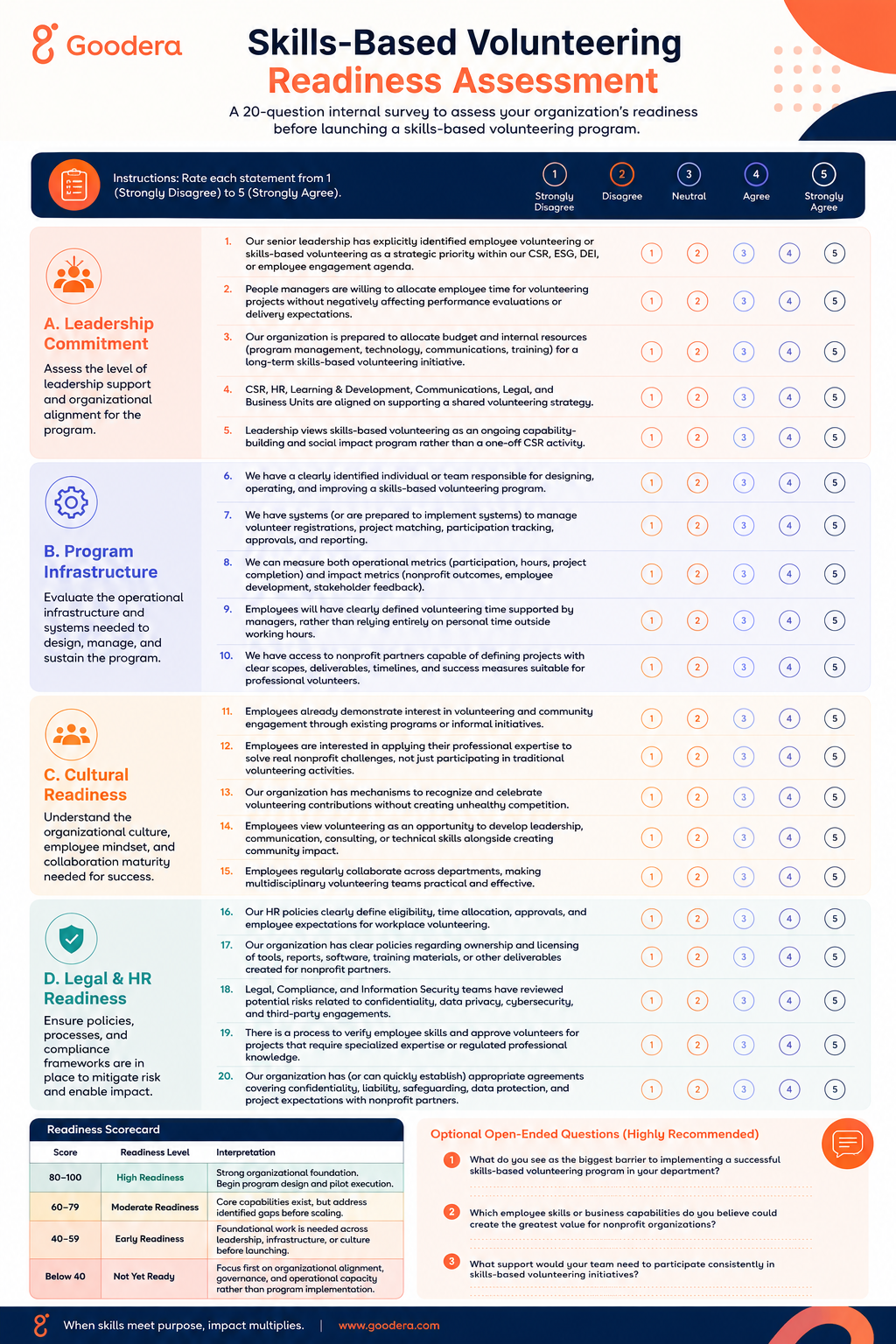
A lack of foundational readiness while launching a skills-based volunteering program results in high project dropout rates, operational friction, and employee burnout.
Step 2: Identify Community Needs
The single most common failure mode in skills-based volunteering program design is companies deciding internally what they will offer nonprofits, then going out to find partners who fit. While this may seem convenient at first, it results in the type of volunteering that serves the company's profile more than the community's most pressing needs.
Reverse the sequence. Go to nonprofits first. Conduct structured "needs assessment" conversations with 8-12 nonprofit organizations in your target geography or issue area. Ask them specifically:
- What are the three operational problems you cannot solve because you lack in-house expertise?
- What would change most significantly in your program delivery if you had access to professional skills you currently cannot afford?
- What specific task takes up the most staff time that you wish could be automated or streamlined?
- What high-priority project has been sitting on your back burner solely due to a lack of specialized tech or marketing expertise?
The specificity produces matched, impactful projects.
Did you know? A study by Common Impact found that 85% of nonprofits that received skilled volunteer support reported measurable increases in organizational capacity and long-term effectiveness.
Step 3: Build Your Impact Measurement Framework From Day One
Most teams starting out naturally keep this step until last. That is exactly why most skills-based volunteering programs cannot demonstrate ROI 7-8 months after launch as they find it difficult to pinpoint what they were measuring before the work started.
Build your impact measurement framework immediately after identifying community needs and before scoping a single project. The metrics you choose shape the projects you scope, which shape the skills you recruit, which shape the nonprofits you partner with.
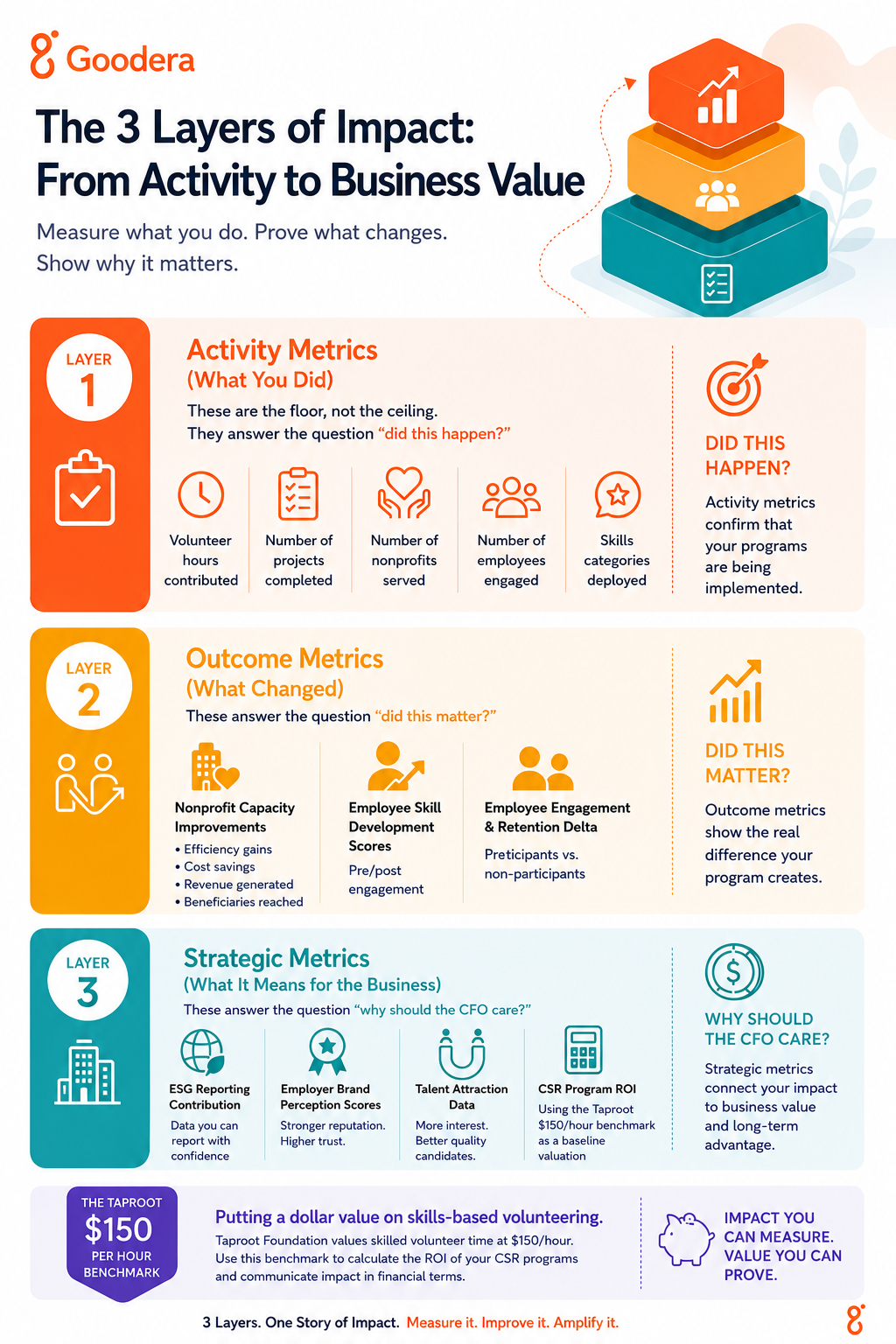
The 3 Layers of Impact
Use the Skills-Based Volunteering Impact Stack, three layers of measurement that together tell the complete program story:
Layer 1: Activity Metrics (What You Did)
Volunteer hours contributed, number of projects completed, number of nonprofits served, number of employees engaged, skills categories deployed. These are the floor, not the ceiling. They answer the question "Did this happen?"
Layer 2: Outcome Metrics (What Changed)
Nonprofit capacity improvements (efficiency gains, cost savings, revenue generated, beneficiaries reached), employee skill development scores pre/post engagement, employee engagement and retention delta for participants versus non-participants. These answer the question "Did this matter?"
Layer 3: Strategic Metrics (What It Means for the Business)
These include ESG reporting contribution, employer brand perception scores, talent attraction data, CSR program ROI (for example, using the Taproot $150/hour benchmark as a baseline valuation). These answer the question "why should the leadership team care?"
Step 4: Map Your Workforce Skills and Interests
You now know what the community needs (Step 2) and what you will measure (Step 3). The next task is understanding what your organization actually has to offer, with real precision.
Run a skills and interests mapping exercise. The format can be a structured survey (recommended for organizations over 500 employees), a series of departmental workshops (effective for under 200), or a combination of both. Ask three categories of questions:
- Professional Skills Inventory
This section maps your technical expertise, specialized tools, and proven track record to ensure your placement matches high-need areas. Understanding your advanced competencies allows you to pair with organizational challenges where your specific skillset can deliver maximum, measurable value.
- What are your primary and secondary professional competencies?
- In what domains have you delivered work that had measurable results?
- What tools, platforms, or methodologies do you have certified or advanced proficiency in?
- Volunteering Interest Areas
This section explores the specific social causes, project durations, and working styles that motivate you most. Aligning the volunteer experience with your personal passions and preferred execution style ensures a deeply engaging, high-energy partnership for both you and the nonprofit.
- What social issues do you care about most?
- What kind of work environment energizes you, strategic/advisory, hands-on/executional, teaching/coaching, building/creating?
- Do you prefer short-term intensive projects or longer ongoing engagements?
- Availability and Format Preferences
This section establishes the practical logistics, time commitments, and scheduling boundaries for your volunteer work. Mapping out your exact availability and remote or in-person preferences ensures seamless collaboration across different global time zones without risking burnout.
- How many hours per month are you realistically available?
- Do you prefer in-person, virtual, or flexible?
- Are there time zones or scheduling constraints?
This data becomes your internal skills marketplace, i.e., the foundation for intelligent volunteer-to-project matching. Companies that match volunteer projects to employees' professional skills and personal interests see 67% higher participation rates than those that assign volunteers based on availability alone.
Step 5: Next, Lock Down Your Project Scope
Bad project scoping is the single biggest destroyer of skills-based volunteering program quality. It produces frustrated volunteers, disappointed nonprofits, and outcomes that nobody can measure because the team was not thorough in defining what success looked like before the work began.
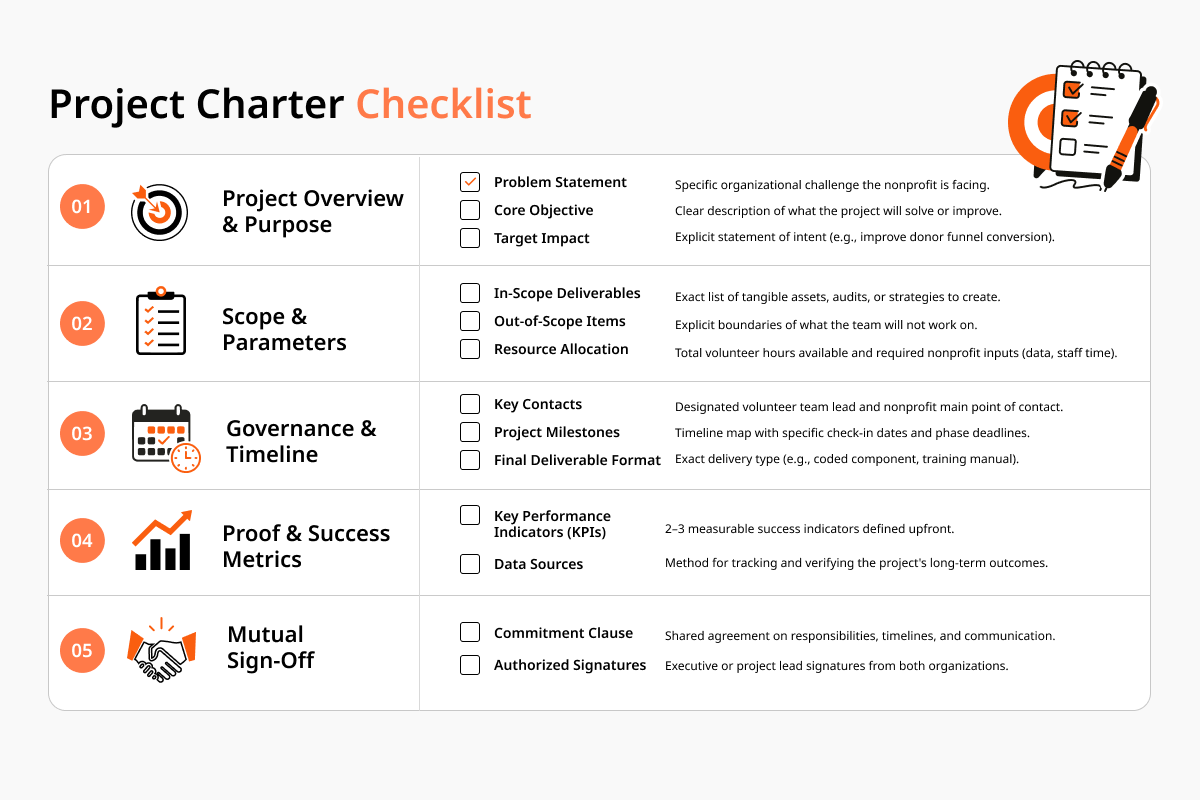
Good project scoping is an exercise in constraint. Use the PPP Scoping Framework, namely Purpose, Parameters, and Proof for every single engagement:
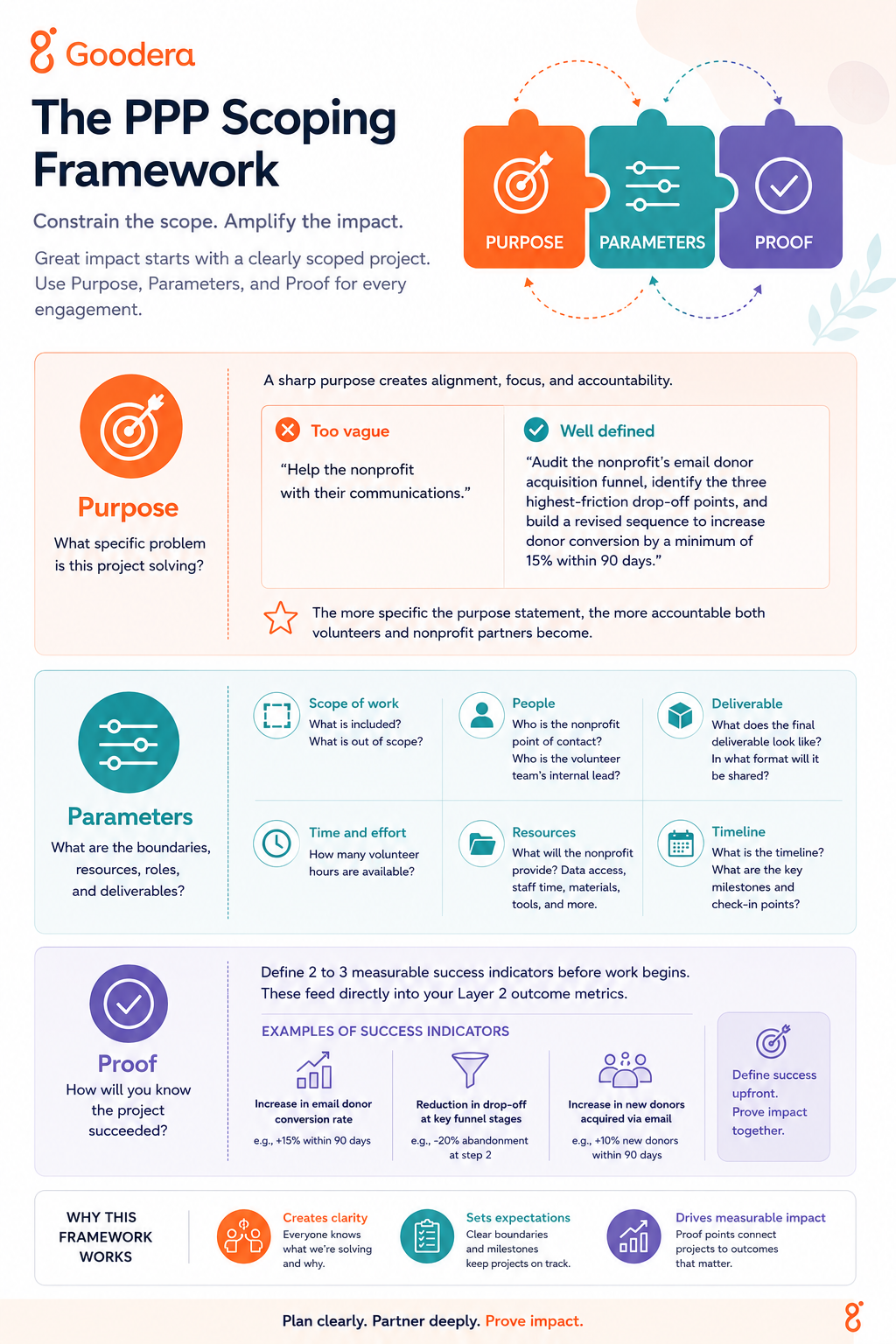
Purpose
What specific problem is this project solving? Not "help the nonprofit with their communications" but "audit the nonprofit's email donor acquisition funnel, identify the three highest-friction drop-off points, and build a revised sequence to increase donor conversion by a minimum of 15% within 90 days." The more specific the purpose statement, the more accountable both volunteers and nonprofit partners become.
Parameters
What is the exact scope of work? What is out of scope? How many volunteer hours are available? What is the timeline, with milestone check-ins? Who is the nonprofit point of contact, and what is the volunteer team's internal lead? What resources will the nonprofit provide (data access, staff time, materials)? What does the final deliverable look like?
Proof
How will you know the project succeeded? Define 2-3 measurable success indicators before work begins. These feed directly into your Layer 2 outcome metrics from Step 3.
A well-scoped skills-based volunteering project brief is typically a 1-2 page document that both the volunteer team and the nonprofit sign off on before work begins. It is the difference between a project that creates lasting value and one that meanders for three months and produces a generic, vague Google Doc.
Step 6: Secure Leadership Buy-In and Employee Opt-In Simultaneously
You now have a complete program design: community needs identified, measurement framework built, skills mapped, projects scoped. This is the moment to seek formal organizational commitment and to do it for two audiences at once.
The reason most buy-in campaigns fail is that they target leadership or employees, not both simultaneously. Leadership approves programs they think employees will value. Employees participate in programs they believe leadership actually cares about. If you approach them sequentially, you get caught in a loop: leadership wants to see employee interest first, employees want to see leadership commitment first. Approach them together.
1. For Leadership, Your Pitch Has Five Components
- The community problem you are solving (with nonprofit research data)
- The business case (ESG reporting value, talent retention ROI, employer brand impact)
- The program design (scoped projects, measurement framework, timeline)
- The resource ask (budget, volunteer time allocation)
- The risk mitigation (pilot structure means limited downside exposure)
2. For Employees, Your Communication Has Three Components
- What is in it for the community (the specific nonprofits and problems)
- What is in it for them (skill development, leadership visibility, meaningful work)
- What the time commitment actually looks like (specific, bounded, not open-ended). The number one reason employees decline to participate in volunteering programs is fear that it will be one more thing on an already full plate. Remove that fear with specificity
Did you know?
According to Vorecol, companies with robust volunteering programs enjoy 57% higher employee retention rates than those without.
When you present this statistic to a CFO, the conversation about budget changes immediately.
Explore how Goodera supports CSR leaders in building employee volunteering programs at scale that get both leadership and workforce alignment from the start.
Step 7: Offer Flexible Formats: In-Person, Virtual, or Both
Once you have buy-in and a confirmed volunteer cohort, design the delivery formats that will maximize both participation and impact. The format is a strategic decision based on your project types, your workforce demographics, and your nonprofit partners' working conditions.
- In-person skills-based volunteering has the highest impact for engagements requiring relationship depth, hands-on training, or collaborative workshops.
- Virtual skills-based volunteering removes geographic limits and is now the dominant format for skills delivery. These include engagements which are entirely virtual, asynchronous across time zones, and deliver measurable outcomes.
- Micro-volunteering includes small task completions in under 3 hours, such as translating a document, reviewing a grant proposal, giving feedback on a pitch deck, or recording a short instructional video. It is particularly effective for recruiting senior employees (VPs, Directors) who want to contribute but cannot commit to multi-week projects.
For a comprehensive resource on structuring virtual volunteering effectively, explore Goodera's Virtual Volunteering Guide.
Step 8: Run a Pilot Before You Scale
A pilot is not a test of whether skills-based volunteering works (it does). Rather, a pilot is a test of whether your specific program design, nonprofit partnerships, matching process, and measurement tools work together without friction.
Structure your pilot in the following way:
Size: 15-30 volunteers, 3-5 nonprofit partners, 2-4 projects running simultaneously. Large enough to surface real operational issues, small enough to fix them quickly.
Duration: 8-12 weeks. Long enough to produce genuine outcomes, short enough to maintain momentum and gather learning while memory is fresh.
Diversity of project type: Include at least one short-term intensive project (4-6 weeks), one medium-term ongoing engagement (10-12 weeks), and one micro-volunteering component. This tests your program's flexibility across formats.
What to evaluate: Volunteer satisfaction (not just participation), nonprofit satisfaction (specifically: did the work meet the need they identified?), project completion rate, matching quality (did skills align with project requirements?), and program manager workload (is the infrastructure sustainable?).
Run formal retrospectives with volunteers, nonprofit partners, and program staff within two weeks of pilot completion. Document what worked, what broke, and what you would design differently.
Step 9: Recognize and Reward Volunteers
Recognition is a retention mechanism, a recruitment engine, and a cultural signal all in one. The companies whose skills-based volunteering programs sustain high participation year after are the ones that make volunteers feel genuinely seen.
Recognition in skills-based volunteering programs works on three levels:
Individual recognition is the most powerful and the most neglected. A personalized note from a senior leader that references the specific project, the specific nonprofit, and the specific outcome the volunteer created is worth more than any award plaque.
Salesforce, whose 1-1-1 model gives every employee 56 hours of paid Volunteer Time Off annually, supplements VTO with a recognition infrastructure that includes internal storytelling, performance review integration, and peer nomination programs.
Team recognition creates the social proof effect that drives organic program growth. When a team's skills-based volunteering project is featured in a company-wide meeting, the employees who did not participate become your next volunteer cohort. Visibility is the most underused recruitment tool in corporate volunteering.
Pro Tip: Build a "Volunteer Impact Story" template and ask every project team to complete one at the end of each engagement. Add three fields: what was the problem, what did your team do, what changed as a result. These stories become your program's most powerful recruitment and retention tool, and your most compelling content for external ESG reporting.
For more on building engagement programs that retain and motivate employees, see Goodera's guide to corporate volunteer programs that drive purposeful impact.
Step 10: Measure Impact Seamlessly
You built the framework in Step 3. Now you put it into action.
The measurement process should feel like a natural part of the program, instead of a burdensome reporting exercise appended at the end. If your volunteers feel like they are filling in forms to justify their participation, the measurement design has gaps.
Build measurement touchpoints into program milestones rather than program endings. A mid-project check-in survey (5 questions, 3 minutes) tells you whether a project is on track while there is still time to course-correct. A nonprofit feedback form sent 30 days after project completion (when the deliverable has been in use long enough to generate real data) produces outcome metrics far more meaningful than an immediate post-project survey.
At the program level, run a quarterly impact review that covers all three layers of the Skills-Based Volunteering Impact Stack from Step 3. Use this data to produce two outputs: an internal impact report for leadership (focused on strategic business value metrics) and an external impact narrative for your ESG report, careers page, and employer brand communications (focused on community outcomes and employee stories).
For more on measurement frameworks for corporate volunteering, Goodera's complete guide to Corporate Social Responsibility covers the full spectrum of CSR impact measurement approaches.
The Most Impactful Skills-Based Volunteering Opportunities by Corporate Function
The most useful way to think about skills-based volunteering opportunities is by corporate function, rather than simply by generic category. Here is what high-impact skills-based volunteering looks like when it is done by function, not by job title:
- Marketing and Communications: Full brand audits for nonprofits, donor acquisition campaign strategy, social media content calendar builds, email marketing automation setup, annual report design.
- Finance and Strategy: Multi-year financial models, grant budgeting frameworks, cost structure analysis, strategic planning facilitation, board financial literacy training. The Taproot Foundation runs a Pro Bono Consulting program specifically placing finance professionals with nonprofits for structured strategy engagements.
- Technology and Data: CRM implementation (Salesforce Nonprofit, HubSpot), donor database builds, impact dashboards, website redesign, cybersecurity audits, data governance frameworks.
- Legal: Contract review, IP protection guidance, nonprofit governance structure advice, grant agreement review, compliance frameworks.
- Operations and Project Management: SOP development, supply chain optimization for food banks and disaster relief organizations, project tracking system implementation, process audit and redesign.
Explore Goodera's full catalog of skills-based volunteer opportunities across each of these functional categories.
Skills-Based Volunteering Programs That Worked
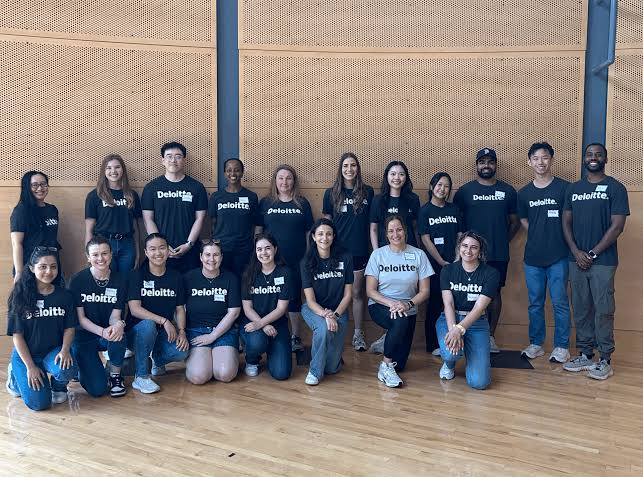
Deloitte's Impact Day deploys thousands of employees globally in a single coordinated day of skills-based service. What makes it work is not the scale but the year-round project scoping work that precedes it. Deloitte's program team spends months identifying nonprofit partners, scoping specific projects, and matching volunteer teams before Impact Day itself. The event is the culmination of preparation.
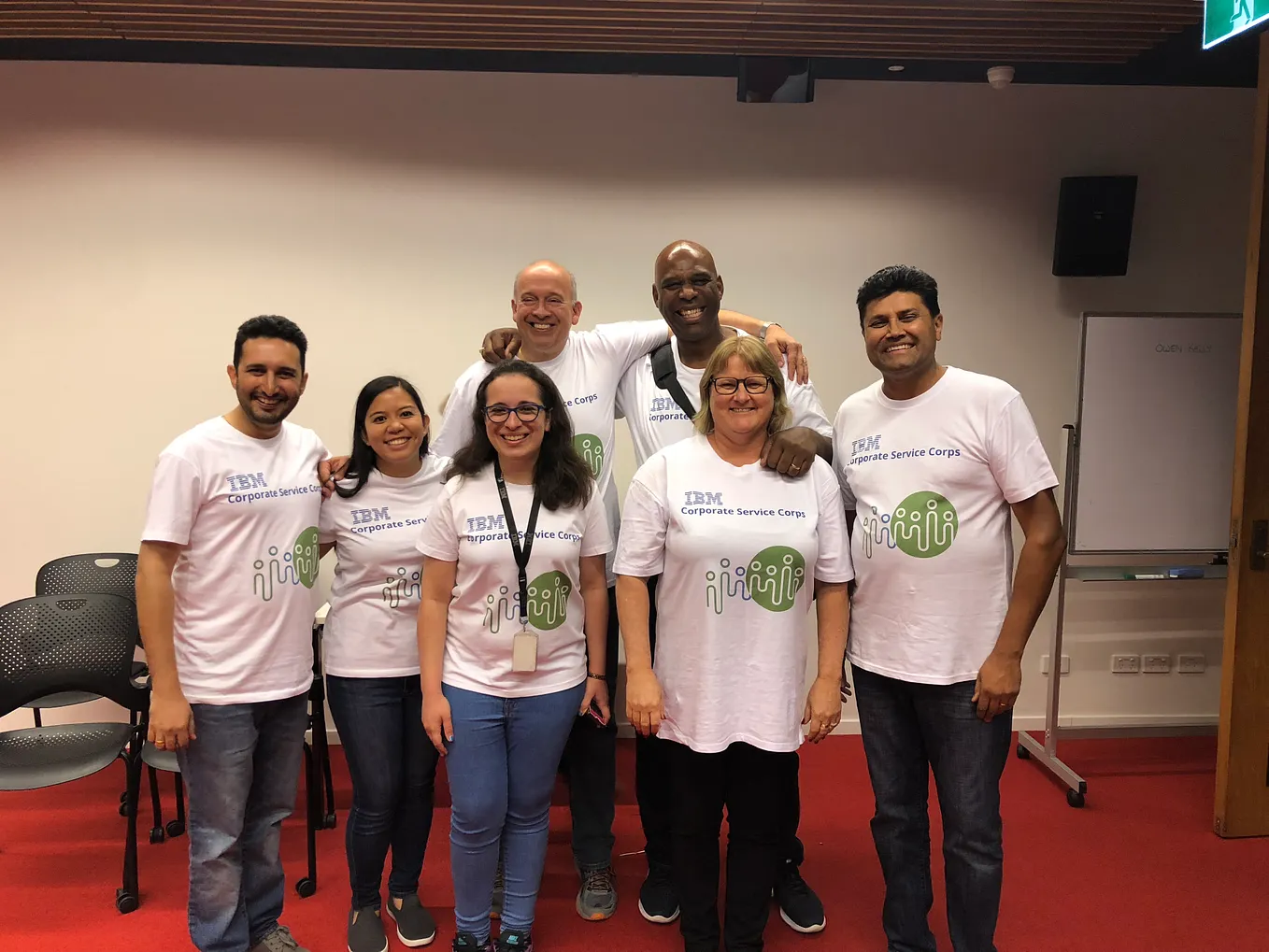
IBM's Corporate Service Corps sends multidisciplinary teams of IBM professionals to developing countries for 4-week immersive engagements with local governments, NGOs, and social enterprises. Since inception, the program has engaged over 4,000 employees across 40 countries. The distinctive design choice: teams are deliberately cross-functional and cross-cultural, meaning an IBM engineer from Brazil works alongside a finance professional from Germany and an HR specialist from Japan.
The Bottom Line: Build It to Last
This 10-step guide functions as a roadmap, where every stage naturally paves the way for the next. Compress it, and the gaps show up at scale, when they might become expensive to fix.
Your employees have expertise that nonprofits in your community desperately need right now. The only thing standing between those two realities is program design.
Start with the readiness audit. Build the measurement framework before the first project launches. Scope with precision. Recognize warmly. Measure relentlessly.
Frequently Asked Questions
1. How long does it take to launch a skills-based volunteering program from scratch?
Realistically, 6 to 8 weeks from readiness audit to first pilot launch. Companies that try to compress this timeline typically skip the nonprofit needs assessment and scoping work, which produces mismatched projects and low volunteer satisfaction. The 6 to 8 weeks timeline is the minimum required to do the foundational work properly.
2. How many employees do you need to start a skills-based volunteering program?
You can run a meaningful pilot with as few as 15 volunteers. What matters more than headcount is skill diversity, i.e., you want coverage across at least 3-4 functional areas so you can match volunteers to varied nonprofit needs. A 15-person team with deep diversity across marketing, tech, finance, and HR will outperform a 50-person team with homogeneous skills.
3. What is the difference between skills-based volunteering and pro bono volunteering?
Pro bono specifically refers to professional services delivered without charge, and it has roots in the legal profession ("pro bono publico," meaning "for the public good"). Skills-based volunteering is a broader concept that encompasses pro bono professional work but also includes teaching, coaching, mentoring, and knowledge transfer that may not have a direct commercial equivalent. All pro bono work is skills-based volunteering; not all skills-based volunteering is strictly pro bono.
4. How do you find nonprofit partners for a skills-based volunteering program?
Start with nonprofits in your existing community investment portfolio, it can be organizations you already fund which are natural first partners because trust is established. Expand through platforms like Goodera, Catchafire, or the Taproot Foundation's matching services. For companies with specific issue-area focus (education, climate, economic inclusion), sector-specific nonprofit networks are the most efficient sourcing channel.
5. How do you get employees to actually participate in skills-based volunteering?
The three highest-impact participation drivers are: protected work time (employees who must volunteer on personal time participate at 40% of the rate of those given work-hours allocation), skills-to-cause matching (participation is highest when employees contribute skills they are proud of to causes they personally care about), and peer visibility (when employees see respected colleagues participating and sharing their experiences, organic uptake follows). Public recognition and leadership participation are multipliers on all three.
6. Can small companies (under 200 employees) run skills-based volunteering programs?
Yes, and in some ways more effectively than large ones. Small companies have flatter structures, which means project scoping decisions happen faster, volunteer matching is more personal, and program adjustments can be made in real time. The constraint for small companies is skill coverage, so a 50-person tech company will have deep technical skills but limited finance, legal, or HR capacity. The solution is cross-company skills-based volunteering coalitions, where 3-4 small companies pool their volunteer capacity to serve nonprofits together.
7. What is the right amount of volunteer time to request from employees?
Industry benchmarks suggest 3-5% of annual work hours as a sustainable skills-based volunteering allocation, approximately 6-10 days per year. Salesforce's 56 hours of paid VTO (roughly 7 full days) sits at the high end of this range and is considered a gold standard. For companies new to skills-based volunteering, starting with 2 days of protected volunteer time annually and building from demonstrated value is a more politically viable approach.
8. How do you prevent volunteer burnout in skills-based volunteering programs?
The three burnout drivers are open-ended time commitments (no defined project end), unclear role definition (volunteers being unsure what they are responsible for), and absence of impact visibility (volunteers cannot see whether their work made a difference). Time-bound projects with clear deliverables and visible outcomes have dramatically lower burnout rates than open-ended engagements.
9. How do you measure the financial ROI of a skills-based volunteering program for an internal business case?
Use a three-part calculation. First, community value generated: total skilled volunteer hours multiplied by $150 (Taproot's pro bono market rate benchmark). Second, talent ROI: calculate the cost of replacing employees who stay because of skills-based volunteering access (using a standard 0.5-2x annual salary replacement cost estimate) against the cost of the program.
Third, employer brand value: quantify the improvement in application quality and volume following public skills-based volunteering program communications. Together these three figures typically produce a program ROI of 3-5x for companies running well-structured skills-based volunteering initiatives.
10. What is the most common reason skills-based volunteering programs fail in year two?
Loss of novelty without replacement by infrastructure. The programs that survive and scale in year two are those that built strong measurement infrastructure (Step 3), robust recognition systems (Step 9), and a pipeline of new nonprofit partnerships (Step 2 is ongoing, not one-time). The programs that collapse are those that assumed year one momentum would carry forward automatically.
Ready to build your skills-based volunteering program? Explore how Goodera helps companies plan volunteering at scale, from nonprofit matching and project scoping to impact measurement and volunteer recognition.
For more on corporate volunteering strategy, read Goodera's complete guide to corporate volunteering programs and explore the State of Corporate Social Impact.