How CSR Program Management Tools Compare on Scalability and Impact Reporting

As corporate volunteering programs grow, so do the operational and reporting demands behind them. A platform that works well for a few offices or a single region may need to support thousands of employees, multiple business units, and programs running across different countries, all while producing consistent, reliable impact data.
That is why scalability and impact reporting are often evaluated together. Expanding a volunteering program means managing more participants, nonprofit partners, activities, and regional data without making reporting more complex or time-consuming.
This piece looks at how the four tools most commonly evaluated in this category, Goodera, Benevity, Bonterra Deed, and YourCause from Blackbaud, handle that linkage, and how to work out which breaking point you're closest to.
Why Scalability and Reporting Are One Problem
What “Scalability” Realistically Means Here
It rarely means software falling over under load. Modern cloud infrastructure handles volume without drama. What breaks is workflow logic: approval chains built for one region, currency and language settings hardcoded for a single market, volunteer matching rules that quietly assume a headquarters-centric program.
A tool that scales well keeps its configuration layer separate from its data layer, so you can add a business unit, a cause area, or a country without re-architecting the reporting underneath. It sounds like an IT concern. It's actually the best single predictor of whether your platform still makes sense in three years.
The Three Points Where Programs Break Their Tools
The first usually arrives somewhere around 5,000 to 10,000 employees, when a program stops being one HR-owned initiative and becomes a cross-functional effort across ERGs, regional offices, and multiple business units.
The second arrives with a new program type, moving from volunteering into skills-based engagement, matching gifts, or disaster relief. Each generates a differently shaped set of data.
The third is the expensive one, and it shows up at reporting season, when someone asks for outcome data tied to a specific ESG framework rather than a count of hours. CECP's Giving in Numbers: 2025 Edition, published October 16, 2025, found that companies with metrics in place to align business practice with corporate purpose reported 25% higher median revenue and 22% higher median pre-tax profit than companies without them. The same research put average volunteer participation at 25%.
Hold those two findings next to each other. The business case is strong and measurable. Participation is at a quarter. Some of that gap is strategy. A surprising amount of it is tooling.
The CSR Reporting Maturity Model
Most programs move through three reporting stages, and each asks more of the platform underneath. Knowing where you sit tells you which capabilities matter now, rather than which ones demo well.
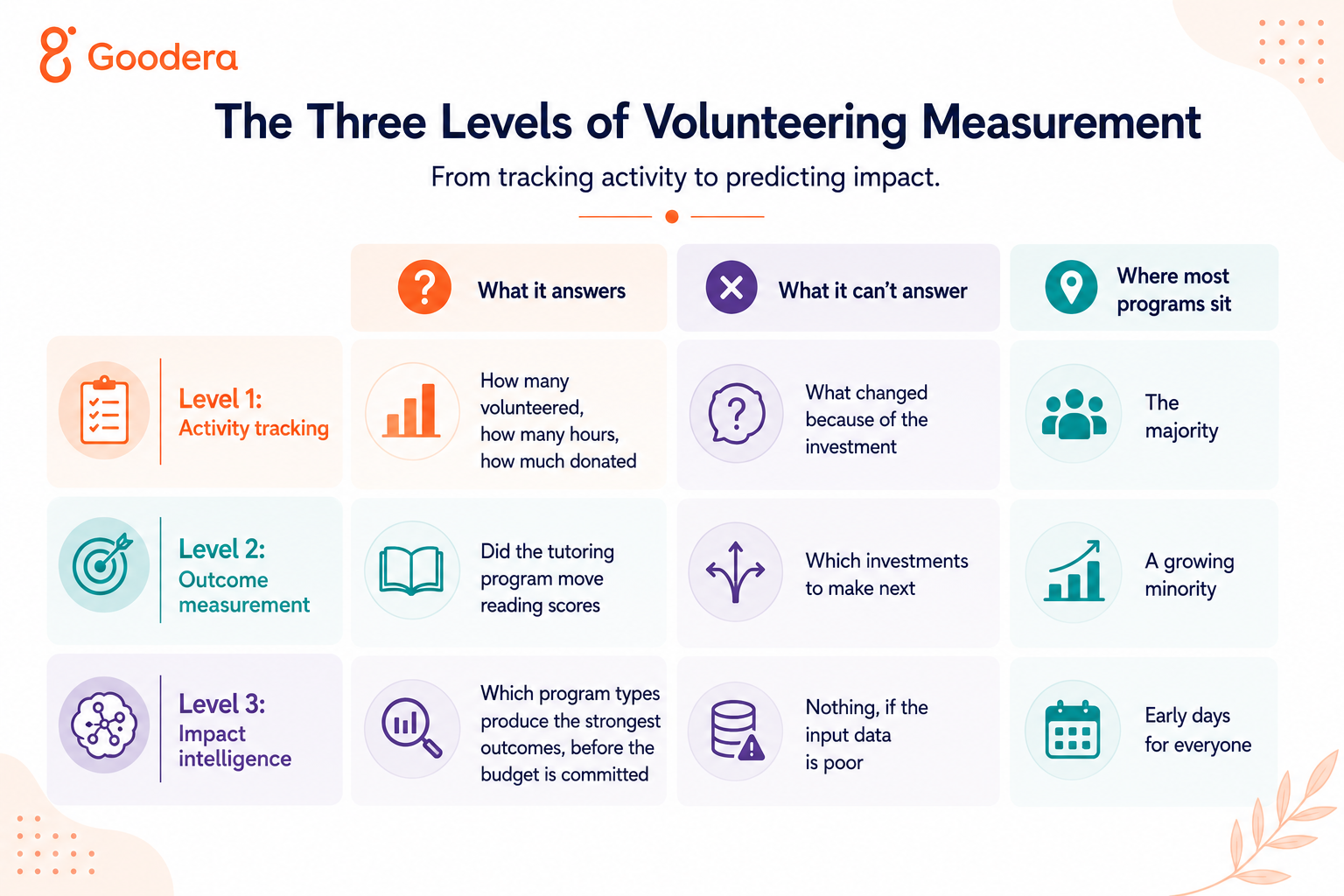
Level 1: Activity Tracking
Hours logged, dollars donated, employees participating. Every serious tool on the market handles this competently, and it's genuinely useful for reading program health at a glance.
The limit is that activity data can't answer the question a CFO eventually asks. It proves participation. It doesn't prove impact, and the sector is starting to feel that. Benevity's State of Corporate Volunteering 2026 found that while corporate volunteer hours hit a record 23.7 million in 2025, up 175% since 2019, only about 20% of nonprofit leaders say corporate volunteers contribute meaningfully to their long-term capacity. Average hours per volunteer fell from 16.4 to 12.7 over the same six years. Participation is up; depth is down. A Level 1 report shows you only the first half of that.
Level 2: Outcome Measurement
This connects an activity to a result, a literacy tutoring program to reading scores among the students served. It's a meaningfully harder data problem, because the platform has to capture beneficiary-level and qualitative data, which means getting nonprofit partners to report structured results back in.
Platforms that get here build structured intake forms for nonprofits, standardized outcome categories, and dashboards that let you compare program types on a common basis. This is where enterprise tools separate from point solutions.
Level 3: Impact Intelligence
The top tier uses aggregated portfolio data to surface patterns an analyst would take weeks to find, and to forecast which investments are likely to produce the strongest outcomes before money is committed.
It depends entirely on data quality coming in from every partner, corporate and nonprofit alike, which is where it usually stalls. As Deepa Chaudhary, Founder of Grant Orb, put it in Goodera's AI for NPOs webinar in late 2025: "When nonprofits don't understand what AI can do for them, they don't just lose efficiency, they lose voice."
That's a tool-selection point as much as a sector one. A platform's intelligence layer is only as good as the weakest data source feeding it, and the weakest source is usually a small nonprofit with no analyst and no time.
The Data Architecture Problem
Underneath the scalability conversation sits an architecture question that rarely gets asked early enough: how does this platform structure, store, and connect your data?
Why Siloed Data Is the Most Common Failure
Most CSR programs start with separate systems for volunteering, giving, and grantmaking, adopted at different times by different teams. Each produces reports in its own format, and someone on the CSR team becomes an unofficial data integration specialist, stitching spreadsheets together every quarter.
That's a completely understandable way to end up, given how these programs actually grow. It's also the most common reason a program that looks strong on paper still takes weeks to report on.
What a Unified Architecture Looks Like
A unified model treats giving, volunteering, grantmaking, and ERG activity as expressions of one underlying impact record, tied to a shared employee, program, and nonprofit taxonomy. A total community investment report pulls donation dollars, volunteer hour valuations, and in-kind contributions from one source, with no reconciliation step.
Newer products build this in rather than bolting it on. Bonterra Deed, launched July 7, 2026, combines Deed Engage with Deed Grants so CSR teams can manage giving, volunteering, and grantmaking "from a single system with one unified view of impact." Bonterra is specific about the mechanism, too: the two products share a common data layer, which is what produces "a unified view of participation, funding, and outcomes without manual reconciliation."
That phrase is worth borrowing when you're in a demo. Ask any vendor whether their modules share a data layer or exchange exports. The answer tells you most of what you need to know.
Integration as a Scalability Strategy
For most enterprise teams, the tool is only part of the stack. It has to connect to HRIS for employee data, payroll for payroll giving, and increasingly to ESG reporting software for disclosure. How openly a platform integrates real APIs, pre-built connectors often predicts long-term scalability better than any individual feature.
The clearest recent example is the Goodera–Benevity API integration, live since February 2026 across a shared base of 100+ enterprise clients. Events created in Goodera appear automatically in Benevity and registration data syncs across, removing a reconciliation step that Benevity's own figures put at up to 30 hours per event for volunteer champions.
The general principle: teams that prioritize integration early tend to find their reporting burden shrinks as the program grows. Teams that don't find it grows alongside.
How the Four Compare on Scalability
Goodera: Execution-Layer Data at Global Scale
Goodera is a managed volunteering service, and its scaling problem is a different one from processing donations: running events across many countries and languages at once, in the physical world. It works with 500+ businesses, 65 of them Fortune 500 companies, across 1,000+ cities in 100+ countries, with a network of 50,000+ nonprofit partners across 50+ cause areas and events hosted in 30+ languages.
Founder and CEO Abhishek Humbad, in a September 2025 CXOToday interview, described the operating model as "Airbnb for volunteering", with over two million volunteers engaged to date, 2,500 trained hosts, and an NPS above 80. One detail from that interview is more revealing than the headline numbers: more than 80% of Goodera's events now happen inside offices. That's a scaling decision, not a delivery preference. In-office events remove travel, scheduling, and site-access variables, which is what makes a coordinated multi-country day tractable at all.
On the reporting side, the relevant features are the API layer, a Champion PMO tool for coordinating regional program managers, and Goodera 365, a fixed annual fee designed so participation can grow without triggering a new budget conversation each time.
Against the two breaking points: Goodera addresses the first well; adding geographies doesn't require new internal event infrastructure. For the second, it's volunteering-shaped data. If your reporting needs to unify giving and grants alongside it, that's the Benevity integration's job rather than Goodera's.
Benevity: Governance at Scale
Benevity's scalability argument is built on transaction volume and compliance. Per its State of Corporate Purpose 2026 report, published July 9, 2026, the Benevity community facilitated $2.7 billion in donations and nearly 24 million volunteer hours across 312,000 nonprofits in 2025, with a record 1.87 million employees participating.
"Simply put, companies can no longer design and execute purpose the way they did just 6 years ago in the face of the pandemic and racial justice movement."
— Sona Khosla, Chief Impact Officer, Benevity, July 2026
Three Benevity nonprofit numbers circulate, and they mean different things, which is worth untangling before you put any of them in a board deck. Over 2 million are vetted and available for employees to choose from. 312,000 actually received support in 2025. More than 560,000 have received support cumulatively since 2008.
The 2 million is the governance claim: employees can give broadly without the CSR team running manual due diligence on each recipient, backed by third-party vetting through TechSoup Global and ongoing sanctions screening through Moody's.
For the second breaking point, adding a program type, that governance layer is the strength. For the first, when the constraint is running events on the ground in new markets, it's software, and execution sits with you or a partner.
Bonterra Deed: Engagement Plus Grantmaking
Bonterra's pitch is removing the tradeoff between an engaging employee experience and enterprise grantmaking controls, two things that historically lived in separate systems. It acquired Deed in March 2026 and launched the combined product in July.
"Employees do not want another clunky portal. They want to do good in seconds."
— Scott Brighton, CEO, Bonterra, March 2026
Across the Bonterra network in 2025, the platform supported $28 billion in giving, including $8.94 billion in grants and $958 million in employee donations, plus 16.2 million volunteer hours. Early deployments cited at launch: Ripple at 78% employee participation, Instacart up at least 40% across programs, Kyndryl exceeding participation goals by 50%.
Two caveats for a scalability evaluation. Bonterra Deed doesn't run a facilitation network, so on-the-ground execution isn't part of it. And at launch, the product is available to enterprise organizations in the US and Canada, even though the nonprofit reach behind it spans 170+ countries. Commercial availability and nonprofit coverage are different questions, and only one of them is usually on the vendor slide.
YourCause from Blackbaud: Reporting Layer Inward
YourCause approaches scale from the reporting end. Impact Edge is a dedicated reporting and storytelling product sitting alongside CSRconnect and GrantsConnect, with AI features that let teams generate narrative reporting from program data rather than building a fresh dashboard for every request.
The more substantive move is on outcomes. Blackbaud announced a partnership with True Impact in January 2025, bringing outcome-based measurement data directly into Impact Edge, then expanded it in September 2025 with a Candid-powered Charity Discovery Tool.
This suits teams whose constraint isn't participation volume but the sophistication of the outcome story they need to tell, year over year, to a board that's read the last one.
How They Compare on Impact Reporting
Output Reporting: The Baseline
Hours, dollars, participants. Every major platform does it, and it's genuinely useful for tracking program health.
It falls down on resource allocation, because two programs with identical hour counts can produce completely different community outcomes. Teams relying on output data alone tend to struggle to justify budget with the specificity finance now expects.
Outcome Reporting: The Differentiator
This requires connecting your activity data to results reported by the nonprofit or community partner. Few platforms have solved it cleanly, because it depends on partners reporting structured results back and most nonprofits are already drowning in bespoke reporting requests from every funder they have.
"By integrating True Impact's outcome-driven insights with the AI-powered capabilities of Impact Edge, we're helping companies seamlessly embed impact data into their daily workflows."
— Farron Levy, founder and CEO, True Impact, January 2025
The more interesting development is what came next. True Impact launched an Impact Reporting Network with Charity Navigator in early 2026, letting a nonprofit produce one expert-reviewed impact report and share those results across participating platforms, YourCause among them. That's an attempt to fix the bottleneck, the reporting burden sitting on nonprofits rather than building another dashboard on the corporate side. Worth watching, because outcome reporting doesn't scale until that problem is solved by somebody.
ESG Disclosure Readiness
Regulation has moved this from nice-to-have to baseline. The EU's Corporate Sustainability Reporting Directive was substantially revised by the Omnibus I package, Directive (EU) 2026/470, published February 26, 2026 and in force March 18 which raised thresholds sharply and narrowed near-term scope.
The narrowing is dramatic: roughly 90% of the companies once projected to fall under CSRD, about 42,000 of an estimated 50,000, are now out of scope. What remains is the largest tier i.e. EU companies above 1,000 employees and €450 million turnover, plus non-EU parents meeting equivalent EU thresholds. Those companies report in 2028 on fiscal year 2027 data.
Read that as relief and you'll be caught out. If your CSR program supports a multinational parent, FY2027 starts in seventeen months, and the data structures that feed a compliant submission need to exist before the fiscal year they're describing. Disclosure readiness is a platform question now, not a 2028 question.
What To Prioritize at Each Stage
- Pilot. Setup speed and employee adoption beat disclosure depth. The job is proving value internally, so look for something that launches with minimal configuration and gives you clean output reporting to share within a quarter.
- Growth. Data architecture and integration flexibility. This is when new program types and new regions arrive. Unified data models and real API access matter far more than they did at pilot, because retrofitting a siloed system costs considerably more than choosing well now.
- Enterprise. Outcome measurement, disclosure alignment, and governance controls. Leadership and external stakeholders expect something activity tracking can't provide, and integration with HRIS, finance, and enterprise ESG platforms stops being optional.
Five Reporting Capabilities That Are Now Baseline
- Unified data architecture connecting giving, volunteering, grantmaking, and ERG activity without manual reconciliation. Ask whether modules share a data layer or exchange exports.
- Outcome-linked reporting tying activities to community-level results, not just participation counts.
- Disclosure-ready exports aligned to CSRD and the ESRS structure, plus clean extracts for benchmarking surveys like CECP's Giving in Numbers.
- Open integration through APIs reaching HRIS, payroll, and ESG reporting software.
- AI-assisted narrative reporting that cuts the manual hours spent rebuilding the same dashboards each quarter.
A tool missing several of these isn't disqualified. But it's worth a hard conversation before a multi-year contract, because these are the capabilities that determine whether year three is easier than year one or considerably harder.
Frequently Asked Questions
What does scalability actually mean for a CSR program management tool?
That the platform can absorb new countries, business units, and program types without a rebuild of its reporting structure. The technical marker is separation between the configuration layer and the data layer, so growth doesn't compromise report accuracy.
Why is impact reporting part of scalability rather than a separate feature?
Because every new program dimension adds a data stream that reporting has to reconcile. A platform that scales operationally but can't absorb that data cleanly still leaves you with a broken reporting process and you've just moved the problem downstream.
What's the difference between output reporting and outcome reporting?
Output reporting tracks activity: hours volunteered, dollars donated. Outcome reporting connects that activity to measurable community results, such as improved literacy scores, and depends on nonprofit partners returning structured data. Output is a platform capability. Outcome is a partnership capability with a platform attached.
How many employees typically participate in corporate volunteering programs?
CECP's Giving in Numbers: 2025 Edition, published October 16, 2025, put average volunteer participation across surveyed companies at 25%, with smaller companies and the materials industry showing the highest engagement.
Do purpose-driven CSR programs affect business performance?
CECP's 2025 research found companies with metrics in place to align business practice with corporate purpose reported 25% higher median revenue and 22% higher median pre-tax profit than companies without them. Giving in Numbers draws on data shared by hundreds of multi-billion-dollar companies over more than two decades of the survey.
What is CSRD and does it still apply to most companies in 2026?
The Corporate Sustainability Reporting Directive is the EU's standardized sustainability disclosure regulation. The Omnibus I revision, in force March 18, 2026, narrowed scope to companies above 1,000 employees and €450 million turnover, taking roughly 90% of previously projected filers out of scope. Those still in report in 2028 on FY2027 data.
How does Goodera differentiate on scalability?
By solving for execution across geographies rather than transaction volume. It runs events in 1,000+ cities across 100+ countries in 30+ languages, supported by trained hosts, an API layer, a Champion PMO tool for regional coordination, and Goodera 365's fixed annual fee, which lets participation grow without a new budget cycle each time.
What makes Bonterra Deed different from a standard employee giving platform?
It pairs an AI-powered engagement experience with enterprise grantmaking controls in one product, with Deed Engage and Deed Grants sharing a common data layer rather than exchanging exports. Launched July 2026, currently available to enterprises in the US and Canada.
How does YourCause from Blackbaud approach impact reporting?
Through Impact Edge, which brings third-party outcome data in via a True Impact partnership announced in January 2025 and expanded with a Candid-powered Charity Discovery Tool in September 2025, alongside AI features for generating narrative reporting from program data.
When should a company move from a growth-stage tool to an enterprise-grade platform?
Usually when leadership starts asking for outcome data tied to ESG frameworks instead of participation counts, or when multinational disclosure requirements come into view. At that point governance and outcome reporting outweigh ease of setup.