Key Benefits of Corporate Volunteering Programs for Employee Engagement in 2026

Keeping employees engaged has become more challenging as organizations navigate hybrid work for global teams, changing employee expectations, and increasing pressure to build a workplace where people feel connected to each other and to the company's purpose. Companies have invested in everything from wellness initiatives to learning programs, but not every intervention delivers the outcomes leaders hope for.
Research supports that observation. In 2024, the Oxford Wellbeing Research Centre evaluated workplace wellbeing interventions across 46,336 employees in 233 organizations. Among the wide range of programs studied, volunteering was the only intervention found to deliver a measurable improvement in employee wellbeing at a collective level.
That finding helps explain why corporate volunteering has become a core employee engagement strategy rather than an occasional CSR initiative. Beyond supporting communities, well-designed volunteer programs strengthen employee wellbeing, improve retention, build workplace skills, foster stronger teams, and reinforce employer brand and ESG commitments. This guide explores the key benefits of corporate volunteering programs for employee engagement in 2026, backed by the latest research, data, and practical examples.
Why 2026 Is a Defining Year for Corporate Volunteering
The Numbers Behind Corporate Volunteering Growth
The scale of growth in corporate volunteering over the past six years is difficult to overstate. According to Goodera’s Global Corporate Volunteering Quotient (VQ) Report 2026, median global workforce participation in volunteering programs reached 25.6%. For companies tracking data consistently over a three-year period, participation climbed from 22.0% to 28.6%, reflecting a strong 19.7% Compound Annual Growth Rate (CAGR).
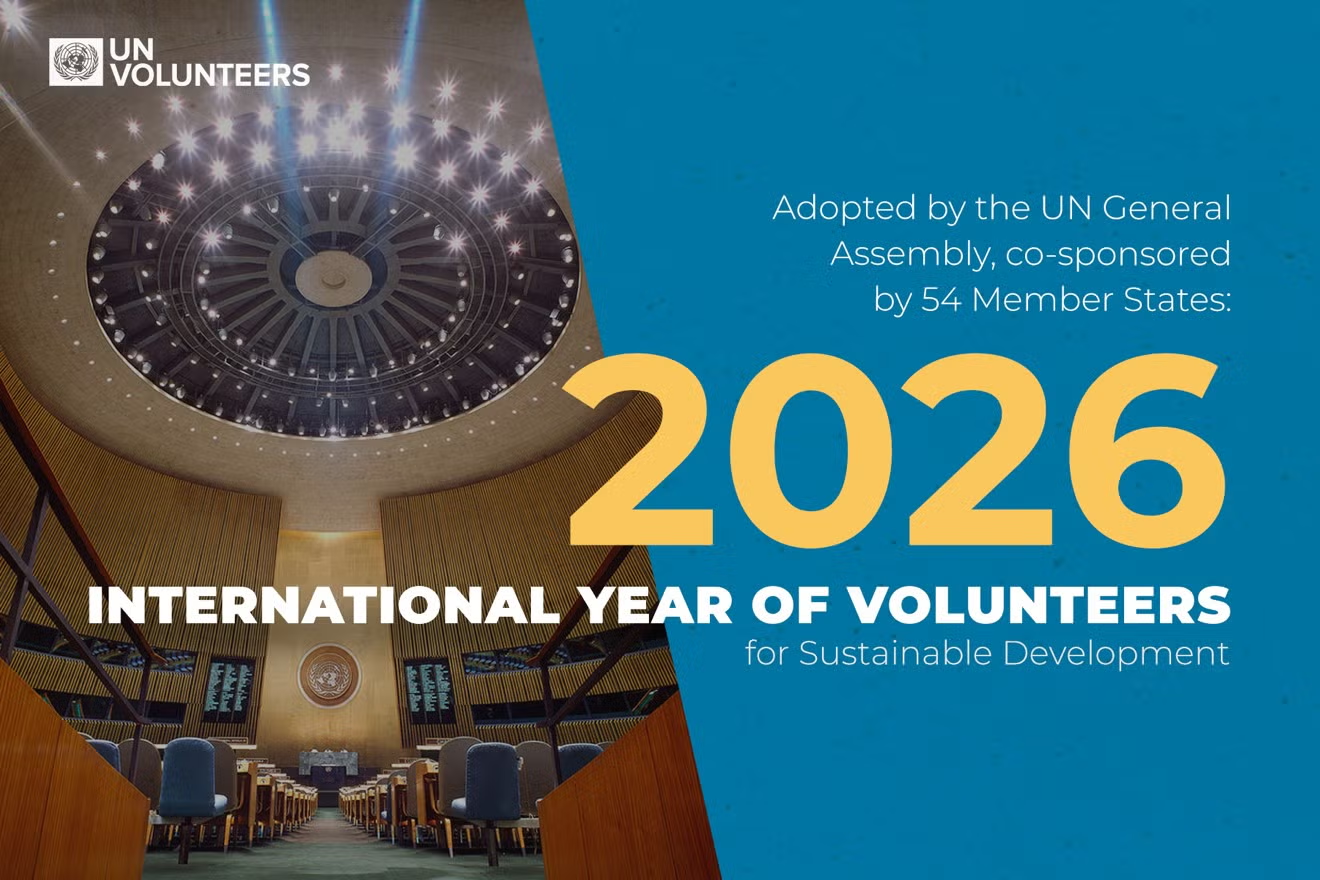
The ACCP's 2025 CSR Insights Report found that 61% of CSR professionals reported increased employee volunteerism in 2025, the third consecutive year of growth. Employee engagement budgets showed the sharpest year-over-year increase of any CSR investment category in the same period. The United Nations' formal designation of 2026 as International Volunteer Year has further amplified that momentum, bringing global institutional attention and resources to the case for structured volunteering.
The "Quiet Cracking" Problem That Volunteering Addresses
Alongside this growth in volunteering participation, a different data point has been forcing its way into the CSR conversation. Gallup's 2024 State of the Global Workplace Report found that employee engagement in the U.S. hit a 10-year low in 2024, with only 31% of employees remaining engaged in their jobs. That figure represents approximately 3.2 million employees who became newly disengaged since 2023 and 8 million fewer engaged employees since 2020.
CSR professionals and organizational leaders have named this phenomenon "quiet cracking": employees who are still showing up, still performing, but are emotionally exhausted, increasingly detached, and quietly evaluating their options.
Data from the ACCP 2025 Making the Case Toolkit and 6th Annual CSR Insights Report underscores structured corporate volunteering as a premier organizational response to workforce detachment. With 91% of tracking companies reporting a positive impact on engagement scores, intentional volunteering addresses foundational employee needs like purpose and social connection rather than just treating the symptoms of workplace burnout.
The Core Benefits of Corporate Volunteering for Employee Engagement
Benefit 1: Volunteering Is the Only Workplace Intervention Proven to Improve Collective Wellbeing
The Oxford study referenced above, published in the Industrial Relations Journal in 2024 and authored by William J. Fleming, Unilever Research Fellow at the Oxford Wellbeing Research Centre, analyzed employee participation across approximately 90 wellbeing interventions including mindfulness apps, resilience training, relaxation classes, mental health coaching, financial wellbeing programs, and sleep tools. The conclusion was unambiguous: the only intervention to show consistent improvement in employee wellbeing at a collective level was volunteering.
As Fleming noted in commentary on the research: "Volunteering satisfies many of the classificatory questions: it is generally promoting of a good life, it involves individual behavior and active participation, and is linked to wellbeing through psychological improvements." Separately, a randomized field experiment published in Management Science in 2024 found that employees of a financial institution who participated in a one-day volunteering activity demonstrated a 50% reduction in turnover after one year compared to those who did not participate.
For CSR leaders making the internal case for volunteering program investment, this is the most credible data point available. Wellbeing programs are widely adopted and widely invested in. Volunteering is the one that actually moves the needle.
Benefit 2: Retention That Shows Up in the Numbers
The retention case for corporate volunteer programs has accumulated enough evidence across enough studies to be considered settled at this point. Corporate engagement findings from Bonterra’s Workplace Giving Data reveal that employees who are actively engaged in corporate giving and volunteering initiatives are 57% less likely to leave their jobs. For newer employees specifically, the protective effect is particularly strong.
A 2024 Deloitte study found that 95% of workers believe it is important that their employer makes a positive impact in their community, and 87% said that workplace volunteer opportunities are crucial in deciding whether to stay with their current employer or pursue a new one. Given that the cost of replacing a single mid-level employee typically ranges from 50% to 200% of their annual salary, the financial value of even a modest retention improvement from a well-designed volunteering program is significant relative to its operating cost.
Benefit 3: Skill Development That Feeds Back Into the Organization
Corporate volunteering, and skills-based volunteering in particular, is increasingly recognized as a genuine component of organizational learning and development rather than an ancillary benefit. Goodera's Volunteering Quotient Report 2026 found that 92% of business leaders agree that skills-based volunteering builds professional capabilities in their employees. The same report identified skills-based volunteering as transitioning from a niche offering to a core L&D strategy across the companies surveyed.
The development pathway is not incidental. Employees who volunteer in cross-functional, real-world contexts develop project management discipline, stakeholder communication, adaptability, and cross-cultural collaboration in environments where the stakes are genuine rather than simulated.
These are precisely the capabilities that rank highest in competency frameworks across most industries, and they develop faster in applied volunteering contexts than in equivalent classroom training settings, as confirmed by the 70-20-10 learning model, which attributes 70% of professional skill development to on-the-job experience.
Benefit 4: Employer Brand That Attracts the Talent You Want
The employer brand dimension of corporate volunteering programs has grown more commercially significant as the workforce composition has shifted. Deloitte's 2025 Gen Z and Millennial Survey found that 89% of Gen Z and 92% of Millennials say having purpose in their work is important to their job satisfaction, both figures up from the prior year. Together, these two cohorts now represent the majority of the global workforce.
An IBM study cited by the ACCP found that 70% of job seekers are more likely to apply for and accept a position at a socially responsible company. For talent acquisition teams managing competitive hiring pipelines, a well-communicated corporate volunteering program is a differentiator that candidates can verify through Glassdoor reviews, LinkedIn posts from current employees, and published impact reports. It provides proof rather than promise.
Benefit 5: Team Cohesion and Cross-Functional Connection
Volunteering creates the conditions for genuine interpersonal bonding in a way that most team-building activities do not. Research published by the Stanford Graduate School of Business in 2022 found that volunteering was associated with strengthened interpersonal bonds and increased employee identification with their employer. The mechanism is social: shared purpose in a non-competitive, community-facing context generates trust and connection that carries back into the workplace.
A Deloitte workplace survey found that 70% of employees say that volunteering boosts morale and team spirit more than conventional company-sponsored events. For companies managing hybrid and distributed teams where organic relationship formation is structurally limited, team volunteering creates one of the few reliable contexts in which employees across functions and geographies build relationships with shared memory and meaning attached.
Benefit 6: ESG and Business Resilience Signal
Data from Goodera's Insights establishes that 76% of companies report structured Corporate Social Responsibility (CSR) and volunteering initiatives significantly mitigate long-term brand reputation risk. As ESG disclosure frameworks such as the EU's Corporate Sustainability Reporting Directive and GRI 413 on Local Communities require documented evidence of community engagement and investment, structured volunteering programs generate exactly the kind of auditable impact data that satisfies those requirements.
Volunteering hours logged against verified nonprofit engagements, with documented outcomes and the Taproot Foundation's $220/hour pro bono value benchmark, translate directly into quantifiable community investment figures that belong in ESG disclosures. For CSR leaders operating under increasing pressure from investors, customers, and regulatory stakeholders to show evidence rather than intention, this measurability is itself a strategic benefit.
The Engagement Mechanism: Maximizing Impact Relative to Alternative Workplace Programs
The Five Psychological Drivers of Volunteering-Led Engagement
Understanding why volunteering consistently outperforms other workplace interventions on engagement metrics requires understanding the psychological mechanisms at work. Five drivers, operating simultaneously, explain the effect.
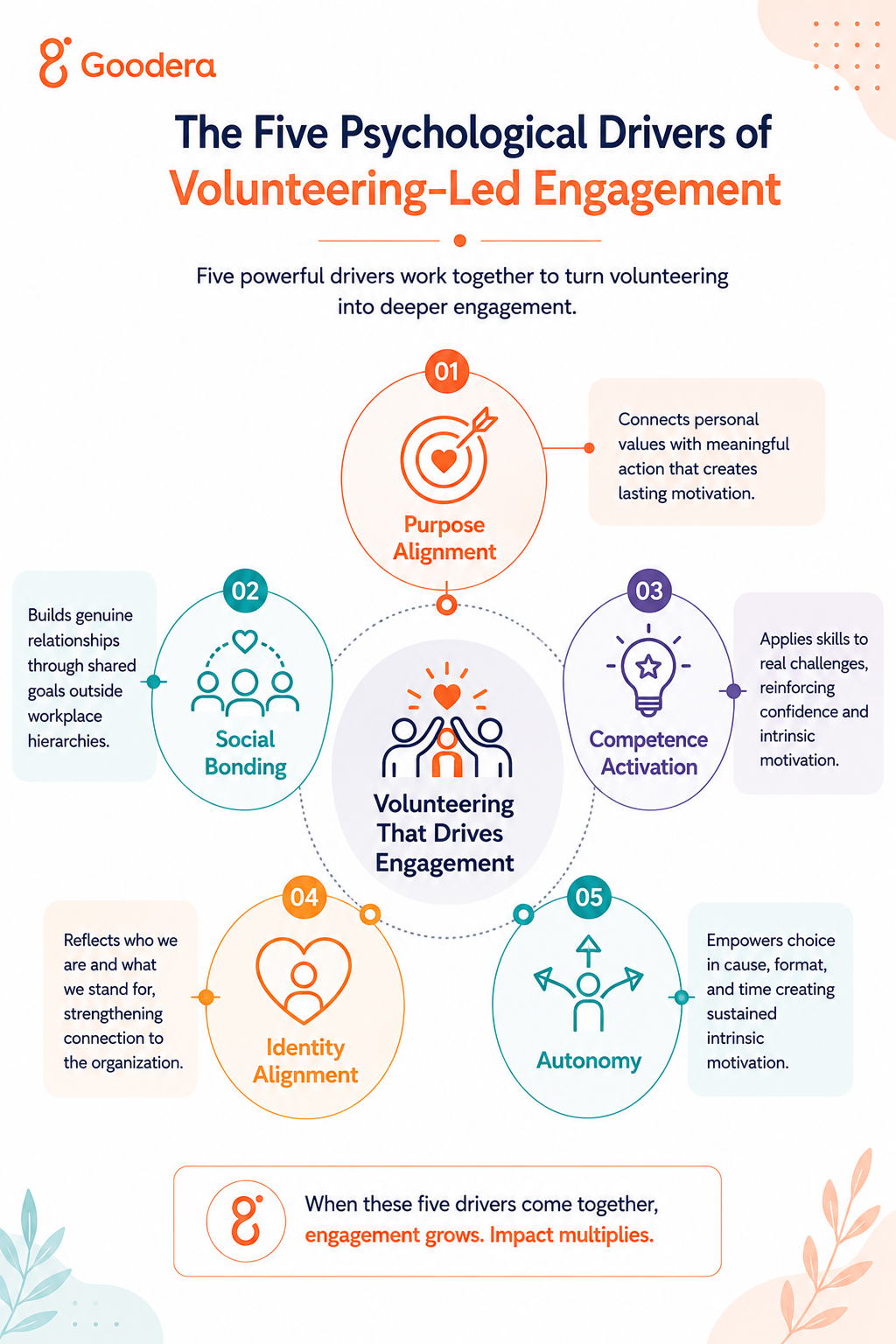
- Purpose alignment is the most foundational. When an employee volunteers for a cause that connects to their personal values, they experience a direct line between their actions and something that matters to them. This alignment produces a quality of motivation that discretionary effort frameworks in organizational psychology consistently identify as the highest-performing form of work engagement.
- Social bonding occurs when people collaborate on meaningful shared goals in contexts outside their professional hierarchy. Volunteering removes the status dynamics and competitive pressures of the workplace and creates conditions for genuine peer connection. Bonds formed in these contexts are more durable than those formed through conventional networking.
- Competence activation describes the experience of applying professional skills in a genuinely challenging context where the stakes are real. When an employee solves a nonprofit's operational problem using their domain expertise, the experience of productive competence reinforces professional confidence and intrinsic motivation.
- Identity alignment emerges when an employee's external contribution reflects positively on their sense of who they are and what they stand for. Research on organizational identification consistently finds that employees who see their company's values reflected in its actions, rather than just its communications, report stronger identification with and commitment to the organization.
- Autonomy is the fifth driver. Volunteering programs that allow employees to choose their cause area, format, and time commitment activate autonomy in a way that prescribed corporate programs rarely do. Psychological research on self-determination theory identifies autonomy as one of the three core human needs that, when met, produces sustained intrinsic motivation.
These five drivers do not operate independently. They reinforce one another, which is why the engagement impact of well-designed volunteering programs tends to compound rather than plateau over time.
The Depth vs. Breadth Problem in Corporate Volunteering
Participation Is Up, but Depth Is Declining
The headline numbers in Goodera’s Corporate Volunteering Trends 2026 are compelling. But the data surfaces a pattern that CSR leaders need to take seriously: employee participation in corporate volunteering programs is increasing, but the depth of engagement is not.
While median workforce participation has grown steadily to 25.6%, Goodera’s global tracking metrics reveal that active depth remains shallow, with volunteers contributing a global median of just 6.2 hours per employee annually. Most employees participate only once or for a short period of time without a clear path back, reflecting a broader shift toward shorter, more transactional micro-volunteering formats.
This is not a failure of the volunteering model. It reflects a rational adaptation to workforce schedules, the normalisation of micro-volunteering, and the growing accessibility of digital platforms that make bite-sized participation possible. The challenge it creates is that shallow engagement, however broad, does not consistently generate the psychological depth required to produce the full range of engagement benefits described above. High participation numbers with low average hours per volunteer is a program that is reaching many employees at the surface rather than fewer employees more meaningfully.
What Program Design Determines Whether Benefits Materialize
The engagement benefits of corporate volunteering are not automatic. They materialize reliably under specific program design conditions, and they are weaker in their absence. CSR leaders who want the outcomes described in this article need to build programs around five design principles.
- Cause Alignment
Cause alignment means giving employees genuine choice over the causes they support rather than assigning them to the most convenient or largest program. Cause-matched volunteers report higher satisfaction and stronger engagement lift than those assigned by default.
- Format Flexibility
Format flexibility means offering a range of participation formats, from multi-week skills-based projects to one-hour micro-volunteering tasks, so that employees at different life stages and career moments can participate at the depth that suits them. Goodera’s research shows that employees at well-structured programs volunteer at three times the rate of those at poorly structured ones, with structured enablers yielding up to 1.9 times higher overall participation than programs without them.
- Protected Time
Protected time is perhaps the single biggest program design lever. The SHRM 2024 survey found that companies offering paid time off for volunteering reached 28% of employees, a figure that continues to rise. Employees who must volunteer entirely on personal time participate at significantly lower rates than those whose companies formally designate work hours for volunteering.
- Leadership Visibility
Leadership visibility means that senior leaders actively participate in and publicly communicate their support for volunteering programs. Visible leadership involvement increases both the legitimacy of the program and the social permission employees feel to participate during work hours.
- Recognition
Recognition means systematically acknowledging volunteer contributions within performance conversations, internal communications, and career development frameworks. Volunteering that is invisible in the formal reward system sends a signal that it is extracurricular rather than valued, which suppresses participation over time.
Measuring the Benefits: A New Framework to Replace Hours Logged
What Most Companies Are Currently Measuring (And Why It Is Not Enough)
The Goodera VQ Report 2026 found that the most common volunteering metrics across companies surveyed remain participation rates and volunteer hours. These are useful for understanding program reach and demonstrating activity at a surface level. They answer the question of how much volunteering happened. They do not answer the question of what changed because of it.
For CSR leaders making the business case for continued or increased investment, participation rates are a starting point, not a conclusion. Boards and CFOs respond to outcomes, and the measurement infrastructure in most corporate volunteering programs is not yet producing outcome data that connects clearly to business performance.
The Outcome Metrics That Tell the Engagement Story
The outcome metrics that create a credible, board-ready engagement story connect volunteering participation directly to the business indicators that organizations already track.
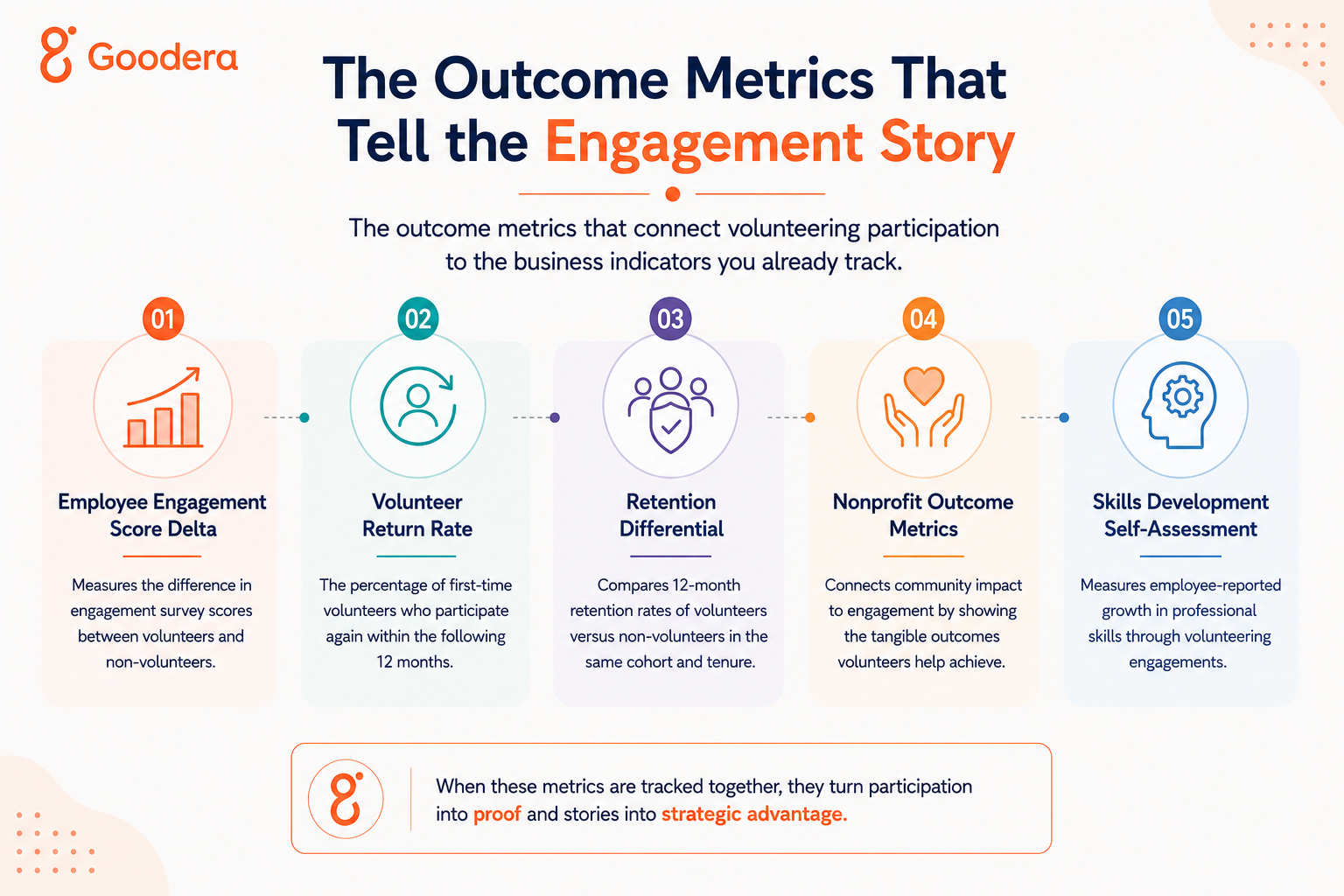
- Employee engagement score delta measures the difference in engagement survey scores between employees who participated in volunteering programs and those who did not. This is the most direct evidence of volunteering's engagement effect and the metric most directly comparable to the investment organizations make in other engagement interventions.
- Volunteer return rate measures the percentage of first-time volunteers who participate again in the following 12 months. High return rates signal genuine engagement value. Declining return rates signal a design problem worth investigating before it becomes a participation problem.
- Retention differential compares the 12-month retention rate of volunteering participants versus non-participants within the same employee cohort and tenure range. Even a small retention advantage, when converted into avoided replacement costs, typically demonstrates a compelling ROI for the program investment.
- Nonprofit outcome metrics connect the community impact story to the employee engagement story. When volunteers can see the specific outcome their contribution produced, the personal meaning of their participation deepens, and return rates improve accordingly.
- Skills development self-assessment measures employee-reported growth in professional competencies pre- and post-skills-based volunteering engagements. When aggregated across the participant population, this data bridges the volunteering program to the L&D investment conversation.
In a Nutshell
In 2026, corporate volunteering has evolved into a core strategic framework directly linked to organizational culture, workforce performance, and employee retention. It is the workplace intervention with the strongest evidence base for improving collective employee wellbeing, the most consistent data on retention impact, and one of the clearest pathways to the kind of purpose-aligned culture that the current workforce explicitly evaluates when deciding where to work and whether to stay.
The companies that will lead on employee engagement in the years ahead are building volunteering into their culture infrastructure, measuring it on outcome metrics and designing programs with enough flexibility, cause alignment, and leadership visibility to produce the psychological conditions that make the engagement benefits real.
If your program is currently measuring hours logged and participation rates, the next step is adding the engagement delta, the retention differential, and the volunteer return rate to your measurement framework. Those three numbers will tell you more about what your program is actually producing than any participation headline.
Explore how Goodera helps companies build and measure corporate volunteering programs designed for engagement outcomes, and read the Goodera VQ Report 2026 for the latest global trends in corporate volunteering.
Explore how Goodera helps companies build structured corporate volunteering programs designed to deliver measurable engagement, retention, and community outcomes at goodera.com/csr-volunteering. Read the full Volunteering Quotient Report 2026 for the most current data on corporate volunteering trends.
Frequently Asked Questions
1. What is the most important benefit of corporate volunteering for employee engagement?
The research points most consistently to wellbeing improvement as the foundational benefit. The Oxford Wellbeing Research Centre's 2024 study of 90 workplace interventions found that volunteering was the only one to consistently improve collective employee wellbeing. Wellbeing is the precondition for engagement: employees who feel well are significantly more likely to be engaged, and the connection between volunteering and wellbeing is now one of the most rigorously documented relationships in organizational research.
2. How much does corporate volunteering exactly reduce employee turnover?
Employees who actively engage in workplace volunteer opportunities report 43% higher job satisfaction and are significantly less likely to leave their roles. A 2024 randomized field experiment led by Portocarrero and Burbano found a 50% reduction in turnover among employees who participated in a single one-day volunteering activity compared to those who did not. Both figures point to volunteering as one of the highest-ROI retention investments available to organizations.
3. Does corporate volunteering contribute to enhancing employee skills?
Yes, and the evidence has become more specific in recent years. Goodera's Global Trends in Corporate Volunteering 2026 found that 92% of business leaders agree that skills-based volunteering builds professional capabilities in employees. The development value is highest in skills-based volunteering formats, where employees apply domain expertise to real organizational challenges with genuine stakes, rather than simulated learning environments. The 70-20-10 learning model, widely used in L&D frameworks, categorizes this type of applied experience as the most potent form of professional development.
4. How does corporate volunteering improve employer brand?
The employer brand effect operates through two channels: external perception and internal advocacy. Externally, an IBM study found that 70% of job seekers are more likely to apply to socially responsible companies. Internally, employees who find their volunteering experience meaningful become authentic advocates for the employer brand through their own networks, social media, and word-of-mouth references. The combination of documented community impact and genuine employee advocacy is more credible to candidates than any recruitment marketing.
5. What is "quiet cracking" and how does volunteering address it?
Quiet cracking is a term used by CSR and HR researchers to describe employees who are functionally present but emotionally exhausted and progressively disengaging. Gallup's 2024 data showing a 10-year low in employee engagement, with 3.2 million newly disengaged employees since 2023, reflects this phenomenon at scale. Volunteering addresses it specifically because it provides purpose, social connection, and autonomy, the three psychological needs most directly connected to disengagement in organizational research.
6. What is the difference between participation rate and engagement depth in corporate volunteering?
Participation rate measures how many employees volunteer at least once in a given period. Engagement depth measures how meaningfully they engage, typically proxied by average hours per volunteer and volunteer return rate. Goodera’s Global Trends in Corporate Volunteering highlights this distinction, revealing that while median workforce participation has grown steadily to 25.6%, active depth varies significantly, with global volunteers contributing a median of 7.21 hours annually.
Furthermore, Goodera’s data reveals a stark maturity curve where ad-hoc programs average just 7.1% participation, whereas highly embedded cultures hit a depth of 70% participation. Programs that optimize only for participation breadth may generate impressive headline numbers while underdelivering on the engagement benefits that require deeper involvement.
7. How should companies measure the ROI of corporate volunteering programs?
Move beyond participation rates and volunteer hours to outcome metrics that connect to business performance. The three most actionable metrics are: the employee engagement score delta between volunteers and non-volunteers, the 12-month retention differential between the same two groups, and the volunteer return rate. Each of these connects volunteering investment directly to business outcomes that finance leaders and boards already track and value.
8. Does virtual volunteering produce the same engagement benefits as in-person volunteering?
The evidence suggests yes, for most benefit categories. Virtual volunteering offers comparable engagement benefits to in-person formats, driven by high adoption rates where 63% of all volunteer positions are now virtual. Goodera’s Karma Survey indicates 33% of corporations identify driving engagement as a primary motivation for adopting virtual formats, with effectiveness relying on cause alignment and flexibility rather than physical presence. The key variables are cause alignment, format flexibility, and the depth of engagement opportunity offered, not the physical location.
9. What program design elements are most important for generating employee engagement benefits?
Five elements have the strongest evidence base: cause alignment (employees choosing causes connected to their personal values), format flexibility (a range of time commitment options from micro-volunteering to multi-week projects), protected paid time (employees with designated work hours for volunteering participate significantly more), visible leadership participation, and formal recognition of volunteering contributions in performance and career development frameworks. Programs that incorporate all five consistently generate stronger engagement outcomes than those that include only some.
10. Is 2026 a particularly important year to invest in corporate volunteering?
The combination of factors making 2026 significant is unusual. The UN's designation of 2026 as International Volunteer Year places global institutional attention on volunteering as a driver of social cohesion. Corporate volunteering participation has grown 175% since 2019, creating momentum and employee expectation. Employee engagement has hit a 10-year low, making the need for effective interventions more acute. And the evidence base for volunteering's impact on engagement, retention, and wellbeing has never been more specific or more peer-reviewed. The case for investment has both urgency and evidence in equal measure.