How Employee Volunteerism Improves Occupational Wellness: Metrics, Program Design, and Examples

What if employee well-being wasn't just about helping people cope with work, but also about giving them meaningful ways to connect with others? Employee volunteerism creates opportunities for colleagues to work towards a shared purpose, build relationships, and contribute to causes they care about.
Employee volunteerism is the practice of employees giving time and skills to community causes through employer-supported programs. It improves occupational wellness, the part of wellbeing that comes from finding satisfaction, purpose, and growth in one’s work, because volunteering adds three things a job alone often cannot: visible results, connection with colleagues outside normal roles, and skills used in a new setting.
This guide covers the evidence, the benefits of employee volunteer programs, what increases participation across remote and global teams, the metrics that matter to CSR and HR leaders, examples by population and geography, and how to fix a program when participation stalls.
The evidence is unusually clear. A 2024 University of Oxford study of 46,336 workers across 233 organizations found that of about 90 workplace wellbeing interventions, including mindfulness, resilience training, and wellbeing apps, volunteering was the only one associated with a positive effect on employee wellbeing.
And employees already want it. Deloitte’s 2017 Volunteerism Survey found that 77% of working Americans say volunteering is essential to employee wellbeing, and 69% say they don't volunteer as much as they would like. Of that group, 62% say the reason is that they cannot volunteer during the workday.
That last number is the design brief for this entire guide.
What Is Occupational Wellness, and Where Does Employee Volunteerism Fit?
Occupational wellness is the dimension of wellbeing that comes from work itself: feeling that your work has purpose, that you are growing, and that you belong to a team. It is one of the dimensions in the six-dimension wellness model used widely in workplace wellbeing programs, alongside physical, emotional, social, intellectual, and spiritual wellness. Employee volunteerism sits inside it because volunteering is work with the usual pressures removed and the usual rewards kept.
- What Does Occupational Wellness Mean at Work?
In practice, occupational wellness shows up as four things: a sense that the work matters, a sense of progress and skill growth, relationships with colleagues that go past the task list, and enough control over time to recover. A job can supply all four, but many supply only one or two, and remote work has made the relationship piece harder to come by.
Wellness programs usually target the individual: better sleep, better focus, less stress. Occupational wellness is harder to reach that way, because it depends on the work and the people around it, not on the employee alone.
- Why Is Volunteer Work Important for It?
Volunteer work matters for occupational wellness because it provides the three things most often missing from a job: a result you can see the same day, time with colleagues where nobody is managing anybody, and a chance to use a skill where the stakes are low and the thanks are immediate.
A marketer who rewrites a nonprofit’s donor appeal in an afternoon sees the finished piece. A team that packs 400 kits watches the stack grow. A manager who mentors a student is the expert in the room without being the boss. Volunteer work can improve occupational wellness precisely because it is structured like work and feels nothing like it.
- What Does the Evidence Say?
The Oxford finding is the strongest single piece of evidence. Across roughly 90 interventions, volunteering was the one associated with better wellbeing scores; the study’s author attributed it to purpose, accomplishment, and social connection. The study is cross-sectional and self-reported, so it shows association rather than cause, but it is large and it points one way.
Employee surveys point the same way. In Deloitte’s 2017 survey, 89% of working Americans said companies that sponsor volunteering offer a better working environment, and 70% said volunteering boosts morale more than company-sponsored happy hours. A 2023 study by Edge Research for Ares Management found that 79% of employees who volunteer through employer programs are satisfied with their jobs, compared with 55% of those who do not.
For a fuller summary of the research on engagement, our guide to the key benefits of corporate volunteering programs for employee engagement covers it; this guide focuses on what to build.
What Are the Benefits of Employee Volunteer Programs?
The benefits of employee volunteer programs fall into five groups, and each one maps to a part of occupational wellness. The order below runs from the most immediate to the slowest to show up in data.
- Belonging and Team Connection
Volunteering puts colleagues side by side without roles, titles, or a deliverable between them. A team that has packed kits together or built a garden bed together talks differently on the next project call. For hybrid teams, a shared volunteering day is often the only time the whole team is in one place with no agenda.
- Skills Development
Skills-based volunteering lets employees use professional skills in a new setting and pick up adjacent ones: an analyst learns to explain data to a nonprofit board, a developer learns to scope with a client who has no technical staff. The Ares/Edge study found that 72% of employee volunteers said they develop new skills at work, compared with 42% of non-volunteers.
- Leadership Development
Leading a volunteering project is the lowest-risk leadership assignment a company can offer. Someone has to brief the group, coordinate with the nonprofit, and make decisions when the plan changes. Many companies use volunteer project leadership as a first step for emerging managers. In the same Ares/Edge study, 70% of volunteers said they had opportunities to grow professionally, compared with 39% of non-volunteers.
- Retention and Engagement
Employees who feel connected, useful, and recognized stay longer. Volunteering is one of the few programs that delivers all three in a single afternoon. The retention effect takes a year or more to show in HR data, which is why the metrics section below pairs volunteering data with engagement survey results rather than waiting for exit data.
- Purpose and Sense of Progress
Much knowledge work has no visible endpoint. Volunteering has one by design: the kits are delivered, the trail is clear, the student passed the interview. That completion directly supports occupational wellness, and it is the benefit employees mention first when asked why they came back.
Did You Know These Facts About Employee Volunteerism?
A few points for the next conversation with HR or leadership.
- The one wellness benefit that worked was the one employees did together. In the Oxford study, individual interventions such as apps and resilience training showed no measurable benefit; volunteering did.
- The barrier is the calendar, not the will. In Deloitte’s 2017 survey, 69% of working Americans said they volunteer less than they would like, and 62% of those said they cannot volunteer during the workday. The fix is a policy, not a campaign.
- Employees undersell the career benefit. In the same survey, only 18% believed volunteering could enhance their career and 36% said it could build skills, while volunteers in the Ares/Edge study reported skill growth at nearly double the rate of non-volunteers. Most employees do not know what they would get.
- Paid time off is now the majority practice among companies with programs. Goodera’s Volunteering Quotient (VQ) Report 2026 found that 65% of companies have a defined volunteer time off (VTO) policy, and those companies see 1.4x higher participation. That is aggregate data across the companies in the report, and your lift will depend on how the policy is communicated and how easy the hours are to use; the action is to check whether your employees know the policy exists.
What Increases Participation Across Remote, Hybrid, and Global Teams?
Participation rises when the program removes the three barriers that stop most employees: no time in the workday, no activity that fits their location, and no easy first step. Five design choices address those barriers, and they work in combination rather than alone.
- Put It in Working Hours
The single biggest lever is paid time to volunteer during the workday. Deloitte’s finding that 62% of would-be volunteers cannot volunteer during work hours is the clearest argument for a VTO policy. Goodera’s VQ Report 2026 found that companies with a defined VTO policy see 1.4x higher participation than those without. That figure comes from aggregate historical data and will vary by company; run your own comparison of participation before and after the policy, by region, before you attribute a change to it. Our VTO policy guide and our [comparison of VTO, volunteer grants, and donation matching](URL of Blog 5 once published) cover how to set it up.
- Run One Campaign on One Date, Everywhere
Global teams take part when the activity is the same in every office and every home in the same week. A hybrid kit build, with materials shipped to remote employees and set up at office stations, gives a company in twelve countries one campaign and one result. Our [types of volunteering guide](URL of Blog 7 once published) covers how hybrid formats work, and Goodera’s campaign calendar maps the dates most companies anchor to.

- Host Virtual Sessions Live
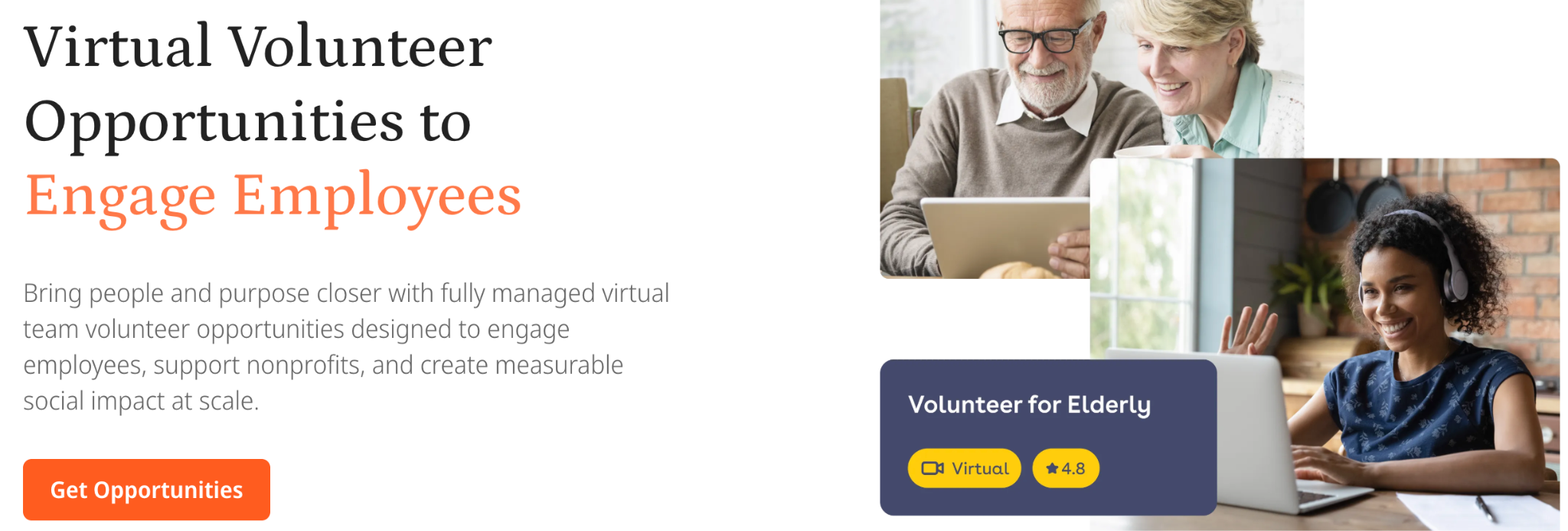
Virtual volunteering fills when it is an event with a host, a clear task, and a visible result, and empties when it is a link in an email. Goodera’s VQ Report 2026 found that virtual accounted for 13.8% of volunteers versus 26.5% of scheduled events, suggesting many virtual events are scheduled without the hosting that gets people to show up. That is a pattern across the companies in the report, not a rule for yours; check your own virtual attendance against your virtual schedule before changing either. Our virtual volunteering activities are hosted live for this reason.
- Let Teams and ERGs Choose the Cause
Participation rises when employees name the cause. Run a short cause survey, hand campaign weeks to employee resource groups, and let team leads pick from a short list rather than a catalog. Employees who chose the cause recruit their colleagues; employees who were assigned it do not.
Which Volunteer Experiences Build Belonging and Team Connection?
Belonging comes from shared effort with a visible result, in a setting where the usual hierarchy is off. Four formats deliver that reliably, and each suits a different team shape.
- Team Days at a Site
A half day at a food bank, a school, or a park with the whole team builds connection fastest. Nobody is in charge of anybody; the result is visible by lunch, and the stories carry back into work. Best for teams that share a city and meet in person at least occasionally. Our in-person volunteering opportunities list site-based activities by cause and city.
- Kit Builds Across Locations
A hybrid kit build gives a distributed team a shared task on a shared call. Materials go to remote staff at home and to office stations, everyone builds the same kit during a hosted session, and a local team delivers the result. This format lets a team spread across continents do one thing together.
- Skills-Based Projects in Small Groups
A four-person team scoping and delivering a project for a nonprofit, such as a website rebuild or a donor data cleanup, builds the deepest working relationships because it runs over weeks rather than hours. Our guides to skills-based volunteering and the skills-based volunteering landscape cover how to scope these so they finish.
- Mentoring Pairs With a Shared Kickoff
Mentoring is individual, but a shared in-person kickoff followed by monthly virtual sessions turns a set of pairs into a cohort. Mentors compare notes, swap approaches, and recognize each other in the hallway. It suits companies that want depth of impact with a lighter calendar load.
Which Engagement Metrics Matter to CSR, HR, and People Leaders?
Five metrics tell CSR, HR, and people leaders whether volunteering improves occupational wellness or just produces hours. The first two measure reach, the middle two measure experience, and the last one connects volunteering to the numbers HR already tracks. Our [enterprise CSR reporting guide](URL of Blog 8 once published) covers how to capture and report them.
- Participation Rate and Reach
Unique volunteers divided by eligible headcount, cut by region, business unit, and tenure. The cut matters more than the total: a 30% overall rate that is 60% in headquarters and 8% in a remote region tells leadership where to invest.
- Repeat Engagement
The share of volunteers who come back within twelve months. This metric is closest to occupational wellness, because people return to what made them feel useful and connected. A program with broad participation and low repeat engagement is running events; one with high repeat engagement is building a habit.
- Post-Event Sentiment
Three questions after every activity: Did this connect you to the company’s values? Did you use or build a skill? Did you feel more connected to colleagues? Track the share answering yes to each, by format and by region, and watch which formats move the connection question.
- Skills and Growth Signals
For skills-based projects, log the skill used and whether the volunteer rated the project as developmental. Pair that with the “used or built a skill” survey item. These are the numbers that interest learning and development teams, and they turn volunteering into a line in the talent conversation.
- Retention and Engagement Score Correlation
Partner with HR to compare volunteers and non-volunteers on engagement survey scores and, over time, on retention. Treat the result as a correlation rather than a cause, since employees who volunteer may already be more engaged, but a gap that widens with repeat engagement is the strongest case a CSR leader can bring to a budget conversation.
What Are Examples of Employee Volunteering Programs by Population, Geography, and Type?
No single program fits an entire company. The examples below are organized by who the employees are, where they are, and what the program is for, with formats that Goodera runs for each.
- By Employee Population
- Engineers, analysts, and other technical roles: skills-based projects for nonprofits, such as data cleanups, website accessibility reviews, and STEM mentoring; usually virtual or hybrid, in small groups.
- Frontline and operational staff: hands-on team days and office kiosks, which fit shift patterns and need no laptop; in-person, short, and visible.
- New hires and interns: a volunteering activity in the first 90 days, often a kiosk or a team day, as part of onboarding; it builds connection before the org chart does.
- Managers and emerging leaders: leading a volunteering project end to end, from briefing to delivery, as a first leadership assignment.
- Senior leaders: nonprofit board service and mentoring, supported with volunteer time off rather than organized events.
2. By Geography
- Single headquarters with satellite offices: team days at headquarters, kiosks in satellites, one hybrid campaign a quarter to connect them.
- Multi-country enterprise: one global campaign on one date, delivered locally through partners in each country, with the format adjusted to local preference. Goodera’s VQ Report India 2026 found that 92% of Indian volunteers chose in-person initiatives and India’s event mix was 75% in-office, 13% outdoor, and 12% virtual. Those figures describe the companies in the report, not every company; use them to prompt a check of your own regional preferences before setting a global format mix.
- Fully remote company: virtual activities hosted live, kit-at-home builds, and skills-based projects, with an annual in-person day tied to a company gathering.
3. By Program Type
- Onboarding program: a volunteering activity in week one, small-group, hosted, with a visible result.
- Day of Service: one date, every office, a mix of site-based team activities and kiosks for those who cannot travel.
- Campaign week: five days of kiosks and virtual sessions around a cause moment such as Earth Day or Giving Tuesday, with ERGs leading each day.
- Skills-based cohort: a quarter-long program where small teams deliver a defined project for one nonprofit each, with a kickoff and a closing showcase.
- Mentoring program: in-person kickoff, monthly virtual sessions, a closing event with the students or job seekers.
How Do You Diagnose Low Participation and Redesign the Program?
Low participation almost always traces to one of five causes; the fix is to change one variable, measure for a quarter, then change the next. Diagnose before redesigning, because the fix for “no time” is different from the fix for “no interest.”
1. Check the Five Usual Causes
- No time in the workday. Employees cannot take hours without a policy, or do not know the policy exists.
- Wrong format for the location. Remote staff offered only site events; in-person staff offered only links.
- Sign-up friction. A form, an approval, a two-week lead time.
- Cause mismatch. The company picked causes employees did not name.
- Nobody asked them personally. An email went out; no manager mentioned it in a team meeting.
Pull your participation data by region, format, and tenure and look for where the number collapses. The pattern usually points at one cause.
2. Ask Employees Directly
A three-question survey to non-participants: Did you know about the program? What stopped you? What would you join? Keep it anonymous and short. The answers will be blunt, and they will tell you which of the five causes you have.
3. Redesign One Variable at a Time
Fix the cause the data and the survey agree on. If it is time, announce or clarify the VTO policy. If it is format, add a kiosk or a hosted virtual session. If it is sign-up, remove the form. If it is cause, hand the next campaign to an ERG. If it is awareness, ask managers to raise it in team meetings for one month. Change one thing so you can see what moved.
4. Set a 90-Day Test
Pick the metric that should move (participation in the lagging region, repeat engagement, first-time volunteers), set a target, and check it at 90 days. Goodera’s VQ Report 2026 found that companies with volunteering fully embedded in their culture reach 70% employee participation, while companies running mostly ad hoc initiatives see 7.1%. The gap is an average across the report’s companies and will not match yours exactly; its use is as a reminder that the difference between those two numbers is frequency and design, which are the two things a 90-day test changes.
Key Takeaways From This Guide
Most wellness spending goes to things employees do alone. The evidence points to the thing they do together. Five points to take into planning.
- Volunteering is the one workplace wellbeing intervention with measured positive effect. The 2024 Oxford study across 46,336 workers found it was the only one of about 90 interventions associated with better wellbeing.
- The barrier is the calendar. 69% of working Americans volunteer less than they want, and 62% of them say they cannot do it during the workday. Paid time to volunteer is the first fix, before any campaign.
- Design for where people are. Working hours, one global campaign on one date, live-hosted virtual sessions, employee-chosen causes, and a fifteen-minute first step are the five levers for remote, hybrid, and global teams.
- Measure experience, not only hours. Participation by region, repeat engagement, post-event sentiment, skills signals, and the correlation with engagement scores are the five metrics that connect volunteering to occupational wellness.
- Diagnose before you redesign. Low participation traces to time, format, friction, cause, or awareness. Find which, change one variable, and run a 90-day test.
Goodera plans and runs employee volunteering programs for companies across 100+ countries, with 50K+ nonprofit partners, in every format this guide describes, and captures the participation and sentiment data behind the metrics. If you want help diagnosing a program or designing one for a global team, start with our CSR volunteering solutions, or read the VQ Report 2026 for the benchmarks used here.
Frequently Asked Questions
1. What Is Employee Volunteerism?
Employee volunteerism is the practice of employees giving time and skills to community causes through programs their employer organizes or supports. It includes hands-on team activities at nonprofit sites, virtual and hybrid volunteering, skills-based projects that apply professional expertise, mentoring, and micro-volunteering tasks that take minutes. Companies typically support it with paid volunteer time off (VTO), organized events, and partnerships with nonprofits.
2. Why Is Volunteer Work Important for Employees?
Volunteer work is important for employees because it supplies three things many jobs lack: a visible result, time with colleagues outside normal roles, and a chance to use skills in a low-stakes setting. Deloitte’s 2017 Volunteerism Survey found that 77% of working Americans say volunteering is essential to employee wellbeing, and a 2023 Edge Research study for Ares Management found that 79% of employees who volunteer through employer programs are satisfied with their jobs, compared with 55% of those who do not.
3. How Can Volunteer Work Improve Occupational Wellness?
Occupational wellness is the part of wellbeing that comes from purpose, growth, and connection at work. Volunteer work can improve occupational wellness because it is structured like work but removes the pressures: the result is visible the same day, nobody is managing anybody, and skills are used where the thanks are immediate. A 2024 University of Oxford study of 46,336 workers across 233 organizations found that, of about 90 workplace wellbeing interventions, volunteering was the only one associated with a positive effect on employee wellbeing.
4. What Are the Benefits of Employee Volunteering for the Company?
The benefits of employee volunteering for a company include stronger team connection, skills and leadership development, higher engagement, and over time better retention. Deloitte’s 2017 survey found that 89% of working Americans believe companies that sponsor volunteering offer a better working environment, and 70% said volunteering boosts morale more than company-sponsored happy hours. Companies also gain nonprofit partnerships, community presence, and data they can report to leadership and investors.
5. What Are the Benefits of Employee Volunteer Programs for Retention?
Employee volunteer programs support retention by giving employees connection, purpose, and recognition, three of the factors most associated with staying. The effect shows up in engagement survey scores first and in retention data a year or more later, so companies usually measure it by comparing volunteers and non-volunteers on engagement scores and tracking the gap over time. The comparison shows correlation rather than cause, but a gap that widens with repeat engagement is strong evidence for the program.
6. What Is the Value of Volunteer Work to Employees’ Careers?
The value of volunteer work to a career lies in skills, leadership experience, and visibility. The 2023 Edge Research study for Ares Management found that 72% of employee volunteers said they develop new skills at work, against 42% of non-volunteers, and 70% said they had opportunities to grow professionally, against 39%. Leading a volunteering project is often a first leadership assignment, and skills-based projects let employees apply expertise in new settings. Many employees underestimate this: in Deloitte’s 2017 survey, only 18% thought volunteering could enhance their career.
7. How Do You Increase Participation in Employee Volunteering for Remote Teams?
Five design choices raise participation for remote and hybrid teams: paid volunteer time off (VTO) so people can take part during work hours, one global campaign on one date delivered as a hybrid kit build, virtual sessions hosted live rather than sent as links, causes chosen by employees and employee resource groups (ERGs), and a fifteen-minute micro-volunteering or kiosk option as a first step. Goodera’s Volunteering Quotient (VQ) Report 2026 found companies with a VTO policy see 1.4x higher participation; that is aggregate data, so compare your own participation before and after any change.
8. Which Metrics Should a Company Track for Employee Volunteering?
Five metrics connect volunteering to occupational wellness: participation rate cut by region, business unit, and tenure; repeat engagement within twelve months; post-event sentiment on values, skills, and connection; skills and growth signals from skills-based projects; and the correlation between volunteering and engagement survey scores, with retention tracked over time. Hours and headcounts show scale; these five show whether the program is changing how employees feel about work.
9. Why Is Participation Low, and How Do You Fix It?
Low participation usually traces to one of five causes: no time in the workday, the wrong format for where employees are, sign-up friction, a cause mismatch, or nobody asking employees personally. Diagnose by cutting participation data by region, format, and tenure and by surveying non-participants with three questions. Then change one variable, such as announcing a volunteer time off (VTO) policy or adding a kiosk, set a target, and check it at 90 days before changing the next.
10. How Does Goodera Support Employee Volunteerism?
Goodera plans and runs employee volunteering programs in every format: site-based team days, office kiosks, live-hosted virtual activities, hybrid kit builds across locations, skills-based projects, and mentoring programs, for companies across 100+ countries with 50K+ nonprofit partners. Each activity captures participation, repeat engagement, and post-event sentiment, and the data flows automatically into Benevity. Goodera’s Volunteering Quotient (VQ) Report 2026 provides the participation and volunteer time off (VTO) benchmarks referenced in this guide.