Outdoor Volunteering V/S Volunteering at a Kiosk

Two volunteering events, same company, same quarter. The first is a Saturday park cleanup: a long sign-up list, a much shorter line at the gate, and a great photo. The second is a kit-packing station by the office café on a Tuesday: no sign-up sheet, and a steady stream of people stopping by before lunch is over.
Outdoor volunteering means taking a team off-site to do physical work in a community space, such as planting trees, clearing trails, or restoring a garden. Kiosk volunteering means bringing a short, hands-on activity into the workplace, so employees take part in 15 to 30 minutes between meetings. Outdoor events build teams and visible impact; kiosks build participation and habit. Most companies need both, in that order reversed.
Outdoor volunteering: off-site, half or full day, team-based | Kiosk volunteering: in-office, 15 to 30 minutes, drop-in | Best together: kiosk first, outdoor second
The difference between nineteen and 212 is not enthusiasm. It is friction. A sign-up form, a Saturday, and a bus ride filter out most of a company before anyone has considered the cause. The format you choose decides how many people make it past those filters.
This guide explains how each format works, who it reaches, what it costs, how to pick, and how to pair them so the Tuesday crowd becomes the Saturday crowd.
What Is Outdoor Volunteering?
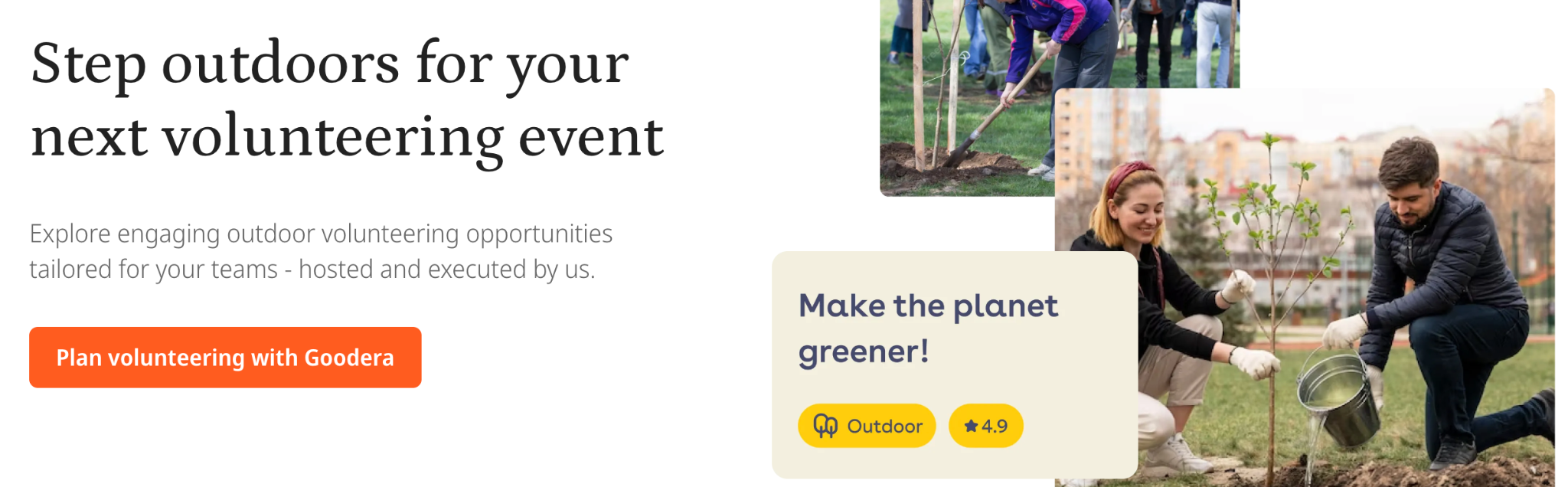
Outdoor volunteering is a team activity held in a community space, usually with an environmental or neighborhood focus. Think park and beach cleanups, tree planting, trail maintenance, community garden builds, or restoring a school playground. The team travels to the site, works for half a day or a full day, and leaves something visibly changed.
It is the format most people picture when they hear “corporate volunteering,” and for good reason. The results are tangible, the photos are strong, and the shared effort does what offsites try to do at a fraction of the cost.
- How Does an Outdoor Volunteering Event Work?
A nonprofit or parks partner identifies the site and the work. Your team picks a date, usually a weekday morning or a Saturday, and sets a headcount. Volunteers sign up in advance, travel to the site, get a safety briefing and tools, and work in groups for two to six hours.
Weather, transport, and tools are the three things that go wrong. A good partner handles the last one; your event lead handles the first two, including the rain plan nobody wants to write.
- Who Shows Up to Outdoor Volunteering?
The people who already volunteer. Outdoor events ask for a sign-up, travel, physical effort, and often a weekend, so they attract employees who are already motivated and physically able to take part. Teams that come together tend to be the ones whose manager made it a team event.
That is the format’s strength and its limit. It deepens engagement among people who are in. It rarely pulls in the colleague who has never volunteered through work.
- What Does an Outdoor Event Cost?
Transport, tools and materials, refreshments, and a partner fee if the nonprofit charges one. Add the time cost: a half-day event with forty people is 160 working hours, plus travel.
Per volunteer, it is the more expensive format, which is fine if the goal is team-building and visible impact. It is a poor choice if the goal is to get as many employees as possible to volunteer for the first time.
What Is In-Person Volunteering at a Nonprofit Site?
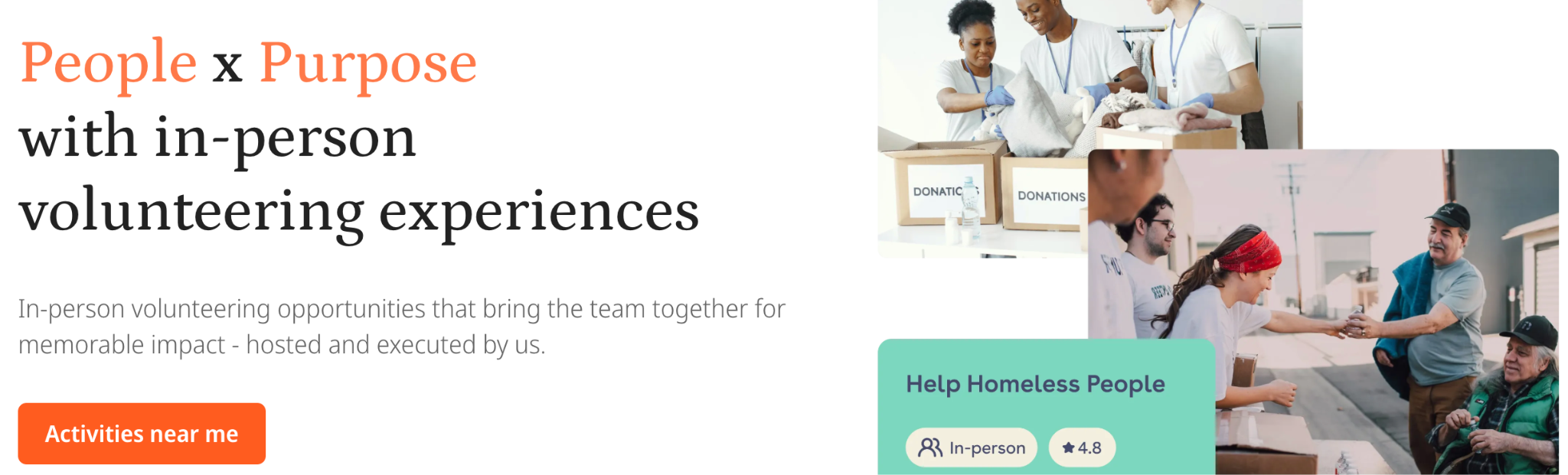
In-person volunteering at a site is the third format most companies run, and it sits between the other two. Employees travel to a specific place, such as a community kitchen, a school, a shelter, a hospital ward, or a care home for older adults, and spend the time directly with the people the nonprofit serves.
What sets it apart from outdoor volunteering is the contact. An outdoor event changes a place; a site visit changes an afternoon for the people in it. Serving a meal, reading with children, running a game session with residents, or helping at an intake desk puts volunteers face to face with the beneficiaries, which is the part employees talk about afterward.
It asks more of the partner than either other format. The nonprofit has to host, brief, and supervise a group in a space where its own work carries on, so group sizes are smaller, usually five to twenty, and the activity is shaped by what the site can absorb on that day rather than by what the company would like to do.
Per volunteer it costs about the same as an outdoor event, with travel and time the main lines, and it carries the same sign-up and scheduling friction. Where it pays back is depth: the employees who do a site visit are the ones most likely to ask for the next one. Our in-person volunteering opportunities include site-based activities alongside outdoor ones, organized by cause and city.
What Is Kiosk Volunteering?
Kiosk volunteering brings the activity to where employees already are. A station is set up in a high-traffic spot in the office, such as the café, the lobby, or a floor’s kitchen, with everything needed to complete one small, useful task. Employees stop by, do the task in 15 to 30 minutes, and go back to their day.
The tasks are real. Assembling hygiene kits for a shelter. Packing school supply bags. Writing letters to isolated older adults. Recording short audiobooks. Building tactile learning aids. Each one has a nonprofit recipient and a delivery date, and the kiosk runs until the quota is met.
1. How Does a Kiosk Work?
A partner such as Goodera designs the activity, sources the materials, and sets up the station with instructions, a facilitator, and a running tally. The kiosk opens for a window, often a lunch period, a full day, or several days during a campaign week. Employees drop in without signing up.
At the end, the finished kits or letters are collected and delivered to the nonprofit. The running count on the station is what turns a passerby into a participant, because people can see the number move.
2. Who Shows Up to a Kiosk?
Almost everyone, including the people who would never sign up for a Saturday. New hires, parents who cannot give a weekend, employees with mobility limits, people who are curious but shy about group events, and the large middle of the company that has simply never been asked in a way that fit their day.
Kiosks also catch people in groups. Two colleagues walking to lunch stop together, and a third joins because they see the first two. That is how a drop-in station gets a quarter of the building in a day.
3. What Does a Kiosk Cost?
Materials for the kits, a facilitator, and delivery to the nonprofit. The time cost per participant is 15 to 30 minutes with no travel, so the cost per volunteer is far lower than an outdoor event.
What a kiosk does not give you is a team day. Participation is individual or in twos and threes, and the impact per person is small. The impact per building, though, can be large.
How Do Outdoor Volunteering and Kiosk Volunteering Compare?
Side by side, the two formats answer different questions. Outdoor volunteering answers “how do we build this team and show visible impact?” Kiosk volunteering answers “how do we get most of the company to volunteer at all?” Use the table to see which question you are asking.
The last row is the one to act on. Outdoor events anchor a calendar; kiosks fill it.
Did You Know These Facts About Volunteering Formats?
A few points worth dropping into the planning conversation.
- The drop-in format is older than the office. Kit-packing lines for care packages date back to community halls during both World Wars; the kiosk simply moves the table to where people work.
- The sign-up gap is predictable. Across Goodera-run outdoor events, a meaningful share of people who sign up do not attend, and the gap widens for weekend dates. Plan headcount for the gap, not the sign-up list.
- The number on the kiosk is the hook. Facilitators consistently report that a visible running tally draws more participants than any poster or email about the same event.
- Virtual and in-person are not rivals. A kiosk converts easily into a kit-at-home activity for remote employees, so one campaign can run in the office and on a dozen kitchen tables the same week.
Which Format Should Your Company Choose?
Choose by the goal, the people, and the calendar. Four questions get you there.
1. What Are You Trying To Change?
If the goal is to get your overall participation number up, start with kiosks. They remove the sign-up, the travel, and the weekend, which are the three reasons most employees never take part.
If the goal is to build a specific team, mark a flagship date, or produce visible community impact, plan an outdoor event. It gives a team a shared story and gives leadership a photo that means something.
2. Who Are You Trying to Reach?
Look at who came to your last event. If it was the same two dozen faces, you have an outdoor-event culture, and a kiosk will introduce you to the rest of the building.
If participation is already broad but shallow, the outdoor event is the next step. It takes people who have done fifteen minutes at a kiosk and gives them a half day with their team.
3. What Does Your Office Look Like Right Now?
Hybrid schedules changed the math. A kiosk works on the days people are in, and a kit-at-home version covers the days they are not. An outdoor event needs everyone in one place on one date, which is harder to land than it was five years ago.
If your office has anchor days, run kiosks on them. If your teams gather quarterly, that gathering is your outdoor event.
4. What Is on the Calendar?
Outdoor events fit specific dates: Earth Day, a city cleanup weekend, a Day of Service. Kiosks fit campaign weeks, when you want many people to do something small over several days.
Goodera’s campaign calendar lists both kinds of moments through the year. Pick two or three outdoor dates and fill the months between with kiosks, and the calendar plans itself.
How Do the Two Formats Work Together?
The best programs use kiosks to grow the crowd and outdoor events to deepen it. A kiosk in February introduces 200 employees to volunteering in a format that cost them 20 minutes. An outdoor event in April gives 40 of them a team day. By the fall, the sign-up list for the outdoor event is longer because the kiosk made the idea familiar.
A simple rhythm that works: one kiosk per quarter, timed to a campaign week, and two outdoor events per year, one in spring and one in fall. Add a kit-at-home option to each kiosk so remote colleagues are in the same campaign.
The formats also feed each other’s stories. The kits packed at a kiosk can be delivered during the outdoor event, so the Saturday team sees the Tuesday crowd’s work arrive at the nonprofit. That link between the two is what makes employees understand they are part of one program rather than attending separate events.
Key Takeaways
Nineteen at the park gate, 212 at the kiosk. Both numbers are good; they just measure different things. Five points to take into your planning.
- Outdoor volunteering builds teams and visible impact. It is off-site, half or full day, and attracts the employees who are already motivated. Use it for flagship dates and team days.
- Kiosk volunteering builds participation. It is in the office, drop-in, 15 to 30 minutes, and reaches the broad middle of the company. Use it for campaign weeks and for getting first-timers in.
- The friction, not the cause, decides who shows up. Sign-up, travel, and weekends filter out most employees before the cause is ever considered. Remove the friction first.
- Run kiosks to grow the crowd and outdoor events to deepen it. One kiosk a quarter and two outdoor events a year is a rhythm most companies can hold.
- Frequency is what makes volunteering part of the culture. A format that runs often, that people can join without planning their week around it, is how a program stops being an annual event and becomes a habit. Kiosks give you that frequency; outdoor events give it a high point.
Goodera plans and runs both formats, from the nonprofit partner and the materials to the facilitator at the station and the team at the trailhead, for companies working with 50K+ nonprofits across 100+ countries. Explore our in-person volunteering opportunities and team-building volunteering to see examples of each format.
Frequently Asked Questions
1. What Is Outdoor Volunteering?
Outdoor volunteering is a team activity held off-site in a community space, usually with an environmental or neighborhood focus. Common examples include park and beach cleanups, tree planting, trail maintenance, community garden builds, and playground restoration. Teams travel to the site, work for two to six hours with a nonprofit or parks partner, and leave a visible result. It is the format that builds team bonds and produces strong, shareable impact.
2. What Is Kiosk Volunteering?
Kiosk volunteering is a short, hands-on activity set up in a high-traffic spot in the workplace, such as a café or lobby, so employees can take part for 15 to 30 minutes without signing up. Tasks include packing hygiene or school supply kits, writing letters to isolated older adults, and building learning aids, each with a nonprofit recipient. A facilitator runs the station, and a visible tally tracks progress until the quota is met.
3. Which Format Gets More Employees to Take Part?
Kiosk volunteering, by a wide margin, because it removes the three biggest barriers: advance sign-up, travel, and giving up personal time. A single kiosk day can reach a quarter or more of an office, including employees who have never volunteered through work. Outdoor events typically draw 10 to 100 people and skew toward employees who are already motivated. Frequent, low-friction formats are how companies turn occasional volunteers into regular ones.
4. Which Format Is Better for Team-Building?
Outdoor volunteering. A half-day or full-day event where a team travels together, works side by side, and sees a result is closer to an offsite than to a kiosk visit. Kiosks create small, pleasant moments between two or three colleagues, which helps culture but does not replace a shared team day. Many companies use kiosks to build participation and reserve outdoor events for the moments when they want a team to bond.
5. How Much Does Each Format Cost?
Outdoor volunteering costs more per volunteer: transport, tools and materials, refreshments, a possible partner fee, and three to eight working hours per person including travel. Kiosk volunteering costs materials, a facilitator, and delivery, with 15 to 30 minutes of time per participant and no travel. Per volunteer, kiosks are the lower-cost format; per team-building outcome, outdoor events are the better value. The right comparison is cost against the goal, not cost alone.
6. Can Remote or Hybrid Employees Take Part in Either Format?
Kiosks adapt well. The same activity can be shipped as a kit-at-home version, so remote employees pack kits or write letters on the same campaign week as colleagues in the office. Outdoor events require everyone at one site on one date, which hybrid schedules make harder; companies often tie them to quarterly gatherings or offsites when teams are already together. For a distributed workforce, kiosks plus kit-at-home cover most of the year and outdoor events anchor the moments people are in one place.
7. What Are Good Causes for Outdoor Volunteering?
Environmental causes fit naturally: park and beach cleanups, tree planting, habitat restoration, and trail work. Neighborhood causes work too, such as community garden builds, school or playground refreshes, and mural painting. Pick a cause your employee survey or employee resource groups have named, and time it to a date on the calendar such as Earth Day or a city cleanup weekend so the event has a built-in reason to happen.
8. What Are Good Activities for a Volunteering Kiosk?
Activities that one person can finish in 15 to 30 minutes with no training: assembling hygiene kits for shelters, packing school supply bags, writing letters or cards to isolated older adults or hospital patients, recording short audiobooks for children, and building tactile learning aids for classrooms. Each needs a nonprofit recipient and a delivery date before the kiosk opens, so employees know where their work is going.
9. How Often Should a Company Run Each Format?
A rhythm that most companies can hold is one kiosk per quarter, timed to a campaign week, and two outdoor events per year, usually spring and fall. The kiosks keep participation broad and frequent; the outdoor events give teams a shared day. Companies that run only outdoor events tend to see the same faces each time, and companies that run only kiosks miss the team-building moment, so the combination is stronger than either alone.
10. How Does Goodera Run Outdoor and Kiosk Volunteering?
Goodera plans and runs both formats end to end. For outdoor events, that means finding and vetting the nonprofit or parks partner, handling tools, materials, and logistics, and staffing the day. For kiosks, it means designing the activity, sourcing materials, setting up the station with a facilitator and a running tally, and delivering the finished kits to the nonprofit. Participation data from both flows into Benevity automatically. Goodera works with 50K+ nonprofits across 100+ countries, so the same campaign can run in multiple offices and countries at once.