Idées de journées de bénévolat et comment planifier le mécénat de compétences en entreprise

Day of Service Ideas and How To Plan Corporate Volunteering
Most companies want their employees to give back, but turning that intention into action is harder than it sounds. A day of service, a single scheduled day when a team steps away from work to volunteer together, is one of the simplest ways to close that gap. Yet the median workforce participation rate in corporate volunteering was only 22.2% in 2025, as per Goodera’s Global Volunteering Report 2025.
The 2026 edition says this number has now risen to 25.6%. However, this also means that companies are still leaving out a lot of employee goodwill on the table.
The good news is that momentum is building. 61% of CSR professionals reported rising employee volunteerism in 2025, the third year in a row of growth, and a well-planned day of service is often what turns that interest into real participation. This guide covers what a day of service is, how to plan one, which activities employees enjoy most, and which dates to build your calendar around.
What Is a Day of Service?
A day of service is an event where a group of people volunteer their time together to support a cause, a community, or a moment that matters to them. It can be organized by a company, a school, a government body, or a public campaign, but the core idea stays the same: people set aside their regular routine for a set day and put that time toward something bigger than themselves. Volunteers don't need to belong to the community they're helping. They might show up for a cause they care about, a heritage or commemorative moment, or a community they're personally part of.
Corporate or public is really the next layer to think about, not the definition itself. A public day of service might rally an entire city around one cause, while a corporate one is organized by a company for its own employees. Either way, the heart of it is the same: showing up, together, for the community they want to be a part of . For companies specifically, this usually means employees step away from their desks for a few hours or a full day and put that time into a shared volunteering project, either in person or online.
Think of it as a team-building day with a purpose. Instead of an offsite lunch, your team might clean a beach, mentor students, or pack meals for families in need.
- What Happens on a Day of Service?
A typical day of service follows a simple flow: employees sign up for a pre-planned project, show up (physically or virtually), and work through a specific task designed by the nonprofit partner to deliver a real, tangible outcome. The day often wraps up with a shared moment, like a group photo or a quick debrief on what actually got done and who it helped.
Some companies run one big event for the whole organization. Others let smaller teams pick their own projects on the same day, so everyone's still contributing, just to different causes.
A few things you'll usually find on a day of service:
- A defined time block, anywhere from two hours to a full workday
- A specific task, such as packing meals, cleaning a park, or mentoring students, rather than open-ended volunteering
- A nonprofit or community partner who defines the need
- A way to track volunteering hours, participant count, supplies volunteered, and more, so the company can report on participation and impact later
2. How Is It Different From Regular Volunteering?
The biggest difference is structure. Regular volunteering is something an employee does on their own time, whenever it suits them. A day of service is organized by the company, scheduled on the calendar, and usually done as a group.
Many companies use a day of service as the kickstart for a full volunteering calendar rather than treating it as a one-off event. One scheduled day gets people in the door, and a year-round calendar is what turns that initial interest into lasting impact, since the two build on each other.
Why Your Company Needs a Day of Service
A company Day of Service helps your employees, your community, and your business at the same time. It gives people a reason to feel proud of where they work, and it gives your company something real to point to when it talks about its values.
The numbers back this up:
- Better retention: Employees at companies with volunteer programs are five times more engaged than those at companies without one, according to Bonterra's 2025 Impact Report, and engaged employees are far less likely to leave.
- More resilience: 97% of companies agree that volunteering strengthens community resilience, based on Benevity's 2025 State of Corporate Purpose Report.
- Growing momentum in employee volunteerism: 61% of CSR professionals reported more employee volunteerism in 2025, the third year in a row of growth.
- Boosts morale: 70% of corporate volunteers say volunteering with their company boosted their morale.
National Day of Service in January
January already carries a moment built for this: the national day of service, observed on the third Monday of the month. In 2027, that's Monday, January 18. It's meant to be a day on, not a day off, and it's one of the biggest volunteering moments of the year in the US, a day when collective action is at its highest.
The idea behind it is simple: instead of taking the day for yourself, you give it to your community. Federal offices, banks, and most schools close, but community centers, food banks, and nonprofits often see their busiest day of the year, since millions of people use the holiday to create change instead of rest.
For companies, this makes January a meaningful month to launch your first day of service if you haven't run one before. The date already carries public momentum behind it, so employees are joining a nationwide moment, not just a company event. Many nonprofits also run pre-planned projects around this day, built specifically for the scale of need the day represents, which means your team's effort lands exactly where it's needed. It's a strong starting point for a habit you can carry through the rest of the year.
- How you Can Take Part in the National Day of Service
You don't need a huge plan to join in. A few simple steps go a long way:
- Pick a project early. Book your nonprofit or community partner in November or December, since popular projects fill up fast.
- Offer choices. Give employees a mix of in-person and virtual options so everyone can take part.
- Give people the time. Let employees volunteer during work hours instead of asking them to give up their day off.
- Share the story. Post photos and results afterward so people see the difference they made.
How To Plan a Corporate Day of Service
Planning a corporate day of service comes down to answering four questions before you touch a calendar invite:
- why are you doing this,
- who will you help,
- who's driving it internally,
- what could go wrong on the day.
Most of the actual work happens in the weeks leading up to the event, not on the day itself.
- Know Your Reason Before You Pick a Date
Skip the temptation to pick a date first and figure out the "why" later. Teams that lead with a date often end up with a generic clean-up event that nobody remembers. Instead, ask what problem you're trying to solve. Maybe engagement scores dipped last quarter, maybe your ESG report needs a stronger volunteering story, or maybe a specific team asked for it. Write that reason down in one sentence. It'll shape every decision after this, from which cause you pick to how you measure success.
Once you know the "why," attach two or three numbers to it: sign-up rate, volunteer hours logged, or a concrete community outcome like meals packed. Vague goals lead to vague reports later.
- Choose a Cause Your People Care About
It's tempting to pick a cause that photographs well or matches your company's marketing. Resist that. A quick pulse survey, even a three-question one, tells you what your employees actually care about, and that's what drives real sign-ups. Cross-reference that against causes your leadership already supports publicly, and you'll usually land somewhere that works for both.
From there, the partner nonprofit matters as much as the cause itself. Ask them directly what a "successful day" looks like from their side, not just what task they'll hand your team. A nonprofit that can tell you exactly how many meals, how many kids, or how many trees gives you a real number to report afterward.
- Make the First Move as a Leader
Sign-up rates rise when a senior leader is the first name on the list, not a last-minute add. If someone on the leadership team can commit publicly and early, in the same announcement that goes out to everyone else, it removes the unspoken question, "Is this optional for people who matter?"
Additionally, treat sign-up like a product, not a form. One link. One click. A two-line description of what the day actually involves, written in plain language, not corporate copy. If someone has to ask a follow-up question to understand what they signed up for, the description wasn't clear enough.
- Lock the Logistics Two Weeks Out
The gap between a smooth day and a chaotic one usually comes down to how early you locked the boring stuff: transport, supplies, headcount, and a backup plan if the weather or the tech doesn't cooperate. Two weeks out is the right window to confirm all of it, not the week before.
A short reminder a few days prior, covering what to wear, where to go, and who to call if something changes, cuts down on day-of confusion more than any amount of pre-event planning. For virtual events, run the tools once with a small group beforehand. It's the easiest failure to prevent and the hardest one to explain afterward.
Corporate Volunteering Activities That Employees Actually Enjoy
The best corporate volunteering activities share a few traits: people can join without much friction, the work genuinely helps, and it's something coworkers actually want to do together. Variety matters here, because not everyone wants to volunteer the same way. In fact, individual volunteer opportunities rose from 26% to 37% in 2025 as companies moved toward more flexible options, and volunteering hours per volunteer climbed from 6.87 to 7.21 hours over the same year.
1. Team-Based Activities
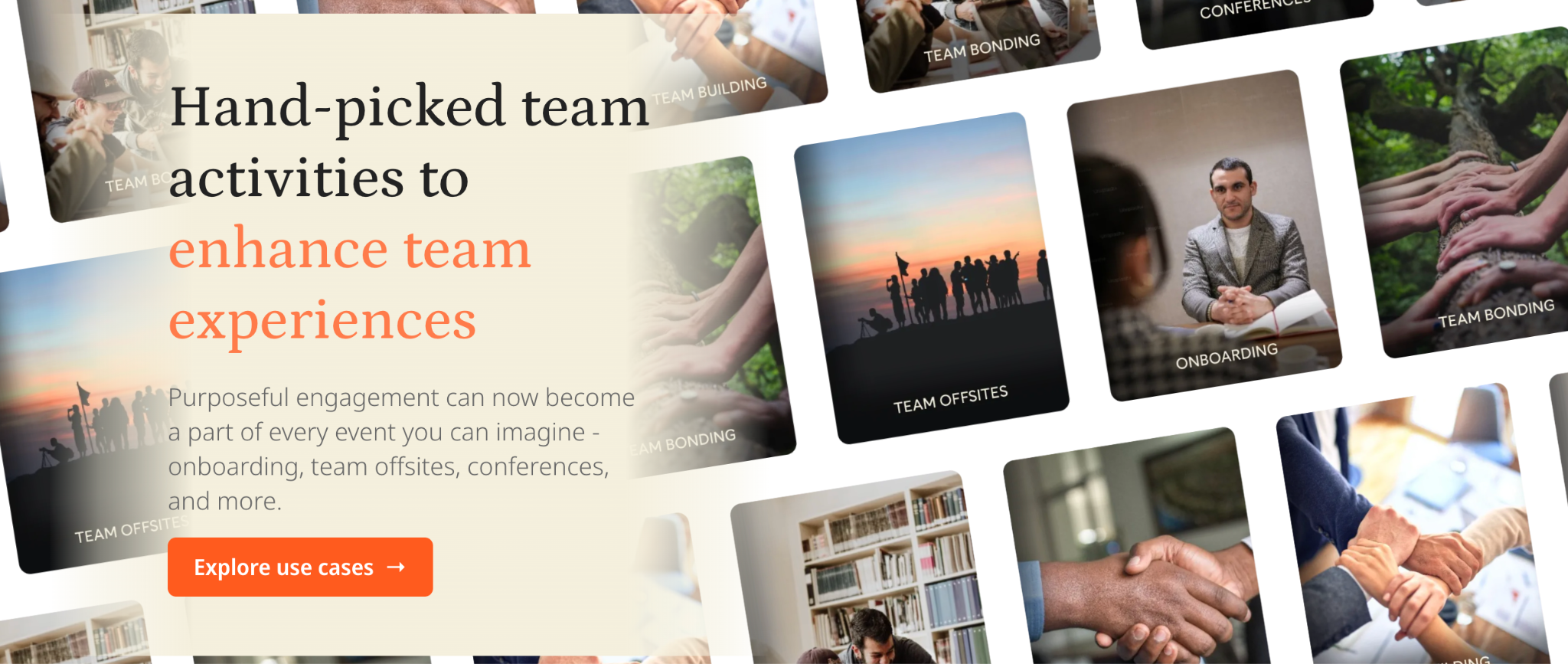
These work well when you want people to bond while helping out:
- Clean-ups and tree planting at parks, beaches, or school grounds
- Food drives and meal packing with a local food bank
- Building or painting projects at shelters and community centers
2. Individual and Flexible Activities
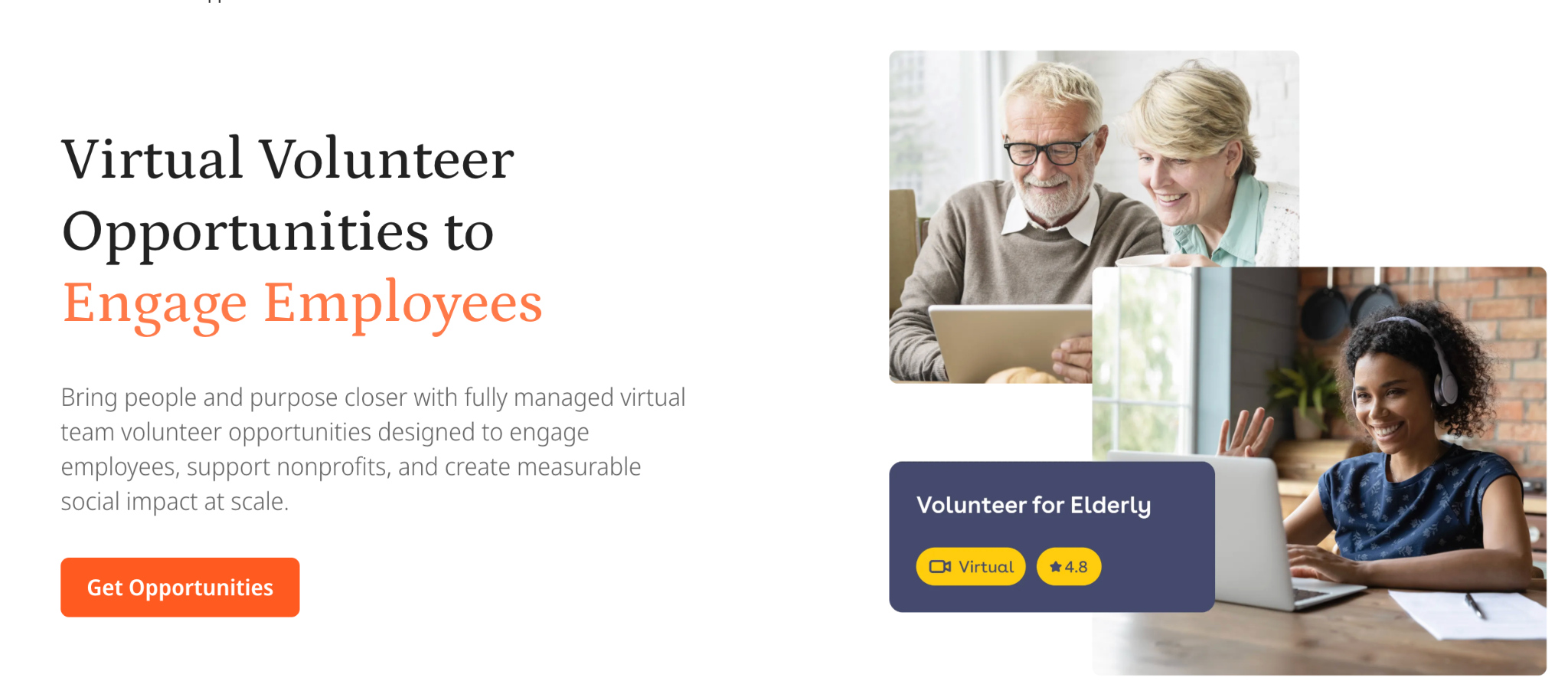
Some people prefer to help on their own time or from home:
- Virtual mentoring for students or job seekers
- Skill-based volunteering, like helping a nonprofit with design, finance, or marketing
- Online tutoring or reading sessions
- Micro-volunteering, such as writing letters or assembling kits at your desk
3. Activities by Cause
Matching activities to a cause helps people connect with the "why":
- Education: tutoring, career talks, donating books
- Environment: tree planting, waste cleanups, community gardens
- Health: blood drives, wellness camps, care packs
- Hunger: food drives, community kitchens, meal packing
Journées d'engagement à retenir pour organiser votre journée de bénévolat d'entreprise
Si vous hésitez sur la date de votre événement, appuyez-vous sur une journée déjà reconnue. Cela donne plus de sens à votre invitation et facilite la recherche de projets partenaires. Voici les dates à noter dans votre calendrier :
Il y a une raison supplémentaire de planifier à l'avance cette année. L'ONU a déclaré 2026 : Année internationale des volontaires pour le développement durable, le bénévolat bénéficie donc d'une attention particulière.
Voici quelques ressources pour vous aider à préparer ces prochaines opportunités de bénévolat :
- Journée internationale des bénévoles 2026 pour les entreprises
- Martin Luther King Day of Service : histoire et idées
- Comment célébrer le Mois de l'histoire des Noirs au travail
- Mois de l'histoire des femmes 2026 : activités et idées pour l'entreprise
- Guide détaillé pour célébrer le Jour de la Terre au travail
Comment mesurer l'impact de votre journée d'engagement
Pour mesurer une journée d'engagement, suivez le nombre de participants, les bénéfices pour la communauté et le lien avec vos objectifs RSE. Les chiffres vous aident à progresser, et les témoignages permettent de maintenir l'enthousiasme de la direction.
- Indicateurs de participation et d'engagement
Comparez les inscriptions à la participation réelle, comptabilisez le nombre total d'heures de bénévolat et le taux de fidélisation. Un court sondage après l'événement pour recueillir le ressenti des collaborateurs vaut également son pesant d'or.
- Indicateurs d'impact communautaire
Demandez à vos partenaires associatifs des résultats concrets : repas servis, arbres plantés, élèves mentorés, kilos de déchets collectés. Des résultats précis sont bien plus convaincants qu'un simple « nous avons fait du bénévolat ».
- Reporting RSE et ESG
Intégrez vos heures et vos résultats dans votre rapport RSE ou ESG. Centralisez vos données tout au long de l'année pour éviter de devoir tout rassembler dans l'urgence au moment du reporting.
En résumé : planifiez votre prochaine journée d'engagement
Voici ce qu'il faut retenir à propos d'une journée de solidarité : elle n'a pas besoin d'un gros budget ou d'un plan parfait pour avoir du sens. Il lui faut un objectif clair, une cause qui compte vraiment pour les gens et un processus d'inscription simple qui ne demande aucune réflexion. Tout le reste — le lieu idéal, les t-shirts assortis, la vidéo récapitulative léchée — peut attendre la deuxième année. Alors, commencez petit si nécessaire. Menez un projet avec vingt personnes plutôt que d'attendre la version « idéale » avec deux cents. Observez ce qui a fonctionné, corrigez ce qui n'a pas marché et construisez à partir de là. Les entreprises qui possèdent aujourd'hui les cultures de bénévolat les plus fortes ne sont pas arrivées là grâce à un événement parfait ; elles y sont parvenues en répondant présent année après année et en laissant le programme grandir avec elles.
Goodera aide les entreprises à éviter les tâtonnements : projets associatifs vérifiés, gestion simplifiée du bénévolat et rapports d'impact prêts à être présentés à la direction dès qu'elle les demande. Choisissez une date, choisissez une cause, et faisons en sorte que cela compte.
Frequently Asked Questions
1. Quand a lieu la journée nationale de solidarité en janvier ?
Elle tombe le troisième lundi de janvier. En 2027, il s'agit du 18 janvier.
2. Quelles sont les bonnes idées de journées de solidarité pour les équipes en entreprise ?
Les idées populaires incluent le nettoyage de quartiers, les collectes alimentaires, la plantation d'arbres, le mentorat virtuel et les projets basés sur les compétences avec des associations. Proposez un mélange d'options en présentiel et en ligne pour que tout le monde puisse participer.
3. Combien de temps doit durer une journée de bénévolat en entreprise ?
Tout est possible, de quelques heures à une journée complète. Une demi-journée est un bon point de départ pour une première expérience, car il est plus facile pour les collaborateurs de l'intégrer à leur emploi du temps.
4. Comment inciter davantage d'employés à s'inscrire ?
Simplifiez le processus, accordez du temps rémunéré pour y participer et assurez-vous que les dirigeants s'impliquent de manière visible. Proposer des choix aide également, car les gens sont plus enclins à participer lorsque l'activité correspond à leurs centres d'intérêt.
5. Quelle est la différence entre une journée de solidarité et le bénévolat classique ?
Une journée de solidarité est organisée par l'entreprise à une date fixe, généralement pendant les heures de travail, tandis que le bénévolat classique est une démarche qu'un employé effectue sur son temps personnel, quand cela lui convient. De nombreuses entreprises proposent les deux en parallèle.
6. Combien coûte l'organisation d'une journée de bénévolat en entreprise ?
Les coûts varient considérablement en fonction de l'activité, du nombre de participants et du recours éventuel à une plateforme externe pour la gestion. Une opération de nettoyage locale ou une session de mentorat virtuel peut ne coûter que le temps passé par les collaborateurs, tandis que les événements avec traiteur, les transports ou les fournitures pour un grand groupe font grimper la facture rapidement. Collaborer avec une association permet généralement de mieux maîtriser son budget, car elle peut vous indiquer précisément les besoins du projet en amont.
7. Quelles activités de bénévolat d'entreprise sont les plus adaptées aux grandes entreprises ?
Les grandes entreprises obtiennent généralement de bons résultats avec des activités facilement déployables sur plusieurs sites, comme des défis de collecte de fonds entre bureaux, des programmes de mentorat virtuel ou des opérations de nettoyage simultanées organisées sur différents sites le même jour. Diviser un grand groupe en équipes plus restreintes autour d'une même tâche permet également de simplifier la logistique.
8. Comment mesurer le succès d'une journée de bénévolat en entreprise ?
Comparez le taux de participation aux inscriptions, comptabilisez le nombre total d'heures de bénévolat et le taux de fidélisation des bénévoles, puis associez ces données aux résultats concrets obtenus par votre partenaire associatif, comme le nombre de repas préparés ou d'arbres plantés. Un court sondage post-événement sur le ressenti des participants complète le tableau et vous aide à améliorer la prochaine édition.
9. Les employés souhaitent-ils réellement participer à une journée de bénévolat en entreprise ?
Oui, très largement. 82 % des entreprises déclarent que leurs employés souhaitent participer à des événements de bénévolat parrainés par l'entreprise avec leurs collègues, bien qu'environ un tiers seulement passe à l'acte en l'absence de programme structuré. C'est précisément ce manque qu'une journée de bénévolat bien organisée permet de combler.
10. Les équipes en télétravail peuvent-elles participer à une journée de bénévolat ?
Oui. Les équipes en télétravail peuvent mentorer des étudiants, donner des cours en ligne, offrir leurs compétences pro bono à des associations ou participer à un défi de collecte de fonds. De nombreuses entreprises proposent une option virtuelle en complément d'événements locaux en présentiel pour les équipes hybrides.