Skills-Based Volunteering vs Traditional Volunteering: Finding The Right Fit For Your Impact Strategy

Traditional volunteering or skills-based volunteering?
It sounds like a straightforward choice, yet it is one of the most misunderstood questions in corporate social impact.
Spend a few minutes reading about employee volunteering, and you will quickly come across comparisons that frame skills-based volunteering as the evolution of traditional volunteering, the higher-impact option that companies should aspire to. At the same time, thousands of nonprofits continue to rely on volunteers who serve meals, mentor students, clean parks, pack food, and support community events because those needs are just as real and just as urgent.
The problem is not that one model is replacing the other. The issue is that they are often compared as though they are solving the same problem.
They are not.
Traditional volunteering is designed to provide hands-on support where people are needed today. Skills-based volunteering is designed to strengthen a nonprofit's ability to solve problems tomorrow. Both create meaningful social impact, but they do so in fundamentally different ways.
Understanding that distinction is what allows companies to design volunteer programs that are valuable for employees, genuinely useful for nonprofit partners, and aligned with the outcomes they hope to achieve.
What Traditional Volunteering Is (And Why It Still Matters)
Traditional volunteering is what most people picture when they hear the word "volunteering": showing up somewhere, doing something physical or logistical, and leaving having contributed time and energy to a cause. Serving meals at a shelter. Building homes with Habitat for Humanity. Planting trees. Running a charity 5K. Sorting donations. Mentoring young people at a Saturday session.
It is also, in many CSR circles, quietly talked about as the lesser option, the thing companies did before they discovered skills-based volunteering. That framing is wrong, and it produces real programmatic damage when CSR leaders internalize it.
Traditional volunteering does specific things that skills-based volunteering structurally cannot.
- Creates A Community Presence
When 80 employees from a financial services company spend a Saturday building a sensory garden at a school for children with disabilities, that school's community sees a company showing up with its sleeves rolled up.
No strategy document or pro bono engagement produces that visible, physical presence. For companies building social license in communities where they operate, this matters enormously.
- Accessible to Every Employee, Regardless of Role
Not every employee has a professional skill that maps to nonprofit needs. A warehouse operations manager, a receptionist, and a manufacturing line supervisor, their daily work may not translate directly into consultable expertise.
Traditional volunteering includes them in a way that skills-based programs often do not. Programs that pivot entirely to skills-based volunteering frequently see participation drop among frontline and non-specialist staff, creating a two-tier culture where the "real" volunteers are the knowledge workers.
- Provides Psychological Recovery
This is the point almost nobody in the CSR industry makes publicly: for many employees, especially those in high-pressure, high-cognition roles, the most valuable volunteering experience is one that requires them to use their hands, be present in a community, and leave work at the office for a day.
A software engineer who spends 50 hours a week problem-solving does not always want to problem-solve for a nonprofit on a Thursday afternoon. Sometimes they want to build something physical, work next to colleagues they rarely see, and feel the uncomplicated satisfaction of a visible, immediate result.
- Fast To Deploy In Crisis Moments
When a flood hits a region where your company operates, you cannot scope a skills-based project and run a readiness audit. You need to move people. Traditional volunteering infrastructure, i.e., the relationships, the logistics, the cultural habit of showing up, is what makes crisis response possible.
Did you know?
According to the 2024 Deloitte Global Volunteer Impact Survey, 89% of employees who participated in company-organised volunteering reported improved wellbeing, regardless of whether the activity was skills-based or traditional. The act of contributing to the community, in any structured form, produces measurable mental health benefits.
A critical loophole when it comes to implementing traditional volunteering is operating it without long-term intention, making it difficult to measure impact sustainably over a period of time.
What Is Skills-Based Volunteering: A Model Gaining Momentum
Skills-based volunteering is when employees contribute their professional expertise, in technology, finance, marketing, legal, HR, design, operations, or any other discipline, to nonprofit organizations on a pro bono basis, with the goal of building lasting organizational capacity.
The difference lies in what happens after the project ends. Instead of simply helping a nonprofit deliver its work today, skills-based volunteering helps it work more effectively tomorrow.
Whether it's a new fundraising strategy, a streamlined HR process, or a better financial system, the objective is to leave the organization stronger and better equipped to achieve its mission long after the volunteers have stepped away.
Consider a marketing manager volunteering with a nonprofit. Running a one-off social media workshop is valuable, but it is still traditional volunteering that draws on a professional skill.
Skills-based volunteering goes a step further. The same marketing manager might audit the nonprofit's donor communications, redesign its email strategy, train the internal team, and leave behind a documented content plan. The nonprofit is then able to continue using those systems and practices long after the engagement has ended.
According to the Taproot Foundation, every hour of skilled pro bono service delivers up to $150 in value to a nonprofit organization. At that rate, a five-person team working a four-week skills-based volunteering engagement (approximately 80 total hours) delivers the equivalent of $12,000 in professional services. No traditional volunteering program, regardless of how well-intentioned, produces that multiplier.
When Is Volunteering Actually Skills-Based?
As skills-based volunteering has grown, so has the confusion around what it actually means.
Some organizations use the term broadly, while others reserve it for structured, capacity-building projects. That's why it's worth understanding what sets skills-based volunteering apart.
For example, a team of lawyers serving food at a community dinner is making a valuable contribution, but the impact comes from their time rather than their professional expertise. Similarly, a finance director offering one hour of budgeting advice provides meaningful support, but that alone does not constitute a structured skills-based volunteering engagement.
The defining characteristic of skills-based volunteering is not simply who is volunteering or what profession they belong to. It is whether their expertise is applied through a structured engagement that leaves the nonprofit with stronger systems, processes, or capabilities once the project is complete.
The distinction matters because when the label is applied loosely, the program design follows accordingly, and what gets built is neither good traditional volunteering nor good skills-based volunteering. But when we define and categorize both properly, we obtain a level of clarity and balance that helps fulfill the program objectives of companies as well as the exact needs of the nonprofits.
Did you know? True Impact research found that 85% of nonprofits that received structured, skilled volunteer support reported measurable and lasting increases in organizational capacity. The operative word here is "structured," i.e. ad hoc skill-sharing produced no comparable improvement.
For a comprehensive breakdown of what a properly structured skills-based volunteering program looks like from the ground up, check out Goodera's complete guide to building a skills-based volunteering program from scratch.
The Core Difference Between Skills-Based Volunteering and Traditional Volunteering: Intent
Here is the reframe that changes how you think about this entire comparison.
Traditional volunteering and skills-based volunteering are not competitors on a quality spectrum. They are different tools designed for different jobs. The confusion, and most of the broken program design in this industry, comes from applying the wrong tool to the wrong job and then realizing that the tool does not work.
The distinction that actually matters is output versus capacity.
Output volunteering produces a result that exists at the moment of completion. A painted wall. A sorted warehouse. A served meal. A planted garden. These outputs are real and valuable. But they do not compound. The moment the volunteers leave, the rate of deterioration of those outputs begins. Next year, the wall needs painting again.
Capacity-building volunteering produces a result that grows after the volunteers leave. A financial system that the nonprofit's team now knows how to operate. A recruitment framework that will be used for every future hire. A communications strategy that the internal team can execute and iterate on. A data dashboard that generates insight every week without anyone from the volunteering company being involved. These outputs compound. They make the nonprofit more capable this year and more capable still next year.
The Volunteering Intent Spectrum is a useful mental model for placing any volunteering activity in the right category:
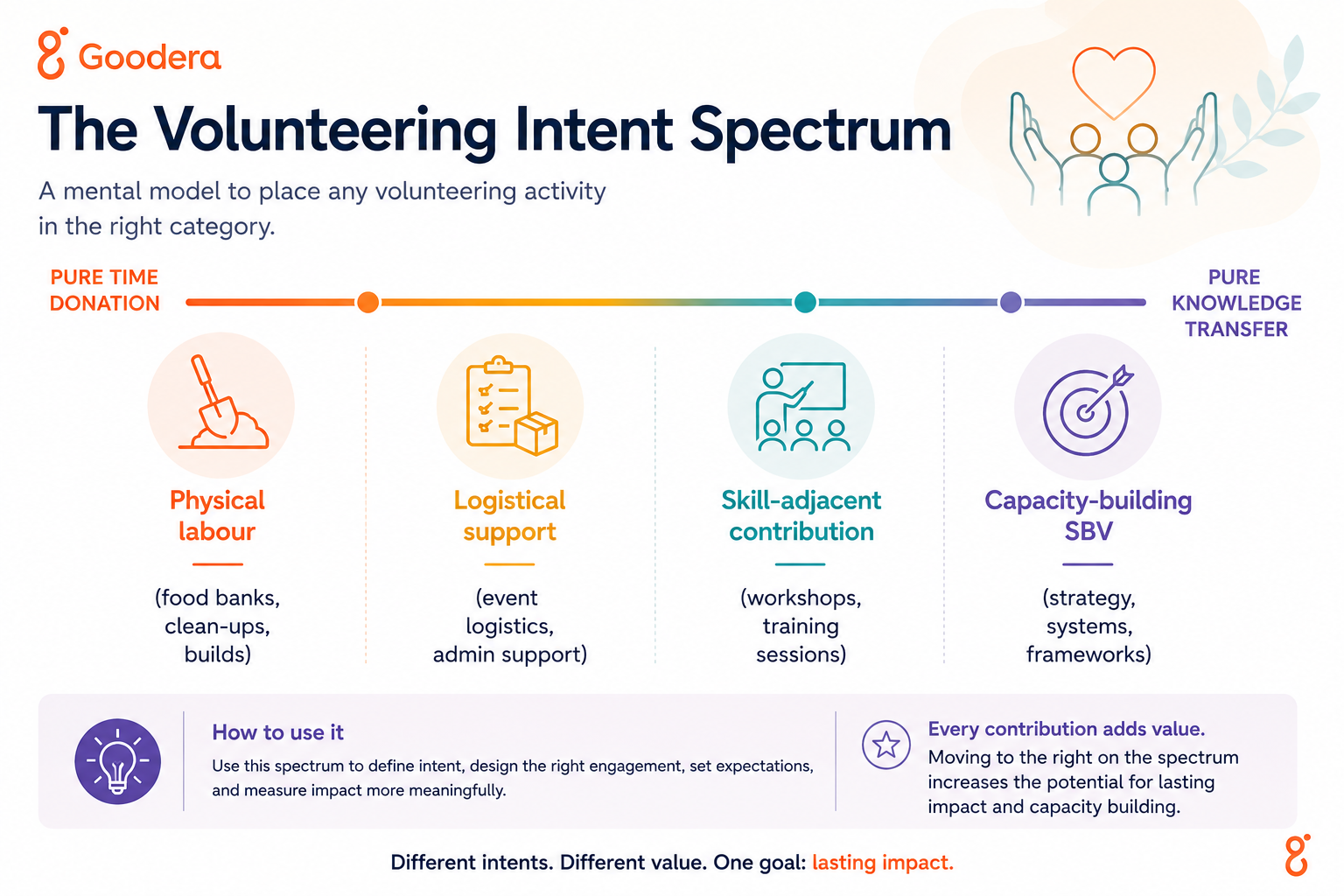
The Volunteering Intent Spectrum
Most corporate volunteering programs operate in the middle two zones without realizing it. They deliver activities that look like skills-based volunteering (a workshop, a consulting session, a training day) but produce outputs rather than capacity.
Moving a program from the middle zones to genuine capacity-building skills-based volunteering requires a design change, not just a labeling change.
Side-by-Side: How Skills-Based Volunteering and Traditional Volunteering Differ
Generally, we see time commitment and skill levels as criteria to compare both of these formats of volunteering. Although they give a big picture view of major considerations, those criteria do not help a CSR director make a fully well-informed program decision. Here is an honest analysis across the six dimensions that effectively drive strategic CSR choices.
1. Community Impact: Depth vs. Breadth
Traditional volunteering creates a broad, visible community impact. It reaches many people, offers frequent moments of connection, and often supports multiple organizations across different causes through activity-based participation.
Skills-based volunteering creates deep, structural community impact, engaging fewer organizations directly but driving changes that compound over time within those organizations and the systems they operate in.
Both are ideal in their own ways. They serve different community needs. For instance, a nonprofit in an operational crisis needs depth, whereas a community in disaster recovery needs breadth.
2. Employee Development Return
This is where skills-based volunteering pulls significantly ahead. A Boston College Center for Corporate Citizenship study found that 88% of skills-based volunteering participants returned with stronger cross-functional collaboration and communication skills.
Research consistently shows that employees learn 70% of their professional capabilities on the job, 20% through peer interaction, and just 10% through formal training sessions, a framework widely known as the 70-20-10 model, documented by Docebo and widely cited by SHRM. Skills-based volunteering sits squarely in that 70%; it is real work, with real stakes, for a real organization, in a domain the employee has genuine expertise in.
3. Nonprofit Preference and Absorption Capacity
This is an underrated dimension usually missed. Not every nonprofit can absorb skilled volunteers effectively. Early-stage nonprofits with weak operational infrastructure often need skills-based volunteering the most but have the least capacity to manage it.
Meaning they cannot brief volunteers properly, lack the internal bandwidth to implement deliverables, and may not have the data access that skilled volunteers require to do meaningful work.
Mature, well-structured nonprofits can absorb and deploy skills-based volunteering with high efficiency. Traditional volunteering, by contrast, is absorbable by almost any nonprofit at almost any stage.
4. Program Cost and Management Complexity
Traditional volunteering is significantly cheaper and simpler to run. Logistics, transportation, safety briefings, and partner coordination are the primary costs. Skills-based volunteering requires more infrastructure: project scoping, volunteer-to-project matching, impact measurement, nonprofit partner assessment, and program management oversight.
Goodera's Corporate Volunteering Quotient Report 2026, which analyzed data from 240 companies worldwide, found that companies deploying structured volunteering enablers, including dedicated program infrastructure, recorded 1.5 times higher workforce participation rates than those without such structures in place.
5. ESG Reporting and Measurability
Traditional volunteering is easier to aggregate at scale because it relies on standardized output metrics like volunteer hours, number of participants, beneficiaries reached, and the estimated value of donated time or goods.
These indicators are widely used in ESG reporting because they are simple to collect across teams, geographies, and time periods, which makes them highly comparable in annual sustainability disclosures and internal dashboards.
The trade-off is that these metrics mostly capture activity, not change. They can tell you how many people volunteered or how many individuals were served, but they don’t consistently show what changed inside the organizations being supported.
For example, a food drive can report meals distributed and volunteer hours contributed, but it typically won’t track whether the nonprofit improved its supply chain efficiency, strengthened its logistics systems, or reduced future operational bottlenecks as a result of that engagement.
Because of this, traditional volunteering data fits neatly into ESG reporting structures focused on scale and participation, but it is less effective at demonstrating sustained organizational or systems-level improvement over time.
That type of insight usually requires additional qualitative reporting, case studies, or outcome-specific frameworks, which are not yet standardized across ESG disclosures.
6. Employee Accessibility and Participation Breadth
Traditional volunteering tends to have lower participation barriers because it does not require specific domain expertise or prior training.
Most activities are designed to be accessible across all employee levels and functions, and often involve time-bound commitments such as a single day of service or event-based participation. This makes it easier for a larger and more diverse group of employees to take part.
Skills-based volunteering, by contrast, naturally has higher participation thresholds. It depends on matching specific professional skills to defined nonprofit needs, which limits eligibility to certain roles or expertise.
It also typically requires deeper time and cognitive commitment than event-based volunteering, which may not align with every employee’s workload or preferred way of engaging.
As a result, programs that rely exclusively on skills-based volunteering often see lower broad participation rates compared to hybrid models that include traditional volunteering options alongside skills-based projects.
From The Nonprofit Perspective
Nonprofits are highly diverse in structure and needs. A community food bank, a policy advocacy organization, a healthcare access nonprofit, and a youth education charity have profoundly different operational profiles, workforce compositions, and absorptive capacities for volunteer support.
For a food bank running 15 distribution days a month, high-value volunteer contribution often looks like large groups of volunteers showing up on a scheduled day to sort and pack supplies, enabling consistent downstream distribution.
Skills-based contributions can also be valuable, particularly when they address operational challenges such as logistics or process design, but they typically operate on longer timelines and in more targeted scopes.
For an education technology nonprofit with a small internal team building a product used by tens of thousands of students, a UX researcher spending several weeks on a product audit or user experience redesign can have a significant structural impact.
In contrast, short-term, event-based volunteering activities may provide limited alignment with the organization’s immediate priorities, even if they contribute value in other ways.
The honest framework for understanding nonprofit preference is their organizational lifecycle stage:
Early-stage nonprofits (0-3 years, under $500K budget): Need operational infrastructure built from scratch. Finance systems, HR frameworks, technology setup, communications strategy. Skills-based volunteering is a high priority, but program complexity must be managed carefully, they often cannot brief volunteers well without support.
Growth-stage nonprofits (3-8 years, $500K-$5M budget): Need strategic capacity: fundraising strategy, donor acquisition systems, impact measurement frameworks, leadership development. Skills-based volunteering is the highest-value intervention at this stage.
Mature nonprofits ($5M+ budget, established operations): Often have more internal capability and more nuanced needs. May benefit from high-level strategic skills-based volunteering (board-level strategy, M&A support, complex financial modeling) alongside traditional volunteering for community engagement events they run throughout the year.
Understanding where your nonprofit partners sit on this spectrum is the single most underused tool in CSR partnership design.
Pro Tip: Before your next nonprofit partnership conversation, ask directly: "What is the biggest operational problem you cannot solve because you lack the in-house expertise?" and "What does a successful volunteer engagement look like from your side?" The answers will tell you immediately whether skills-based volunteering or traditional volunteering, or both is the right fit.
When Traditional Volunteering Is the Right Call
Six specific scenarios where traditional volunteering is the strategically superior choice:
1. Community Relationship Building In New Markets:
When a company enters a new geography or community, showing up physically and consistently before asking to be trusted with strategic work is how social license is earned. Traditional volunteering is the relationship-building foundation that makes skills-based volunteering partnerships possible later.
2. Employee Onboarding and Culture Programs:
New employee cohorts benefit enormously from a shared volunteering experience early in their tenure. It creates cross-functional relationships, signals company values through action, and produces the psychological safety and team cohesion that make subsequent collaboration more effective. The activity matters less than the shared experience.
3. Crisis and Disaster Response:
Speed and physical presence trump skill deployment when a community is in acute need. Companies with existing traditional volunteering infrastructure can activate rapidly. Skills-based project pipelines cannot.
4. Frontline and Non-Specialist Workforces:
Manufacturing, logistics, retail, hospitality, all these industries where the workforce's daily work is physical or operational. Skills-based volunteering programs designed around knowledge-worker skills exclude these employees by design. Traditional volunteering is generally the relatively more inclusive option.
5. Employee Mental Health and Decompression:
High-burnout, high-pressure environments sometimes need a volunteering program that asks employees to step completely outside their professional identity for a day. Gardening, building, cooking, and painting are not lesser contributions. They are psychologically restorative in ways that pro bono consulting rarely is.
6. Nonprofit Partners Who Are Not Yet Skills-Based Volunteering-Ready:
Running skills-based volunteering with a nonprofit that lacks the internal capacity to absorb and implement skilled volunteer contributions is not impactful. It is an expensive frustration for everyone involved. When a partner is not ready, traditional volunteering maintains the relationship while capacity develops.
When Skills-Based Volunteering Is the Right Call
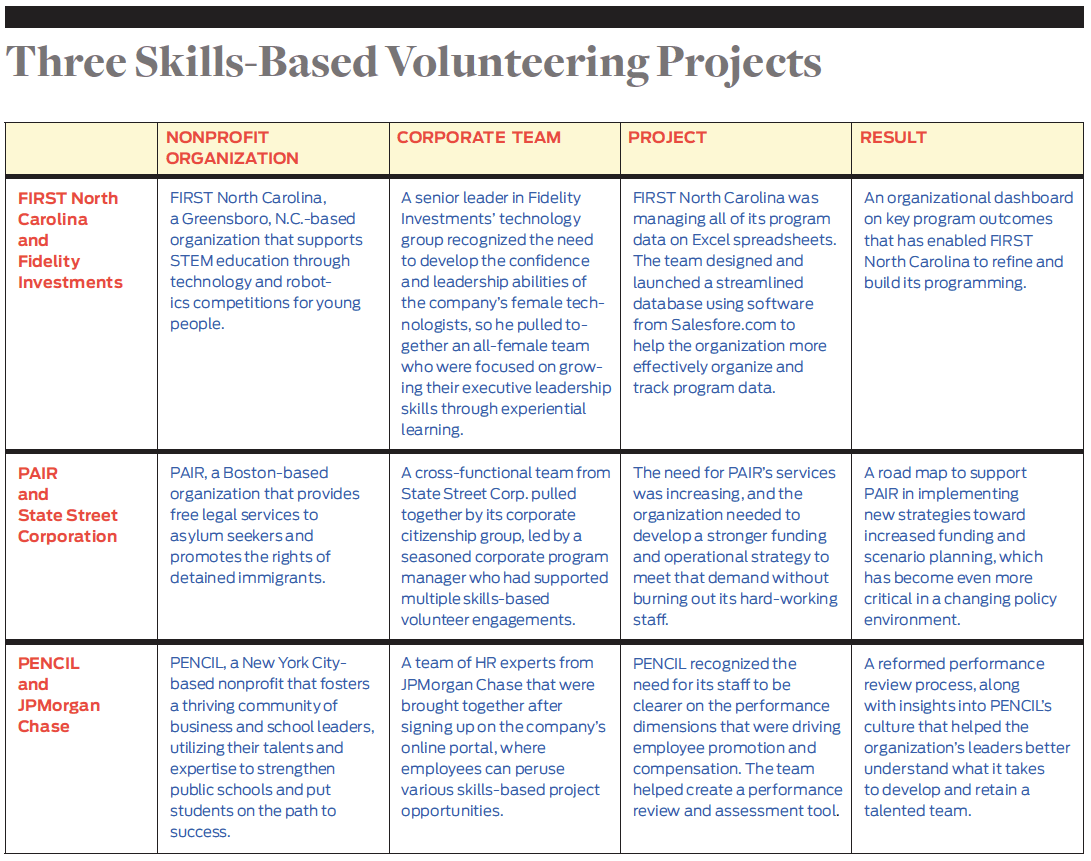
Six specific scenarios where skills-based volunteering is clearly the superior strategic choice:
1. ESG Reporting Requires Demonstrable, Measurable Community Outcomes:
If your sustainability report needs more than hours-logged data, skills-based volunteering is a model that produces defensible outcome metrics.
2. Your Workforce Is Specialist-Heavy:
Technology companies, consulting firms, financial services organizations, and law firms mostly workforces where professional expertise is the primary organizational asset. The opportunity cost of deploying these people in non-specialist volunteering is high. The leverage available through skills deployment is enormous.
3. You Are Building An Employer Brand In A Competitive Talent Market:
Deloitte's 2024 Gen Z Survey found that 44% of Gen Z candidates have turned down a job offer because of values misalignment. skills-based volunteering programs that let employees use their actual professional capabilities for genuine community impact are significantly more compelling to this cohort than generic corporate volunteering days.
4. Your Nonprofit Partners Have Identified Specific Operational Bottlenecks
When a nonprofit can tell you precisely what expertise gap is preventing them from scaling, and you have employees with that exact expertise, skills-based volunteering is not just the right choice; it is, oftentimes, the only choice that serves the actual need.
5. You Are Running L&D Programs That Need Real-World Application:
Leadership development, cross-functional collaboration, and project management are capabilities that develop faster in real, high-stakes environments than in training rooms. Skills-based volunteering is one of the few contexts where employees practice strategic work with genuine consequences.
6. You Have The Program Infrastructure To Do It Properly:
Skills-based volunteering done badly, without scoping, without matching, without measurement, damages nonprofit relationships and produces volunteer cynicism. If your program infrastructure is strong enough to manage it well, skills-based volunteering's ROI is unmatched. If it is not, traditional volunteering done well outperforms skills-based volunteering done badly every time.
For more on building the infrastructure for effective skills-based volunteering, explore Goodera's corporate volunteer programs guide and the full catalogue of skills-based volunteer opportunities by function.
The Hybrid Model: Running Both Without Running Them Into Each Other
The most strategically sophisticated corporate volunteering programs do not choose between traditional and skills-based volunteering. They run both as distinct, complementary tracks, each designed for a specific purpose, each communicating a specific value proposition to employees.
Call this the Two-Track Volunteering Framework:
Track A: Community Presence (Traditional Volunteering)
Purpose: Build community relationships, create inclusive participation across all employee levels, support employee wellbeing and team cohesion, and respond to acute community needs.
Format: Quarterly day-of-service events, crisis response activation, employee-choice opportunities for personal-time volunteering.
Measurement: Participation rate, employee satisfaction, nonprofit partner relationship quality, and community visibility metrics.
Track B: Strategic Capacity Building (Skills-Based Volunteering)
Purpose: Deliver measurable nonprofit capacity improvements, develop employee professional skills, produce ESG-reportable community investment value, build employer brand with specialist talent.
Format: Scoped project engagements (4-12 weeks), micro-volunteering tasks (under 3 hours), virtual pro bono programs.
Measurement: Nonprofit outcome metrics, employee skill development scores, pro bono value generated, retention delta for skills-based volunteering participants.
The critical design principle is that these tracks should be explicitly named and communicated as separate options, not bundled into a single "volunteering program" that expects all employees to engage in the same way. Employees self-select the track that fits their availability, preferences, and professional context, and participation across both tracks is significantly higher than participation in either track alone.
Salesforce's approach illustrates this well. Their 1-1-1 model gives all employees 56 hours of paid volunteer time annually and runs both community service days (Track A) and structured pro bono engagements through their Pro Bono program (Track B). Employees choose how to allocate their time. The result is an 80%+ participation rate, nearly unheard of in corporate volunteering because the program meets employees where they are rather than expecting them all to be in the same place.
Deloitte runs its annual Impact Day as a global Track A event, with tens of thousands of employees in community service worldwide on a single day, while simultaneously running Deloitte's Volunteer Impact Leadership Exchange and sector-specific pro bono programs as its Track B. The two tracks reinforce each other: Impact Day builds the cultural habit of giving back, while the pro bono track channels the most motivated, professionally engaged volunteers into deeper contributions.
The Decision Framework: Which Model Fits Your Organisation Right Now?
Answer these four questions honestly. They will tell you where to start.
Question 1: What Does Your Workforce Look Like?
If your employee base is predominantly knowledge workers (tech, finance, consulting, legal, marketing, HR), you have the raw material for high-impact skills-based volunteering. If your workforce is mixed or predominantly frontline/operational, a hybrid model with a strong Track A foundation is the right entry point.
Question 2: What Do Your Current Or Prospective Nonprofit Partners Actually Need?
The first step is reaching out and listening. It’s surprising how many requirements are clarified by a simple conversation or a discovery call with the nonprofit teams by approaching them directly. If your existing partners are mature organizations with operational capacity and identified strategic gaps, skills-based volunteering will be welcomed and well-absorbed.
If they are early-stage or crisis-mode organizations, start with Track A and build the skills-based volunteering relationship over time.
Question 3: What Is Your Program Management Capacity?
Be honest. Skills-based volunteering requires approximately 3x the management resource per volunteer hour compared to traditional volunteering. If you have a one-person CSR team managing a 500-person company, launching a full skills-based volunteering program at scale will break your infrastructure before it produces results. Start with Track A at scale and a small, tightly managed skills-based volunteering pilot.
Question 4: What Does Your ESG Reporting Framework Require?
If you are operating under CSRD, GRI, or similar reporting standards that require documented community outcome metrics, skills-based volunteering is not optional here, it is the only model that produces the evidence those frameworks require. If your reporting is less prescriptive, you have more flexibility to balance the two tracks based on employee and community needs.
Your answers to these four questions produce a clear starting position:
- All four point to skills-based volunteering: build a full skills-based volunteering program with a small traditional volunteering component for inclusion.
- Mixed answers: design a Two-Track program from the start.
- All four points away from skills-based volunteering: build a strong Track A program with a 6-12 month timeline to develop skills-based volunteering readiness.
Measuring What Each Model Actually Delivers
The most common measurement mistake in corporate volunteering is applying the same metric of volunteer hours to both traditional and skills-based programs, and then drawing conclusions about relative impact from that single number. Hours are a unit of input, not a unit of outcome. Comparing two programs by hours is like comparing two restaurants by how many ingredients they use.
Measuring Traditional Volunteering Well:
The right metrics are community reach (number of beneficiaries served or touched), partner relationship quality (nonprofit feedback scores), employee experience quality (post-event satisfaction and wellbeing data), and participation breadth (percentage of employee base engaged). These metrics tell you whether your Track A program is building the community relationships and internal culture it is designed to build.
Measuring Skills-Based Volunteering Well:
The right metrics are nonprofit capacity outcomes (specific, pre-defined changes in the partner organization's capability, efficiency, or reach), pro bono value generated (hours multiplied by Taproot's $150 benchmark), employee skill development (pre and post-engagement competency assessment), and retention delta (whether skills-based volunteering participants stay at the company at higher rates than non-participants).
These metrics tell you whether your Track B program is building the strategic community impact and workforce development it is designed to build.
Comparing these two measurement sets directly makes no sense, which is precisely why the "which is better" question misses the point. They are measuring different things because they are delivering different things.
For a complete framework on measuring corporate volunteering impact across both models, see Goodera's guide to CSR strategy and measurement.
Real Companies, Real Choices
IBM Corporate Service Corps is a study in deliberate skills-based volunteering design. Teams of IBM professionals spend four weeks in emerging markets, working with local governments, NGOs, and social enterprises on specific strategic and operational challenges. Over 4,000 IBM employees have been deployed across 40 countries.
IBM also runs traditional community volunteering domestically. The two programs are never confused with each other internally; they have different names, different application processes, and different organizational homes. That separation is intentional, and it is a large part of why both programs maintain their quality.
Unilever's UniVerse Platform allows employees to contribute both time and skills to community organizations, explicitly distinguishing between the two contribution types in how opportunities are listed and how impact is reported.
The platform shows employees which opportunities are skills-based and which are time-based, and employees self-select based on their current availability and interest. Participation across both tracks exceeds industry benchmarks because the distinction reduces the friction of decision-making.
Atlassian builds skills-based volunteering into its company value framework rather than running it as a standalone CSR program. Their engineers, designers, and product managers contribute technical skills to nonprofits in ways that are directly continuous with their daily work.
Atlassian also runs traditional volunteering through its Atlassian Foundation partnerships. The two tracks serve different communities and different employee needs, and the company communicates them as such.
In A Nutshell
The companies winning at corporate volunteering in 2026 are increasingly opting for a hybrid model of volunteering, according to their unique positioning and community needs.
The community organizations your company has the opportunity to serve need different things at different times. Your employees are an amazing, driven, heterogeneous bloc with different motivations, varied skills, and psychological needs. The ESG reporting environment you operate in is changing every year, demanding more evidence and impact.
A program built on that reality, one that knows when to send skilled volunteers, designs for depth and for breadth simultaneously, and measures what each track is actually supposed to deliver, is not more complicated than a single-track program. It is more honest. And in corporate volunteering, honesty about what you are building, why you are building it, and what it can actually accomplish is the only foundation worth building on.
Frequently Asked Questions
1. Is skills-based volunteering better than traditional volunteering?
Neither is categorically better. They serve different purposes, different communities, and different employee needs. The question to ask is not which is better but which is right for your organization's current capacity, your employees' profiles, and your nonprofit partners' actual needs. Companies that run both strategically consistently outperform companies that run either one exclusively.
2. Can small nonprofits benefit from skills-based volunteering?
Yes, but with an important caveat. Small nonprofits benefit enormously from skilled volunteer support; they are often the organizations with the most acute expertise gaps. However, they also have the least internal capacity to manage complex skills-based volunteering engagements. The solution is rigorous project scoping by the corporate partner, not by the nonprofit. If your program takes on the scoping and management burden, small nonprofits can absorb and benefit from skills-based volunteering at any stage.
3. How do you convince leadership to invest in a skills-based volunteering program over traditional volunteering?
The business case has three components leadership responds to: ESG reporting value (skills-based volunteering produces auditable, quantifiable community investment metrics that traditional volunteering cannot), talent ROI (Deloitte research shows companies with structured skills-based volunteering programs see 57% higher retention rates), and employer brand impact (skills-based volunteering is a significantly stronger talent attraction signal for specialist and Gen Z candidates).
Present all three simultaneously, with data, and position skills-based volunteering as a complement to rather than a replacement for existing traditional programs.
4. What is the average cost of running a skills-based volunteering program versus traditional volunteering?
Per volunteer hour, skills-based volunteering costs approximately 3x more to administer than traditional volunteering, due to the project scoping, matching, and measurement infrastructure required. However, the community value generated per volunteer hour ($150 pro bono benchmark versus no equivalent market-rate figure for traditional volunteering) makes the cost-to-impact ratio of skills-based volunteering significantly superior for organizations focused on measurable community outcomes.
5. How do you measure the impact of traditional volunteering?
The right metrics are community reach (beneficiaries served), partner organization satisfaction, employee participation breadth, and employee wellbeing improvement. Qualitative metrics and impact are also great measures. Avoid applying pro bono financial valuation frameworks to traditional volunteering; the resulting numbers are methodologically indefensible and will not survive ESG audit scrutiny.
6. Can a company run skills-based and traditional volunteering simultaneously without confusing employees?
Yes, provided the two tracks are explicitly named, separately communicated, and positioned as serving different purposes. The confusion arises when companies blend the two into a single "volunteering program" without distinguishing between them. Separate branding, separate application processes, and separate impact reporting for each track prevent confusion and actually increase participation in both.
7. What types of companies are best suited to skills-based volunteering?
Technology, financial services, consulting, legal, and marketing-heavy organizations have the highest natural alignment with skills-based volunteering because their workforces are primarily knowledge workers whose professional skills have direct nonprofit applications. That said, any company with employees who have specialist expertise, even in industries not typically associated with knowledge work, can run an effective skills-based volunteering. A logistics company's supply chain experts are extraordinarily valuable to food banks and disaster relief organizations.
8. How do nonprofits feel about receiving skilled volunteers versus traditional volunteers?
Nonprofits do not have a universal preference; it depends entirely on their stage, capacity, and current operational needs. What nonprofits consistently report preferring, regardless of volunteering type, is well-managed engagements with clear briefs, committed volunteers, and corporate partners who follow through on commitments. A poorly scoped skills-based volunteering project is more damaging to a nonprofit than a well-run traditional volunteering day.
9. Is virtual skills-based volunteering as effective as in-person skills-based volunteering?
For most skilled volunteer engagements, yes. Strategy development, financial modeling, design work, HR framework building, technology implementation, and communications strategy are all deliverable virtually with no loss of quality. In-person skills-based volunteering adds value specifically for engagements requiring deep relationship building, hands-on training of nonprofit staff, or physical presence in a community context.
According to Goodera's research, over 65% of corporate volunteers now prefer virtual skills-based volunteering opportunities due to flexibility and geographic reach.
10. How do you transition a traditional volunteering program to include skills-based volunteering without disrupting what works?
The answer is addition, not replacement. Start by identifying the 10-15% of your existing volunteer base who are most engaged and most likely to respond positively to a skills-based opportunity. Run a small, well-scoped skills-based volunteering pilot alongside your existing traditional program. Use the pilot's outcomes to build an internal business case for a formal Two-Track Volunteering Framework.
Maintain your traditional program throughout, both for the employees it serves well and for the community relationships it has built. The transition from a single-track to a Two-Track program typically takes 12-18 months when done without disrupting existing participation.
Explore Goodera's full range of skills-based volunteer opportunities across marketing, technology, finance, HR, and more. For a deeper dive into building the program infrastructure that makes both tracks work, read the complete guide to corporate volunteer programs and Goodera's CSR strategy resources.