International Human Rights Day 2026: What Can Your Workplace Do?

On December 10, companies around the world pause to recognize the principles of dignity, safety, equality, and justice that shape the way people live and work. For CSR and social impact teams, those principles are rarely confined to a single day. They already show up in employee volunteering programs, community partnerships, responsible sourcing efforts, workplace policies, and investments in the communities where businesses operate.
International Human Rights Day 2026 marks 78 years since the adoption of the Universal Declaration of Human Rights. It offers companies an opportunity to bring those efforts into sharper focus: to look at where human rights already feature in their social impact strategy, where there is room to go further, and how employees can play a meaningful role in advancing that work.
For CSR leaders planning their December 10 initiatives, the opportunity is not to start from scratch. It is to build on existing commitments with actions that connect employees to real community needs, strengthen partnerships with credible organizations, and create momentum that extends beyond a single awareness day. From skills-based volunteering and community support to employee-led advocacy and longer-term partnerships, Human Rights Day can become a meaningful point in a broader year-round impact strategy.
What Is International Human Rights Day?
Human Rights Day is an observance that governments, civil society groups, and increasingly the private sector use to take stock of how well universal rights translate into everyday practice. The day falls on December 10 every year, tied permanently to a single historical event that still shapes corporate policy language today.
In 2026, the significance of this date extends beyond symbolic reflection. As regulatory frameworks shift and public scrutiny intensifies, December 10 has evolved into a key operational checkpoint for modern enterprises. It provides corporate teams with a crucial moment each year to audit internal standards, evaluate external vendor relationships, and align business growth with basic human rights across every region they touch.
The History and the Universal Declaration of Human Rights
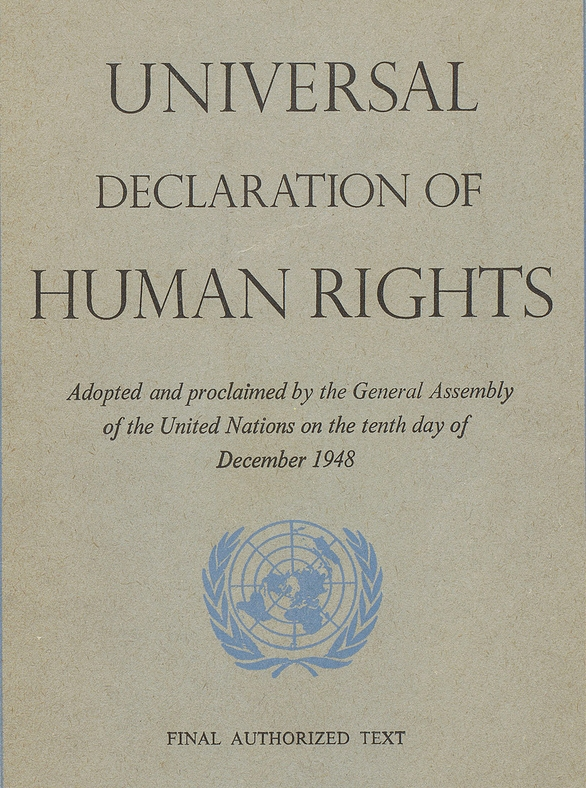
On December 10, 1948, the United Nations General Assembly adopted the Universal Declaration of Human Rights in Paris, a document born directly out of the devastation of the Second World War. The Declaration set out 30 articles covering civil, political, economic, social, and cultural rights that apply to every person regardless of nationality, gender, or background.
It remains the most translated document in the world, now available in more than 500 languages, and it continues to serve as the foundation for nearly every human rights treaty and corporate human rights policy written since.
While the original 1948 framework was primarily designed to guide nation-states, its core principles have steadily filtered into the private sector over the past several decades. As global trade expanded and multinational corporations grew to rival the economic power of entire countries, the global community recognized that protecting fundamental rights required direct corporate accountability. Concepts like fair wages, safe working conditions, and non-discrimination, all rooted in the original 30 articles, shifted from purely legal ideals into baseline expectations for ethical commercial enterprise.
Understanding this foundation gives corporate leadership a clear lens for modern decision-making. The Universal Declaration established a practical baseline for human dignity, one that today’s global workforce, business partners, and institutional investors look for when choosing where to build long-term relationships.
Connecting your company's values to this history brings clarity to your day-to-day operations. It helps move internal discussions past surface-level policies and toward building an enterprise culture that naturally protects people across every market you enter. Ultimately, honoring that heritage is how forward-thinking companies build trust, strengthen organizational resilience, and create lasting value.
The 2025 Theme and What It Passed Forward to 2026
The 2025 observance carried the theme "Human Rights: Our Everyday Essentials," chosen to reconnect people with the idea that rights are not abstractions but the conditions that shape daily life, from safety to speech to opportunity. Marking the campaign's launch, UN Human Rights Chief Volker Türk said:
"Human rights are our compass in turbulent times, guiding and steadying us through uncertainty."
– Volker Türk, UN Human Rights Chief, November 2025
That framing carries directly into 2026. The campaign's emphasis on the practical, lived experience of rights gives CSR teams a natural bridge from abstract policy language to concrete workplace and supply chain programming.
Why December 10 Has Grown in Corporate Relevance
The Office of the High Commissioner for Human Rights has designated 2026 as the year marking the 60th anniversary of the International Covenant on Civil and Political Rights and the International Covenant on Economic, Social and Cultural Rights, the two treaties that operationalized the Declaration in international law. For companies, this anniversary lands alongside a wave of binding regulation, including the EU's Corporate Sustainability Due Diligence Directive and national laws like Germany's Supply Chain Due Diligence Act.
For US companies, this arrives alongside a major shift in how domestic enforcement works. Strict federal mandates like expanded customs enforcement under the Uyghur Forced Labor Prevention Act and Section 307 of the Tariff Act now put the burden of proof squarely on importers. Your company has to prove that your supply chains are completely free of forced labor before goods even cross the border.
At the same time, state laws like the California Transparency in Supply Chains Act and growing SEC expectations around human capital disclosure have changed the stakes. December 10 has become a crucial checkpoint for risk management, regulatory compliance, and operational integrity across your entire business.
Thus, International Human Rights Day has shifted from a communications moment to a genuine compliance and reputation touchpoint for global businesses.
What Corporate Responsibility to Human Rights Means in Practice
Corporate human rights responsibility is often confused with philanthropy, but the two are distinct disciplines with different owners, timelines, and success metrics. Understanding that distinction is the first step toward building a program that holds up to scrutiny.
The UN Guiding Principles on Business and Human Rights
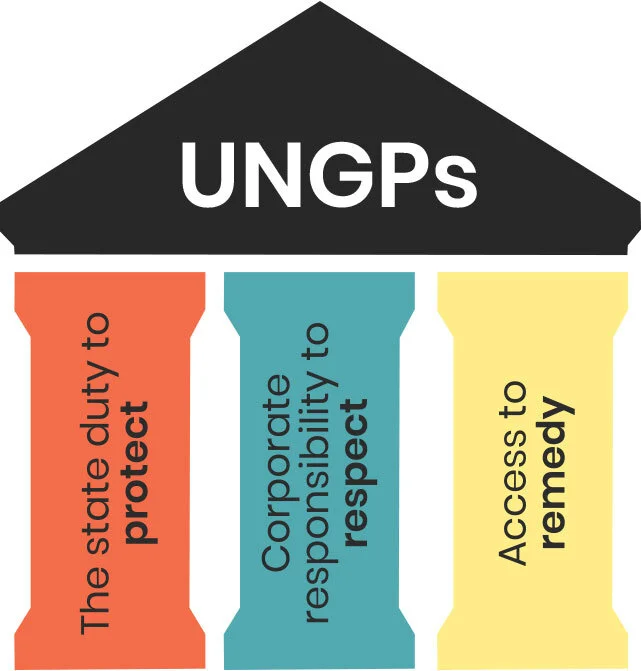
Endorsed unanimously by the UN Human Rights Council in June 2011, the UN Guiding Principles on Business and Human Rights (UNGPs) were developed by then Special Representative John Ruggie after six years of global consultation. They comprise 31 principles organized under three pillars: the state duty to protect, the corporate responsibility to respect, and access to remedy for those harmed. The UN Guiding Principles remain the single most widely referenced global standard for how a business should identify, prevent, and address its human rights impacts.
The Supply Chain Accountability Gap
Most human rights exposure for large companies does not originate inside their own walls; it originates several tiers deep in raw material sourcing, contract manufacturing, and labor recruitment. Organizations like the Business & Human Rights Resource Centre now track the human rights performance of more than 10,000 companies across over 180 countries and raise more than 1,500 direct allegations with companies each year.
Randy Newcomb, former President and CEO of Humanity United, captured the scale of the challenge plainly:
"The scope of this issue is enormous. We need new actors, new skills, new data, new ideas and new energy to improve anti-trafficking efforts around the world."
– Randy Newcomb, President and CEO, Humanity United, October 2015
How Companies Can Take Meaningful Action on December 10, 2026
Programming for Human Rights Day works best when it blends structural review with visible employee participation. The most credible activations do both rather than choosing one over the other.
Human Rights Due Diligence as a December 10 Program Prompt
Use the date as an internal deadline to review or refresh your human rights due diligence process against the UNGPs, covering policy commitment, impact assessment, and remedy pathways. As UK modern slavery expert Caroline Haughey, OBE KC, put it at the 2026 ethica26 supply chain leadership summit:
"It is not good enough any more to say 'But I didn't do anything wrong.' What you are now tasked, required, legally obliged to say: 'This is what I did right. These are the positive steps that I took to ensure that I did not have modern slavery, human trafficking, labour exploitation, abuse of humans, within my supply chain.'"
–Caroline Haughey, OBE KC, ethica26 Summit, April 2026
That distinction, between avoiding harm and demonstrating proactive care, is a useful internal test for any due diligence refresh planned around the anniversary.
Skills-Based Volunteering for Human Rights Organizations
Skills-based volunteering lets employees apply professional expertise such as legal review, data analysis, or communications strategy directly to a human rights nonprofit's operational needs. Over 70% of Fortune 500 companies already include skills-based volunteering as part of their CSR strategy, and employee resource groups that participate in structured volunteering report roughly 30% higher engagement than those that do not.
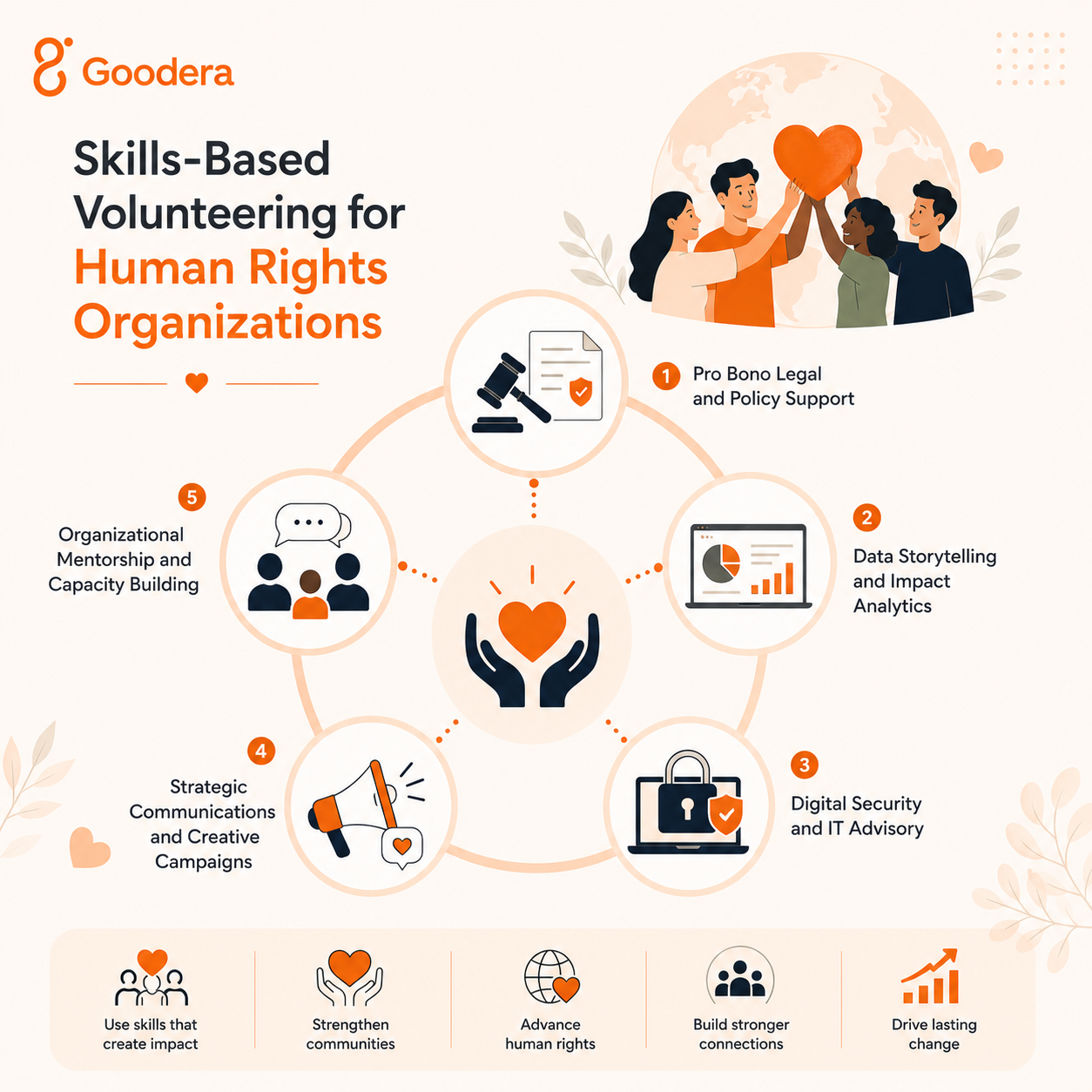
- Pro Bono Legal and Policy Support:
Legal and governance professionals can partner with human rights non-profits to review case documentation, analyze localized policy changes, or co-draft educational materials for rights-holders.
- Data Storytelling and Impact Analytics:
Data analysts, researchers, and visualization specialists can help research-heavy non-profits clean, structure, and visualize complex human rights datasets. This speeds up the publication of field reports on labor conditions, migration trends, and community access.
- Digital Security and IT Advisory:
Cybersecurity and IT specialists can offer technical guidance to grassroots human rights organizations. By helping set up secure communications, encrypted storage, and practical access protocols, tech teams help keep frontline advocates and sensitive community data safe.
- Strategic Communications and Creative Campaigns:
Marketing, design, and communications professionals can collaborate with non-profits to amplify their voice. Teams can lend their creative talents to design digital media kits, refine campaign messaging, or build multi-channel outreach strategies for upcoming awareness drives.
- Organizational Mentorship and Capacity Building:
Finance, operations, and HR professionals can facilitate interactive workshops for non-profit leaders. Sharing practical knowledge on volunteer management, modern donor tracking, or long-term financial planning helps grassroots organizations build lasting operational resilience.
High-Impact Group and Workplace Volunteering Activations
Group volunteering around December 10 works best when it is tied to a specific, named organization. Companies with dedicated volunteering program infrastructure recorded 1.5 times higher workforce participation than those without it, according to Goodera's Corporate Volunteering Quotient Report 2026, which analyzed data from 240 companies worldwide.
Experiential, hands-on group activations give team members a tactile connection to human rights causes without requiring specialized professional backgrounds. These shared activities build community internally while delivering tangible aid to local advocacy groups, shelters, and frontline organizations.
- Human Rights Care Kit Assembly:
Host an in-person or hybrid packing event where teams assemble essential hygiene, warmth, or comfort kits for individuals served by local domestic violence shelters, refugee resettlement agencies, or legal aid clinics. To connect the activity directly to December 10, teams can include handwritten message cards that highlight fundamental human rights protections, offering dignity alongside physical aid.
- Accessible Workplace & Community Audit Drives:
Organize a walk-and-map activation where groups of employees audit local public spaces or corporate facilities for accessibility compliance. Teams can map physical barriers, evaluate wheelchair access, and review signage clarity. This activity transforms equal access from an abstract legal concept into an experiential learning moment that generates actionable data for facility managers or local civic planners.
- Migrant and Refugee Welcome Package Creation:
Partner with local resettlement agencies to build custom welcome packs for newly arrived families. Teams can put together household essentials, localized transit maps, community resource guides, and winter gear. Working together in group settings gives employees a grounded understanding of the social and economic rights facing displaced communities in their own cities.
- Solidarity Meal Prep and Food Dignity Packing:
Collaborate with community kitchens or food sovereignty non-profits to prepare and pack nutritionally dense meals for marginalized groups. Teams can handle prep, packaging, and distribution logistics while learning about food security as a core human right. This shared, hands-on experience provides immediate community relief while fostering strong bonds across cross-functional work teams.
Grantmaking and Corporate Partnerships With Human Rights NPOs
In addition to volunteering, International Human Rights Day is a natural point in the calendar to formalize or renew grant commitments with organizations working directly on forced labor, trafficking, and access to justice.
Verité's corporate partnerships framework provides a clear template for what these collaborative relationships look like in practice. By working directly with brands like Target, Starbucks, and The Walt Disney Company, Verité helps businesses identify labor abuses early and build transparent, ethically managed supply chains for the long term.
Internal Employee Programming That Reflects the Day's Purpose
Internal programming, including learning sessions on the Universal Declaration of Human Rights, panel discussions with human rights practitioners, or spotlighting supplier-level human rights investments, helps employees connect the observance to the company's own operations rather than treating it as an external cause disconnected from daily work.
Active Human Rights Nonprofits Worth Knowing for Corporate Partnerships
Choosing the right nonprofit partner matters as much as the size of the commitment. Each of the organizations below works on a distinct piece of the human rights landscape, which makes them useful for companies looking to match a partnership to a specific business risk or workforce interest.
- Amnesty International
What They Do:
Amnesty International operates as a global human rights movement that conducts independent field research, lobbies governments, and mobilizes public pressure. Its corporate accountability work focuses on pressing governments and multi-national businesses to enforce mandatory human rights due diligence, stop supply chain labor exploitation, and ensure access to judicial remedies.
Impact:
Supported by a movement of over 10 million members and supporters worldwide across 150+ countries, Amnesty’s research and global advocacy have helped abolish the death penalty in 113 countries and repeatedly compelled international bodies and governments to restrict military exports and supply chain abuses tied to conflict zones.
- Human Rights Watch
What They Do
Human Rights Watch investigates and reports on human rights conditions worldwide, sending ground-level researchers and legal specialists into more than 100 countries each year. In the corporate sector, HRW directly engages executives, board members, and international regulatory bodies to push for legally binding, UNGP-aligned supply chain due diligence standards.
Impact
With a global staff of over 450 experts, Human Rights Watch publishes the annual HRW World Report covering human rights developments across 100+ countries, generating verified documentation that routinely drives sanctions against abusive actors, compels policy reforms from global brands, and informs international legal proceedings.
- The Business and Human Rights Resource Centre
What They Do
The Business & Human Rights Resource Centre tracks the human rights policies and public allegations for over 10,000 companies across 180+ countries. They maintain an independent corporate response mechanism that directly contacts companies when human rights abuses are alleged, publishing the claim and the corporate reply side-by-side to foster public accountability.
Impact
The Business and Human Rights Resource Centre has logged thousands of corporate approaches through its Company Response Mechanism, driving transparent public engagement from major international firms. Its targeted sector benchmarks have successfully pressured top global fashion and energy companies to fix unfair purchasing practices and compensate affected supply chain workers.
- Humanity United
What They Do
Humanity United is a philanthropic organization focused on changing the systemic conditions that enable forced labor, human trafficking, and violent conflict. They work with corporate leaders, investors, and civil society to shift market incentives, build worker power, and advocate for safer labor migration pathways.
Impact
Humanity United created KnowTheChain, a supply chain benchmarking initiative whose official Investor Statement is backed by over 160 global institutional investors representing over $7 trillion in assets under management to hold major technology, food, and apparel companies accountable for forced labor risks.
- International Justice Mission
What They Do
International Justice Mission partners directly with local law enforcement and justice systems across Asia, Africa, Europe, and Latin America to combat forced labor trafficking, violence, and police abuse. They work directly on the ground to rescue victims, prosecute perpetrators, and equip local governments and corporate partners to protect vulnerable populations over the long term.
Impact
As reported by The Guardian, joint operations between IJM investigators and Philippine authorities led to the rescue of over 120 child trafficking victims and 21 court convictions in a single year, while securing milestone human trafficking convictions in Southeast Asian cyber-scam networks.
Connecting International Human Rights Day to Your ESG and CSR Strategy
Treating December 10 as a standalone event limits its value. The strongest CSR strategies use the day as a lens for evaluating year-round ESG commitments, particularly around supply chain governance and workforce equity.
SDG Alignment for Human Rights Programs
Human rights programming maps most directly onto Sustainable Development Goal 8, Decent Work and Economic Growth, Goal 10, Reduced Inequalities, and Goal 16, Peace, Justice and Strong Institutions, with clear crossover into Goal 5, Gender Equality, wherever supply chain labor practices intersect with women's economic participation. Framing internal reporting against these specific goals gives CSR teams a consistent structure that investors and ESG raters already recognize.
The Business Case for Human Rights Leadership
Human rights due diligence increasingly functions as an early warning system for broader business risk rather than a standalone compliance line item. As Caroline Haughey noted at the ethica26 summit, the impacts of poor due diligence tend to surface in operations and relationships well before they appear in financial statements, which is precisely why leading companies now treat human rights review as a resilience exercise more than a reputational one.
Companies Setting the Standard
A handful of companies have built human rights programming detailed enough to serve as reference points for CSR teams building or refreshing their own frameworks.
Microsoft's Human Rights Statement and Supplier Code of Conduct
Microsoft's Global Human Rights Statement aligns explicitly with the UN Guiding Principles and the Global Network Initiative Principles, and its Supplier Code of Conduct requires suppliers to maintain anonymous, confidential grievance channels that are tracked and reviewed periodically. Its Responsible Sourcing of Raw Materials policy extends these same expectations to the furthest upstream tiers of its device supply chain.
Patagonia's Supply Chain Transparency and Worker Rights Program
Patagonia was a founding member of the Fair Labor Association and redefined supply chain transparency in 2007 through its Footprint Chronicles initiative, which publicly It serves as an interactive transparency tool that tracks the environmental and social impacts of manufacturing select items, detailing the journey of raw materials, textile mills, farms, and sewing factories. Today more than 90 percent of its product line is made in Fair Trade Certified factories, with the associated wage premium paid directly into worker-controlled community development funds.
The CSR Execution Roadmap: Planning, Activation, and Legacy
Turning Human Rights Day into a program that outlasts the news cycle requires the same discipline companies apply to any other business initiative: a pre-launch audit, a focused activation, and a plan for what comes after.
Pre-Launch Phase: Auditing Internal Readiness and Equity Gaps
Before announcing any external commitment, review internal grievance mechanisms, supplier code enforcement rates, and workforce equity data to confirm the company's own house is in reasonable order. This internal audit protects against the credibility gap that opens when external messaging outpaces internal practice.
Day-Of Activation: Locking In One Core Structural Promise
Resist the temptation to announce five initiatives at once. Companies deploying structured volunteering enablers, rather than one-off events, recorded 1.5 times higher participation according to Goodera's 2026 Volunteering Quotient Report, which suggests one well-resourced, structural commitment outperforms several smaller gestures.
Post-Event Momentum: Embedding Human Rights into Your 365-Day Strategy
The final and most important step is scheduling a quarterly review of whatever commitment was made on December 10, tying it to the same ESG reporting cadence used for climate or governance metrics. Programs that survive past the anniversary are the ones with a named internal owner, a defined budget line, and a measurement plan set before the day itself arrives.
In a Nutshell
International Human Rights Day 2026 gives CSR and social impact leaders a fixed, credible point in the calendar to review human rights due diligence, deepen partnerships with organizations Humanity United and Amnesty International, and translate skills-based volunteering into measurable engagement. The UN Guiding Principles remain the reference framework worth building every program around, and companies like Microsoft, Patagonia, and Apple offer detailed, publicly available templates for what mature supplier and workforce programming looks like in practice. The commitments that matter most are the ones with a named owner and a plan that extends well past December 10.
Frequently Asked Questions
1. What is International Human Rights Day 2026 and when is it observed?
International Human Rights Day is observed globally on December 10 each year, commemorating the 1948 adoption of the Universal Declaration of Human Rights. In 2026, the observance coincides with the 60th anniversary of the two treaties, the ICCPR and ICESCR, that gave the Declaration binding legal force.
2. What is the theme for Human Rights Day 2026?
As of this writing, the United Nations has not yet published an official theme for the 2026 observance. The 2025 theme, "Human Rights: Our Everyday Essentials," is expected to continue informing messaging until a new theme is confirmed closer to December.
3. How can a company meaningfully participate in Human Rights Day?
The most credible approach combines an internal human rights due diligence review against the UN Guiding Principles with an external activation, such as skills-based volunteering or a grant partnership with an organization like International Justice Mission or the Business & Human Rights Resource Centre.
4. What are the UN Guiding Principles on Business and Human Rights?
The UNGPs are a globally endorsed framework of 31 principles built around three pillars: the state duty to protect human rights, the corporate responsibility to respect human rights, and access to remedy for those harmed by business-related abuses.
5. Which nonprofits are best suited for corporate human rights partnerships?
Organizations such as Amnesty International USA, Human Rights Watch, the Business and Human Rights Resource Centre, Humanity United, and International Justice Mission each focus on distinct aspects of the human rights landscape, from corporate accountability research to direct anti-trafficking intervention, allowing companies to match a partnership to their specific supply chain or workforce risk profile.
6. What is Human Rights Due Diligence (HRDD), and how does it differ from a standard ESG audit?
Human Rights Due Diligence is an ongoing risk-management process outlined in the UNGPs to identify, prevent, mitigate, and account for how a business impacts people. Unlike traditional ESG audits, which often capture a point-in-time snapshot of compliance, HRDD requires continuous stakeholder engagement, root-cause risk mapping across supply chain tiers, and active remediation processes.
7. Are companies legally required to conduct human rights due diligence, or is it voluntary?
While historically voluntary under the UNGPs, human rights due diligence is increasingly mandatory. Regulations such as the EU Corporate Sustainability Due Diligence Directive (CSDDD) and Germany’s Supply Chain Due Diligence Act (LkSG) legally require qualifying multinational corporations to identify and address human rights and environmental harms across their global value chains.
8. How far down the supply chain does corporate human rights responsibility extend?
Under global frameworks like the UNGPs, corporate responsibility covers a business's entire value chain. In practice, regulations require companies to prioritize their efforts based on the severity and likelihood of harm. While direct control is highest with Tier 1 suppliers, high-risk sectors (such as electronics, apparel, and agriculture) require risk visibility and mitigation reaching deeper into raw material suppliers.
9. How can mid-sized companies engage in human rights advocacy without dedicated CSR teams?
Mid-sized organizations can build credible human rights programs by leveraging pre-existing industry tools and coalition frameworks. Joining collective multi-stakeholder initiatives such as the Ethical Trading Initiative (ETI), or utilizing established benchmarking platforms like KnowTheChain allows companies to access shared risk frameworks, audit templates, and corporate response networks without building massive internal departments.
10. What metrics or indicators should a company track to prove the real-world impact of its human rights initiatives?
Rather than tracking simple activity metrics (like hours of staff training completed), companies should focus on outcome-based indicators. Key impact metrics include the resolution rate of grievance mechanisms, measurable changes in supplier purchasing practices, the percentage of high-risk suppliers audited beyond Tier 1, worker-reported feedback on safety or pay, and formal remediation provided to affected workers.