Factors To Consider While Selecting a Corporate Volunteering Program for Your Company

Every social impact team understands the high-stakes momentum that builds ahead of a major corporate volunteering directive. Whether your company is staring down an upcoming ESG audit, managing a massive post-acquisition culture merge, or trying to fix a frontline employee retention issue, executive mandates for these programs carry immense pressure.
A successful corporate volunteering program is shaped by a few critical decisions:
- Business Alignment: Connect volunteering goals to your company's values, ESG priorities, and long-term business objectives
- Workforce Fit: Design experiences that work for office-based, remote, and frontline employees
- Volunteer Model: Decide on the right mix of skills-based volunteering and community service opportunities
- Budget and Resources: Build a program that matches your available budget and internal capacity
- Cause Selection: Support causes that align with your industry, employees, and community priorities
- Program Policies: Establish clear guidelines around participation, volunteer time off, and eligibility
- Legal and Compliance: Address labor laws, liability, insurance, and HR requirements before launch
- Delivery Model: Determine whether to build and manage the program internally or partner with an external volunteering platform.
A Deloitte survey found that 91 percent of participants believe volunteering strengthens their connection to their employer, but that outcome depends entirely on choosing a program structure that fits the company running it.
This guide walks through each factor in detail, along with the practical questions worth resolving before a single opportunity gets posted.
What Factors Should Guide Your Program Selection?
Before comparing formats, vendors, or cause areas, it helps to settle two foundational questions:
- What does the company actually stand for
- Who gets a voice in answering that question
Skipping this step is the single most common reason a volunteering program feels bolted on rather than built in.
1. Mission-Aligned Programs Earn Stronger Employee Buy-In
Employees are more likely to trust and participate in a volunteering program when it clearly reflects the company's mission and strategic priorities. Reviewing your organization's mission, sustainability goals, and broader social impact commitments before selecting a program gives you a clear framework for evaluating every decision that follows. Investing a few hours in this alignment upfront can prevent months of employees questioning why the program exists.
Imagine a renewable energy company launches a year-round volunteering program focused primarily on animal shelter visits and holiday gift drives. While those are worthwhile initiatives, employees struggle to see how they connect to the company's stated mission of accelerating the transition to clean energy. Participation remains low because the program feels disconnected from the organization's purpose.
If the company instead offered opportunities such as community tree planting, environmental restoration, climate education in schools, or energy-efficiency workshops, employees would more naturally understand how volunteering reinforces the company's broader mission.
2. Getting Leadership Input Before Employee Input
Leadership buy-in affects everything from funding and internal visibility to whether employees see volunteering as something the company truly values. This secures a clear point of view from leadership on priorities, whether that is a specific cause area, a participation target, or a budget ceiling.
Surveying employees prevents the awkward situation of building excitement around an idea that never gets funded.
Once that leadership framing is set, employee input becomes the tool for refining the details rather than reopening the entire decision.
Does Your Workforce Structure Change Which Program Format Fits Best?
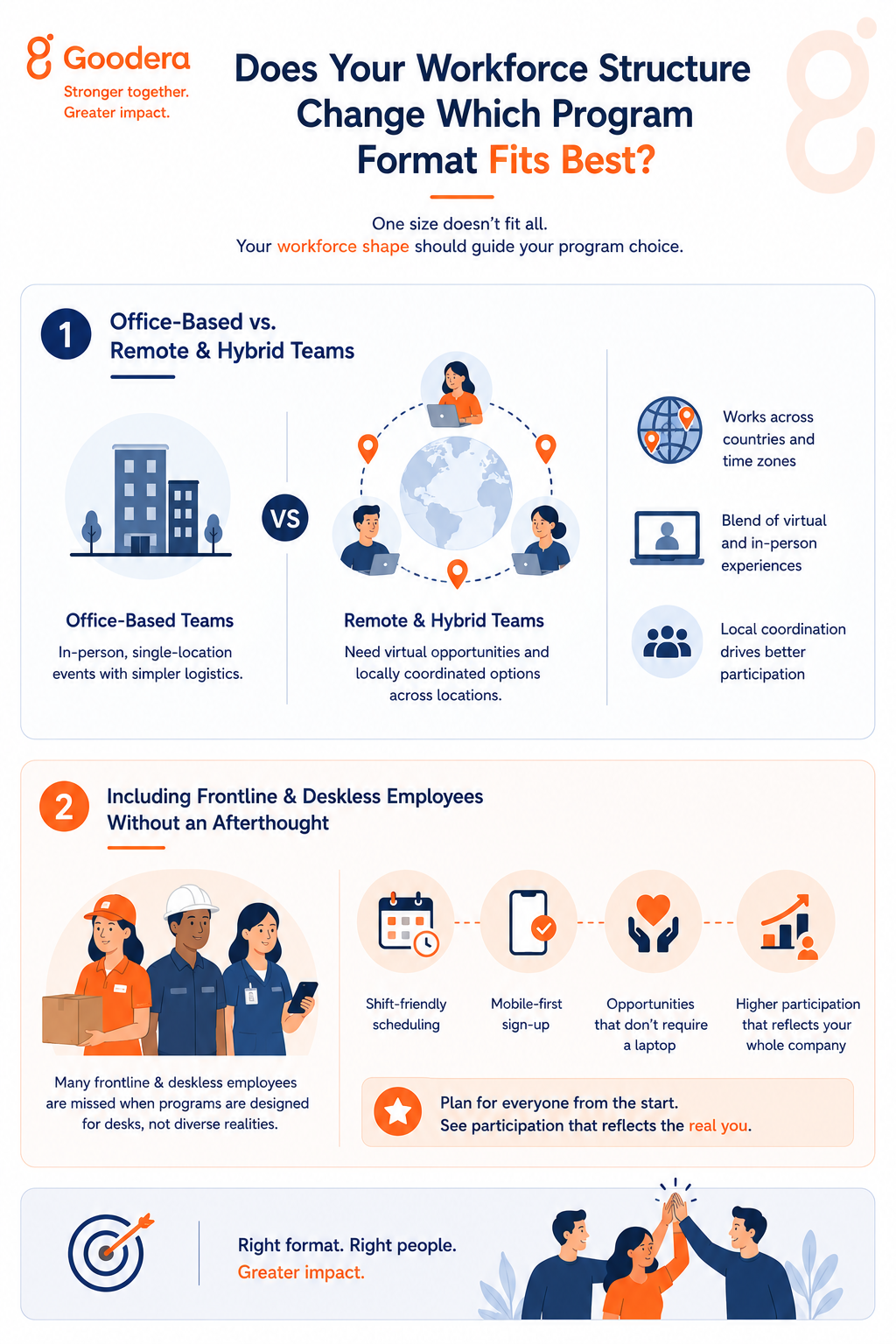
Yes, significantly, and this is one of the most overlooked factors in program selection. A format that works beautifully for a single-office headquarters can fall flat for a company with a distributed, hybrid, or frontline-heavy workforce, simply because the assumptions baked into the format do not hold everywhere.
1. Remote and Hybrid Teams Need Flexible Volunteering Formats
Office-based teams can rely on in-person, single-location events with relatively simple logistics, while remote and hybrid teams need a mix of virtual opportunities and locally coordinated in-person options spread across wherever employees actually live.
Kenrick Fraser of PayPal described exactly this challenge during a Goodera webinar, explaining how the company manages centralized project scoping alongside local volunteer ambassadors who coordinate delivery across 23 countries, precisely because a single physical location assumption breaks down at that scale.
Companies with a smaller distributed footprint face a lighter version of the same problem, but the underlying principle holds regardless of size.
2. Frontline Teams Need Accessible Participation Models
Frontline and deskless employees, common in retail, manufacturing, and healthcare-adjacent industries, are often left out of volunteering program design simply because most planning happens over email and calendar invites that assume desk access.
Building in shift-friendly scheduling, mobile-first sign-up methods, and opportunities that do not require a laptop closes a gap that otherwise excludes a meaningful share of the workforce by default. Programs that plan for this group from the start tend to see participation numbers that better reflect the company, not just the office-based portion of it.
Should You Choose Skills-Based Volunteering, General Volunteering, or a Mix of Both?
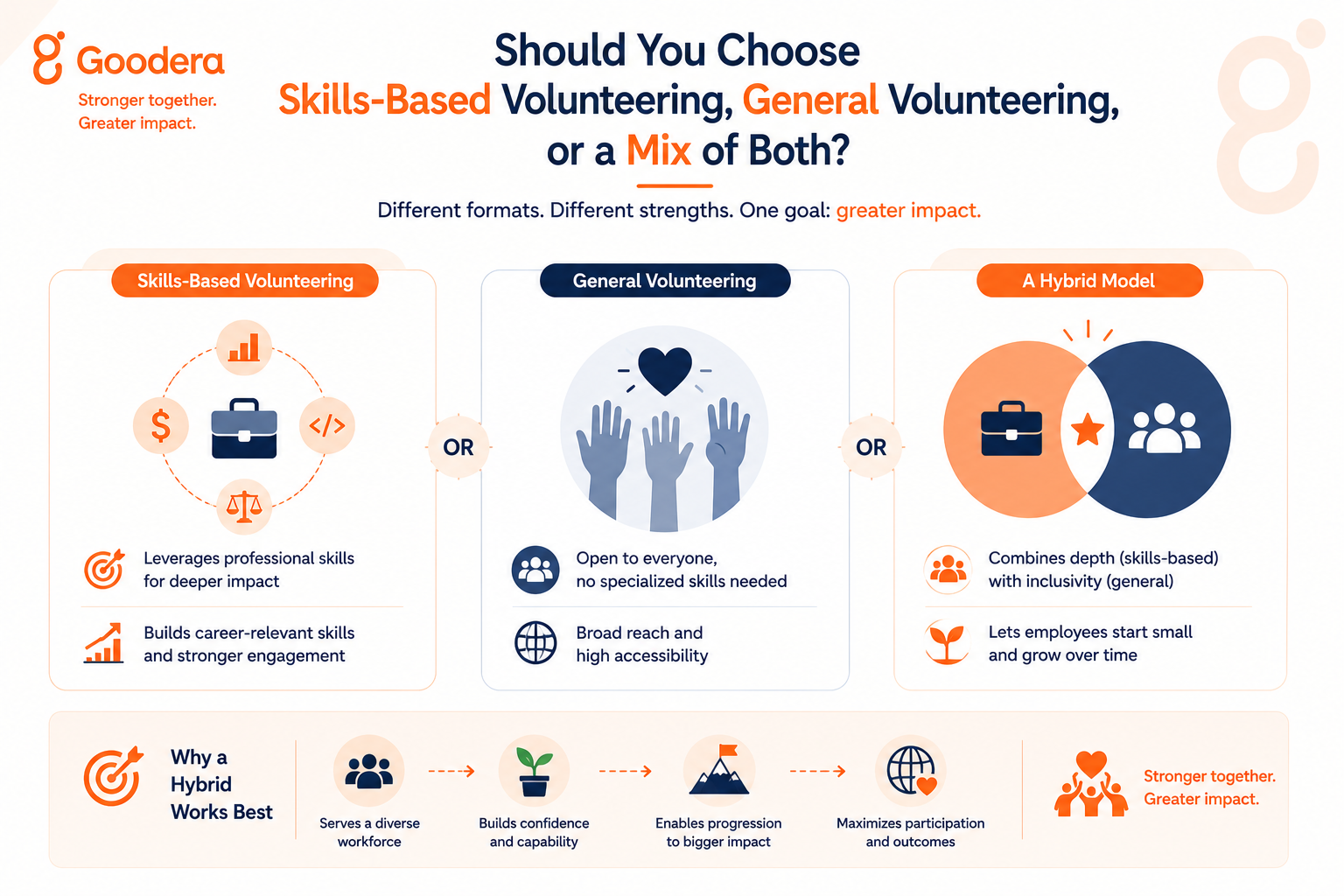
For most organizations, a combination of skills-based and general volunteering is the strongest approach. The two formats solve different problems: skills-based volunteering creates deeper impact by applying employees' professional expertise, while general volunteering makes participation accessible to a broader workforce. The right balance depends on your employees' skills, interests, and the kinds of community impact you want to create.
Each Format Serves a Different Purpose
Skills-based volunteering is most effective when employees can apply expertise in areas such as finance, marketing, legal, or technology to help nonprofits solve specific challenges. It also provides employees with meaningful opportunities to strengthen job-relevant skills.
Research from the Taproot Foundation found that participants in skills-based volunteer projects build new, job-relevant skills at 95% the rate of traditional structured learning experiences, demonstrating that these programs create value for both nonprofits and employees.
General volunteering, by comparison, requires less specialized preparation and makes it easier for employees across different roles and experience levels to participate. These activities are often better suited for company-wide engagement, team building, and first-time volunteers.
Choose the Right Mix for Your Workforce
Organizations with diverse roles, locations, and experience levels typically benefit from offering both formats under a single program. General volunteering creates an accessible entry point for employees, while skills-based opportunities allow those with specialized expertise to contribute in deeper ways.
This flexibility is especially valuable for companies launching a new program or managing distributed teams. Employees can begin with shorter, lower-commitment opportunities before progressing to longer-term skills-based projects, allowing participation to grow naturally over time.
How Much Does a Corporate Volunteering Program Cost?
Budget is often one of the biggest barriers to launching a corporate volunteering program because many organizations lack reliable benchmarks for what these initiatives actually cost.
Understanding typical cost ranges and the expenses other than volunteer hours helps leadership set realistic budgets and avoid unexpected overruns.
Use Industry Benchmarks as a Starting Point
Realized Worth's benchmarking data estimates that organizations spend an average of $179 per employee across their entire workforce each year, or about $416 per active volunteer, depending on how program costs are allocated. These figures reflect average annual program spending across the organizations included in its benchmarking, rather than a universal cost standard.
Actual costs vary widely based on factors such as participation rates, workforce size, volunteer time off policies, program frequency, geographic footprint, and whether the program is managed internally or through an external platform. Skills-based and pro bono initiatives also tend to require greater investment than one-day community volunteering events because of the additional planning, nonprofit matching, and project management involved.
Treat these benchmarks as a way to begin budget discussions with finance stakeholders, not as a target every organization should expect to meet.
The Hidden Costs of Running a Volunteer Program
Volunteer hours are only one part of the total investment. A complete corporate volunteering budget should also account for:
- Program management: Staff time for planning, nonprofit coordination, communications, and reporting.
- Technology: Volunteering platforms, software, or vendor fees if the program is not managed entirely in-house.
- Event logistics: Venue costs, materials, transportation, catering, or other expenses for in-person activities.
- Employee recognition: Volunteer grants, rewards, appreciation events, or other participation incentives.
These operational costs often represent a significant share of the overall budget. Organizations that account for them upfront are less likely to face unexpected expenses during the first year and can make more informed decisions about the scale and structure of their program.
What Role Does Your Industry Play in Choosing the Right Program?
Industry shapes program selection more than most companies initially assume, both in terms of what causes feel authentic and what format employees are realistically equipped to engage with. A program that ignores this context risks feeling generic rather than genuinely connected to the business.
Cause Alignment With Your Business and Expertise
Companies in financial services often find strong alignment with financial literacy nonprofits, technology companies frequently gravitate toward STEM education and digital access initiatives, and healthcare organizations naturally connect with community health programs.
This alignment is not a requirement, but it does tend to produce deeper, more sustained engagement than a cause selected with no connection to the business at all. Employees notice when a cause area draws on what the company truly does well, and that recognition tends to translate into stronger participation over time.
Avoiding Programs That Feel Disconnected From What Your Company Does
A mismatch between cause and company is rarely fatal to a program, but it can create a quiet skepticism that undercuts genuine enthusiasm, particularly among employees who are already skeptical of corporate social responsibility efforts in general. Grounding cause selection in a combination of business relevance and employee interest, rather than choosing a cause purely because it is popular or trending, tends to produce a program that holds up under scrutiny.
This does not mean every volunteering opportunity needs to tie directly to the company's product, but the overall program direction benefits from at least a loose thread connecting it to what the company stands for.
Should Participation Be Mandatory, Optional, or Incentivized?
This question generates more internal debate than almost any other program decision, and the answer carries real legal weight alongside the cultural one.
For most organizations, participation should remain voluntary while being actively encouraged. This approach balances employee choice with organizational goals, leading to stronger long-term engagement while reducing legal and cultural risks. Making volunteering mandatory can undermine its purpose and create compliance concerns, whereas thoughtful incentives and leadership support encourage participation without making employees feel obligated.
Build Your Program Around Voluntary Participation
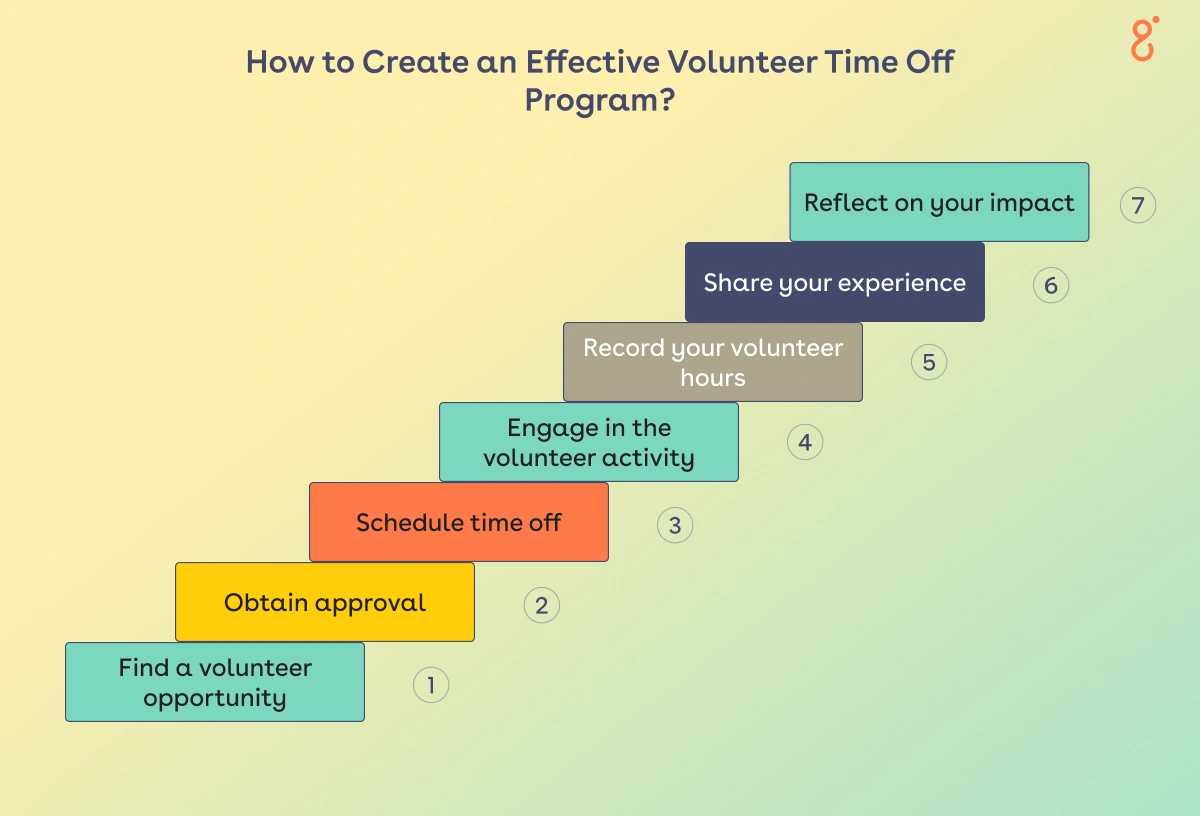
A clear participation policy sets expectations before the program launches. Most organizations support voluntary participation through Volunteer Time Off (VTO), which provides employees with a set number of paid hours or days to volunteer with approved nonprofit organizations without making participation a job requirement.
Organizations should also consider applicable labor and employment laws when designing participation policies. In the United States, whether a volunteer program is genuinely optional can affect wage-and-hour obligations, making clear communication essential. Your VTO policy should explicitly state that participation is voluntary, and managers should avoid creating direct or indirect pressure for employees to participate.
ALSO READ:

Encourage Participation Through Recognition, Not Obligation
Once participation is voluntary, the next goal is making employees want to take part. Recognition programs, team volunteering challenges, volunteer ambassadors, manager support, and visible executive participation all help build momentum without making volunteering feel compulsory.
The key is to reward participation without attaching consequences to non-participation. Volunteering should never influence performance reviews, promotions, or career progression. Instead, remove barriers to participation, celebrate employees who volunteer, and make opportunities easy to discover and join. Programs that strike this balance typically achieve stronger participation while preserving employee trust and the integrity of the volunteering experience.
What Legal and HR Considerations Should Factor Into Your Decision?
Legal and HR review often happens too late in the program design process, brought in only after a format has already been selected and announced internally. Involving these stakeholders earlier tends to prevent the kind of policy rewrite that can undermine momentum right after launch.
Wage and Hour Questions Around Volunteer Time Off
The Fair Labor Standards Act requires employers to pay non-exempt employees for all hours worked, and volunteer time can fall into that category if the company directs, schedules, or otherwise treats the activity as work rather than genuine volunteering.
This is precisely why the "optional" framing from the Department of Labor's guidance matters so directly for VTO policy design. Clear, written documentation of how volunteer time is classified and approved protects the company from wage and hour claims down the line.
Liability and Insurance Considerations Worth Clarifying Upfront
Workers' compensation coverage for injuries during a volunteering event depends heavily on whether attendance is mandatory and whether the event happens during paid time, with mandatory or paid participation making a compensable claim considerably more likely, according to Setnor Byer Insurance & Risk.
This risk becomes especially direct with paid VTO specifically, since an employee injured while on the clock during an approved volunteer activity is highly likely to have that injury deemed compensable. Reviewing these scenarios with your insurance broker and legal counsel before launch, rather than after an incident, is a step worth treating as non-negotiable regardless of program size.
How Do You Know If a Cause Area Is the Right Fit for Your Company?
Cause selection often gets treated as a lighter decision than it deserves, when in practice it shapes employee engagement as much as the program format itself does. A cause that resonates broadly tends to sustain participation far longer than one chosen quickly to fill a launch deadline.
Letting Employee Interest Guide Cause Selection
Surveying employees directly about which causes matter most to them, before finalizing nonprofit partnerships, gives program leads real data instead of a guess based on leadership preference alone. This does not mean every employee preference gets accommodated, but a program built around causes with genuine grassroots interest tends to outperform one selected entirely from the top down.
Revisiting this input periodically, rather than treating it as a one-time survey, keeps the cause selection current as the workforce itself evolves.
Should You Build the Program In-House or Work With a Platform or Vendor?
This decision often gets made by default rather than deliberately, usually because whoever is building the program simply starts with whatever tools are already familiar. Treating it as a genuine choice, weighed against your specific resources and goals, tends to produce a better long-term outcome.
What In-House Management Truly Requires
Managing a volunteering program entirely in-house requires dedicated staff time for nonprofit sourcing and vetting, event logistics, participation tracking, and reporting work that scales in complexity quickly as headcount and geographic footprint grow.
This approach can work well for a smaller, single-location company with a modest program scope, but it becomes considerably harder to sustain once a company operates across multiple offices or countries. Companies underestimate this workload most often in year two, once the initial launch enthusiasm settles into ongoing operational reality.
When Working With a Volunteering Platform Makes More Sense
A platform brings pre-vetted nonprofit networks, built-in reporting, and operational infrastructure that would otherwise need to be built from scratch, which becomes increasingly valuable as a program scales.
Goodera's own infrastructure, spanning partnerships with more than 50,000 nonprofits across over 100 countries, illustrates the kind of operational depth a platform can offer that would be genuinely difficult for most internal teams to replicate independently.
Mallory Burke of Atlassian, in Goodera’s Skills-Based Volunteering webinar, described how centralizing this kind of infrastructure allowed her team to track participation, engagement, and skills development consistently across roughly 900 employees globally, a level of visibility that manual tracking methods struggle to match.
How Do You Test a Program Before Committing to It Company-Wide?
Launching a fully scaled program without any pilot phase is one of the more common ways a promising idea underperforms its potential. A structured test run, even a small one, surfaces problems while they are still cheap and easy to fix.
Running a Pilot With One Team or Region
Selecting a single department, office, or region for an initial pilot gives the program a controlled environment to test logistics, communication, and nonprofit partnerships before rolling anything out company-wide.
Choosing a pilot group that reasonably represents the broader company, rather than the easiest or most enthusiastic team available, produces results that actually predict how the full rollout will perform. A pilot lasting one full quarter typically provides enough data to identify real patterns without dragging the broader rollout timeline unnecessarily.
What to Measure Before Scaling Up
Participation rate is the most obvious metric, and it is worth benchmarking against realistic expectations. The average corporate volunteer participation rate sits around 33 percent, while top-quartile companies reach as high as 66 percent, giving a useful range to evaluate pilot performance against rather than an arbitrary internal target.
Beyond participation, completion rate, employee feedback quality, and nonprofit partner satisfaction round out a fuller picture of whether the pilot is ready to scale or needs another iteration first.
Is It Better to Start Broad or Start Focused?
For most companies launching a new program, starting focused, with a small number of well-supported opportunities and a limited set of cause areas, tends to outperform an ambitious, broad rollout attempted all at once.
A focused start allows the program team to build genuine competence in logistics, nonprofit relationship management, and communication before adding complexity. Expanding cause areas, formats, and geographic reach in deliberate phases, informed by what the pilot and early rollout actually reveal, produces a program with a stronger foundation than one that tries to do everything from day one.
Building a Program That Fits With How Your Company Works
The strongest corporate volunteering programs are not the ones with the most ambitious launch announcement; they are the ones built around a clear-eyed assessment of the company's actual values, workforce, budget, and legal obligations.
Working through each of these factors before selecting a format takes real time upfront, but it prevents the far costlier scenario of relaunching a program that never quite fit in the first place. A program grounded in genuine company context, tested through a real pilot, and supported by the right internal or external infrastructure gives employees something they can actually engage with rather than another initiative that fades after its first announcement.
Frequently Asked Questions
How much should we budget per employee for a corporate volunteering program?
Research from Realized Worth found that programs average around $179 per employee company-wide, or about $416 per employee when calculated only against active participants. Skills-based and pro bono formats typically run higher due to the scoping and coordination involved, so treat these figures as a starting benchmark rather than a fixed target.
Do we have to pay non-exempt employees for volunteer time off?
It depends on whether the program is genuinely optional and free from employer pressure. A 2019 Department of Labor opinion letter confirmed that time spent in a truly optional volunteer program does not count as compensable hours under the FLSA, but if participation is directed or expected, that protection disappears.
Is our company liable if an employee gets injured during a volunteer event?
Liability depends heavily on whether attendance was mandatory and whether the event happened during paid time, with both factors making a workers' compensation claim more likely to be deemed compensable. Reviewing this with your insurance broker before launch, particularly for paid VTO programs, is worth treating as a required step rather than an optional one.
Should volunteering be mandatory or optional?
Optional participation is both the safer legal position and generally the better cultural one, since mandatory volunteering risks both wage and hour exposure and genuine employee resentment. Strong recognition and visible leadership participation can drive high engagement without crossing into pressure.
A full quarter is typically enough to surface meaningful patterns in participation, logistics, and nonprofit partnership quality without unnecessarily delaying a broader rollout. Choosing a pilot group that reasonably represents your broader workforce, rather than your most enthusiastic team, gives you a more accurate preview of full-scale performance.
A full quarter is typically enough to surface meaningful patterns in participation, logistics, and nonprofit partnership quality without unnecessarily delaying a broader rollout. Choosing a pilot group that reasonably represents your broader workforce, rather than your most enthusiastic team, gives you a more accurate preview of full-scale performance.
What's the difference between skills-based and general volunteering, and do we need both?
Skills-based volunteering puts professional expertise like finance, marketing, or technical skills directly to work for a nonprofit, while general volunteering asks for less specialized preparation and tends to be more broadly accessible. Most companies benefit from offering both under one program, since it serves a wider range of roles and comfort levels.
How do we choose a cause area that fits our company without seeming inauthentic?
Start by combining employee survey input with a look at where your company's expertise or industry naturally connects to community needs, rather than picking a cause purely because it is trending. Committing to a smaller number of causes for at least a year tends to build more credibility than rotating causes frequently.
Can remote and frontline employees participate equally in a volunteering program?
Yes, but it requires deliberate design rather than assuming a single format works for everyone. Mobile-first sign-up methods, shift-friendly scheduling, and a genuine mix of virtual and local in-person opportunities close the gap that otherwise excludes frontline and deskless employees by default.
Should we manage volunteering in-house or use a platform?
In-house management can work well for a smaller, single-location company, but it becomes considerably harder to sustain as headcount and geography grow. A platform's pre-vetted nonprofit network and built-in reporting infrastructure tend to become more valuable the larger and more distributed your program gets.
What's a good participation rate to aim for in our first year?
The average corporate volunteer participation rate sits around 33 percent, while top-quartile companies reach as high as 66 percent. A first-year program landing anywhere in that range, with a clear upward trend, is generally a strong indicator that the format and communication strategy are working.