Geographical Expansion
Design a volunteering framework that scales across regions and markets.


Why Teams Come to This Workshop
What works in one geography may not translate well in another. Communication, participation patterns, nonprofit ecosystems, and cultural expectations vary. Without structure, programs become inconsistent, fragmented, or overly centralized.
Expanding geographically is not just about adding regions. It requires intentional design. This workshop helps teams move from fragmented growth to a globally aligned and locally relevant volunteering model.
How It Works
We co-create a plan tailored to where you are, helping you move from intent to real community impact.
Diagnose
01

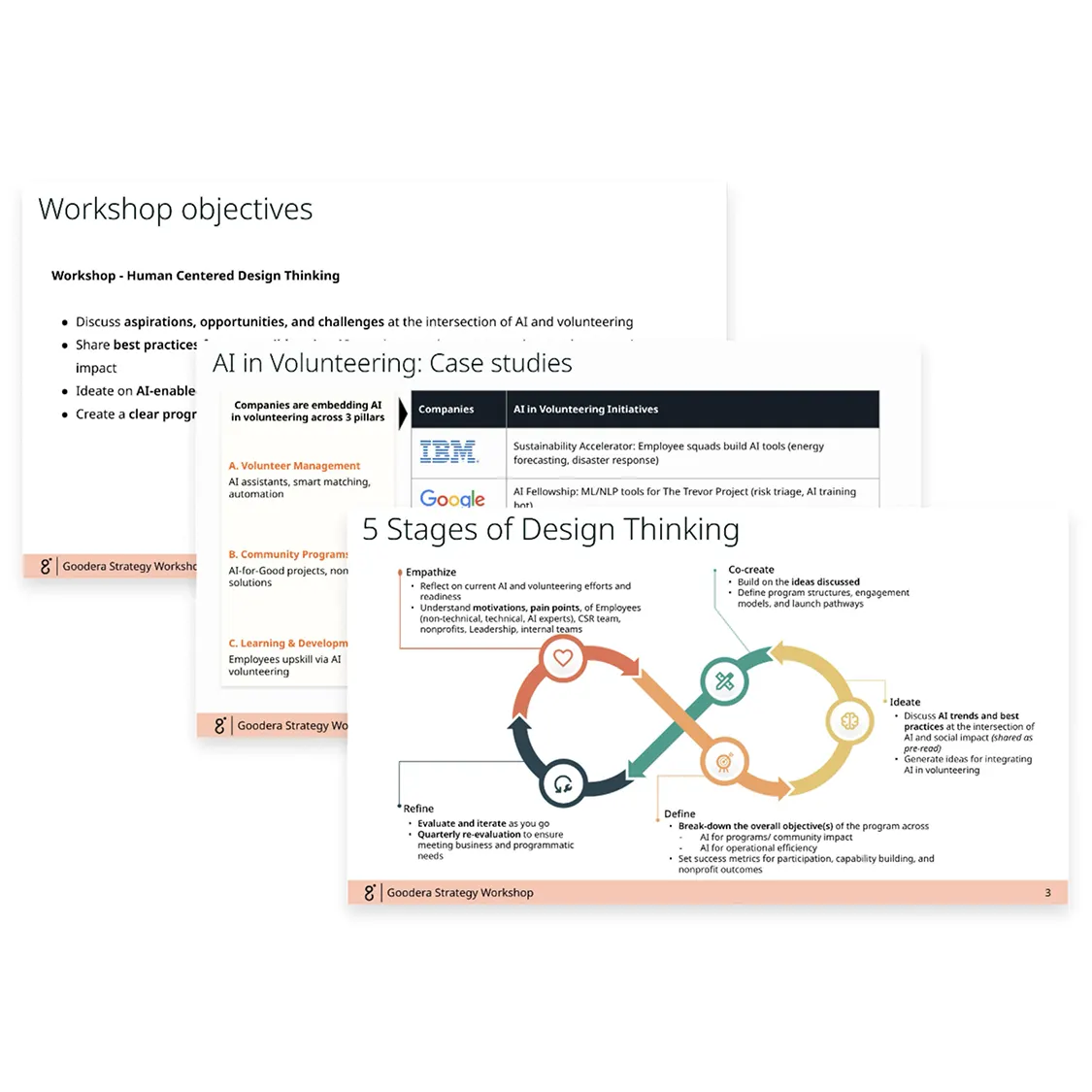
Evaluate participation patterns and regional disparities while identifying cultural, regulatory, and operational barriers to scale.
Define Your Problem Statements
02
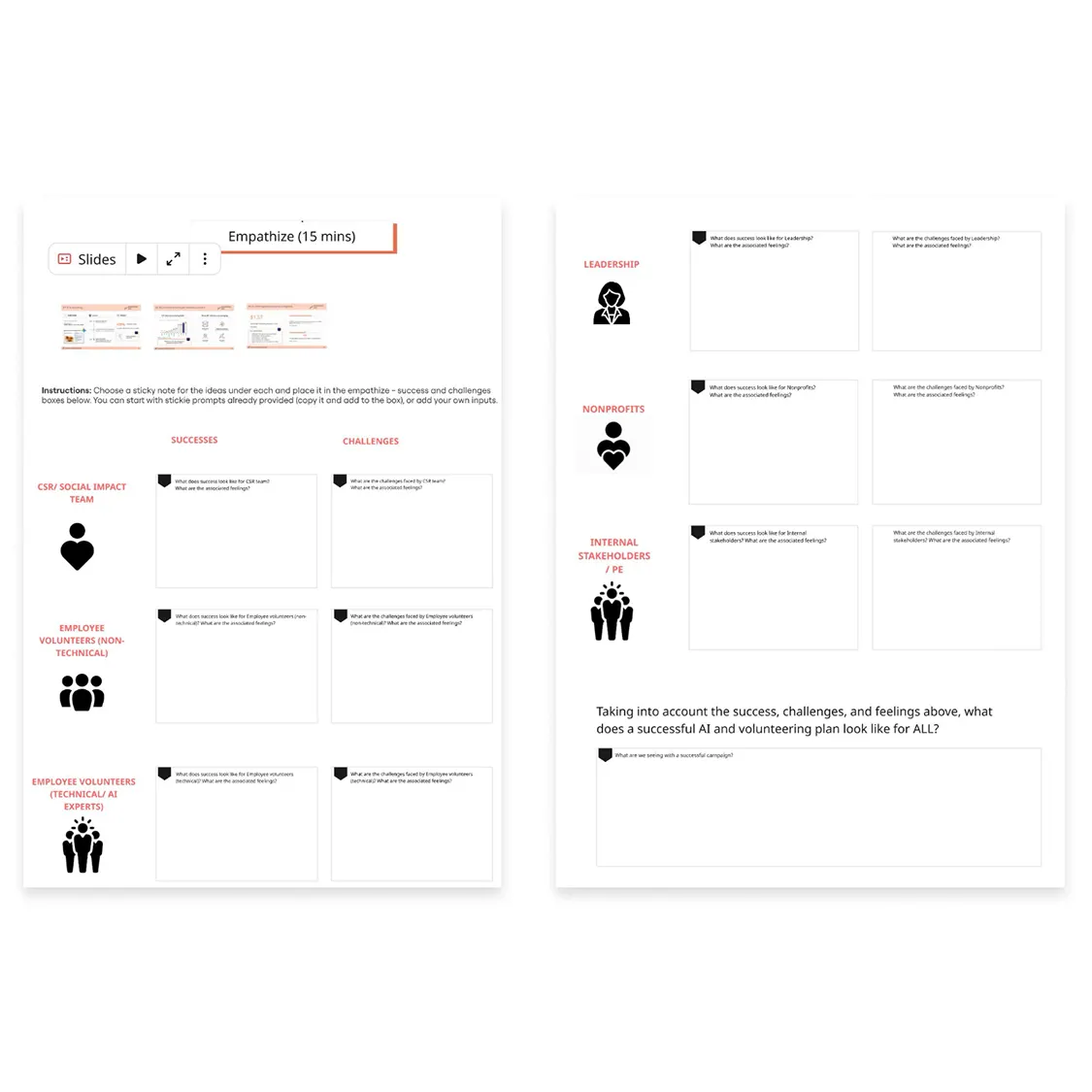
Synthesize insights into a clear, shared problem statement and focused “How might we” questions that define the balance between global alignment and regional adaptability.
Design the Global-Local Volunteering Framework
03
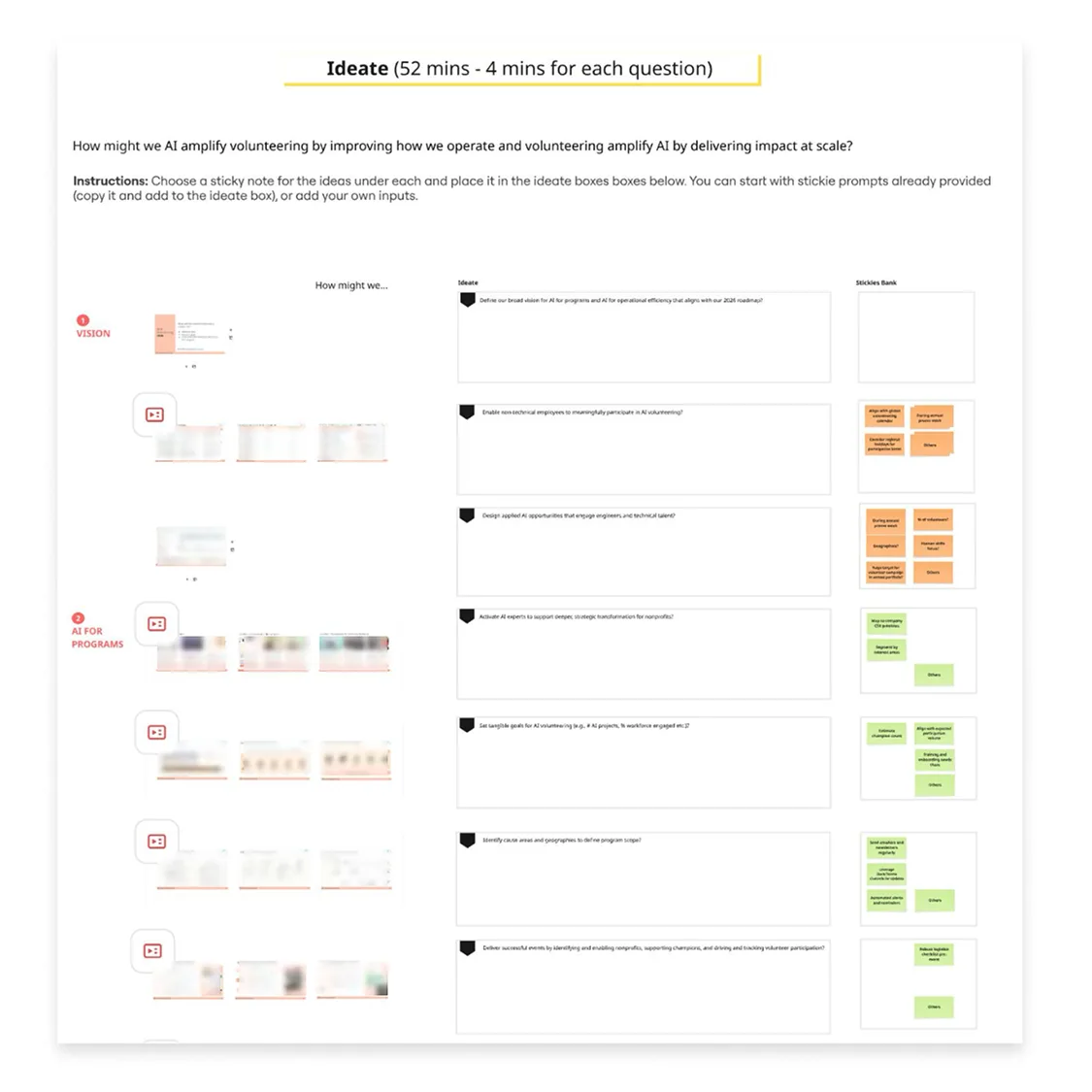
Collaborate to define global guardrails while enabling regional flexibility in execution, participation, storytelling, and consistent impact measurement across markets.
.webp)
Examine Core Enablers
04
Assess the role of technology and champion networks in supporting participation, scale, and consistency.
Co-create the Next Actionable Plan
05
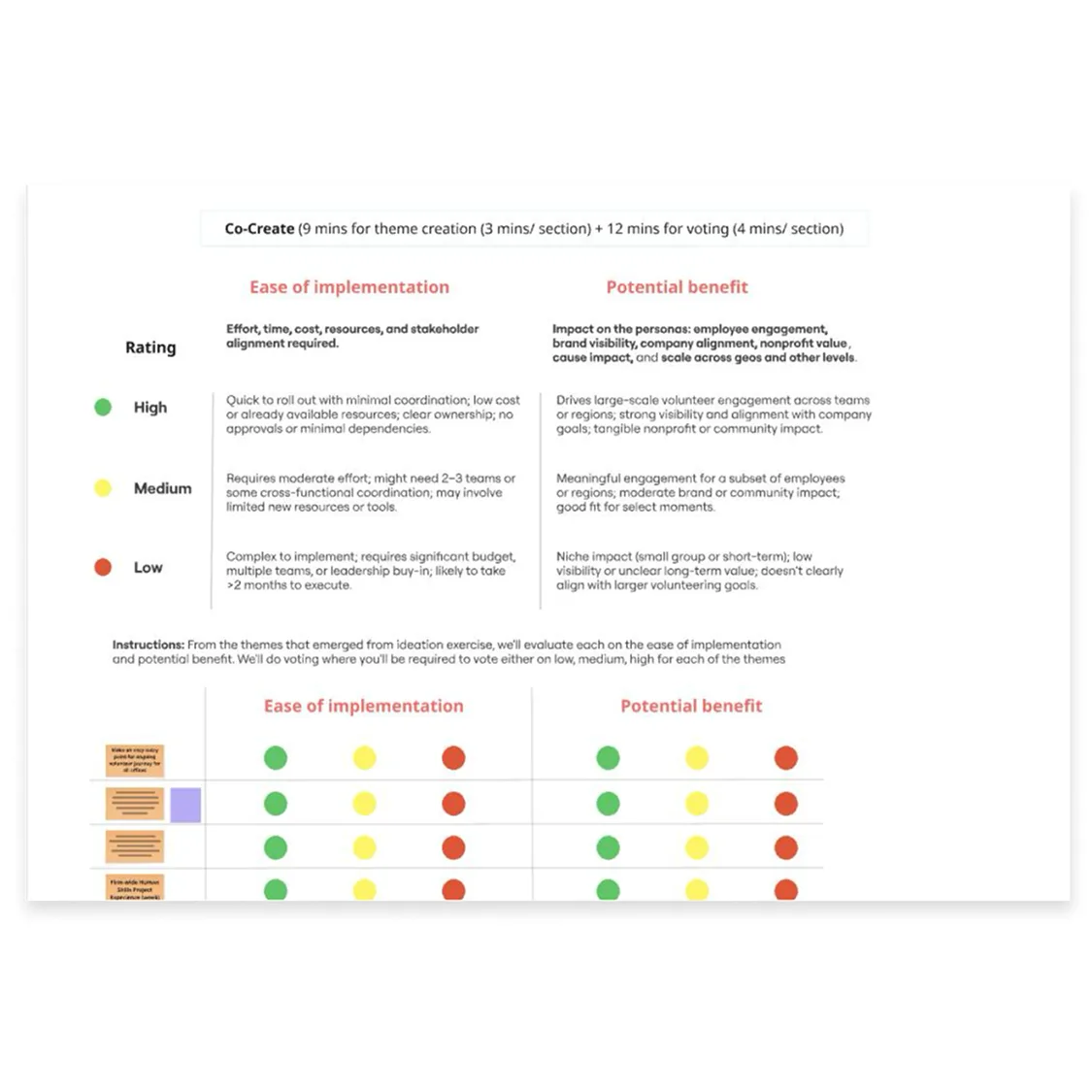
Align on a clear ambition for the year ahead and outline the foundations needed to support it.
A Peek into the Knowledge
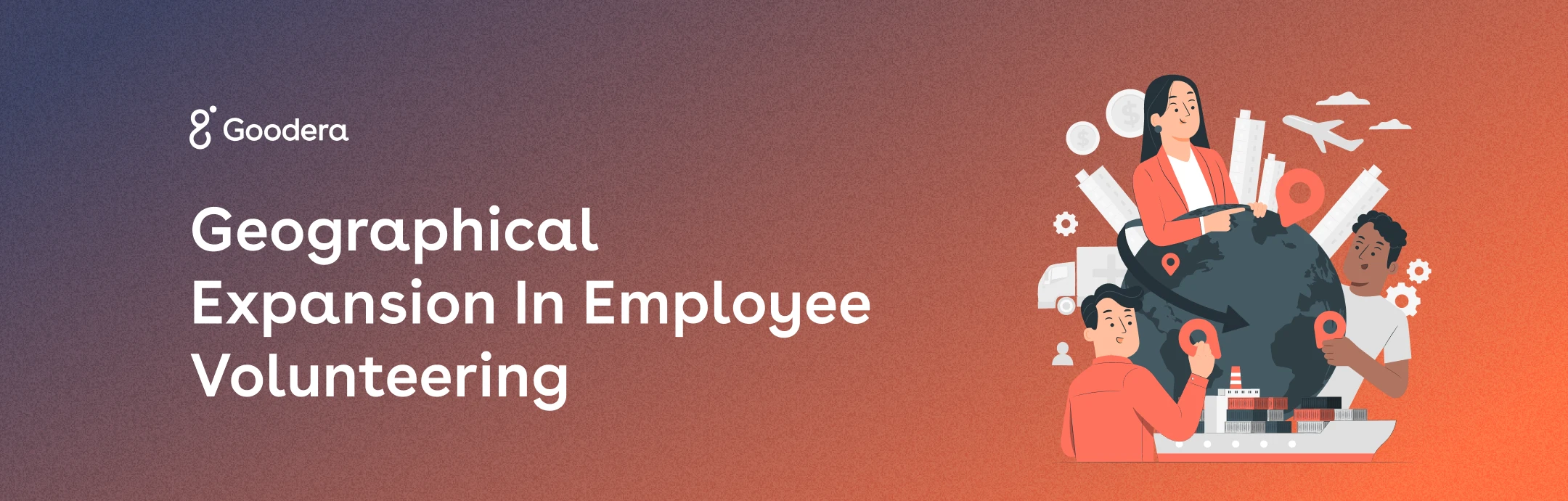
You launch a successful volunteering program in one country. Participation is strong. Leadership is visible. Impact stories are compelling. Encouraged by the momentum, you expand to new regions.
A few months later, the picture looks uneven. An employee in São Paulo sees a volunteering opportunity focused on food security. A colleague in Berlin receives an invitation centered on digital inclusion. A team in Singapore hears nothing at all.
From headquarters, the program appears global. On the ground, it feels inconsistent.
Employee volunteering programs often begin strong in one market and then struggle to scale across regions. The challenge is rarely enthusiasm. It is architecture.\
As workforces become increasingly distributed, social impact strategies must operate across countries, cultures, and time zones. Geographical expansion in employee volunteering is about designing a model that scales structurally while adapting locally.
This is the core focus of the Geographical Expansion Workshop.
What Does Geographical Expansion in Employee Volunteering Mean?
Geographical expansion means building a volunteering program that operates consistently across regions while remaining culturally relevant in each location.
It requires two capabilities at the same time: global clarity and local ownership.
Global clarity defines the non-negotiables. It establishes shared purpose, impact priorities, governance standards, reporting definitions, and measurement frameworks. It answers questions such as: What do we stand for? How do we measure impact? What policies guide partnerships? What does “participation” mean across markets?
Local ownership ensures relevance. It allows regional teams to adapt programming based on community needs, cultural expectations, language, and nonprofit ecosystems. It answers a different set of questions: Which causes resonate locally? What formats fit workforce realities? Who are the trusted community partners?
Research from Deloitte’s Global Human Capital Trends shows that organizations empowering local leadership while maintaining enterprise alignment report higher workforce engagement than those relying solely on centralized control. Expansion succeeds when structure and autonomy coexist.
Scaling social impact without design leads to fragmentation. Over-centralizing it erodes participation. The balance must be intentional.
Why Do Global Volunteering Programs Struggle to Scale?
Expansion challenges tend to follow predictable patterns.
First, participation varies by region. Volunteering behaviors are influenced by cultural norms, local nonprofit infrastructure, and leadership visibility. Participation rates in North America may look very different from APAC or EMEA markets. Research from Gallup indicates employees are significantly more engaged when leaders visibly participate in initiatives. In markets where leadership visibility is inconsistent, participation often mirrors that gap.
Second, operational and legal environments differ. Nonprofit registration processes vary by country. Data privacy laws such as GDPR in Europe introduce stricter requirements around volunteer data. Due diligence standards are not uniform. Without standardized governance frameworks, reporting becomes inconsistent and compliance risk increases.
Third, expansion often overlooks the importance of local champions. A central CSR or social impact team cannot maintain relational presence in every geography. Without regional advocates who contextualize messaging and mobilize participation, programs feel distant and imposed.
Expansion struggles when it assumes uniformity instead of designing for difference.
How Do You Balance Global Consistency with Local Relevance?
The most effective models operate in layers rather than choosing between centralization and decentralization.
At the global layer, organizations define non-negotiables. These typically include social impact priorities, measurement standards, governance policies, reporting definitions, budget guardrails, and technology infrastructure. This layer ensures credibility, comparability, and executive oversight across markets.
At the regional layer, teams adapt execution. They select locally relevant nonprofit partners, align causes with community priorities, translate communications into local languages, schedule events in time-zone appropriate formats, and account for cultural norms around volunteering.
This layered approach mirrors how multinational companies such as Unilever design sustainability strategies. Global commitments anchor direction, while regional execution allows contextual flexibility.
The result is alignment without rigidity.
What Happens Inside Goodera’s Geographical Expansion Workshop?
The workshop applies a human-centered design methodology across three structured phases.
In the Empathize phase, participants examine the current state across regions. They analyze participation trends, workforce demographics, barriers to engagement, leadership visibility gaps, and the capacity of local nonprofit ecosystems. The goal is shared understanding before structural decisions are made.
In the Define phase, teams align on a focused expansion challenge. A typical framing might be: “How might we scale employee volunteering across markets while preserving local ownership and participation stability?” Clear alignment at this stage reduces downstream conflict between global and regional stakeholders.
In the Ideate phase, cross-functional groups co-design solutions across three pillars: global guardrails and governance, regional activation models, and engagement and measurement frameworks. Ideas are prioritized using feasibility and impact scoring to ensure that ambition aligns with operational reality.
By the end, participants have not just a vision, but a structured expansion roadmap.
What Metrics Matter During Geographic Expansion?
Expansion must be measurable to be sustainable. Without shared metrics, global programs lose comparability, credibility, and executive confidence. A strong measurement framework typically evaluates three dimensions: participation stability, experience quality, and impact outcomes.
1. Participation Stability
These metrics indicate whether the program is structurally embedded across regions, not just successful in isolated markets.
- Regional participation rate: Are engagement levels steady across geographies, or concentrated in headquarters locations?
- Repeat volunteer percentage: Are employees returning for additional opportunities, signaling habit formation?
- Leadership participation rate: Are senior leaders visibly participating across markets, or only in select regions?
- Participation consistency over time: Do regions show stable engagement quarter over quarter?
Stable participation across geographies suggests the expansion model is working. Sharp fluctuations often indicate communication, leadership, or structural gaps.
2. Experience Quality
Scaling should not dilute the volunteer experience. These indicators assess whether engagement remains meaningful.
- Post-event satisfaction scores: Did employees find the opportunity valuable and well-organized?
- Volunteer Net Promoter Score (vNPS): Would participants recommend the experience to colleagues?
- Qualitative feedback themes: Are employees reporting clarity, relevance, and ease of participation?
If satisfaction declines as the program expands, it signals operational strain or misalignment at the regional level.
3. Impact Outcomes
Impact metrics demonstrate value to nonprofit partners and executive stakeholders.
- Total volunteer hours contributed
- Beneficiary reach across markets
- Skills-based project outputs or deliverables
- Impact consistency across regions
According to research from Chief Executives for Corporate Purpose, organizations that align impact measurement across markets are more likely to sustain executive sponsorship and long-term budget continuity.
Measurement is not just reporting. It strengthens alignment, ensures accountability, and protects the credibility of expansion efforts. When metrics are standardized and transparent, growth becomes strategic rather than reactive.
What Risks Should Organizations Avoid?
Geographic expansion creates pressure to move quickly. But speed without structure creates instability.
1. Over-Expansion Without Structure
When global guardrails are unclear, fragmentation follows. Regions may define impact differently, track hours inconsistently, or apply separate approval standards for nonprofit partners. Reporting becomes difficult to compare across markets. Budget allocation lacks transparency. Leadership struggles to evaluate performance because data is not aligned.
Over time, executive confidence weakens. If outcomes cannot be measured consistently, investment becomes harder to justify. What began as expansion turns into decentralization without direction.
Structure protects credibility. It ensures that while regions adapt locally, the organization still speaks one language when it comes to impact, governance, and measurement.
2. Over-Centralization Without Flexibility
The opposite risk is just as damaging.
When headquarters dictates causes, formats, and timelines without regional input, participation declines. Employees may feel the selected causes do not reflect local community needs. Cultural nuances around volunteering may be overlooked. Time-zone differences and work patterns may not be considered.
In these cases, volunteering feels imposed rather than owned. Regional leaders disengage because they lack decision-making authority. Employees participate less because relevance is unclear.
Flexibility fuels ownership. Ownership fuels engagement.
3. Treating Expansion as Duplication
A common misconception is that expansion simply means replicating a successful pilot in new markets. In reality, what works in one geography may rely heavily on local leadership, nonprofit ecosystems, regulatory environments, or cultural norms.
Copying without adapting can dilute effectiveness. Expansion requires design, not duplication.
Geographical expansion is strategic architecture. It defines which elements must remain consistent globally and which should evolve locally. When this balance is intentional, programs scale without losing authenticity.
Bottom Line
Geographic expansion succeeds when structure and flexibility operate together.
Too much structure creates rigidity. Too much flexibility creates fragmentation.
Organizations that design clear global guardrails while empowering regional ownership build volunteering programs that are scalable, measurable, and locally relevant.
Webinars and Podcasts










.png)

.png)






Related Blogs








Frequently Asked Questions

It is a structured workshop designed to help teams scale volunteering programs across regions with global alignment and local relevance.
Global CSR, ESG, People, and Regional Leads responsible for managing or expanding volunteering programs across multiple markets.
When participation varies significantly across regions, new markets are being added, or global campaigns are not translating effectively at the local level.
It addresses regional disparities, inconsistent execution, lack of local ownership, regulatory and cultural differences, and unclear governance structures.
Not necessarily. It can support both expansion into new geographies and optimization of existing multi-region programs.
A globally aligned, locally adaptable volunteering framework, defined guardrails, clarified regional roles, and prioritized next steps for scalable execution.
Explore the workshop overview and submit a booking request. A Goodera strategist will connect with your team to understand your geographic footprint, current structure, and expansion goals before confirming scope and next steps.
