Skills-Based Volunteering
Build a scalable model that aligns employee skills with nonprofit needs.


Why Teams Come to This Workshop
Skills-based volunteering is gaining momentum faster than most programs can meaningfully design for it, raising questions about value, readiness, and sustainability.
Skills-based volunteering has high potential, but without clear design, it becomes hard to deliver consistently or equitably.
How It Works
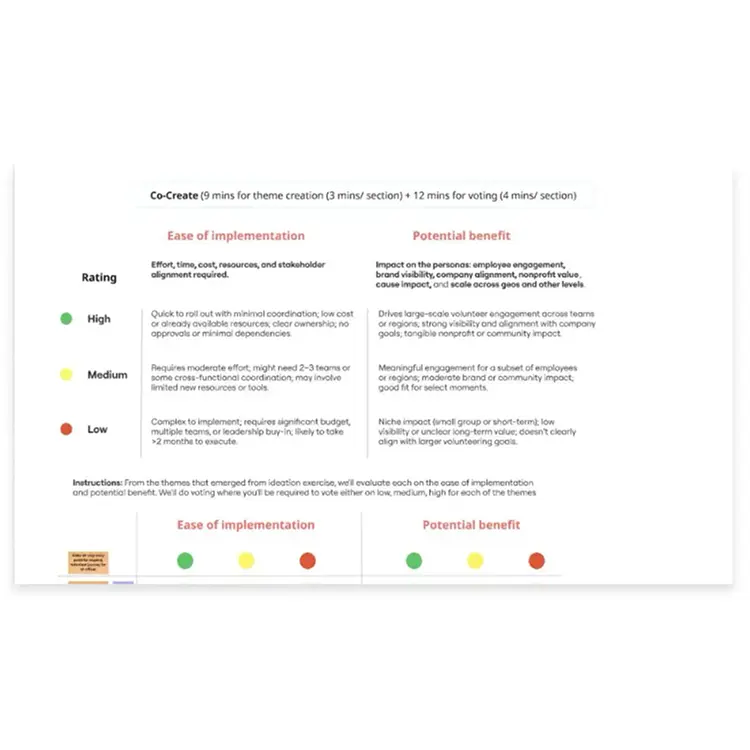
We co-create a plan tailored to where you are, helping you move from intent to real community impact.
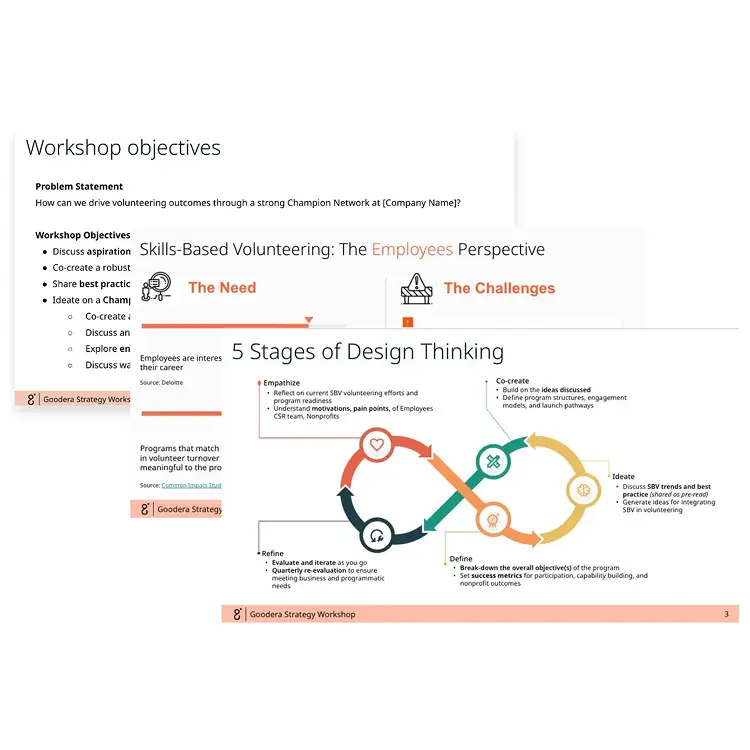
Diagnose
01

Review past performance, participation, experience, and impact while surfacing stakeholder motivations, pain points, and definitions of success.
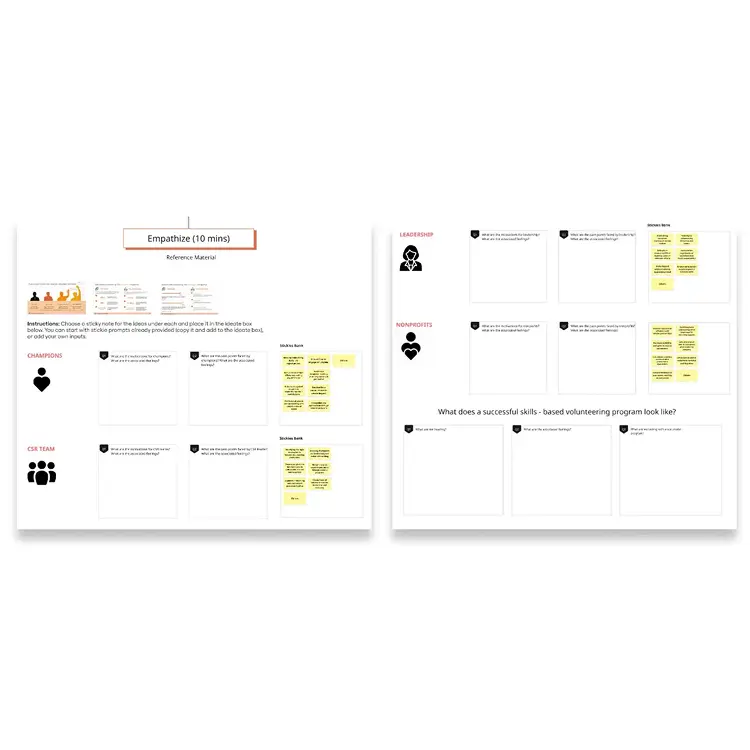
Define the Core Challenge
02
Synthesize insights into a clear, shared problem statement that clarifies what is limiting scale, quality, or sustainability.
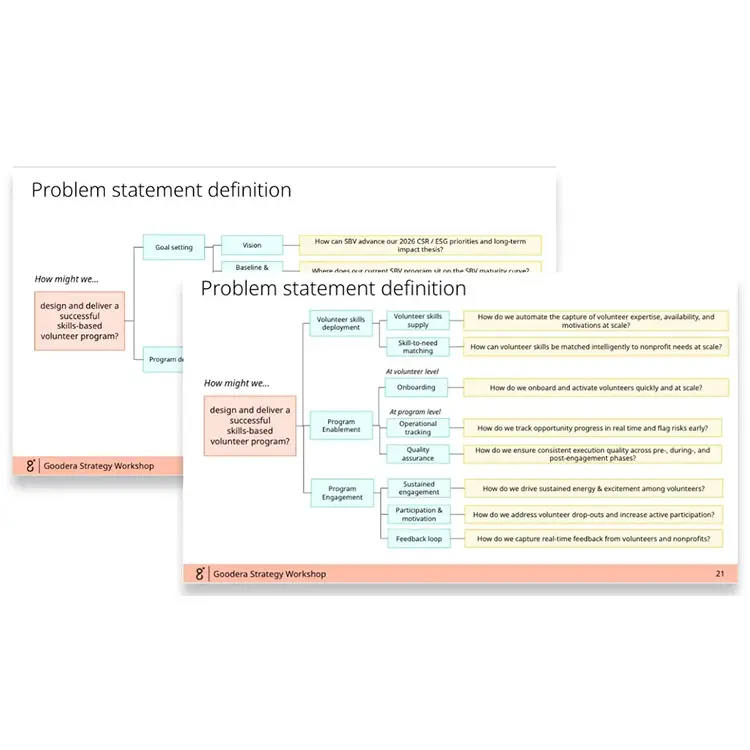
Design the Skills-Based Volunteering Model
03
Collaboratively define goals, program structure, enablement systems, and engagement strategies to build a scalable, high-impact skills-based framework.
Examine Core Enablers
04
Assess the role of technology and champion networks in supporting participation, scale, and consistency.
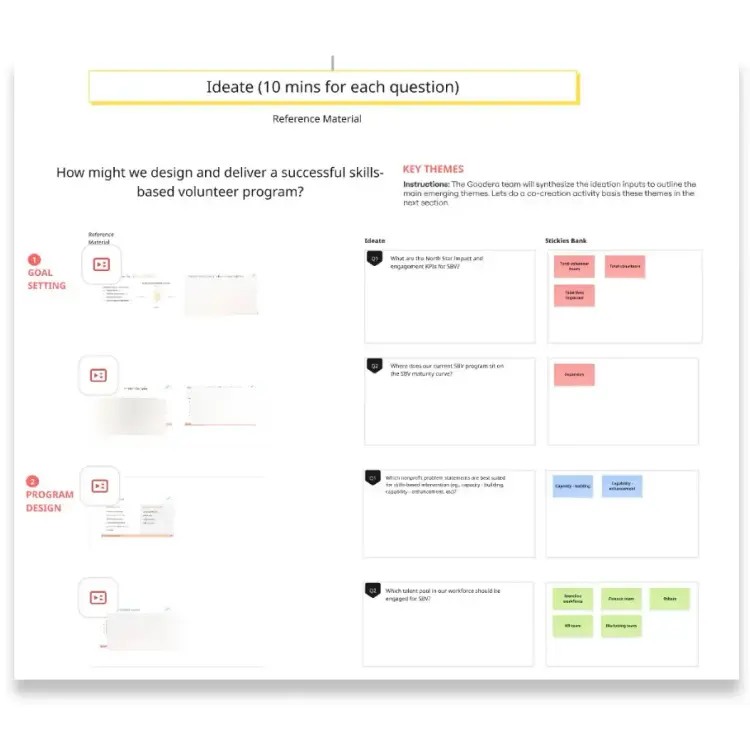
Co-create the Next Actionable Plan
05
Align on a clear ambition for the year ahead and outline the foundations needed to support it.
A Peek into the Knowledge

Skills-based volunteering has long been described as the future of employee volunteering. The promise is compelling. Employees contribute what they are best at. Nonprofits receive expertise they would not otherwise be able to afford. Companies see deeper engagement and clearer alignment between business strengths and social impact.
And yet, many organizations find that skills-based volunteering remains harder to scale than expected.
Programs launch with excitement, pilots show promise, and then momentum slows. Opportunities take longer to scope. Matching becomes manual. Nonprofit capacity varies widely. Employees hesitate, not because they lack interest, but because the commitment feels heavier and less predictable than traditional volunteering.
To understand why skills-based volunteering often stalls, it helps to look at the landscape as it exists today.
Why Skills-Based Volunteering Still Matters
At its core, skills-based volunteering offers something rare. It allows organizations to create impact that is both meaningful and material.
For nonprofits, it can unlock capabilities that directly strengthen operations, strategy, and long-term sustainability. This might include help with data analysis, financial planning, marketing strategy, technology implementation, or process design. When done well, the value extends far beyond volunteer hours.
For employees, skills-based volunteering offers a different kind of fulfillment. It validates professional expertise, provides stretch opportunities, and allows people to see the real-world relevance of their work. It often feels more personal and more consequential than one-day activities.
For organizations, it creates a clear bridge between business value and social impact. Skills-based programs can support leadership development, cross-functional collaboration, and employer brand, while also delivering outcomes nonprofits can point to.
This is why interest in skills-based volunteering continues to grow, even when execution feels difficult.
The Current State of Skills-Based Volunteering
Across industries, a few patterns show up consistently.
Interest is high on all sides. Employees want to use their skills for good. Nonprofits are eager for support that goes beyond general labor. Leaders like the idea of deeper impact tied to business strengths.
At the same time, programs struggle with complexity. Skills-based opportunities take longer to design. They require clearer scoping, stronger alignment, and more coordination than traditional volunteering. When those elements are missing, the experience can feel risky for everyone involved.
As a result, many organizations find themselves stuck in the middle. They want to offer skills-based volunteering, but only a small percentage of employees participate. Opportunities remain limited. Success depends heavily on individual effort rather than program design.
This gap between potential and practice defines the current landscape.
The Hidden Challenges Behind Skills-Based Volunteering
1. Scoping Is Harder Than It Looks
Unlike traditional volunteering, skills-based projects cannot be easily standardized. Nonprofit needs vary widely. Some organizations are ready to work with volunteers on strategic projects. Others need more foundational support.
Without clear scoping, projects can drift. Expectations become misaligned. Volunteers are unsure what success looks like. Nonprofits may feel overwhelmed or under-supported.
When scoping relies on back-and-forth emails and informal conversations, programs struggle to scale.
2. Matching Often Becomes Manual and Uneven
Skills-based volunteering depends on fit. The right skills, availability, and motivation need to align with the right nonprofit need at the right time.
In many programs, this matching happens manually. CSR teams review profiles, forward emails, and make introductions one by one. This approach works for a handful of projects, but it does not hold up as demand grows.
The result is uneven access. Some employees get opportunities through personal networks or proximity to the program team, while others never see a clear pathway to participate.
3. Commitment Feels Riskier for Employees
Skills-based volunteering often asks for a deeper investment of time and reputation. Employees worry about overcommitting, delivering the wrong thing, or being pulled into something open-ended.
Without clear boundaries, timelines, and support, the decision to participate can feel heavy. Even motivated employees may opt out simply because the effort feels uncertain.
This is rarely a motivation problem. It is a design problem.
4. Nonprofit Capacity Is Not Always Accounted For
Skills-based support is only effective when nonprofits have the time and structure to engage. Many organizations are already stretched thin. Managing volunteers, even highly skilled ones, requires effort.
When programs underestimate this reality, partnerships suffer. Projects stall. Trust erodes. Over time, nonprofits become hesitant to engage again, regardless of intent.
Strong skills-based programs recognize that nonprofit readiness is as important as employee skill.
What the Landscape Is Telling Us
Taken together, these challenges point to a clear conclusion. Skills-based volunteering cannot be treated as an add-on to traditional volunteering programs.
It requires intentional design.
Programs that succeed tend to share a few characteristics. They define clear project types rather than one-off custom requests. They create structured pathways for employees to participate. They invest in scoping upfront to reduce friction later. They respect nonprofit capacity and build predictability into partnerships.
Most importantly, they move away from hero-driven execution and toward systems that make participation repeatable.
The Shift From Opportunity to Infrastructure
The next phase of skills-based volunteering is not about finding more interest. Interest already exists.
The real work lies in building infrastructure that supports scale. This includes clearer frameworks for identifying suitable projects, better matching mechanisms, realistic time expectations, and feedback loops that improve quality over time.
When this infrastructure is in place, skills-based volunteering becomes less intimidating and more accessible. Participation grows. Nonprofits see consistent value. CSR teams spend less time coordinating and more time improving the program.
This is where the landscape is heading, and where many organizations are now deciding how seriously they want to invest.
Webinars and Podcasts













.png)

.png)


Related Blogs








Frequently Asked Questions

Skills-based volunteering enables employees to contribute professional expertise, such as technology, finance, marketing, or strategy, to support nonprofit needs.
This workshop is designed for teams looking to design, refine, or scale skills-based volunteering programs.
No. The workshop explores formats that work across a range of skills, experience levels, and time commitments.
Skills-based volunteering focuses on capacity-building and expertise, rather than time-bound or task-based activities.
Teams often struggle with scoping projects, matching skills effectively, ensuring nonprofit readiness, and sustaining programs beyond pilots.
Teams walk away with a clear skills-based volunteering model, prioritized formats, and a roadmap to pilot or scale initiatives.
Yes. The workshop explores in-person, virtual, and hybrid skills-based volunteering formats.
Yes. The session accounts for regional variation in skills availability and nonprofit capacity.
