L'art du possible
Évaluez votre programme de volontariat et identifiez les formats et l'infrastructure nécessaires pour le développer.


Why Teams Come to This Workshop
Lorsque les programmes arrivent à maturité, l'activité augmente, mais la clarté peut prendre du retard et l'impact peut se diluer en fonction de multiples causes.
À ce stade, les équipes n'ont pas besoin de plus d'idées, elles ont besoin d'un espace pour réfléchir. Cet atelier aide les équipes à évaluer leur situation actuelle, à identifier ce qui fonctionne et à définir ce qu'il faudra pour évoluer avec intention.
How It Works
We co-create a plan tailored to where you are, helping you move from intent to real community impact.
Diagnose
01

Evaluez l'écosystème de volontariat existant, y compris les formats, l'infrastructure, les modèles de participation et les niveaux d'investissement.
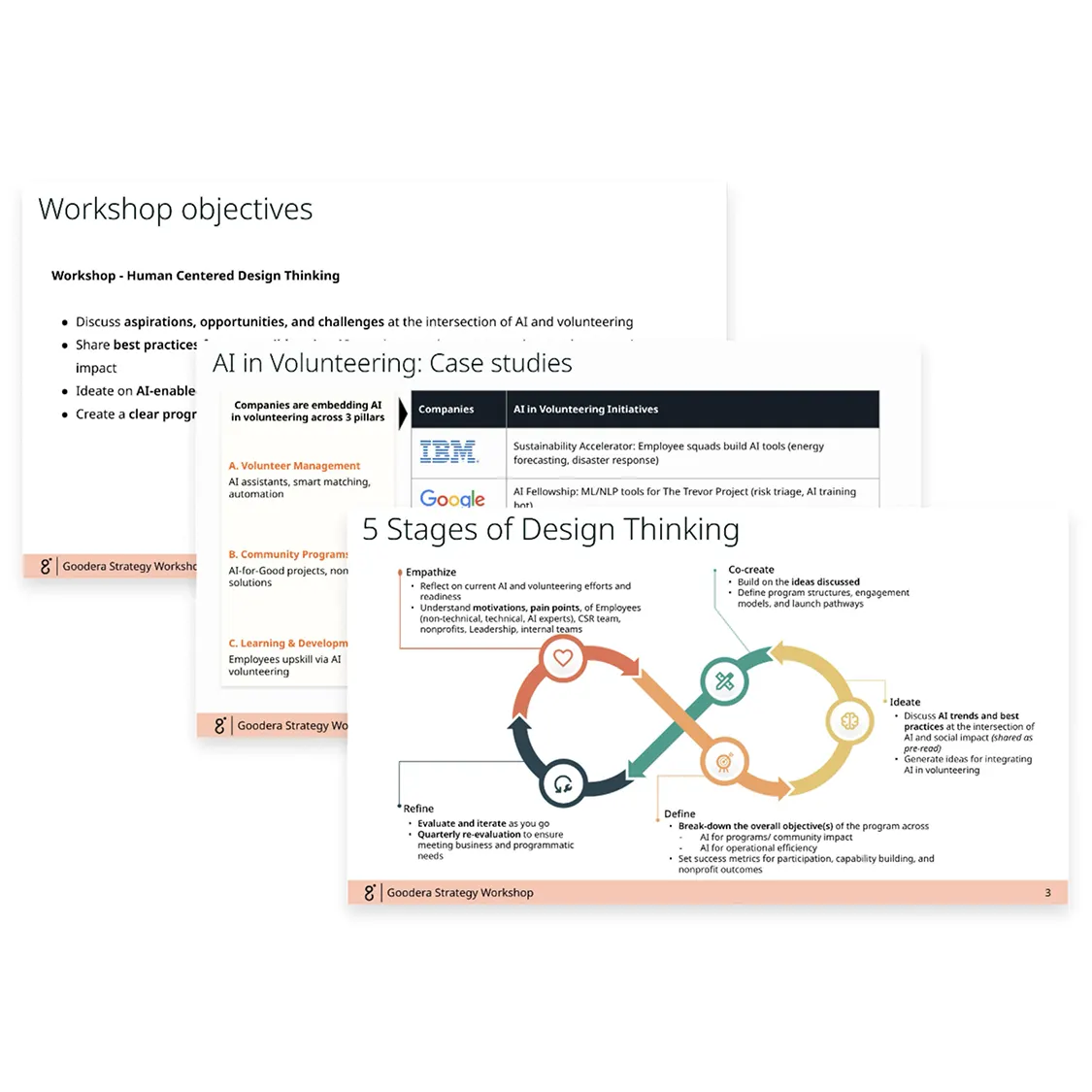
Définissez votre ambition
02
Clarifiez ce qui est réaliste à ce stade en définissant les domaines d'opportunité, les contraintes et le potentiel à long terme.
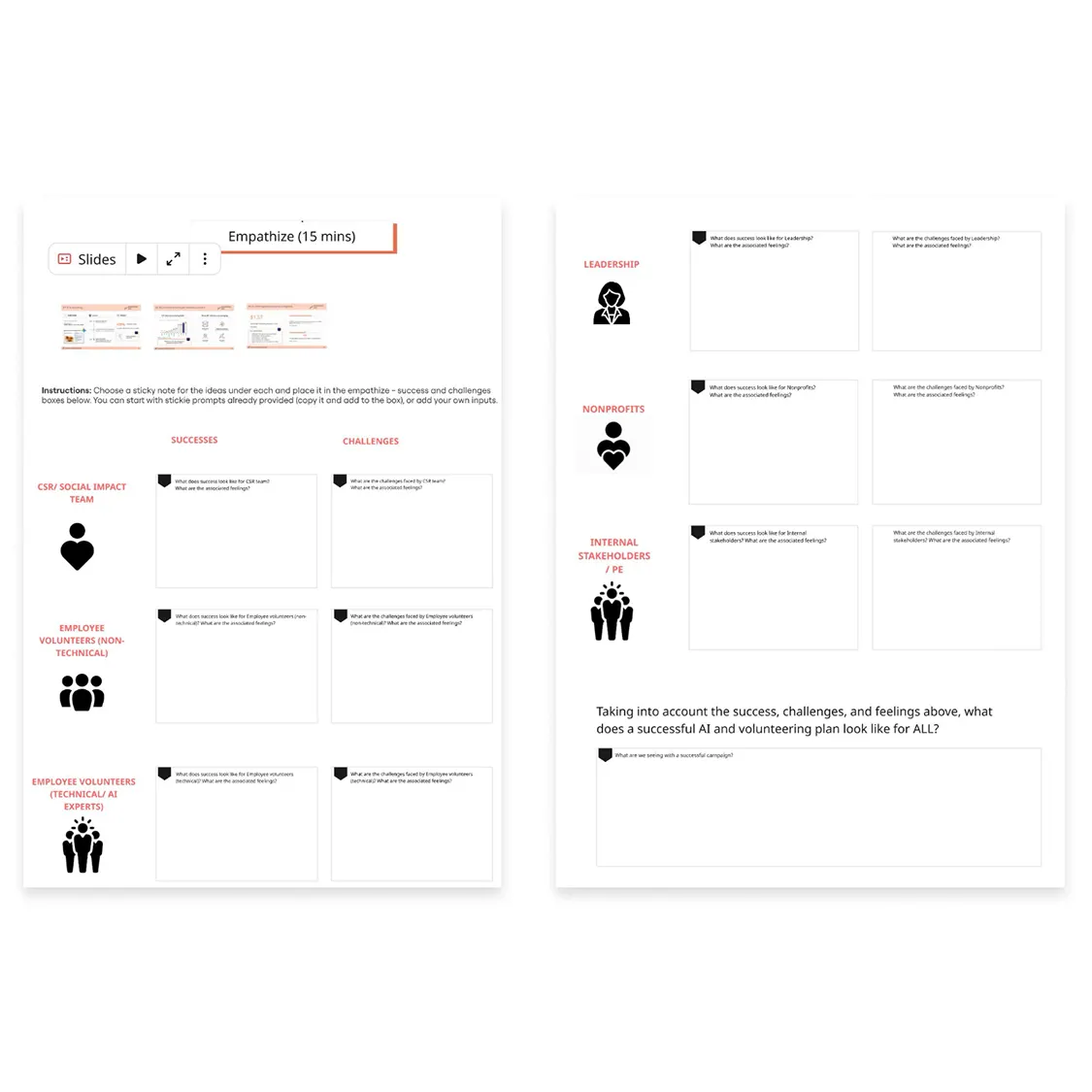
Tracez la voie à suivre
03
Identifiez les formats viables, les lacunes en matière de capacités et les prochaines étapes stratégiques pour passer de l'activité à une échelle intentionnelle.
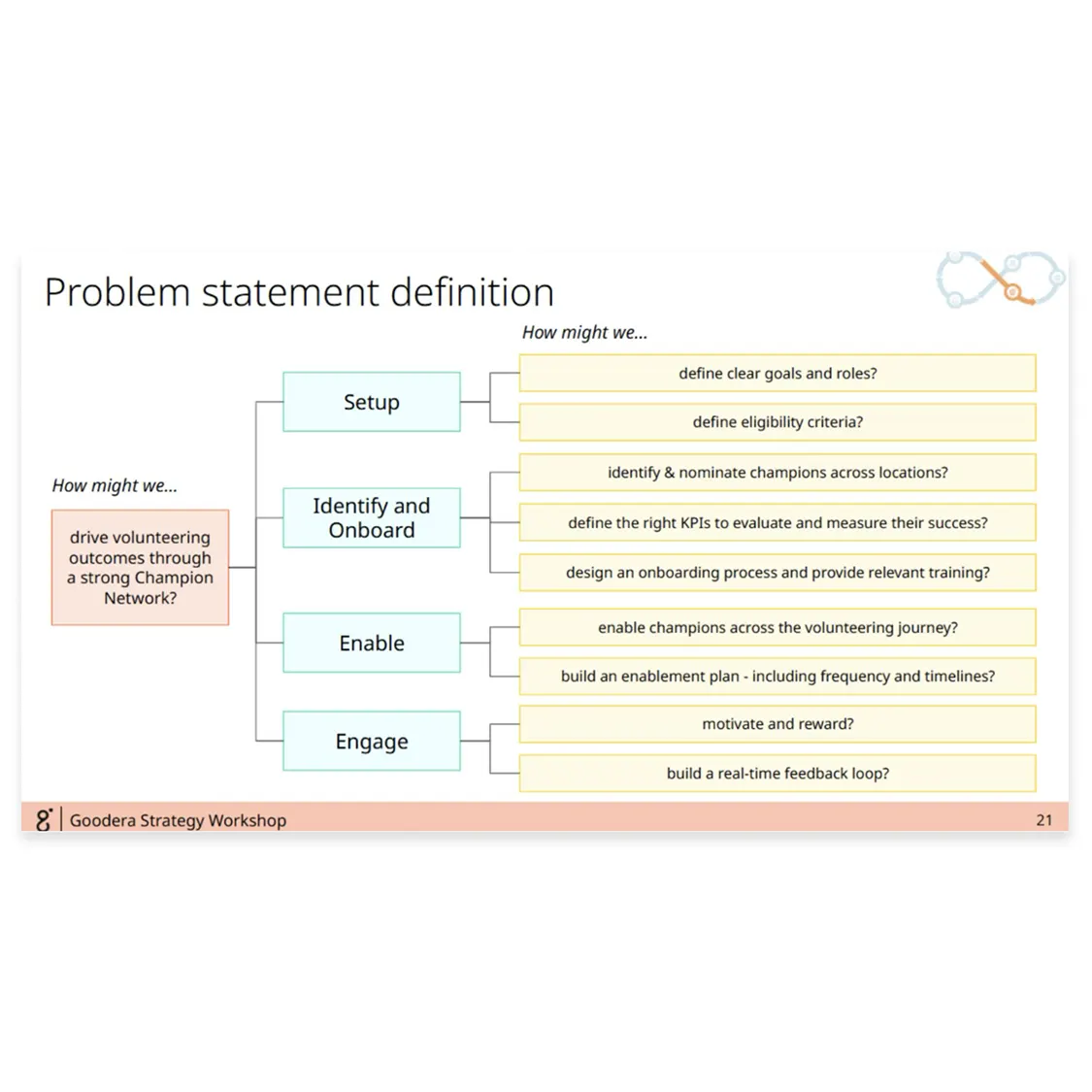
Examine Core Enablers
04
Assess the role of technology and champion networks in supporting participation, scale, and consistency.
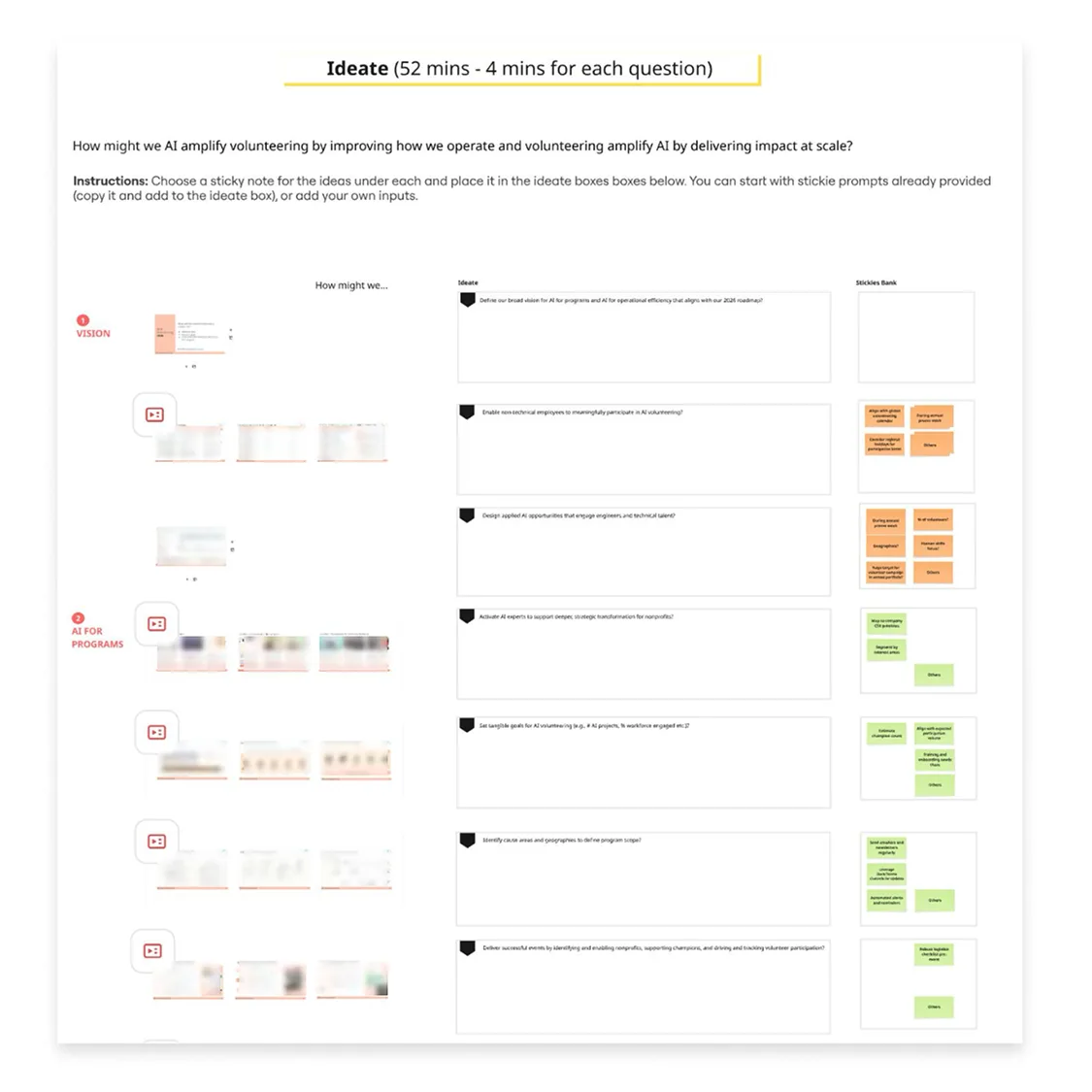
Co-create the Next Actionable Plan
05
Align on a clear ambition for the year ahead and outline the foundations needed to support it.
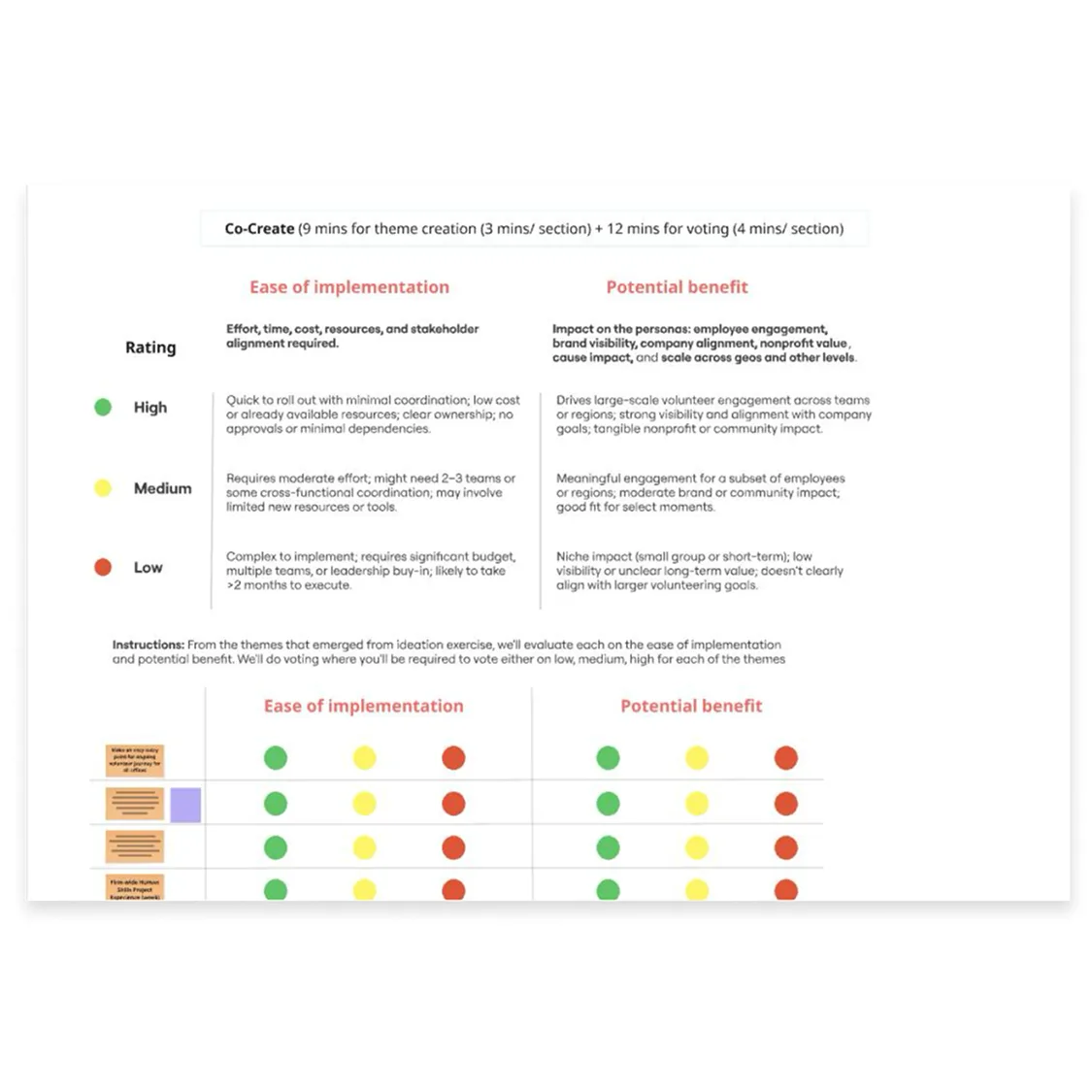
A Peek into the Knowledge
If you’ve been running employee volunteering for a while, you’ve probably noticed something shifting, even if you haven’t put your finger on it yet.
So you start noticing patterns. Volunteering feels harder to run than it used to. Employees are asking for more flexibility. Leadership expectations have shifted. More time is going into coordination than strategy. Participation spikes, then quietly fades. And slowly, it becomes clear: this isn’t a lack of interest, it’s operational friction.
And when you step back, you realize these aren’t isolated problems; they’re signals of something bigger.
Employees want volunteering to feel real, relevant, and easy to join.
Leaders want it to connect to culture, retention, and reputation.
Nonprofits want it to be reliable, respectful of their time, and actually useful to the causes they serve.
And CSR teams are stuck in the middle, trying to scale something deeply human, inside systems that were never designed for it.
That’s where The Art of Possible begins.
Because the question is no longer “Should we do employee volunteering?”
The real question is: What does it take to make employee volunteering work consistently and at scale in today’s world of work?
Why Volunteerism Still Matters, and Why It Matters Now More Than Ever
Employee volunteering has always had a purpose, but its role inside organizations has evolved. Today, volunteering is one of the few levers that can create impact outside the company while also building something meaningful inside the company.
At its best, volunteerism creates a rare overlap between:
- Employee purpose (I want to contribute)
- Community needs (we need support that matters)
- Company culture (we stand for something)
- Leadership priorities (engagement, retention, employer brand)
But what makes volunteering powerful isn’t just the feel-good moment of a volunteer day. It’s what happens when volunteering becomes a consistent habit rather than a one-time campaign.
That’s when it starts to shape how employees connect with each other, how teams build pride and identity, how people experience the company beyond work deliverables, and how the organization shows up in the world with credibility.
In a workplace where many employees feel stretched, transactional, or disconnected, volunteering becomes one of the few experiences that still feels human.
And that’s exactly why it’s worth doing right.
The Current State of Volunteering: More Interest, More Pressure, More Complexity
Employee volunteering isn’t declining because people don’t care. It’s getting harder because the environment around it has changed. Most organizations today are operating in a reality shaped by hybrid teams and distributed workplaces, constant reprioritization and workload pressure, fragmented cultures across locations and functions, increased scrutiny of impact claims, and nonprofits balancing their own capacity constraints.
So, while volunteering still has a strong emotional pull, it now has operational friction tethered to it. This is the paradox CSR teams face:
The appetite for meaningful experiences is high, but the tolerance for effort is low.
Employees want to participate, but they don’t want complexity. Leaders want outcomes, but they don’t want chaos. CSR teams want scale, but they don’t want a never-ending inbox.
That tension is shaping the trends we’re seeing across volunteering programs today.
Volunteering Trends We’re Seeing Right Now, and What They Really Mean
Here are a few patterns showing up across companies, industries, and geographies. These aren’t “new ideas.” They’re signals. And they tell us what volunteering needs to become next.
1. Participation Is Easier to Spark Than It Is to Sustain
Many organizations can still drive a spike in volunteering during a big moment, a month-long campaign, or a flagship day of service.
The harder part is what comes after. Sustained engagement requires consistent programming, repeated communication, and enough simplicity that employees can say “yes” without thinking too hard.
The trend here is clear:
One-time participation is common. Repeat participation is the real challenge. And repeat participation is what turns volunteering into a culture, not just a activity.
2. Volunteering Is Becoming More “Experience-Driven”
Employees want to do good, but they also want the experience to be organized, social, meaningful and worth their time. This is especially true for employees who are open to volunteering but don’t naturally go out of their way to find opportunities.
The trend is simple:
- When volunteering is smooth and welcoming, people come back.
- When it feels confusing or last-minute, they quietly opt out next time.
Volunteering is now judged like any other employee experience. And the experience is what determines whether participation grows or stalls.
3. Employees Want Flexibility, But Still Crave Connection
Virtual and hybrid volunteering made participation more accessible, especially across geographies.
But there’s a catch.
Flexible formats increase reach, but they can diminish the sense of shared energy if they’re not intentionally designed. Employees often want both, something that fits into real schedules, and something that feels like a team moment, not a solo task.
The real shift isn’t virtual versus in-person. It’s that volunteering must be frictionless to join and a meaningful experience, at the same time.
4. Measurement Expectations Have Risen, Even When Programs Are Still Maturing
As volunteering becomes more visible, expectations around impact have changed. Measurement is no longer just something that lives in an annual CSR report, it’s become a credibility signal. Leaders, employees, and external stakeholders all want clarity on what’s actually being achieved, not just what’s being planned.
Organizations increasingly want to answer simple but important questions: Did this make a real difference for the nonprofit? Was the experience worthwhile for employees? Are we creating value beyond participation numbers?
The challenge is that measurement depends on consistency. When volunteering is still managed through spreadsheets, inbox coordination, and fragmented follow-ups, impact tracking becomes secondary to just getting things done. Over time, this makes it harder to tell a clear story about progress.
And when the story isn’t clear, leadership confidence erodes, not because the intent is missing, but because the signal is noisy.
5. CSR Teams Are Being Asked to Scale Without Scaling Headcount
This is rarely said out loud, but it’s the most common reality. As volunteering grows, it spreads across more locations, more employee groups, more causes, more partners, and more internal expectations, while the CSR team running it often stays the same size.
That creates a hidden operating-model problem. Volunteering is being asked to scale like a product, but it’s still being run like a project. And projects don’t scale without breaking something.
Usually, that something is the CSR team.
What These Trends Reveal: The Real Challenges Behind Volunteering Today
Trends are symptoms. The real story is the underlying friction.
Trends are usually just the surface. The real story is what’s happening underneath, and why volunteering can feel harder to sustain even when employees genuinely care.
Here are the challenges these patterns point to, and why they matter.
Challenge 1: Volunteering Competes With Mental Bandwidth, Not Motivation
Most employees aren’t saying no because they don’t believe in volunteering. They’re saying no because it can feel like one more thing to figure out in a week that’s already packed. Even a well-intentioned employee has a quick set of questions running in their head: What is this exactly? Who else is going? Will it be awkward? Will my manager support it? Am I going to be the only one who shows up?
That’s why the biggest barrier often isn’t purpose, it’s decision friction. When volunteering feels easy, clear, and socially safe, people join. When it feels uncertain, they postpone, even if they care.
Challenge 2: The First Experience Determines What Happens Next
Employees don’t always remember what the impact report said. They remember how the experience felt. If their first volunteering moment is confusing, disorganized, or underwhelming, participation doesn’t usually drop with a complaint, it just quietly disappears the next time.
But when the experience is smooth, welcoming, and well-run, volunteering becomes repeatable. That’s why execution quality isn’t a “nice-to-have.” It’s the engine of repeat engagement.
Challenge 3: Unpredictability Weakens Nonprofit Partnerships Over Time
Nonprofit partners value reliability more than excitement. When volunteering programs come with last-minute changes, unclear communication, inconsistent turnout, or mismatched expectations, it adds burden to organizations that are already stretched thin.
And when nonprofit partners feel that burden, the relationship becomes harder to sustain, no matter how good the intent is. The strongest programs operate on a simple principle: community impact requires operational respect.
Challenge 4: The Long Tail of Coordination Is What Burns Teams Out
Every volunteering activity, even a simple one, comes with invisible work: answering questions, confirming details, sending reminders, tracking attendance, collecting feedback, sharing stories, and closing the loop. That long tail is manageable once or twice, but when it sits entirely with a central team across multiple regions and moments, it becomes the thing that limits scale.
That’s why the future of volunteering isn’t just about better ideas. It’s about building systems that make those ideas repeatable.
So What Is “The Art of Possible,” Really?
The Art of Possible isn’t about doing more. It’s about designing volunteering so it works in the real world, for busy employees, distributed teams, lean CSR functions, nonprofit partners who need reliability, and leaders who expect outcomes.
It’s the shift from volunteering as a set of events to volunteering as a durable system. Because when the system is strong, participation becomes easier to activate, experiences become more consistent, impact becomes easier to track, and programs become easier to scale.
And that’s the real opportunity in front of CSR leaders right now, not to “run volunteering harder,” but to build the kind of program that can run well even as the organization grows.
The Bottom Line: The Next Era of Volunteering Will Be Won On Design, Not Just Intent
Most organizations already have the intent. Employees care. Leaders want impact. Communities need support. The gap is rarely purpose, it’s structure.
The organizations that win the next era of employee volunteering will be the ones that make it easy to join, meaningful to experience, credible to measure, and sustainable to run.
That is the art. And it is possible.
Webinars and Podcasts










.png)

.png)




Related Blogs
More Workshops







Frequently Asked Questions

Cet atelier est conçu pour les équipes responsables de la RSE, de l'ESG, des ressources humaines et de l'impact social responsables de la stratégie, de la planification et de l'exécution du volontariat.
Les équipes repartiront avec des objectifs et des priorités claires et un calendrier de bénévolat annuel, adapté aux initiatives, aux régions et aux domaines de cause.
Non L'atelier est structuré pour guider les équipes de tout niveau d'expérience en évaluant les programmes actuels et en concevant un plan évolutif.
Oui La session tient compte des différences régionales et des initiatives mondiales visant à créer un plan cohérent sur toute l'année.
Les équipes disposeront d'une vue d'ensemble du programme partagée et exploitable, d'un calendrier hiérarchisé et de garde-fous opérationnels clairs pour exécuter les initiatives efficacement.
Oui Le contenu et les exercices peuvent être adaptés aux objectifs de votre organisation, à la capacité de bénévolat et à la maturité du programme existant.
En alignant les objectifs, en clarifiant les priorités et en cartographiant les initiatives tout au long de l'année, l'atelier garantit que les programmes peuvent évoluer sans perdre leur orientation ou leur cohérence.
