Des idées de marketing à but non lucratif qui génèrent des dons, des bénévoles et un impact à long terme

Une organisation à but non lucratif mène une campagne réussie. Les dons affluent, de nouveaux sympathisants s'inscrivent et les bénévoles manifestent leur intérêt. Pendant un instant, on a l'impression que les choses fonctionnent.
Puis, quelques mois plus tard, la plupart de ces premiers donateurs ont disparu.
C'est la réalité à laquelle de nombreuses organisations à but non lucratif sont confrontées aujourd'hui. Même si la philanthropie mondiale a dépassé 2 300 milliards de dollars en 2024, la rétention reste l'un des plus grands défis. Selon un article de Ortto sur la rétention des donateurs, les organisations à but non lucratif perdent environ 60 % des nouveaux donateurs, ce qui peut se traduire par une perte de 3 000 $ à 6 000 $ pour 100 donateurs acquis.
La réponse n'est pas la qualité de la mission, car les gens sont concernés. Les donateurs veulent donner. Les bénévoles veulent être présents. Les équipes ESG des entreprises recherchent activement des partenaires à but non lucratif capables d'offrir des programmes structurés et mesurables.
La lacune, dans la plupart des cas, est le marketing. Non pas son absence, mais l'absence d'un système.
Nous savons ce que c'est que de gérer une organisation à but non lucratif où chaque roupie ou dollar a trois destinations. Embaucher une équipe marketing complète n'est pas réaliste pour la plupart des organisations. Mais certains des canaux marketing les plus efficaces disponibles aujourd'hui ne nécessitent pas de gros budgets. Ils exigent de la clarté, de la cohérence et la capacité de raconter la bonne histoire aux bonnes personnes.
Ce guide est un manuel détaillé par canal pour le marketing des organisations à but non lucratif en 2026. Il est conçu pour les organisations qui souhaitent augmenter les revenus des donateurs, attirer des partenariats de bénévolat d'entreprise et construire une base de sympathisants qui reste réellement.
Que signifie le marketing des organisations à but non lucratif en 2026 ?
Le marketing des organisations à but non lucratif est la pratique qui consiste à utiliser la communication, le contenu et la création de communautés pour accroître la notoriété, attirer des donateurs, recruter des bénévoles et établir des partenariats institutionnels qui soutiennent un impact à long terme.
Cela semble simple. Mais c'est significativement différent de la façon dont une entreprise à but lucratif aborde le marketing. Une entreprise commercialise un produit. Une organisation à but non lucratif propose une transformation ; un avenir qui n'existe pas encore mais qui devient plus possible chaque fois que quelqu'un donne, se porte volontaire ou s'associe. Votre public n'achète pas quelque chose pour lui-même. Il investit dans quelque chose de plus grand, et votre marketing doit faire en sorte que cet investissement semble réel, crédible et urgent.
En 2026, le marketing des organisations à but non lucratif couvre les canaux numériques et hors ligne : votre site web, votre présence sur les réseaux sociaux, votre liste de diffusion, les médias acquis, les événements communautaires et les partenariats d'entreprise. Les organisations les plus solides ne considèrent pas tous ces éléments comme des tâches distinctes, mais comme les parties d'un récit unique et cohérent. Ce récit est votre mission, racontée de cent manières différentes à un public spécifique qui se soucie de la cause et y participe avec enthousiasme.
Pourquoi la plupart des stratégies marketing des organisations à but non lucratif échouent
La plupart des organisations à but non lucratif n'ont pas un problème de marketing. Elles ont un problème de stratégie qui ressemble à un problème de marketing.
Les symptômes sont constants : des e-mails envoyés uniquement lorsqu'une campagne est active, des publications sur les réseaux sociaux qui semblent réactives, et un site web qui n'a pas changé depuis 18 mois. Pendant ce temps, le taux moyen de fidélisation des donateurs s'élève à 45 %, en baisse de 2,6 % par rapport à 2023. Près de la moitié de tous les donateurs acquis s'en vont en moins d'un an.
Quatre problèmes structurels sont à l'origine de cette situation :
- Équipes en sous-effectif se limitent à un ou deux canaux qu'elles connaissent, ignorant les autres
- Pas de stratégie écrite signifie que chaque campagne repart de zéro au lieu de s'appuyer sur ce qui a été fait précédemment
- Dépendance excessive à un seul canal (généralement Facebook ou l'e-mail uniquement) crée une fragilité
- Pensée axée sur les métriques de vanité privilégie le nombre d'abonnés et les impressions au lieu de la fidélisation et de la conversion des donateurs
Naturellement, un budget plus important pourrait être la première solution qui vient à l'esprit, mais ce n'est généralement pas le cas. C'est une question de fondation : une cartographie claire de l'audience, une messagerie cohérente et un plan réaliste qu'une petite équipe peut maintenir sur une période donnée.
Construire les fondations : Votre stratégie marketing pour les organisations à but non lucratif
Avant que toute tactique n'ait de sens, les fondations doivent être solides. La recherche organique représente 38 % des visites de sites web d'organisations à but non lucratif. Cela signifie que plus d'un tiers de vos soutiens potentiels sont déjà à la recherche d'organisations comme la vôtre. Si votre présence numérique n'est pas prête à les accueillir, chaque tactique en aval est moins efficace.
Définissez d'abord vos segments d'audience
L'erreur la plus courante dans le marketing des organisations à but non lucratif est de considérer « toutes les personnes qui se soucient de la cause » comme une audience unique. En pratique, c'est trop vaste pour construire quoi que ce soit d'utile.
Définissez trois segments distincts et créez un profil pour chacun :
1. Donateurs
Leurs motivations et leurs comportements varient considérablement. Un donateur qui fait un premier don de 25 $ via Instagram nécessite un message différent de celui d'un philanthrope évaluant un don majeur. Segmentez en fonction de l'historique des dons, de la préférence de canal et de la motivation. Certains donnent parce qu'ils croient au changement systémique. D'autres réagissent à une histoire spécifique. Savoir qui est qui change tout, de l'objet de l'e-mail à l'appel à l'action.
2. Bénévoles potentiels
Ils sont motivés par l'application de leurs compétences, le sentiment d'appartenance à une communauté et l'alignement de l'organisation avec les objectifs ESG de leur employeur. Le rapport 2026 de Goodera sur le quotient de bénévolat, qui a analysé 162 rapports ESG d'entreprises, a révélé que les entreprises proposant des facilitateurs de bénévolat structurés constatent des taux de participation environ 1,5 fois plus élevés que celles qui n'en proposent pas. Cette information est cruciale lorsque vous présentez un programme de bénévolat basé sur les compétences à un partenaire corporatif.
3. Partenaires corporatifs
Ils ont leur propre cadre d'évaluation : l'alignement ESG, les indicateurs d'engagement des employés, la contribution aux ODD et l'association de marque. Ils ont besoin d'une approche, d'un contenu et de mesures de succès différents de ceux de vos donateurs individuels.
Créez des personas pour chaque segment. Sachez ce qu'ils recherchent, ce qui les effraie et ce qu'ils ont besoin de ressentir avant d'agir.
Comment fixer des objectifs marketing qui sont liés à la mission
Les indicateurs de vanité comme le nombre d'abonnés, les impressions de publications et les sessions de site web sont faciles à suivre mais sont généralement incomplets en tant qu'objectifs organisationnels. Ce qui compte vraiment :
- Dons générés par canal
- Heures de bénévolat obtenues et maintenues
- Partenariats corporatifs initiés et renouvelés
- Taux de rétention des donateurs (conversion du premier au deuxième don)
- Croissance de la liste de diffusion et engagement par segment
Fixez des objectifs à trois niveaux.
Au niveau de la mission : Quel impact cherchez-vous à créer cette année ?
Au niveau du programme : Comment le marketing doit-il soutenir cela ?
Au niveau du canal : à quoi ressemble le succès par e-mail, sur LinkedIn, dans votre séquence de prospection d'entreprise ?
Chaque objectif marketing devrait remonter, en une ou deux étapes logiques, à quelque chose qui fait avancer la mission.
La liste de contrôle avant le lancement : Ce qu'il faut mettre en place

Avant de lancer toute campagne, assurez-vous que ces bases sont solides :
A] Identité de marque
Votre identité visuelle est le chemin le plus court vers la reconnaissance. Avant le lancement de toute campagne, assurez-vous que votre équipe dispose d'une boîte à outils cohérente et accessible : un nom et un slogan finalisés qui communiquent ce que vous faites et pour qui, un logo dans plusieurs formats (horizontal, empilé, icône seule), une palette de couleurs définie et des choix typographiques qui fonctionnent sur les supports numériques et imprimés.
Un branding incohérent nuit à la confiance. Un donateur qui voit trois versions différentes de votre logo sur votre site web, dans le pied de page de vos e-mails et sur vos profils sociaux se sentira, consciemment ou non, moins certain de la crédibilité de votre organisation. La cohérence du design signale une compétence opérationnelle – et dans le secteur à but non lucratif, la confiance est la monnaie sur laquelle tout le reste repose.
B] Budget marketing
Les budgets serrés des organisations à but non lucratif exigent une allocation stratégique. Les organisations de moins d'un million de dollars investissent généralement 5 % à 15 % dans les activités marketing, tandis que les groupes plus importants dépensent environ 10 %. Pour maximiser l'impact, privilégiez les canaux à fort retour sur investissement (ROI) comme l'e-mail et le SEO à long terme, et utilisez le programme Google Ad Grants pour bénéficier de jusqu'à 120 000 $ de crédits de recherche annuels. Commencez par financer les besoins essentiels, y compris votre plateforme d'e-mailing, un calendrier de contenu de base et les événements. Engagez-vous sur un budget défini plutôt que d'attendre des excédents de trésorerie. Enfin, amplifiez votre portée gratuitement grâce aux partenariats d'entreprise, au partage social par les bénévoles et aux médias acquis avant de dépenser en publicité payante.
C] Plan marketing
Répondez à six questions au minimum. À qui nous adressons-nous ? Que voulons-nous qu'ils fassent ? Que disons-nous ? Où ? Quand ? Comment saurons-nous si cela a fonctionné ? Établissez votre calendrier de contenu un trimestre à l'avance. Planifiez vos campagnes autour des périodes de dons, des journées de sensibilisation pertinentes pour votre cause, et des propres jalons de votre organisation, c'est-à-dire les lancements de programmes, les anniversaires de bénévolat et les rapports d'impact. Laissez de la place pour le contenu réactif, mais ne laissez pas le contenu réactif devenir votre seul contenu. Examinez le plan chaque mois.
D] Présence multicanal
Aucun canal unique n'est suffisant. Votre site web est votre base principale, mais il n'a d'importance que si les gens peuvent le trouver (SEO), lui faire confiance (qualité du design et du contenu) et y faire quelque chose (appels à l'action clairs). Vos canaux sociaux favorisent la découverte et la communauté. Votre liste d'e-mails est l'endroit où vivent vos relations les plus chaleureuses. Chaque canal joue un rôle différent dans le parcours du soutien.
Au minimum, maintenez un site web fonctionnel, une liste d'e-mails active et une présence sur deux à trois plateformes sociales qui correspondent aux données démographiques de votre public. Plus de détails sur quelles plateformes à prioriser et pourquoi dans la section des médias sociaux ci-dessous.
E] Appels à l'action sur chaque point de contact
« Faire un don » pour les donateurs individuels. « Devenez partenaire » pour les entreprises. Chaque contenu, chaque page d'événement, chaque pied de page d'e-mail. L'appel à l'action n'est pas accessoire. C'est le pont entre une personne touchée par votre mission et le passage à l'action. Sans une étape suivante claire, vous avez créé de la notoriété sans conversion.
F] Supports physiques
Investissez dans un ensemble simple de supports physiques : un dépliant d'une page, une carte de visite, une brochure de sensibilisation pour les entreprises. Assurez-vous que chaque support inclut l'URL de votre site web, un code QR et une étape suivante claire. Beaucoup de vos plus fidèles soutiens vous ont découvert lors d'un événement communautaire ou par le bouche-à-oreille. Donnez-leur quelque chose à conserver et à transmettre.
G] Partenariats avec des entreprises locales
Une entreprise de quartier qui affiche vos supports ou co-organise une collecte de fonds exploite les réseaux de confiance communautaires existants que les canaux numériques ne peuvent pas reproduire. Un restaurant de quartier qui affiche vos supports, une salle de sport locale qui promeut votre collecte de fonds, ou un espace de coworking qui accueille votre événement de recrutement de bénévoles.
Abordez-les avec une proposition de valeur spécifique et mutuelle. Qu'est-ce qu'ils gagnent à vous soutenir ? Le moral des employés ? Une visibilité communautaire ? Une histoire à raconter à leurs clients ? Facilitez-leur la tâche pour qu'ils disent oui, et faites en sorte que le partenariat soit réellement réciproque.
Marketing de contenu pour les organisations à but non lucratif : Racontez les histoires qui touchent les gens
Le contenu est l'actif marketing qui continue de produire des résultats après sa publication. Une histoire d'impact percutante de 2024 peut encore attirer des donateurs en 2026. Un guide pratique bien structuré peut générer du trafic organique pendant des années. Et 98 % des utilisateurs ne consultent que les résultats de recherche de la première page, ce qui fait de la qualité du contenu non pas un luxe, mais une exigence fondamentale.
Le meilleur contenu pour les organisations à but non lucratif ne ressemble pas à du marketing. Il ressemble à une conversation avec quelqu'un qui comprend le problème mieux que vous. C'est le ton à adopter pour tous les formats.
Le mix de contenu pour les organisations à but non lucratif : Quoi créer et pourquoi
Les programmes de contenu les plus efficaces pour les organisations à but non lucratif utilisent six formats en parallèle, chacun conçu pour un besoin d'audience et un objectif organisationnel différents.
1. Histoires d'impact
Les récits centrés sur l'humain créent le lien émotionnel qui transforme la notoriété en action. Des recherches menées dans le secteur montrent que 70 % des donateurs sont plus susceptibles de donner lorsqu'ils sont touchés par une histoire personnelle, et que les campagnes combinant récit et données génèrent environ 50 % de dons supplémentaires par rapport aux appels basés uniquement sur des données. Les histoires améliorent la rétention mémorielle de 22 fois par rapport aux faits seuls. Les donateurs qui lisent votre histoire d'impact sont beaucoup plus susceptibles de se souvenir de vous lors de leur prochaine décision de don.
Les organisations à but non lucratif qui partagent des études de cas de bénéficiaires signalent constamment des augmentations de dons d'environ 25 % et une croissance de l'intérêt des bénévoles d'environ 35 % d'une année sur l'autre. Pour la rétention des donateurs spécifiquement, les mises à jour régulières des histoires de bénéficiaires sont corrélées à des taux de dons répétés pouvant atteindre 80 %.
2. Guides pratiques
Le contenu pratique et éducatif génère du trafic organique et renforce l'autorité de domaine. Les articles de plus de 2 000 mots génèrent 3,5 fois plus de backlinks que les contenus plus courts, et 47 % des meilleurs résultats de recherche sont des guides complets. Pour une organisation à but non lucratif œuvrant dans le domaine du bénévolat d'entreprise, un guide sur « comment concevoir un programme de bénévolat basé sur les compétences » attire précisément les décideurs en RSE et en RH qui deviendront des partenaires à long terme.
3. Portraits de bénévoles
Mettre en avant les bénévoles humanise votre mission de l'intérieur et de l'extérieur et génère un partage social organique. Une série de contenus axés sur les bénévoles d'une organisation à but non lucratif a enregistré une augmentation de 35 % d'une année sur l'autre des dons et des inscriptions de bénévoles après son lancement. Un coup de projecteur sur un groupe de bénévoles d'une entreprise signale l'authenticité aux partenaires corporatifs potentiels et crée un contenu partageable que les employés mis en avant diffuseront au sein de leurs propres réseaux.
4. Études de cas
Elles sont le pilier du marketing de partenariat d'entreprise. Un décideur en RSE évaluant un partenariat avec une organisation à but non lucratif a besoin de preuves de la qualité du programme et de résultats mesurables, et pas seulement d'une résonance émotionnelle. Une étude de cas bien structurée, telle que « comment une équipe de 50 bénévoles d'une entreprise de services financiers nous a aidés à servir 2 000 membres supplémentaires de la communauté en un seul trimestre », parle directement aux indicateurs qui comptent pour leurs équipes de direction. Les organisations à but non lucratif utilisant des études de cas dans leurs collectes de fonds et leurs actions de sensibilisation ont signalé des contributions annuelles environ 25 % plus élevées. Rédigez les études de cas qui décrivent les partenariats que vous souhaitez développer.
5. Rapports étayés par des données
La publication de recherches originales établit un leadership éclairé et génère des retombées médiatiques. Goodera's Volunteering Quotient Report 2026 a comparé les données de participation de 162 rapports ESG d'entreprise, révélant que le taux médian de participation au bénévolat des employés est de 20,1 %, les services financiers étant en tête avec 23,34 %. Ce type de données propriétaires et spécifiques à un secteur est cité, lié et référencé dans les conversations de l'industrie, renforçant à la fois l'autorité SEO et la crédibilité institutionnelle. 57 % des donateurs déclarent avoir une plus grande confiance dans les organisations qui partagent des indicateurs d'impact clairs, et la recherche originale est le signal le plus clair de cette transparence.
6. Leadership éclairé
Les articles d'opinion, les commentaires d'experts et les articles éditoriaux renforcent la réputation institutionnelle et ouvrent des portes à des partenariats et des opportunités de prise de parole. Le retour sur investissement est plus difficile à mesurer en termes de dons directs, mais a tendance à générer les relations avec les entreprises et les grands donateurs en aval que vos autres contenus convertissent.
Goodera's Volunteering Quotient est une série qui mérite d'être étudiée comme modèle. En publiant des données originales et comparables sur les pratiques de bénévolat d'entreprise, Goodera gagne en crédibilité auprès du public exact qui rend les partenariats de bénévolat d'entreprise viables : les équipes RSE, les responsables ESG et les managers de l'engagement des employés au sein des grandes organisations.
Fréquence de publication : La régularité plutôt que le volume
Une organisation à but non lucratif qui publie deux articles de blog de qualité par mois, envoie une newsletter toutes les deux semaines et publie trois fois par semaine sur son principal canal social obtiendra de meilleurs résultats qu'une organisation qui publie quotidiennement pendant trois semaines puis s'arrête.
Une cadence pratique pour les petites équipes :
- Contenu de blog/long format : 2 à 4 articles par mois
- Newsletter par e-mail : Deux fois par mois (une mise à jour, un envoi axé sur l'action)
- Réseaux sociaux : 3 à 5 fois par semaine sur votre canal principal
- Contenu d'expertise/étude de cas : Une fois par trimestre
Créez votre contenu par lots. Bloquez un ou deux jours par mois dédiés à la création de contenu plutôt que de créer à la volée. Et construisez votre calendrier autour des étapes clés de votre organisation : lancements de programmes, anniversaires de bénévoles, campagnes de dons et dates de sensibilisation pertinentes pour votre cause.
Marketing par e-mail pour les organisations à but non lucratif : Toujours votre canal au ROI le plus élevé
33 % des donateurs déclarent que l'e-mail est l'outil qui les inspire le plus à donner, comparé à 29 % qui citent les réseaux sociaux. Et 48 % des donateurs identifient l'e-mail comme leur canal préféré pour recevoir des mises à jour des organisations qu'ils soutiennent.
Ces chiffres sont valables pour toutes les catégories démographiques de donateurs. L'e-mail est direct. Il arrive dans une boîte de réception personnelle, et non dans un fil d'actualité filtré par un algorithme. Et lorsqu'il est bien fait, il crée un sentiment de relation personnelle entre le donateur et la cause.
Comment rédiger des e-mails associatifs qui sont ouverts
L'objet est votre première, et souvent unique, chance d'obtenir l'ouverture.
- Personnalisation : Les e-mails personnalisés ont des taux d'ouverture supérieurs de plus de 82 % à ceux des envois génériques. Utilisez le nom du destinataire. Mentionnez son historique de dons ou son activité bénévole si possible. Le message adressé à un donateur qui a soutenu votre programme éducatif l'année dernière doit en tenir compte avant de faire toute demande.
- Privilégiez la curiosité, pas l'annonce : « Découvrez l'étudiant que votre dernier don a aidé à entrer à l'université » est plus efficace que « Notre rapport d'impact 2026 est disponible. » Le premier concerne le lecteur. Le second vous concerne.
- Segmentez rigoureusement : Un donateur inactif a besoin d'un message de reconnexion, pas d'une demande de campagne. Un contact d'entreprise explorant un partenariat a besoin de contenu d'étude de cas, pas d'un bouton de don. Les campagnes d'e-mailing segmentées génèrent jusqu'à 760 % de revenus supplémentaires que celles non segmentées.
- Épurez votre liste : Seulement 38 % des organisations à but non lucratif suppriment régulièrement les abonnés inactifs. Les autres gonflent la taille de leur liste tout en dégradant discrètement la délivrabilité et en faussant leurs données de performance.
La structure de newsletter qui fonctionne
Les newsletters d'organisations à but non lucratif les plus efficaces suivent une architecture cohérente en quatre parties :
- Mise à jour de l'impact : Une chose spécifique et concrète que votre travail a rendue possible depuis le dernier e-mail. Pas « nous avons aidé des centaines de familles ». Mais « 47 familles à Bengaluru ont eu accès à l'eau potable le mois dernier. »
- Une histoire : Une personne, un moment, un résultat. Lien vers la version complète sur votre site, pour soutenir votre référencement.
- Une demande spécifique : Pas « veuillez nous soutenir ». Mais « Ferez-vous un don mensuel de 500 ₹ pour maintenir ce programme en activité tout au long de l'année scolaire ? » Le spécifique surpasse le vague de manière significative.
- Un CTA d'engagement alternatif : Tout le monde ne peut pas faire de don financier en ce moment. Proposez une façon de faire du bénévolat, de partager du contenu ou de participer à un événement.
Une communication cohérente et fréquente avec les donateurs en ligne entraîne une augmentation de 41,5 % des revenus, ce qui démontre, de manière assez définitive, qu'il faut traiter votre programme d'e-mails comme une priorité opérationnelle essentielle plutôt que comme un plus.
Marketing des médias sociaux pour les organisations à but non lucratif : La stratégie avant la présence
93 % des organisations à but non lucratif utilisent les Pages Facebook. Leur portée organique moyenne est de 2,2 % des abonnés. L'écart entre la présence et la portée est la tension centrale du marketing des médias sociaux pour les organisations à but non lucratif.
Les médias sociaux sont un outil de découverte et de communauté. Ils fonctionnent mieux lorsque votre contenu vaut la peine d'être consulté, partagé ou commenté. De plus, lorsque vous êtes suffisamment cohérent pour que vos abonnés s'attendent à avoir de vos nouvelles.
Sélection de la plateforme : Adapter le canal à l'objectif
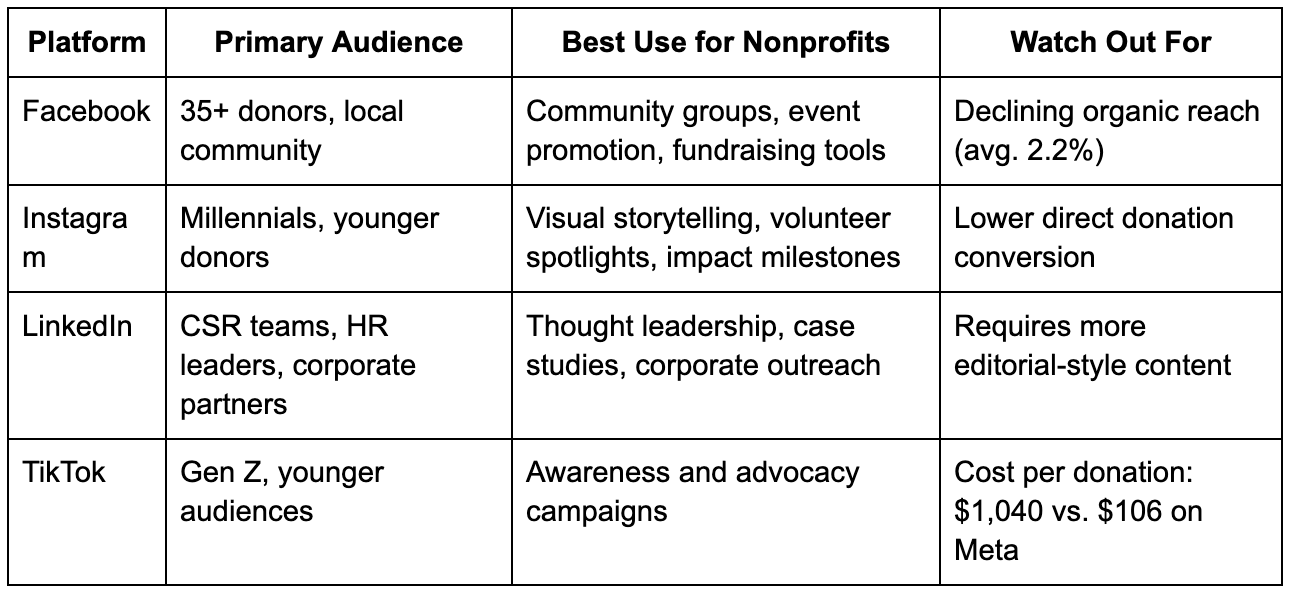
Quel type de contenu sur les médias sociaux fonctionne le mieux pour les organisations à but non lucratif ?
- Publications avec images génèrent 650 % d'engagement en plus que les publications uniquement textuelles
- Vidéos courtes (Reels, TikTok, Shorts) surpasse constamment les images statiques en termes de portée et de partages
- La vidéo sociale génère 1 200 % de partages en plus que le contenu texte et image combiné
- Contenu généré par les utilisateurs provenant des bénévoles et des donateurs génère constamment un engagement plus élevé que les publications de marque, et 90 % des consommateurs déclarent que le CGU influence davantage leurs décisions que le contenu créé par les marques
- Plaidoyer des employés grâce aux programmes de bénévolat d'entreprise, vous étendez votre portée à des réseaux professionnels auxquels vous ne pouvez pas accéder seul
Les types de contenu qui ont tendance à donner les meilleurs résultats pour les organisations à but non lucratif sur toutes les plateformes :
A] Jalons d'impact: « Nous venons de servir notre 10 000e repas. » Les chiffres visualisés créent des moments partageables. Ils servent également de preuves qui attirent les partenaires d'entreprise examinant votre bilan.
B] Portraits de bénévoles et histoires d'équipe: Les photos d'équipes de bénévoles d'entreprise et les récits personnels de bénévoles génèrent un engagement élevé et un partage organique parmi les employés mis en avant. C'est aussi là qu'interviennent les programmes de promotion par les employés : lorsque vos partenaires d'entreprise encouragent activement leurs employés à partager du contenu de bénévolat, votre portée s'étend à des réseaux professionnels auxquels vous ne pourriez pas accéder seul.
C] Contenu des coulisses: À quoi ressemble réellement une journée de programme ? Qui fait partie de votre équipe et pourquoi sont-ils là ? Ce type de contenu renforce la confiance d'une manière qu'une production soignée ne peut jamais tout à fait égaler.
D] Contenu généré par les utilisateurs: Environ 90 % des consommateurs déclarent que le CGU influence leurs décisions plus que les activités de marketing de marque. Encouragez les bénévoles et les donateurs à partager leurs propres histoires et à taguer votre organisation. Republiez et amplifiez. La meilleure preuve sociale est une preuve que vous n'avez pas fabriquée.
E] Partenariats avec des influenceurs et des ambassadeurs: Environ la moitié des organisations à but non lucratif ont travaillé avec des influenceurs sur les réseaux sociaux en 2024. Parmi celles qui ont mené des campagnes payantes, 65 % les ont utilisées pour des demandes de bénévolat ou de plaidoyer, et 77 % pour le travail narratif et de persuasion. Les micro-influenceurs dans votre domaine d'action, comme les personnes ayant de 5 000 à 50 000 abonnés qui se soucient réellement de la cause, ont tendance à générer un meilleur engagement et des associations plus authentiques que les comptes plus importants avec des audiences moins pertinentes.
SEO pour les organisations à but non lucratif : Soyez trouvé par les personnes qui se soucient déjà de votre cause
La recherche organique est le seul canal marketing où le travail que vous faites aujourd'hui continue de porter ses fruits pendant des années. Une page bien optimisée peut générer un trafic gratuit et qualifié chaque jour. Plus de 90 % de tout le trafic de recherche va aux résultats de la première page. Si votre organisation à but non lucratif n'est pas en première page pour les recherches effectuées par vos potentiels soutiens, vous leur êtes effectivement invisible.
Recherche de mots-clés : Un cadre pratique
Commencez par votre mission, pas par un outil de mots-clés. Listez les cinq à dix choses que votre organisation fait. Ensuite, demandez-vous : comment quelqu'un qui n'a jamais entendu parler de nous chercherait-il cela ?
Un responsable RSE d'entreprise qui ne connaît pas votre organisation ne cherche pas votre nom. Il/Elle recherche des "programmes de bénévolat d'entreprise pour les entreprises technologiques" ou "comment mesurer l'impact du bénévolat pour le reporting ESG". Ce sont les requêtes pour lesquelles vous devez être présent(e). Les mots-clés de longue traîne méritent une attention particulière.
Une recherche comme "idées de programmes de bénévolat d'entreprise pour les entreprises technologiques" a un volume plus faible que "bénévolat" mais une intention beaucoup plus élevée. La personne qui tape cette phrase est en plein processus de décision, ce qui est exactement là où vous voulez la rencontrer.
Privilégiez les mots-clés de longue traîne à forte intention plutôt que les termes génériques avec une concurrence énorme et une intention peu claire.
Outils gratuits à utiliser :
- Google Search Console (montre exactement quelles recherches amènent les gens sur votre site aujourd'hui)
- Google Autocomplete et "People Also Ask" (cartographie les questions que de vrais utilisateurs posent sur n'importe quel sujet)
- AnswerThePublic (génère des cartes de mots-clés basées sur des questions à partir de n'importe quel terme de base)
Outils premium qui justifient l'investissement :

Privilégiez les mots-clés de longue traîne plutôt que les termes génériques. "Programmes de bénévolat d'entreprise pour les entreprises technologiques" a un volume de recherche plus faible que "bénévolat", mais la personne qui le tape est en plein processus de décision. C'est là que vous voulez apparaître.
Idées marketing efficaces pour la collecte de fonds des associations
Les dons mensuels ont augmenté de 5 % en 2024 et représentent désormais 31 % de tous les revenus en ligne des organisations à but non lucratif. Le passage aux dons récurrents est la tendance la plus importante de la collecte de fonds des organisations à but non lucratif aujourd'hui, et la plupart des organisations ne la commercialisent pas suffisamment.
Le cadre marketing des dons récurrents
Le don récurrent est une relation, pas une transaction. La façon dont vous le commercialisez doit le refléter dès la première sollicitation.
Trois principes qui favorisent la conversion des donateurs mensuels :
- Mettez en avant la spécificité de l'impact, pas le montant du don. "Vos 20 $ par mois financent une séance de tutorat par semaine" est plus efficace que "faites un don mensuel pour soutenir notre travail".
- Mettez en place une séquence de bienvenue de trois à cinq e-mails sur les 30 premiers jours. Les donateurs qui bénéficient d'un processus d'intégration structuré sont fidélisés à des taux significativement plus élevés.
- Célébrez les anniversaires de don. Un e-mail personnel d'une seule phrase de votre directeur général à l'occasion du premier anniversaire de don d'un donateur contribue davantage à la fidélisation que la plupart des campagnes.
Collecte de fonds de pair à pair : Vos sympathisants comme canal de distribution
Les campagnes de pair à pair étendent votre portée à des réseaux auxquels vous n'avez pas d'accès direct. Vos sympathisants les plus engagés disposent de réseaux professionnels et personnels qui leur font confiance d'une manière qu'ils ne vous font pas encore confiance.

Ce qui fait le succès des campagnes P2P :
- Kits de narration pour chaque participant : quelques statistiques d'impact, un message personnalisable, des publications suggérées pour les réseaux sociaux et un lien vers une page de collecte de fonds
- Un webinaire d'intégration de 30 minutes pour les ambassadeurs avant le lancement de la campagne
- Groupes de bénévoles d'entreprise comme ambassadeurs P2P — les employés qui ont déjà fait du bénévolat avec vous sont déjà motivés et connectés à un réseau professionnel
GivingTuesday et fin d'année : Le modèle de campagne multi-points de contact
GivingTuesday 2025 a vu 19,1 millions de donateurs contribuer 4 milliards de dollars. Les donateurs de GivingTuesday se fidélisent également à un taux de 65 %, un taux plus élevé que celui des donateurs acquis plus tôt dans l'année.
Les organisations qui réussissent lors du GivingTuesday et en fin d'année sont celles qui ont commencé à planifier en octobre.
Mettez en place une campagne multi-points de contact via e-mail, les réseaux sociaux et tous les canaux payants dont vous disposez. Semaine 1 : racontez votre histoire et préparez votre public. Semaine 2 : annoncez votre objectif GivingTuesday et présentez les opportunités de dons jumelés. Le GivingTuesday lui-même : donnez des mises à jour horaires sur les progrès, utilisez l'urgence de manière réfléchie et envoyez un dernier e-mail en soirée aux personnes qui ont ouvert mais n'ont pas donné. Dans les jours qui suivent : remerciez personnellement les donateurs, partagez le résultat et présentez-leur votre programme de dons mensuels.
Les organisations qui réussissent leurs campagnes de fin d'année commencent en octobre :
- Semaines 1 à 2 (octobre) : Racontez votre histoire. Préparez votre public avec du contenu à impact, pas une demande de don.
- Semaines 3 à 4 (octobre/novembre) : Annoncez votre objectif pour le GivingTuesday. Présentez les opportunités de dons jumelés. 84 % des donateurs sont plus susceptibles de donner lorsqu'un don jumelé est disponible.
- Le GivingTuesday lui-même : Mises à jour horaires des progrès sur les réseaux sociaux, un e-mail en soirée aux personnes ayant ouvert le précédent message mais n'ayant pas fait de don.
- Après la campagne : Remerciez personnellement les donateurs. Partagez les résultats. Présentez-leur votre programme de dons mensuels.
Partenariats d'entreprise et bénévolat en entreprise : un canal d'acquisition sous-exploité
74 % des organisations à but non lucratif estiment que le bénévolat en entreprise est important pour leur stratégie globale de collecte de fonds. La plupart d'entre elles abordent encore le marketing des partenariats d'entreprise de manière réactive, attendant que les entreprises les contactent plutôt que de se positionner comme un partenaire de choix.
L'intérêt du côté des entreprises est réel. Les engagements ESG augmentent. La demande des employés pour du bénévolat structuré est mesurable. Les entreprises recherchent activement des partenaires à but non lucratif qui peuvent offrir des programmes fiables et axés sur les résultats.
À LIRE AUSSI : Partenariats d'entreprise pour les OBNL : un guide pratique pour les deux parties
Comment élaborer une proposition de partenariat d'entreprise qui convertit
Les décideurs RSE des entreprises vous évaluent de la même manière qu'ils évalueraient n'importe quel fournisseur de programme : Pouvez-vous tenir vos promesses ? L'expérience des employés est-elle suffisamment bonne pour qu'ils aient envie de revenir ?
Votre argumentaire doit répondre à ces questions avant même qu'elles ne soient posées.
Le cadre de l'argumentaire de partenariat d'entreprise :
- Menu des programmes : Que peut faire une équipe de 20 personnes avec vous en une demi-journée ? Qu'en est-il de 100 employés répartis sur plusieurs sites ? Quelles options virtuelles ou hybrides proposez-vous ?
- Structure de rapport d'impact : Définissez à l'avance les métriques que vous fournirez après chaque engagement. Heures de bénévolat, bénéficiaires atteints, scores de satisfaction des employés, alignement sur les ODD. Les partenaires corporatifs renouvellent leur engagement lorsqu'ils peuvent présenter à leur direction un rapport de résultats clair deux semaines après un événement.
- Preuve par étude de cas : Une étude de cas de deux pages issue d'un partenariat corporatif précédent est plus efficace que n'importe quelle brochure. Incluez les résultats, les retours des employés et des photos.
Comment utiliser les partenariats corporatifs pour amplifier votre portée marketing
Les partenariats corporatifs ne sont pas seulement une source de financement. Ils sont un multiplicateur de contenu et de portée.
73 % des bénévoles font des dons aux organisations à but non lucratif avec lesquelles ils travaillent, ce qui signifie que chaque bénévole d'entreprise est aussi un donateur individuel potentiel, un abonné à la newsletter et un ambassadeur de collecte de fonds entre pairs. Créez des passerelles pour cette transition : partagez votre option d'inscription à la newsletter avec chaque groupe de bénévoles d'entreprise, invitez-les à votre prochain événement communautaire et facilitez-leur la poursuite de leur relation avec vous au-delà du programme d'une journée.
Chaque journée de bénévolat d'entreprise bien exécutée produit :
- UGC naturel : Les employés publient des photos. Les entreprises partagent sur LinkedIn. Leurs audiences sont vastes et chevauchent souvent les données démographiques professionnelles les plus susceptibles de devenir votre prochain partenaire corporatif.
- Opportunités de contenu co-brandé : Un article de blog conjoint avec l'équipe RSE de votre partenaire corporatif sur ce que vous avez accompli ensemble atteint leur public tout en renforçant votre autorité SEO grâce aux backlinks et à l'amplification de contenu.
- Bouche-à-oreille interne : Les expériences de bénévolat positives se propagent rapidement au sein des entreprises. Un engagement réussi génère souvent une recommandation à une autre équipe ou un renouvellement à plus grande échelle.
Publicité payante pour les organisations à but non lucratif : Tirer le meilleur parti des Google Ad Grants
Le programme Google Ad Grants offre aux organisations à but non lucratif éligibles jusqu'à 120 000 $ de crédits publicitaires annuels pour la recherche. Cela représente 10 000 $ par mois de dépenses Google Ads, sans frais pour votre organisation : une offre qu'aucune organisation à but non lucratif ne peut se permettre d'ignorer.
La mise en garde est que les campagnes Ad Grants fonctionnent sous des restrictions spécifiques : les annonces ne peuvent être diffusées que sur Google Search (pas sur Display ou YouTube), vous ne pouvez enchérir que sur des mots-clés avec un seuil de score de qualité maximal, et vos campagnes doivent maintenir un taux de clics minimum pour rester actives.
Ces règles impliquent que les comptes Ad Grants nécessitent une gestion plus active qu'un compte Google Ads standard. Mais le retour sur investissement justifie l'effort : les annonces de recherche génèrent 2,75 $ pour chaque dollar dépensé sur l'ensemble des canaux numériques : le ROAS le plus élevé de tous les formats publicitaires payants pour les organisations à but non lucratif.

Pour postuler, votre organisation doit être une organisation à but non lucratif enregistrée (ou l'équivalent dans votre pays), disposer d'un site web fonctionnel avec des informations claires sur sa mission, et respecter les politiques du programme de Google. Le traitement de la demande prend une à deux semaines dans la plupart des cas.
Une fois actif, associez vos campagnes de recherche payantes à votre stratégie de référencement naturel (SEO). Si vous êtes déjà bien classé organiquement pour "gestion de programme de bénévolat d'entreprise", votre annonce payante sur ce mot-clé renforce votre crédibilité et capte les internautes qui ne cliqueraient pas sur les résultats organiques. Les deux canaux travaillant ensemble surpassent systématiquement l'un ou l'autre canal seul.
Marketing hors ligne pour les organisations à but non lucratif : Là où la communauté se construit
Les canaux numériques accaparent la majeure partie de l'attention. Mais le marketing hors ligne bâtit le type de confiance et d'appartenance qu'aucun algorithme ne peut fabriquer.
- Rencontres locales et événements communautaires: Apportez votre mission dans des espaces physiques où les gens sont déjà rassemblés et réceptifs. Un événement de sensibilisation de quartier, un nettoyage communautaire ou une conférence publique animée par l'un de vos responsables de programme crée un point de contact mémorable que les canaux numériques ne peuvent pas entièrement reproduire.
- Sessions de bénévolat locales: Elles ont une double fonction : elles génèrent un impact pour le programme tout en servant d'activités de marketing expérientiel pour les partenaires d'entreprise potentiels qui y participent aux côtés des bénévoles existants. Une journée de bénévolat bien organisée et significative est le meilleur argument pour un futur partenariat d'entreprise. Les employés de l'entreprise rentrent chez eux après avoir vécu votre mission de première main, et le bouche-à-oreille au sein d'une entreprise se propage rapidement.
- Conférences et événements sectoriels : C'est là que les partenariats d'entreprise commencent. Participez aux conférences sur les RH, l'ESG et le développement durable où vos partenaires idéaux sont déjà présents. Apportez un document d'une page percutant, ayez une description claire de 30 secondes de votre proposition de valeur de partenariat, et assurez un suivi dans les 48 heures suivant toute conversation significative.
- Ambassadeurs de marque : Dans votre communauté, c'est-à-dire les leaders locaux, les éducateurs respectés, le clergé et les chefs d'entreprise, étendez votre portée dans des réseaux auxquels vous ne pouvez pas accéder directement. Identifiez qui, dans votre communauté, a la confiance des publics que vous souhaitez atteindre, et établissez des relations authentiques avec eux.
Mesurer ce qui fonctionne
Les activités marketing sans mesure sont de la pure spéculation, même si elles sont bien présentées.
Suivez ces indicateurs en continu, et non pas seulement trimestriellement :

Créez un tableau de bord partagé, même une simple feuille Google Sheet, qui affiche les indicateurs clés mois après mois. Révisez en équipe. L'objectif n'est pas de disposer de données parfaites. Il s'agit d'une image honnête et cohérente des domaines dans lesquels votre marketing crée de l'intérêt et des domaines dans lesquels il ne l'est pas.
Où aller à partir d'ici
Les idées présentées dans ce guide ne constituent pas une liste de contrôle à compléter. Choisissez-en deux ou trois qui correspondent à vos capacités actuelles et à vos besoins organisationnels les plus urgents. Construisez-les bien. Mesurez honnêtement. Ajoutez le reste.
Si votre organisation explore le volontariat d'entreprise en tant que canal de collecte de fonds et de partenariat, ou si vous êtes un responsable de la RSE ou des ressources humaines qui souhaite créer un programme de bénévolat plus structuré et axé sur les résultats, le réseau de Goodera composé de plus de 50 000 partenaires à but non lucratif et ses outils de reporting d'impact spécifiques au secteur sont conçus exactement pour ce type de programme. Commencez par Rapport sur le quotient de bénévolat 2025 pour une référence sur la situation de la participation des entreprises au volontariat dans tous les secteurs et sur les domaines dans lesquels les meilleurs programmes investissent leur énergie.
La mission est importante. Il en va de même pour l'infrastructure qui lui permet de fonctionner.
Questions fréquemment posées sur le marketing à but non lucratif
1. Quelle est la meilleure stratégie marketing pour une organisation à but non lucratif ?
Il n'existe pas de réponse universelle, mais les programmes de marketing à but non lucratif les plus efficaces partagent trois qualités : ils reposent sur une compréhension claire de leurs différents segments d'audience (donateurs individuels, bénévoles et partenaires commerciaux), ils utilisent de multiples canaux qui renforcent un seul récit cohérent, et ils sont cohérents dans le temps plutôt que uniquement en cas de campagne en rafale. Le courrier électronique offre le meilleur retour sur investissement pour la plupart des organisations. Le contenu et le référencement génèrent des rendements cumulés. Le marketing des partenariats d'entreprise ouvre l'accès à des ressources et à une portée que les programmes individuels de donateurs ne peuvent pas générer à eux seuls.
2. Comment les organisations à but non lucratif peuvent-elles se faire connaître avec un budget serré ?
Commencez par des chaînes à haut rendement et à faible coût. Google Ad Grants fournit jusqu'à 120 000 dollars de crédits d'annonces de recherche annuels aux organisations à but non lucratif éligibles. Le marketing par e-mail est gratuit jusqu'à une certaine taille de liste sur la plupart des plateformes. Le marketing de contenu, les articles de blog, les articles d'impact et les études de cas nécessitent plus de temps que d'argent. Priorisez les canaux dans lesquels vos efforts s'intensifient plutôt que d'expirer, et établissez des partenariats d'entreprise qui co-investissent dans l'expérience du programme à vos côtés.
3. Comment les organisations à but non lucratif utilisent-elles efficacement les réseaux sociaux ?
La sélection de la plateforme et la discipline du contenu sont plus importantes que la fréquence de publication. Sachez quelles plateformes votre public utilise et quel type de contenu y est diffusé. Les projecteurs sur les bénévoles, les jalons d'impact, les vidéos de courte durée et l'UGC obtiennent régulièrement de meilleurs résultats que les publications de sensibilisation génériques. Le taux d'engagement est plus significatif que le nombre d'abonnés. Une petite communauté active a plus de valeur pour votre mission qu'une grande communauté passive.
4. Quel est le rôle du storytelling dans le marketing des organisations à but non lucratif ?
Les histoires sont le mécanisme par lequel une mission devient une réalité émotionnelle pour votre public. Les faits éclairent. Les histoires incitent les gens à agir. Les recherches montrent que 70 % des donateurs sont plus susceptibles de donner lorsqu'ils sont motivés par un récit personnel, et les campagnes combinant histoire et données génèrent des dons environ 50 % plus élevés que les appels uniquement basés sur des données. Le storytelling le plus efficace pour les organisations à but non lucratif est spécifique : une personne, un moment, un résultat, suivi d'un appel à l'action clair et direct.
5. Comment les organisations à but non lucratif peuvent-elles attirer des partenaires commerciaux grâce au marketing ?
Les décideurs en matière de RSE des entreprises évaluent les partenaires à but non lucratif de la même manière qu'ils évaluent n'importe quel fournisseur de programmes : en termes de fiabilité, de qualité du programme et de résultats mesurables. Vos activités de marketing d'entreprise doivent être fondées sur des preuves. Cela signifie des études de cas présentant les résultats de partenariats précédents, un menu clair d'options de programmes pour toutes les tailles d'équipes et les formats d'engagement, ainsi que du contenu, en particulier sur LinkedIn, qui traite de l'alignement ESG, de la contribution aux ODD et de l'impact de l'engagement des employés. Le leadership éclairé dans les publications sur la RSE renforce la crédibilité institutionnelle qui génère au fil du temps des demandes de partenariat entrantes.
6. Comment les organisations à but non lucratif peuvent-elles fidéliser leurs donateurs ?
La rétention est fonction de la façon dont les donateurs soutenus se sentent entre leur premier et leur deuxième don. Les 90 jours qui suivent un premier don constituent la période la plus rentable : une séquence de bienvenue structurée, un message de remerciement personnalisé et une mise à jour significative de l'impact améliorent tous de manière significative la probabilité d'un deuxième don. En outre, communiquez régulièrement entre les demandes de collecte de fonds, reconnaissez personnellement les anniversaires de dons et donnez à vos plus fidèles partisans un aperçu de la mission qu'ils financent. Les donateurs qui ont l'impression d'être des initiés restent. Ceux qui ont l'impression que les noms figurent dans une base de données n'en ont pas.
7. Quelle est la différence entre le marketing pour les organisations à but non lucratif et le marketing à but lucratif ?
La principale différence réside dans ce qui est vendu et à qui. Le marketing à but lucratif demande à quelqu'un d'échanger de l'argent contre une valeur qu'il recevra personnellement. Le marketing à but non lucratif demande à quelqu'un d'investir dans un avenir auquel il croit au nom des autres. L'architecture émotionnelle est différente, le délai de conversion est plus long et la confiance est une variable bien plus critique. Le marketing à but non lucratif s'adresse également à plusieurs types de publics distincts, qu'il s'agisse de donateurs individuels, d'équipes ESG d'entreprises ou de bénévoles, chacun ayant besoin d'un message et d'une combinaison de canaux fondamentalement différents.
Frequently Asked Questions
1. Qu'est-ce que le marketing associatif et pourquoi est-il essentiel ?
Le marketing associatif consiste à communiquer une mission via du contenu, une communauté et des actions ciblées pour attirer donateurs, bénévoles et partenaires institutionnels. Contrairement au marketing commercial, il vend une transformation plutôt qu'un produit. Avec une philanthropie mondiale dépassant 2 300 milliards de dollars en 2024, des systèmes marketing rigoureux distinguent les associations qui se développent de celles qui stagnent.
2. En quoi le marketing associatif diffère-t-il du marketing commercial ?
Le marketing associatif promeut une cause et une transformation, tandis que le marketing commercial vend un produit lié à un prix et à des caractéristiques. Les associations s'appuient sur la narration émotionnelle, la confiance des donateurs et des relations de long terme. Les budgets étant plus serrés, des canaux comme Google Ad Grants, les relations presse et le peer-to-peer pèsent plus que la publicité payante.
3. Quels canaux fonctionnent le mieux aujourd'hui pour le marketing associatif ?
Le mix le plus efficace associe un site optimisé pour le SEO, des séquences email segmentées, des réseaux comme Instagram, TikTok et LinkedIn, ainsi que du contenu via blogs, vidéos et podcasts. La visibilité via Google Ad Grants, les relations presse, les événements, les partenariats d'entreprise et le peer-to-peer complètent l'ensemble. Le bon mix dépend de la cause et du public visé.
4. Pourquoi le marketing de contenu est-il important pour les associations ?
Le marketing de contenu construit confiance et visibilité search sans budget publicitaire récurrent. Blogs, vidéos, podcasts et ebooks permettent à une association de démontrer son expertise, partager des témoignages et se positionner sur les recherches liées à sa cause. Publier régulièrement selon un calendrier mensuel renforce l'autorité SEO, alimente la newsletter et fournit aux partenaires des ressources à co-diffuser.
5. Quels indicateurs suivre pour mesurer la performance du marketing associatif ?
Suivez un taux d'ouverture email de 25 à 30 %, un taux de clic de 3 à 5 %, une rétention de donateurs supérieure à 45 %, le coût d'acquisition d'un donateur et le retour sur investissement publicitaire. Taux de conversion des pages de don, panier moyen et réactivation des donateurs inactifs éclairent la santé du funnel. Complétez avec les inscriptions bénévoles pour relier notoriété et impact.
6. Comment une petite association peut-elle faire du marketing avec un budget limité ?
Priorisez les canaux gratuits et acquis : contenu SEO, liste email active, social organique et Google Ad Grant offrant jusqu'à 10 000 dollars de crédit search mensuel. Recrutez des bénévoles créateurs de contenu, sollicitez la presse locale et formalisez le peer-to-peer. Les partenariats d'entreprise et les programmes d'abondement apportent une portée co-brandée sans dépense média, maximisant chaque euro investi.
7. Quelles erreurs marketing les associations doivent-elles éviter ?
Les pièges fréquents sont solliciter sans remercier, publier sporadiquement, traiter tous les donateurs de la même façon et célébrer les activités plutôt que les résultats. Beaucoup sous-investissent aussi dans l'onboarding des nouveaux donateurs, ce qui explique que près de 60 % ne redonnent jamais. Des CTA faibles et des formulaires de don encombrés érodent aussi la conversion et la rétention.
8. Quelles tendances façonnent le marketing associatif en 2026 ?
La vidéo courte, les partenariats créateurs et les communautés autour d'une cause captent l'attention. Les donateurs attendent des tableaux de bord d'impact transparents, des dons mensuels récurrents et des parcours mobile-first. L'IA sert à la segmentation, aux tests d'objets email et à la personnalisation à grande échelle. Le bénévolat d'entreprise et l'abondement salarial repartent aussi à la hausse sous les budgets ESG consolidés.
9. Comment améliorer la rétention des donateurs grâce au marketing ?
La rétention progresse quand les 90 premiers jours sont traités comme un onboarding : un remerciement sous 48 heures, une mise à jour d'impact sous deux semaines, un témoignage personnel dans le premier mois. Segmentez les donateurs inactifs, reciblez-les avec des campagnes dédiées et proposez un passage au don mensuel. Reconnaissance visible et récits cohérents réduisent le décrochage de près de 60 %.
10. Pourquoi la narration est-elle centrale dans le marketing associatif ?
La narration transforme des missions abstraites en décisions de don, de bénévolat ou de partenariat. Un bénéficiaire nommé, un moment précis et un avant-après clair surpassent les statistiques seules, car ils déclenchent empathie et mémoire. Une voix narrative cohérente sur le site, l'email et les réseaux, associée à une donnée forte, convertit bien mieux que chacun de ces éléments utilisé isolément.