Comment célébrer le Mois des Fiertés au travail : stratégie, idées d'activités et plus encore

Chaque mois de juin, les entreprises arborent leurs logos arc-en-ciel, envoient un e-mail à l'ensemble du personnel, organisent peut-être une table ronde, puis juillet arrive et les choses reviennent progressivement à la normale.
Nous comprenons pourquoi cela arrive. Le mois de juin approche, quelqu'un de l'équipe RH dit : « nous devrions faire quelque chose pour la Pride », quelques idées sont mises en commun et, à la fin du mois, on a l'impression que le sujet est clos pour l'année. Le sentiment ? « C'est fait, on passe à la suite. »
Mais voici le point crucial : la manière dont une entreprise soutient ses employés LGBTQ+ pendant le Mois des fiertés, et au-delà, façonne réellement leur expérience quotidienne au travail. Pas de manière vague ou superficielle. Mais bien en termes de : « Est-ce que je me sens en sécurité pour être honnête ici ? » ou « Est-ce que le fait d'être ouvert sur qui je suis aura un impact sur ma carrière ? »
Ce guide est destiné aux équipes qui veulent bien faire les choses. Pas seulement donner l'impression d'essayer, mais réussir concrètement. Nous vous expliquerons pourquoi c'est important, ce que les employés recherchent réellement, ce qui fonctionne, ce qui a tendance à échouer et comment construire une démarche qui perdure bien au-delà du 1er juillet.
Pourquoi les entreprises devraient-elles célébrer le Mois des fiertés au travail ?
Commençons par une explication honnête de l'importance de ce sujet. Les chiffres parlent d'eux-mêmes.
Les chiffres racontent une histoire claire
Selon les données de Gallup de 2024, 9,3 % des adultes américains s'identifient comme lesbiennes, gays, bisexuels, transgenres ou autrement qu'hétérosexuels — soit près du double du chiffre de 2020 et le triple de celui de 2012, date à laquelle Gallup a commencé ses mesures. Rien que chez les adultes de la génération Z, plus d'une personne sur cinq s'identifie comme LGBTQ+.
Il ne s'agit pas d'une niche démographique. C'est une part importante de votre main-d'œuvre, et cette proportion ne fait que croître à mesure que les jeunes générations entrent sur le marché du travail.
C'est là que les choses deviennent inconfortables : le monde du travail n'a pas suivi le rythme.
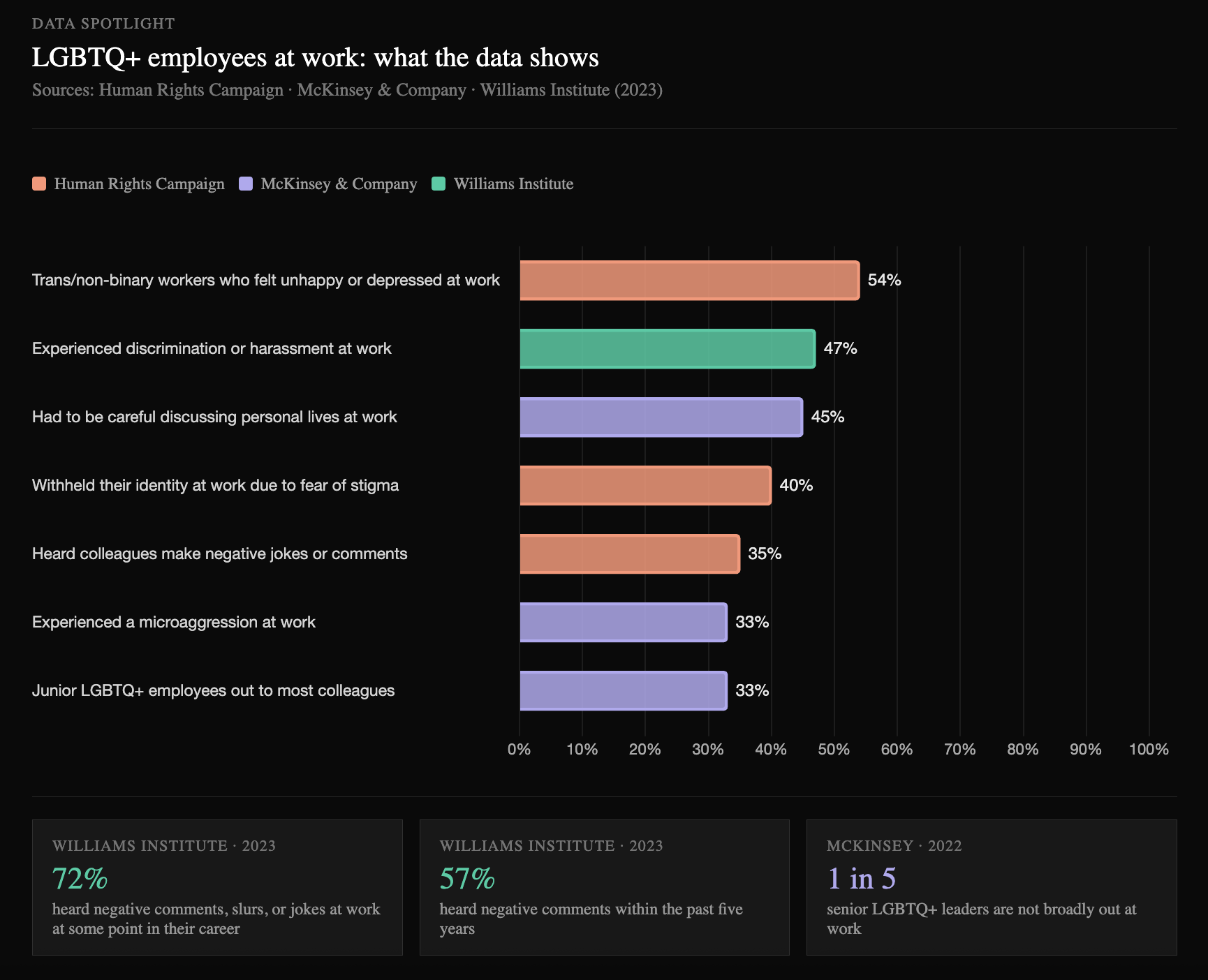
Selon le rapport Human Rights Campaign's Equality Rising , 40 % des travailleurs LGBTQ+ ont dissimulé leur identité au travail par peur de la stigmatisation ou de la discrimination. 35 % ont entendu des collègues faire des blagues ou des commentaires négatifs sur les personnes gays, lesbiennes ou transgenres. Et 54 % des travailleurs transgenres et non-binaires déclarent s'être sentis malheureux ou déprimés au travail.
Les recherches de McKinsey, qui ont analysé les données de plus de 60 000 employés interrogés, révèlent que 45 % des employés LGBTQ+ déclarent devoir faire attention lorsqu'ils parlent de leur vie privée au travail. Près d'un sur trois rapporte avoir été victime de microagressions, comme le fait d'être interrompu, de voir son jugement remis en question ou d'entendre des commentaires dénigrants sur son lieu de travail.
En ce qui concerne l'affirmation de son identité au travail, seul un tiers des employés LGBTQ+ occupant des postes subalternes déclarent être ouverts avec la plupart de leurs collègues. Même à des niveaux de direction, un dirigeant LGBTQ+ sur cinq affirme ne pas être ouvertement lui-même au travail.
Les conséquences ne sont pas seulement personnelles, elles sont aussi professionnelles. Une étude du Williams Institute, basée sur une enquête menée en 2023 auprès de près de 2 000 travailleurs LGBTQ+, révèle que près de la moitié d'entre eux (47 %) ont été victimes de discrimination ou de harcèlement au travail en raison de leur orientation sexuelle ou de leur identité de genre. Près des trois quarts rapportent avoir entendu des commentaires négatifs, des insultes ou des blagues sur les personnes LGBTQ+ au travail à un moment donné de leur vie, et plus de la moitié précisent que cela s'est produit au cours des cinq dernières années.
Un argument commercial bien réel
Au-delà de l'aspect humain, qui devrait suffire en soi, il existe un argument commercial évident en faveur de la création d'un environnement de travail où les employés LGBTQ+ se sentent réellement à l'aise.
Les recherches de Deloitte montrent que plus de 70 % des employés LGBTQ+ se disent plus enclins à rester chez leur employeur actuel en raison de son approche en matière d'inclusion LGBTQ+. Le soutien visible de la direction et l'existence de groupes de ressources pour les employés sont cités comme des facteurs clés permettant aux collaborateurs de se sentir soutenus.
La communauté LGBTQ+ représente un pouvoir d'achat estimé à 1 400 milliards de dollars rien qu'aux États-Unis, et près de 30 % des adultes de la génération Z s'identifient comme LGBTQ+. Il ne s'agit pas de chiffres abstraits ; ce sont les personnes qui postulent à vos offres d'emploi, achètent vos produits et choisissent les employeurs auxquels elles souhaitent accorder leur loyauté.
Non, il ne s'agit pas seulement d'une initiative pour le mois de juin. C'est un signal, un message que les employés perçoivent clairement et retiennent.
Qu'attendent réellement les employés LGBTQ+ de leur entreprise pendant le mois des fiertés ?
Voici une erreur que commettent la plupart des entreprises : elles conçoivent leur programme pour le mois des fiertés en fonction de ce qui est valorisant à l'extérieur, plutôt que de ce qui compte réellement à l'intérieur.
Lorsque l'on interroge directement les employés LGBTQ+, la réponse est assez constante. Ils ne veulent pas de produits aux couleurs de l'arc-en-ciel ou d'un e-mail du PDG utilisant douze fois le mot « célébrer ». Ils veulent sentir que l'entreprise sera toujours là pour eux, même un mardi ordinaire en octobre.
Plus précisément, les employés se soucient généralement de trois choses :
1. La constance, pas les campagnes. En s'appuyant sur les conclusions du rapport 2023 de Deloitte, les enquêtes montrent que la majorité des répondants LGBTQ+ estiment qu'il est important de pouvoir être soi-même au travail, mais que beaucoup ne se sentent pas à l'aise pour le faire. Ce qui a permis de dissiper ce malaise n'est pas un événement ponctuel, mais une constance dans le comportement de la direction et des collègues au fil du temps. Un webinaire durant le mois des fiertés ne changera pas ce que ressent une personne en entrant dans une réunion d'équipe en novembre.
2. Une réelle visibilité de la part de la direction. Lorsque les dirigeants partagent leurs propres points de vue, assistent aux événements au lieu de se contenter de les approuver et dénoncent les comportements inappropriés lorsqu'ils en sont témoins, les employés le remarquent. Deloitte a constaté que lorsque les employés estiment que leur employeur n'en fait pas assez pour soutenir l'inclusion des personnes LGBTQ+, beaucoup sont prêts à chercher ailleurs. Ce que l'on entend par « assez » est généralement moins une question de budget que d'engagement actif des dirigeants, plutôt qu'un simple soutien passif.
3. Tolérance zéro pour les petites choses. Les microagressions, les remarques désobligeantes, les moments « pour rire » : tout cela compte bien plus que la plupart des entreprises ne le pensent. McKinsey a révélé que près d'un tiers des employés LGBTQ+ ont déclaré avoir été victimes de microagressions au travail. Ceux qui les subissent ne tiennent pas un registre pour se plaindre plus tard. Ils réévaluent silencieusement leur sentiment d'appartenance à l'entreprise.
Rien de tout cela ne nécessite un gros budget ou une équipe dédiée. Cela demande de l'intention.
Comment célébrer le Mois des Fiertés au travail de manière authentique et non superficielle
C'est la question que nous entendons le plus souvent, et c'est la première à se poser.
La différence entre l'authentique et le superficiel ne réside pas vraiment dans l'activité elle-même, mais dans le lien entre cette activité et tout ce que l'entreprise fait par ailleurs. Une journée de bénévolat auprès d'une association LGBTQ+ semble authentique lorsqu'elle est soutenue par une entreprise qui garantit activement un traitement équitable à ses employés LGBTQ+. Cette même journée semble vide de sens si c'est la seule action menée par l'entreprise, alors que les employés LGBTQ+ continuent de faire face à des préjugés les 364 autres jours de l'année.
Cela dit, certains choix pratiques sont généralement mieux perçus que d'autres.
1. Commencez par des témoignages
Lorsque les employés entendent un collègue parler de son expérience, de ce qu'a représenté son coming out au travail, de l'importance des petits gestes de soutien ou de ce qui l'a poussé à rester, la conversation passe d'une sensibilisation abstraite à une réelle compréhension. C'est une différence majeure.

Il ne s'agit pas de mettre les employés LGBTQ+ sur le devant de la scène ou de rendre la participation obligatoire. Il s'agit de créer des opportunités via des sessions de témoignages, des portraits internes ou des tables rondes avec des personnes volontaires, où ceux qui souhaitent partager leur vécu peuvent le faire dignement, et où ceux qui ne le souhaitent pas peuvent simplement être présents dans l'audience.
Une remarque pratique : obtenez toujours un consentement explicite avant de partager l'histoire de quelqu'un, et précisez dès le départ que la participation est volontaire et n'entraîne aucune conséquence professionnelle, quelle qu'elle soit.
2. Transformez l'apprentissage en conversations, pas en cours magistraux
La plupart des entreprises s'arrêtent au webinaire. Quelqu'un parle, les gens écoutent d'une oreille distraite derrière leur écran, et une heure plus tard, tout le monde reprend son travail avec la même perspective qu'au départ.
Ce qui crée réellement le changement, c'est le dialogue. Des discussions en petits groupes après une session. Des échanges d'équipe animés par les managers où la question n'est pas « qu'avons-nous appris ? » mais « qu'est-ce que cela signifie pour notre façon de travailler ensemble ? ». Des formats de questions-réponses ouverts où les gens peuvent poser les questions qu'ils n'oseraient jamais soulever lors d'une réunion générale.
L'objectif n'est pas de faire de chacun un expert. C'est d'amener les gens à se parler au-delà des clivages habituels, là où une véritable compréhension peut émerger.
3. Rendez la participation de la direction spécifique et visible
Il existe une différence majeure entre un dirigeant qui valide le budget du Mois des fiertés et celui qui participe aux événements, s'exprime en son nom propre et dénonce publiquement les comportements qu'il ne tolérera pas.
Les employés sont très attentifs à l'écart entre les paroles et les actes de leurs dirigeants. Les déclarations de soutien générales ne suffisent pas à combler ce fossé. Ce sont les engagements concrets — voici ce que nous changeons cette année, voici ce que nous n'accepterons pas au sein de nos équipes — qui façonnent réellement la culture d'entreprise.
Encouragez vos hauts dirigeants à participer aux événements, plutôt que de se contenter de les parrainer. Mieux encore, invitez les leaders LGBTQ+ à partager leur expérience, s'ils se sentent à l'aise pour le faire, car ce type de visibilité envoie un signal irremplaçable.
4. Soutenez les organisations qui agissent concrètement sur le terrain
L'une des démarches les plus crédibles qu'une entreprise puisse entreprendre durant le Mois des fiertés consiste à allouer des ressources à des organisations qui œuvrent déjà pour la communauté LGBTQ+, qu'il s'agisse de bénévolat collectif, de campagnes d'abondement aux dons ou de partenariats avec des associations sur des projets basés sur les compétences.
Cela produit deux effets : les employés peuvent s'impliquer dans des actions à impact réel plutôt que de se limiter à des programmes internes, et l'entreprise se forge une réputation qui dépasse le simple cadre de l'image. Les partenariats crédibles demandent du temps, ce qui distingue les entreprises réellement engagées de celles qui se contentent de signer un chèque en juin avant de passer à autre chose.
À LIRE AUSSI :
Comment planifier une campagne pour le Mois des fiertés au travail qui va au-delà des logos arc-en-ciel et des événements ponctuels
Aborder le Mois des fiertés comme une campagne plutôt que comme une série d'activités isolées est l'une des meilleures décisions que vous puissiez prendre. Une campagne possède un thème, un récit et une progression. Elle crée une dynamique au lieu d'un pic d'activité dont personne ne parle dès la troisième semaine.
Voici une structure efficace :
Semaine 1 : Poser le contexte
Commencez par une initiative qui explique le « pourquoi ». Une session de lancement basée sur des données, un message de la direction personnel plutôt qu'institutionnel, ou une mise en lumière des engagements de l'entreprise. Cela donne le ton.
Semaine 2 : Créer du lien
C'est le moment idéal pour le partage d'histoires et les échanges entre pairs. Panels d'employés, discussions d'équipe et rencontres interservices permettent aux collaborateurs de se connecter au-delà des silos habituels.
Semaine 3 : Agir ensemble
Opportunités de bénévolat, collectes de fonds, partage de compétences avec des organisations locales. Les activités orientées vers l'action permettent aux employés de mettre en pratique ce qu'ils ont appris et génèrent généralement le plus fort engagement.
Semaine 4 : S'engager pour la suite
Terminez par une perspective d'avenir. Qu'est-ce qui change ? Qu'est-ce qui perdure ? À quoi l'entreprise s'engage-t-elle après le mois de juin ? Cela évite l'arrêt brutal qui donne l'impression que tous les efforts précédents n'étaient que de la communication.
Assurez une cohérence dans votre communication. Utilisez un thème fédérateur, un parcours de participation visible et un moyen de valoriser les personnes et les équipes qui se sont mobilisées.
Les meilleures activités pour le Mois des Fiertés, des petites entreprises aux grandes organisations
L'une des questions qui revient le plus souvent est : « Nous voulons faire quelque chose de significatif, mais nous ne sommes pas une entreprise de 5 000 personnes avec une équipe événementielle dédiée. Qu'est-ce qui fonctionne vraiment pour nous ? »
La réponse honnête est que l'intention compte bien plus que l'échelle. Voici ce qui fonctionne généralement, quelle que soit la taille de l'entreprise.
Célébrations du Mois des Fiertés pour les grandes équipes ou les équipes réparties
Le défi des grandes organisations ne réside pas dans le manque d'idées, mais dans la difficulté de proposer des initiatives qui ne semblent pas conçues pour quelqu'un d'autre. Les équipes internationales sont particulièrement concernées, car ce qui résonne à New York peut être perçu très différemment dans un autre pays ou contexte culturel.
Quelques idées qui fonctionnent bien à grande échelle :
- Sessions en direct et enregistrées. Tout le monde ne peut pas être présent en même temps, surtout avec les décalages horaires. Enregistrer et diffuser le contenu (avec des résumés des questions-réponses) permet à davantage de personnes de participer.
- Conversations au sein des équipes en complément des événements à l'échelle de l'entreprise. Une simple table ronde réunissant tout le personnel ne suscitera probablement pas le même type d'échange qu'une discussion en petit groupe. Les deux formats ont des objectifs différents.
- Parcours de participation partagés. Une campagne de dons à l'échelle de l'entreprise, une initiative de partage d'histoires, un défi où les équipes documentent leur participation : autant d'éléments qui relient les équipes réparties autour d'une expérience commune, même lorsqu'elles ne peuvent pas être dans la même pièce.
- Programmation localisée lorsque c'est pertinent. Particulièrement important dans les organisations mondiales : collaborez avec les équipes régionales pour comprendre ce qui résonne et ce qui ne fonctionne pas dans leur contexte, plutôt que de supposer qu'une approche unique convient à tous.
Célébrations du Mois des Fiertés pour les petites entreprises et les startups
Lorsque le budget et le temps sont limités, la qualité et la pertinence l'emportent toujours sur la quantité. Une seule conversation bien menée sera plus efficace que cinq événements qui n'enthousiasment personne.
Quelques idées faciles à adapter à plus petite échelle :
- Une conversation d'équipe en toute franchise. Pas un webinaire, mais une vraie discussion avec votre équipe, animée avec soin, qui offre à chacun un espace pour partager et écouter.
- Établissez un partenariat avec une organisation LGBTQ+ locale. Faites du bénévolat en équipe. Collectez des fonds pour une cause ayant un lien direct avec votre communauté. Les petites entreprises nouent souvent des partenariats plus authentiques que les grandes, car les relations y sont personnelles plutôt qu'institutionnelles.
À lire aussi : 19 associations LGBTQ à soutenir en 2026 - Rendez vos politiques visibles. Examinez et mettez à jour vos politiques de non-discrimination, vos avantages sociaux et vos processus RH. Publiez-les clairement. Cela ne coûte presque rien et en dit bien plus long qu'un déjeuner offert.
- Invitez un intervenant. Faites venir une personne de la communauté LGBTQ+ locale, un militant, un entrepreneur ou un éducateur pour partager son expérience. Privilégiez l'échange informel plutôt que la mise en scène.
À lire aussi : Activités pour le Mois des Fiertés : des façons significatives pour les équipes de célébrer
Comment célébrer le Mois des Fiertés au travail avec des équipes à distance ou hybrides
Les équipes à distance et hybrides nécessitent une approche plus intentionnelle. Pas moins d'activités, mais des activités différentes. Le défi est que les formats qui fonctionnent le mieux au bureau (conversations spontanées dans les couloirs, déjeuners d'équipe, événements en direct) ne se transposent pas directement dans une notification Slack ou un appel Zoom de 60 minutes.
Ce qui fonctionne généralement bien pour les équipes distribuées :
- Les événements virtuels interactifs plutôt que passifs. Une table ronde avec des questions-réponses en direct, où les participants peuvent réellement orienter la conversation, fonctionne bien mieux qu'un webinaire enregistré suivi d'un formulaire de feedback. L'objectif est la participation, pas la consommation.
- Le bénévolat en ligne avec de vrais enjeux. Le bénévolat basé sur les compétences pour des associations LGBTQ+ (travail pro bono, création de contenu, mentorat) permet aux employés à distance de s'impliquer concrètement au-delà de leurs écrans.
- Les campagnes de narration numérique avec la voix des employés. Une campagne interne où les employés, quelle que soit leur identité, partagent ce qu'un environnement de travail inclusif signifie pour eux, permet de créer du lien, même à travers les fuseaux horaires. Veillez à ce que la participation soit entièrement volontaire et rendez les résultats visibles à l'échelle de toute l'entreprise.
- Les petits rassemblements virtuels plutôt que les grandes réunions générales. Une conversation bien animée de 20 personnes crée davantage de liens qu'un webinaire de 500 personnes. Si votre entreprise est grande, organisez plusieurs sessions plus restreintes.
Ce qu'il faut éviter à tout prix : les longues sessions descendantes où l'on attend des participants qu'ils écoutent sans aucun mécanisme d'interaction. Ce sont ces événements qui suscitent des retours du type « c'était bien », une manière polie de dire qu'ils n'ont eu aucun impact.
Comment rendre les célébrations du Mois des fiertés inclusives pour les alliés qui ne font pas partie de la communauté
C'est une question importante, et elle n'est pas assez souvent posée.
Les employés qui se considèrent comme des alliés, qui sont sincèrement engagés et souhaitent bien faire, mais qui ne s'identifient pas eux-mêmes comme LGBTQ+, peuvent parfois douter de leur rôle durant le Mois des fiertés. Si le programme est conçu uniquement pour les employés LGBTQ+, les alliés finissent par être des observateurs passifs plutôt que des participants actifs. C'est une occasion manquée.
Les programmes du Mois des fiertés les plus efficaces sont conçus pour que chacun ait un rôle à jouer :
- Rendre l'apprentissage réellement accessible. Des sessions qui répondent à de vraies questions, y compris celles qui peuvent paraître gênantes ou basiques. Offrez un point de départ à ceux qui ne savent pas par où commencer. Certaines des conversations les plus marquantes que nous avons observées en entreprise naissent lorsqu'un employé non-LGBTQ+ pose une question qu'il n'osait pas formuler, et que quelqu'un prend le temps d'y répondre avec bienveillance.
- Donner aux alliés des actions concrètes à mener. Utiliser systématiquement le prénom et les pronoms privilégiés de chacun. Intervenir lorsque vous entendez un commentaire dégradant. Demander à vos collègues LGBTQ+ comment ils souhaitent être soutenus plutôt que de supposer que vous le savez. Ce sont des comportements que chacun peut pratiquer, et c'est ce qui fait évoluer la culture d'entreprise.
- Concevoir des conversations mixtes, pas seulement des espaces réservés aux personnes LGBTQ+. Certains événements doivent être centrés sur les personnes LGBTQ+ pour offrir à la communauté un espace où se retrouver et être entendue. Mais d'autres doivent être délibérément mixtes, afin que les alliés puissent apprendre en même temps que les autres, plutôt que d'attendre un compte-rendu. Ces deux formats répondent à des besoins différents.
- Reconnaître les contributions des alliés. Lorsque les employés non-LGBTQ+ s'impliquent régulièrement, pas seulement durant le Mois des fiertés mais tout au long de l'année, reconnaissez-le. Une reconnaissance visible renforce l'idée que c'est la responsabilité de tous, et non celle des seuls employés LGBTQ+.
Les erreurs courantes des entreprises lors de la célébration du Mois des fiertés (et comment les éviter)
Nous allons être directs, car cette section est plus utile lorsqu'elle est précise.
Erreur n° 1 : En faire beaucoup en juin et rien les onze autres mois de l'année. C'est l'erreur la plus fréquente, et les employés LGBTQ+ la remarquent immédiatement. Même lorsque les organisations prennent des mesures visibles, les employés ne ressentent pas toujours cette même inclusion au quotidien. Ce fossé entre ce qui est communiqué et ce qui est réellement vécu est le point de départ du désengagement. Si le seul signe d'engagement apparaît en juin, les gens en tirent naturellement leurs propres conclusions.
Erreur n° 2 : Mettre la marque au centre plutôt que les employés. Il existe une approche du Mois des Fiertés qui se concentre principalement sur la visibilité externe : le logo arc-en-ciel, les publications sur les réseaux sociaux, le communiqué de presse. Les employés savent très bien quand une initiative s'adresse au marché plutôt qu'à eux. Les programmes conçus pour avoir un impact en interne diffèrent considérablement de ceux pensés pour l'image de marque.
Erreur n° 3 : Faire porter la charge aux employés LGBTQ+. Si votre programmation du Mois des Fiertés repose sur les employés LGBTQ+ pour la planification, l'animation et la sensibilisation, vous alourdissez un fardeau déjà inégal. Les alliés, y compris les cadres dirigeants, doivent prendre une part significative de ce travail.
Erreur n° 4 : Négliger le suivi. Les événements sans suivi sont oubliés en une semaine. Quels que soient les engagements pris durant le Mois des Fiertés — mises à jour de politiques, annonces de partenariats, accords d'équipe — vous devez les suivre, en rendre compte et responsabiliser les acteurs concernés. C'est ce suivi qui transforme un mois de célébration en un message durable.
Erreur n° 5 : Croire qu'un format unique convient à tout le monde. Les recherches de McKinsey montrent que la génération Z et les jeunes milléniaux attendent davantage de leurs employeurs en matière d'inclusion que les générations précédentes, mais que les employés débutants sont aussi moins enclins à révéler leur orientation sexuelle au travail que les cadres supérieurs. Cela suggère qu'ils estiment avoir davantage à perdre sur le plan professionnel. Ce qui convient à un cadre dirigeant peut ne pas sembler sûr pour un employé débutant qui n'a pas fait son coming out auprès de son équipe. Concevez des programmes avec des formats et des points d'entrée variés.
Comment maintenir l'élan des célébrations du Mois des Fiertés après juin
C'est là que la plupart d'entre nous échouent, et honnêtement, c'est la section la plus importante de tout ce guide.
L'objectif d'un bon Mois des Fiertés n'est pas de réussir le mois de juin. C'est d'opérer un changement permanent dans le fonctionnement de l'entreprise : instaurer un socle de respect et de visibilité qui n'a pas besoin d'un rappel dans l'agenda.
Voici comment y parvenir :
- Maintenez les programmes de bénévolat tout au long de l'année. Si votre équipe a passé du temps avec une association LGBTQ+ en juin, il n'y a aucune raison pour que cette relation s'arrête le 1er juillet. Les partenariats durables, les journées de bénévolat récurrentes et les campagnes de dons annuelles permettent de construire quelque chose de solide.
- Mesurez ce qui compte vraiment. Suivez les taux de participation aux événements. Interrogez les employés LGBTQ+ sur leur expérience au travail, et pas seulement pendant le Mois des Fiertés, puis utilisez ces données pour prendre des décisions. Si vous avez pris des engagements publics, rendez-en compte.
- Intégrez l'apprentissage dans les programmes réguliers. Ne réservez pas le contenu lié aux questions LGBTQ+ au seul mois de juin. Intégrez-le à l'intégration des nouveaux arrivants, à la formation des managers et aux discussions régulières sur le travail d'équipe. Lorsque le sujet est traité tout au long de l'année, il devient une composante de la culture d'entreprise plutôt qu'une performance annuelle.
- Désignez des responsables permanents. Les programmes du Mois des Fiertés ont tendance à s'essouffler après juin, faute de responsable en juillet. Qu'il s'agisse d'un groupe de ressources pour les employés, d'un comité de pilotage ou d'une personne dédiée au sein de l'équipe RH, quelqu'un doit porter le projet. Sans cela, les meilleures intentions seront toujours balayées par d'autres priorités.
Créez des boucles de rétroaction. Demandez aux employés LGBTQ+ ce qui fonctionne et ce qui ne fonctionne pas, non seulement via des sondages anonymes, mais aussi lors de conversations. Agissez en fonction de leurs retours. Le signe qu'une relation de confiance s'installe, c'est quand les employés constatent que leurs commentaires font réellement bouger les choses.
Frequently Asked Questions
1. Comment les entreprises peuvent-elles célébrer le Mois des Fiertés au travail de manière authentique et non superficielle ?
La version la plus courante de cette question revient en fait à demander : comment éviter de donner l'impression que nous le faisons uniquement pour l'image ?
La réponse est que l'authenticité ne dépend pas de ce que vous faites, mais de la cohérence avec le reste de vos actions. Une entreprise qui applique des politiques équitables toute l'année, où les employés LGBTQ+ se sentent réellement à l'aise, peut organiser un événement simple pour le Mois des Fiertés et paraître sincère. Une entreprise qui change son logo et envoie un e-mail sans rien faire d'autre sera perçue comme superficielle par ses propres employés, peu importe ses déclarations publiques.
Concrètement : commencez par auditer ce qui se passe les onze autres mois de l'année. Vos politiques de non-discrimination sont-elles à jour et visibles ? Les employés LGBTQ+ se sentent-ils en sécurité pour révéler leur orientation ou identité à leurs managers ? Les microagressions sont-elles traitées lorsqu'elles surviennent ? Si la réponse à l'une de ces questions est "pas vraiment", c'est là que le travail doit commencer. Les programmes du Mois des Fiertés menés parallèlement à ces améliorations seront perçus très différemment de ceux menés sans elles.
Ensuite, privilégiez le fond à la forme. Les témoignages réels des employés ont plus de poids que les visuels de marque. Une discussion en petit groupe qui génère un dialogue authentique vaut mieux qu'un webinaire léché. Le bénévolat auprès d'une organisation crédible en dit plus long qu'un communiqué de presse.
Enfin, tenez vos engagements. Selon une étude de Deloitte, quatre employés LGBTQ+ sur dix ayant subi un comportement non inclusif au travail ne l'ont pas signalé, pensant que leur plainte ne serait pas prise au sérieux. C'est un problème de culture, pas de programmation. Si vos employés croient que les engagements sont tenus et que l'entreprise fait ce qu'elle dit, alors la confiance devient le socle sur lequel tout le reste repose.
2. Quels sont les moyens efficaces d'impliquer les équipes distantes et hybrides pendant le Mois des Fiertés ?
L'engagement à distance fonctionne lorsqu'il est interactif et qu'il crée de véritables moments de connexion, et non lorsqu'il se contente de reproduire des programmes en présentiel sur un écran.
Les formats qui fonctionnent systématiquement pour les équipes distribuées sont : les panels virtuels avec questions-réponses en direct où les participants mènent la discussion ; les discussions en petits groupes après une session plénière ; les campagnes numériques auxquelles les employés peuvent participer à leur propre rythme ; et le bénévolat en ligne, axé sur les compétences auprès d'organisations LGBTQ+, qui permet aux gens d'apporter une contribution concrète.
Ce qui ne fonctionne pas : les sessions passives trop longues, les diffusions à sens unique, les événements sans suivi et les programmes manifestement conçus pour un bureau physique et mal adaptés pour les autres.
Une note pratique pour les entreprises hybrides : résistez à la tentation de proposer du "présentiel + livestream" comme s'il s'agissait d'expériences équivalentes. Les participants à distance ont besoin de leur propre niveau d'engagement, de sondages interactifs, de salles de réunion virtuelles et de canaux de discussion dédiés, et non simplement d'une caméra braquée sur une salle de conférence.
3. Pourquoi est-il important pour les entreprises de célébrer le Mois des Fiertés, et quel impact cela a-t-il sur les employés ?
Distinguons deux choses : l'importance pour les employés individuellement et l'importance pour l'entreprise.
Pour les employés, le lieu de travail est souvent l'un des derniers espaces où les personnes osent faire leur coming out, si elles le font un jour. Le rapport Equality Rising de la HRC a révélé que 40 % des travailleurs LGBTQ+ ont activement dissimulé leur identité au travail par peur de la stigmatisation ou de la violence. Ce n'est pas une abstraction, c'est un nombre important de personnes qui gèrent au travail une version d'elles-mêmes différente de qui elles sont réellement. Cela demande de l'énergie. Cela affecte l'engagement. Cela influence l'investissement de chacun dans son travail et son équipe.
Lorsqu'une entreprise célèbre le Mois des Fiertés avec un engagement réel et visible, cela change la donne. Pas du jour au lendemain, mais sincèrement. Les employés réévaluent si cet endroit est réellement sûr pour eux, ce qui impacte tout : de la rétention à la productivité, en passant par la prise de parole en réunion.
Pour les entreprises, les enjeux sont de plus en plus concrets. Les recherches de Deloitte montrent qu'un employé LGBTQ+ sur trois recherche activement un employeur plus inclusif, et près de 70 % citent la diversité comme critère principal lors de l'évaluation d'un nouveau poste. Avec près de 30 % des adultes de la génération Z s'identifiant comme LGBTQ+ et une communauté détenant 1 400 milliards de dollars de pouvoir d'achat, l'argument commercial est évident.
4. Quelles sont les idées simples pour célébrer le Mois des fiertés au travail sans gros budget ?
Certaines des actions les plus marquantes qu'une entreprise puisse entreprendre durant le Mois des fiertés coûtent très peu :
Organisez une vraie conversation. Pas un webinaire, mais une discussion animée en petit groupe où chacun peut poser des questions sincères et partager des expériences réelles. Une heure suffit. Si c'est bien fait, l'impact est durable.
Mettez en avant la parole des employés. Créez une campagne interne simple, un canal Slack, une rubrique dans la newsletter ou une page intranet où les collaborateurs peuvent exprimer ce qu'un environnement de travail inclusif signifie pour eux. C'est volontaire, sans pression, et souvent très touchant.
Collaborez avec une association locale. Identifiez une organisation LGBTQ+ dans votre région. Faites du bénévolat en équipe ou organisez une petite collecte de fonds. La relation compte plus que le résultat, surtout s'il s'agit du début d'un partenariat durable.
Passez vos politiques en revue. Examinez vos politiques de non-discrimination, vos avantages sociaux et vos processus RH. Mettez à jour ce qui doit l'être. Rendez-les visibles. Cela demande du temps, pas de l'argent, et c'est un signal bien plus fort qu'un déjeuner traiteur.
Impliquez la direction de manière personnelle. Un message authentique d'un dirigeant — pas un texte corporate, pas un script, mais quelque chose de sincèrement personnel — a souvent plus d'impact qu'une semaine d'événements. Encouragez les cadres dirigeants à partager ce que cette cause représente pour eux, avec leurs propres mots.
5. Comment les entreprises peuvent-elles rendre les célébrations du Mois des fiertés inclusives pour les alliés ?
Les alliés finissent souvent par être des spectateurs passifs lors des événements du Mois des fiertés : présents, mais sans rôle clair. C'est un problème de conception, pas un problème de personnes.
La solution consiste à créer des parcours de participation spécifiquement destinés aux personnes non LGBTQ+ qui souhaitent s'impliquer concrètement. Non pas en tant qu'observateurs, mais en tant que contributeurs actifs.
Donnez-leur des comportements précis à adopter. « Être un allié » est trop vague pour agir. « Utiliser systématiquement les pronoms corrects », « intervenir la prochaine fois que vous entendez un commentaire dégradant », « demander à vos collègues LGBTQ+ comment les soutenir » : voilà des choses que les gens peuvent faire dès demain.
Proposez des formats d'apprentissage adaptés au niveau de chacun. Tout le monde ne connaît pas le vocabulaire ou l'histoire. Des sessions qui accueillent les questions sincères, sans jugement, offrent aux alliés un point de départ. L'objectif n'est pas de faire de chacun un expert, mais de réduire l'écart entre l'intention et l'impact.
Deloitte a constaté que le soutien visible des alliés était l'un des facteurs les plus souvent cités par les employés LGBTQ+ pour décrire ce qui rendait leur lieu de travail réellement bienveillant. Cette visibilité ne vient pas d'une présence passive à un événement en juin, mais de collègues et de managers qui le démontrent au quotidien. Dans l'idéal, le Mois des fiertés sert à apprendre comment faire.
6. Comment faire durer le Mois des fiertés au-delà de juin en entreprise ?
C'est finalement la bonne question, car la valeur du Mois des fiertés ne réside pas dans le mois de juin en soi. Elle réside dans ce qu'il sème pour le reste de l'année.
Les étapes pratiques les plus simples :
Maintenez vos activités de bénévolat et vos partenariats associatifs après la fin du mois de juin. Les liens tissés lors d'une journée de volontariat ont une valeur qui dépasse le calendrier.
Intégrez les sujets LGBTQ+ dans vos programmes habituels, l'intégration des nouveaux arrivants, la formation des managers et le team-building, afin qu'ils ne soient pas isolés sur un seul mois. Lorsque ces conversations font partie du fonctionnement quotidien de l'entreprise, elles deviennent une culture plutôt qu'une simple campagne.
Créez des mécanismes de feedback continus. Interrogez régulièrement les employés LGBTQ+, organisez des sessions d'écoute et, surtout, utilisez ces retours pour apporter de vrais changements. Lorsque les employés voient que leurs avis sont pris en compte, la confiance se renforce avec le temps.
Désignez un responsable pour porter ces sujets après juin. Sans redevabilité, même les meilleurs programmes s'effondrent lorsque les priorités du troisième trimestre prennent le dessus. Qu'il s'agisse d'un groupe de ressources pour les employés, d'un comité de pilotage ou d'une personne dédiée au sein de l'équipe RH, quelqu'un doit assurer la continuité.
Et assurez un suivi public de vos engagements. Si le Mois des Fiertés donne lieu à des engagements précis, des changements de politique, des annonces de partenariats ou des objectifs de représentation, rendez-les visibles et communiquez sur leur avancement. C'est la concrétisation qui transforme un moment éphémère en un message durable.
7. Qu'est-ce que le rainbow-washing et comment les entreprises peuvent-elles l'éviter pendant le Mois des fiertés ?
Le rainbow-washing désigne les démonstrations superficielles de soutien LGBTQ+, comme un changement temporaire de logo, sans politique ni engagement durable pour les accompagner. Les entreprises l'évitent en associant leur communication externe à des actions concrètes : couverture santé inclusive, prestations pour les personnes transgenres, politiques anti-discrimination et responsabilité des dirigeants. Le Corporate Equality Index de HRC offre un référentiel utile.
8. Comment les groupes d'affinité peuvent-ils piloter la programmation du Mois des fiertés au travail ?
Les groupes d'affinité LGBTQ+ structurent le Mois des fiertés en co-concevant les événements avec des sponsors exécutifs, en organisant des tables rondes et en conseillant les RH sur les politiques inclusives. Ils collaborent avec les alliés pour proposer des ateliers pédagogiques, des espaces de récit et du bénévolat communautaire. Un budget dédié, du temps protégé et une représentation au sommet renforcent leur impact.
9. Quels exemples de partenariats associatifs les entreprises peuvent-elles bâtir pendant le Mois des fiertés ?
Les entreprises s'associent à des organisations comme The Trevor Project, PFLAG et la Human Rights Campaign pour financer l'aide en situation de crise, l'éducation des familles et la recherche sur l'égalité au travail. Les centres LGBTQ+ locaux, GLSEN et Lambda Legal offrent d'autres possibilités de bénévolat, de dons abondés ou de plaidoyer. Les partenariats pluriannuels prolongent l'engagement au-delà de juin.
10. Comment mesurer l'impact des initiatives du Mois des fiertés en entreprise ?
La mesure combine données de participation, ressenti et indicateurs de politique interne. Suivez la fréquentation des événements, la croissance des groupes d'affinité, les heures de bénévolat et les dons collectés. Complétez avec des sondages sur le sentiment d'appartenance des salariés LGBTQ+, les taux de rétention et des scores comme le Corporate Equality Index de HRC. L'évolution des signalements révèle un changement structurel.