Estado de la alfabetización en IA: comprendiendo el alcance de la implementación de la IA en el sector de impacto social

¿Te identificas con esta sensación: hay mucho por hacer, pocas manos y la preocupación silenciosa de que el mundo avanza más rápido de lo que puedes seguir? Se supone que la inteligencia artificial ayuda precisamente con eso. Entonces, ¿por qué sigue pareciendo inalcanzable para la mayoría de los equipos orientados a una misión?
Para comprender el estado real de la alfabetización en IA en el impacto social, Goodera encuestó a más de 1.000 organizaciones sin fines de lucro de los sectores de educación, salud, medio ambiente, desarrollo comunitario, igualdad de género y ayuda humanitaria, en más de 30 países. El panorama resultante es honesto y un poco sorprendente. El sector tiene curiosidad, esperanza y está listo. Simplemente aún no cuenta con las herramientas necesarias. Esto es lo que nos dicen los datos.
¿Qué es la alfabetización en IA en el impacto social?
La alfabetización en IA en el impacto social es la capacidad de los equipos de las organizaciones sin fines de lucro, y de las comunidades a las que sirven, para comprender y utilizar herramientas de IA de forma segura, confiable y con un valor real para su misión. No necesitas aprender a programar para aprovechar la IA. Se trata más bien de saber qué puede hacer la IA, dónde ayuda y cómo utilizarla de manera responsable. Piénsalo como la diferencia entre haber oído hablar de la IA y ponerla realmente a trabajar.
Esa distinción es importante porque la mayoría de las organizaciones sin fines de lucro se encuentran claramente en el primer grupo. Saben que la IA existe. Pero están mucho menos seguras de cómo hacerla útil.
¿Cuál es la situación real de las organizaciones sin fines de lucro respecto a la IA en este momento?
La respuesta corta: grandes esperanzas, baja adopción. El interés en la IA es casi universal, pero muy pocas organizaciones han pasado de la curiosidad al uso constante. La encuesta reveló un sector en un punto de inflexión, deseoso de actuar pero esperando un impulso.
Aquí está el resumen en cifras:
- El 71% de las organizaciones sin fines de lucro quiere utilizar la IA para gestionar sus operaciones de manera más eficiente
- Solo el 25% utiliza activamente herramientas de IA hoy en día
- El 54% se encuentra en una etapa exploratoria, probando herramientas o planificando hacerlo
- 19 % están interesados pero aún no han comenzado
- Solo un 2 % no muestra ningún interés
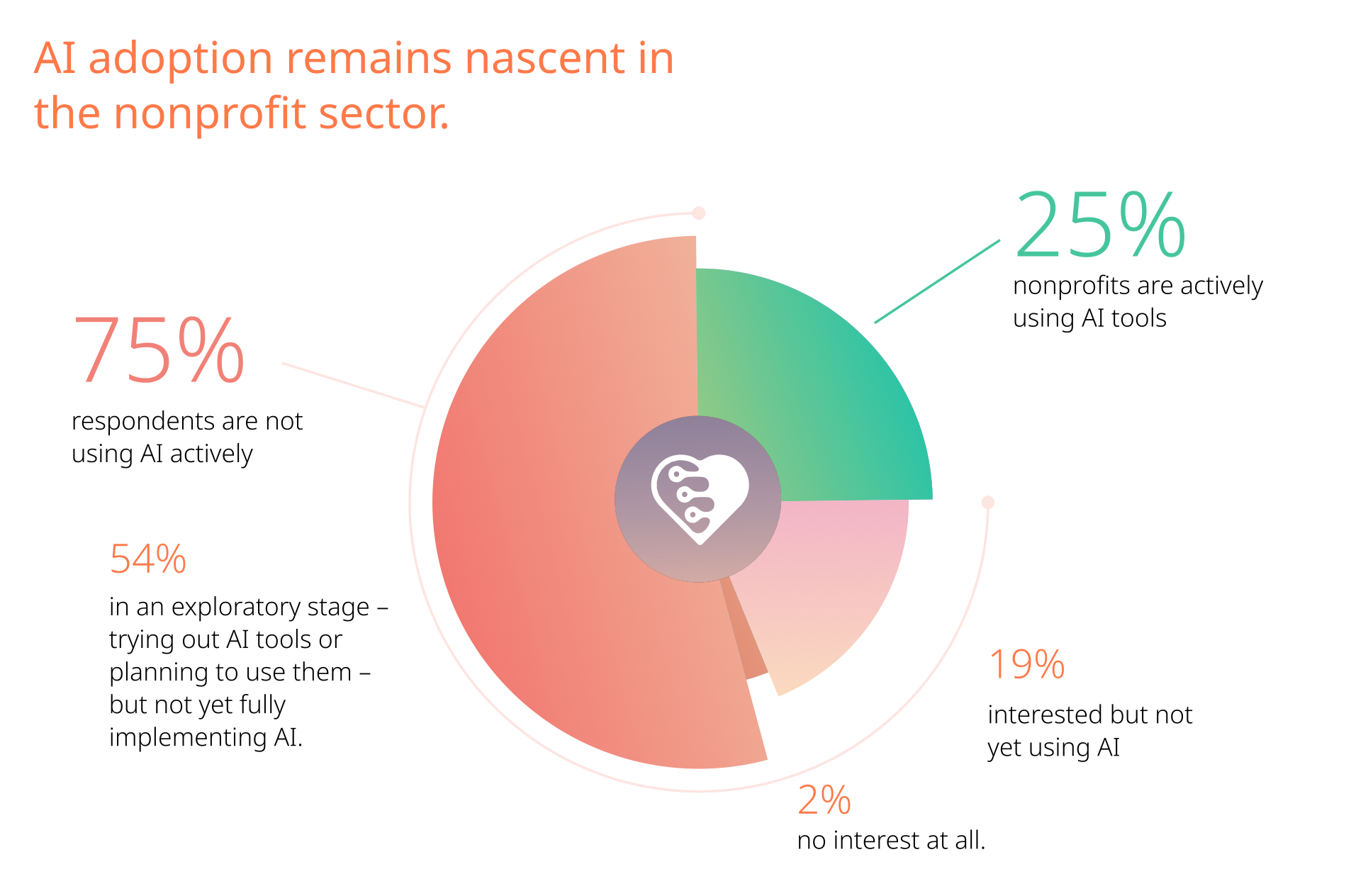
Fuente de la imagen: El estado de la alfabetización en IA en el impacto social 2025
Vuelva a leer ese último dato. Casi todas las organizaciones encuestadas están utilizando, probando o, al menos, interesadas en la IA. La resistencia total es poco común. Este no es un sector que se esté quedando atrás. Es un sector que está en la puerta, esperando a que alguien le invite a pasar.
Esa brecha entre querer y hacer es el tema principal de los datos y se refleja en todo lo demás.
¿Para qué quieren usar más la IA las organizaciones sin fines de lucro?
Cuando se les preguntó dónde podría marcar la IA la mayor diferencia en el día a día, las organizaciones sin fines de lucro señalaron cinco tareas prácticas. Ninguna de ellas es futurista. Son las tareas poco glamurosas que consumen silenciosamente la semana de un equipo pequeño.
1. Comunicación y narración de historias
Esta fue la opción favorita con diferencia, mencionada por alrededor del 80 % de los encuestados. La mayoría de las organizaciones sin fines de lucro no cuentan con un equipo de comunicación, por lo que redactar boletines, publicaciones en redes sociales, propuestas de subvenciones e historias de impacto recae en quien tenga una hora libre.
La IA puede ayudar a redactar todo esto. Como dijo un encuestado, la IA podría ayudarles a "parecer una organización más grande".
Una mejor narración de historias ayuda a resaltar su impacto, impulsar el sentimiento hacia las causas que apoyan y abrir puertas a una recaudación de fondos adecuada, lo que convierte a este en un punto de partida inteligente.
2. Medición de impacto e informes
Casi la mitad de los encuestados señaló la elaboración de informes como un caso de uso principal. Los informes para donantes y los documentos de evaluación pueden consumir semanas de trabajo del personal. La IA puede acelerar la visualización de datos, la redacción de informes y el análisis de resultados, convirtiendo una tarea temida en algo más parecido a un activo estratégico.
Un encuestado resumió el problema claramente: "Los informes llevan semanas. La IA podría reducir eso drásticamente".
3. Recaudación de fondos y compromiso de los donantes
Los equipos ven un gran potencial en el uso de la IA para encontrar y retener donantes: una segmentación más inteligente, solicitudes personalizadas, investigación de prospectos y notas de agradecimiento automatizadas. Para un equipo de recaudación de fondos de dos personas, este tipo de ayuda puede marcar una diferencia enorme.
4. Gestión y análisis de datos
Muchas organizaciones sin fines de lucro tienen datos que nunca tienen tiempo de utilizar. La IA puede limpiar bases de datos, extraer patrones de los resultados de encuestas y revelar información que de otro modo permanecería oculta. Un encuestado resumió la frustración: "Tenemos datos, pero no tenemos tiempo para analizarlos".
Descarga el informe para acceder al análisis completo:
5. Contenido de formación y educativo
Desde la incorporación del personal y las guías para voluntarios hasta los materiales de aprendizaje para la comunidad, la creación de contenido es costosa y lenta. La IA puede redactar una primera versión de un manual de formación o un plan de estudios para jóvenes que el personal luego perfecciona, ayudando a los equipos pequeños a llegar a más personas sin disparar los costos.
El denominador común: no se trata de proyectos inalcanzables. Son puntos de dolor cotidianos, y la IA está siendo recibida como un compañero de equipo práctico en lugar de un experimento llamativo.
¿Por qué la adopción de la IA en las organizaciones sin fines de lucro sigue siendo tan baja?
Si el interés es tan alto, ¿por qué solo una cuarta parte de las organizaciones utiliza realmente la IA? La respuesta honesta es que el entusiasmo aún no se ha traducido en apoyo. La encuesta reveló cinco brechas claras que se interponen entre la intención y la acción.
- La brecha entre la conciencia y la acción. La mayoría sabe que la IA puede ayudar, pero saber no se ha convertido en hacer. Muchos equipos están atrapados en un "modo de exploración" permanente.
- La brecha de implementación. La falta de puntos de partida claros y la escasa experiencia práctica dejan a las organizaciones sin saber cuál es el primer paso. Casi la mitad informa que no cuenta con las habilidades adecuadas internamente.
- La brecha de alfabetización comunitaria. La mayoría de las organizaciones sin fines de lucro quieren llevar la alfabetización en IA a las personas a las que sirven, pero menos de una cuarta parte ejecuta programas que lo hagan.
- La brecha de apoyo al aprendizaje. Los seminarios web aislados no son suficientes. El 86% de las organizaciones sin fines de lucro desea recibir formación, pero la mayoría carece de acceso a ayuda guiada y práctica.
- La brecha de herramientas. Más allá de las habilidades, muchos simplemente no tienen acceso a las herramientas avanzadas necesarias para ir más allá de la generación básica de contenido.
Descargue el informe para acceder al análisis completo:
Este patrón no es exclusivo de la encuesta de Goodera. Un estudio independiente de Nonprofit Tech for Good reveló que el 60% de las organizaciones sin fines de lucro afirma carecer de la experiencia interna necesaria incluso para evaluar herramientas de IA, y solo el 4% tiene un presupuesto destinado a la formación en IA.
Y en la investigación de TechSoup y Tapp Network, solo el 24% de las organizaciones contaba con una estrategia formal de IA, a pesar de que la mayoría está explorando activamente esta tecnología. La barrera rara vez es interesante; casi siempre se trata de orientación, habilidades y tiempo.
¿Se está convirtiendo la alfabetización en IA en un problema de equidad?
Sí, y las organizaciones sin fines de lucro lo ven venir. El hallazgo más visionario de la encuesta es que las organizaciones no solo quieren la IA para sí mismas. La quieren para sus comunidades porque les preocupa quién se quedará atrás si no lo hacen.
- El 76% de las organizaciones sin fines de lucro afirmó que las comunidades a las que sirven desean programas de alfabetización en IA.
- El 87% ve un valor claro en extender la alfabetización en IA a esas comunidades.
La lógica es sencilla. Si las habilidades en IA van a determinar quién es contratado, quién progresa y quién es escuchado, entonces dejar a los grupos vulnerables fuera de la conversación sobre la IA corre el riesgo de ampliar las brechas que ya existen. Las organizaciones sin fines de lucro prefieren adelantarse a eso que intentar solucionarlo más tarde.
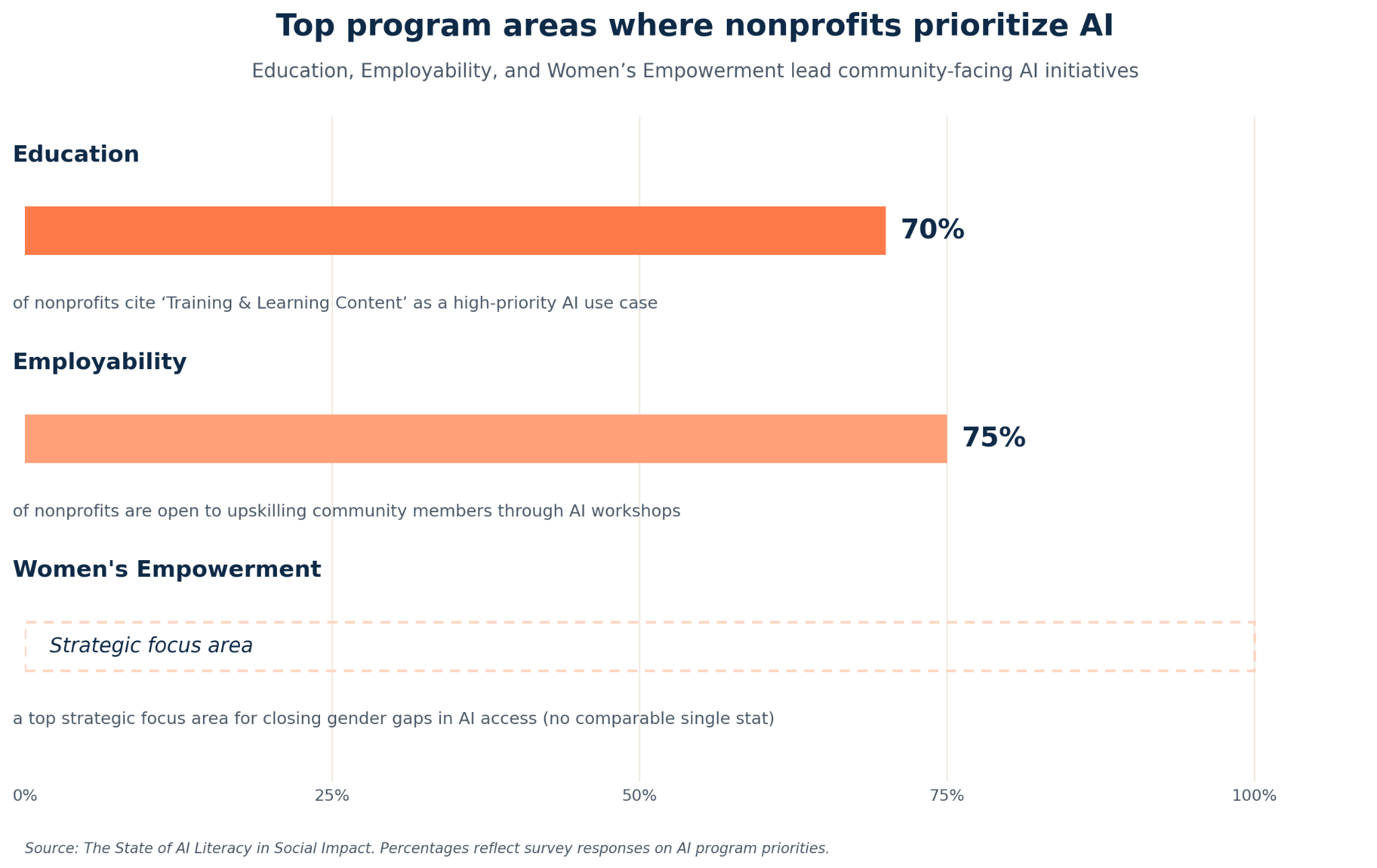
Tres áreas de programas destacaron como la primera línea para la IA orientada a la comunidad.
1. Educación
Casi el 70% de los encuestados señaló la formación y el contenido de aprendizaje como un uso prioritario de la IA. Las organizaciones quieren integrar la tutoría con IA, la creación de contenido y el aprendizaje personalizado en sus programas, y cada vez consideran más la alfabetización en IA como una parte fundamental de la preparación de los estudiantes para el futuro.
Un encuestado resumió lo que está en juego sin rodeos: "Si nuestros estudiantes no aprenden IA, los estamos preparando para un mundo que ya no existe".
2. Empleabilidad
Las organizaciones sin fines de lucro dedicadas a la formación laboral ven en la IA una vía directa hacia mejores medios de vida. Más de tres cuartas partes están dispuestas a capacitar a los miembros de la comunidad mediante talleres de IA, integrando estas habilidades en sus programas vocacionales y de emprendimiento para que quienes buscan empleo puedan seguir el ritmo de un mercado en rápida evolución.
3. Empoderamiento de la mujer
Las organizaciones centradas en mujeres y niñas planean utilizar la IA para cerrar las brechas en el acceso a la tecnología y las oportunidades, mediante talleres de sensibilización, contenido de aprendizaje personalizado y herramientas que ayuden a amplificar las voces femeninas. Para estos equipos, las habilidades en IA se están convirtiendo rápidamente en una cuestión de acceso equitativo a las oportunidades económicas.
¿Qué tipo de formación en IA necesitan realmente las organizaciones sin fines de lucro?
No otro seminario web. Los datos son claros: las organizaciones sin fines de lucro quieren un aprendizaje práctico, guiado y directo, idealmente con alguien a su lado que ya haya pasado por ello. Los cursos pasivos y las charlas únicas no generan una confianza real.
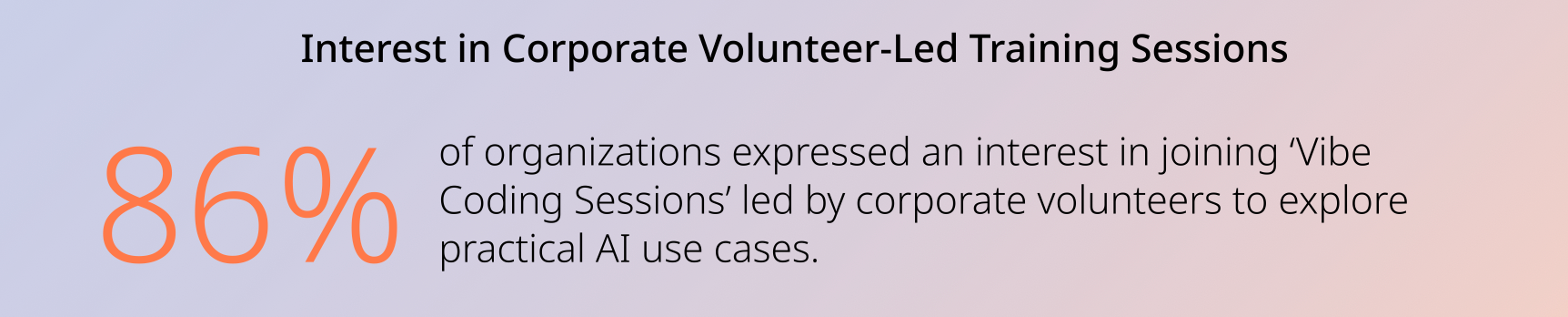
Aquí es donde entran en juego los voluntarios corporativos. El 86% de las organizaciones afirmó que se uniría a sesiones de programación colaborativa dirigidas por voluntarios corporativos para explorar juntos casos de uso reales de la IA. Es un nivel de demanda sorprendente de apoyo entre pares y aprendizaje práctico, lo que apunta a una combinación obvia: las empresas tienen empleados con exactamente las habilidades en IA que les faltan a las organizaciones sin fines de lucro.
Goodera, como servicio de voluntariado gestionado, ocupa ese espacio, conectando a voluntarios corporativos cualificados con organizaciones sin fines de lucro que desean ayuda práctica en lugar de otra presentación de diapositivas. El interés ya existe; lo que el sector necesita es estructurarlo.
LEE TAMBIÉN:
¿Cómo pueden las organizaciones sin fines de lucro pasar del interés a la implementación?
La encuesta concluyó con cuatro prioridades que, en conjunto, forman una guía sencilla para cualquier organización sin fines de lucro lista para dejar de explorar y empezar a actuar. Si te preguntas por dónde empezar, hazlo aquí.
- Elige formación práctica y guiada en lugar de cursos a tu propio ritmo. Los talleres, la mentoría y la práctica aplicada generan confianza mucho más rápido que los videos que se ven en solitario. Empareja a tu equipo con personas que puedan responder preguntas en tiempo real.
- Extiende la alfabetización en IA más allá de tu personal. Involucra a jóvenes, personas en búsqueda de empleo y familias en el aprendizaje para que los beneficios lleguen a la comunidad, no solo a la oficina administrativa.
- Empieza poco a poco con usos de alto impacto. Elige una tarea tediosa (redacción de contenido, limpieza de datos, creación de materiales de aprendizaje, automatización básica) y demuestra su valor antes de escalar. Un pequeño logro justifica el siguiente paso.
- Establece asociaciones a largo plazo. Apóyate en universidades, voluntarios corporativos, financiadores y proveedores tecnológicos para obtener herramientas, mentoría y formación continua. La alfabetización en IA es una relación, no un evento único.
Las organizaciones que siguen este camino tienden a evitar una trampa en la que el sector en general ya está cayendo. En un estudio comparativo de 2026 sobre 346 organizaciones sin fines de lucro, el 92% utilizaba la IA de alguna manera, pero solo el 7% informó una mejora significativa; un "estancamiento de la eficiencia" causado por un uso disperso y aislado sin un sistema compartido que lo respalde. Empezar poco a poco es bueno. Empezar poco a poco con un plan es lo que realmente marca la diferencia.
Conclusión
El estado de la alfabetización en IA en el ámbito del impacto social es una historia de preparación que actualmente se ve frenada por la falta de una hoja de ruta. Las organizaciones sin fines de lucro creen que la IA puede ser un multiplicador de fuerza para su misión, y tienen razón. Lo que les falta no es motivación, sino apoyo: formación guiada, primeros pasos prácticos y socios dispuestos a aprender junto a ellas.
La brecha entre el interés y la implementación es real, pero se puede salvar. Con un aprendizaje práctico, una educación centrada en la comunidad y asociaciones intersectoriales, las organizaciones sin fines de lucro pueden pasar de decir "sabemos que la IA podría ayudar" a "la IA nos está ayudando ahora mismo".
Como dijo un encuestado, lo que el sector más necesita es "un lugar seguro para entender la IA sin juicios". Crear esos espacios es la tarea que tenemos por delante.
Frequently Asked Questions
1. ¿Cuál es el estado actual de la adopción de la IA en las organizaciones sin fines de lucro?
La adopción es temprana, pero el interés es alto. En la encuesta de Goodera, solo alrededor del 25% de las organizaciones sin fines de lucro utiliza activamente herramientas de IA, mientras que el 71% desea usarla para mejorar la eficiencia y casi todas al menos la están explorando. El sector está entusiasmado y preparado, pero a la mayoría de los equipos les faltan las habilidades, la orientación y el tiempo para implementar la IA de manera constante.
2. ¿Para qué utilizan más la IA las organizaciones sin fines de lucro?
La comunicación y la narrativa encabezan la lista, mencionadas por alrededor del 80% de los encuestados. Otros usos comunes incluyen la elaboración de informes de impacto, la recaudación de fondos y la captación de donantes, el análisis de datos y la creación de contenido educativo o de formación. Se trata de tareas cotidianas que a los equipos pequeños les cuesta mantener al día.
3. ¿Cuál es la mayor barrera para la adopción de la IA en el sector del impacto social?
La escasez de orientación práctica y de habilidades internas, no la falta de interés. Casi la mitad de las organizaciones sin fines de lucro afirma no contar con las habilidades adecuadas internamente, y la mayoría prefiere una formación práctica en lugar de seminarios web aislados. La financiación y el acceso a herramientas avanzadas les siguen de cerca.
4. ¿Por qué es importante la alfabetización en IA para las comunidades a las que sirven las organizaciones sin fines de lucro?
Porque las habilidades en IA están empezando a determinar el acceso al empleo, la educación y las oportunidades. El 76% de las organizaciones sin fines de lucro afirma que sus comunidades desean programas de alfabetización en IA, y el 87% ve valor en ofrecerlos, principalmente para garantizar que los grupos vulnerables no se queden atrás a medida que la tecnología se extiende.
5. ¿Cómo puede una pequeña organización sin fines de lucro empezar a usar la IA sin un gran presupuesto?
Comience con una tarea de alto impacto y bajo costo, como redactar comunicaciones o limpiar datos, y utilice herramientas gratuitas o de bajo costo. Luego, busque apoyo práctico, como voluntarios corporativos, y construya a partir de un pequeño éxito comprobado en lugar de intentar transformarlo todo a la vez.
6. ¿Cómo pueden las empresas apoyar la alfabetización en IA de las ONG?
Las empresas pueden financiar programas de formación en IA, donar herramientas validadas con licencias, patrocinar talleres para el personal de ONG y ofrecer voluntariado basado en habilidades para implementar sistemas de IA. Como solo el 25 % de las ONG utiliza IA activamente hoy, el apoyo corporativo cierra una brecha crítica. Emparejar voluntarios técnicos con equipos de misión convierte la curiosidad en flujos de trabajo útiles para captación y servicios.
7. ¿Cuáles son los principales riesgos éticos de la IA en el impacto social?
Los riesgos clave incluyen sesgos en el emparejamiento de voluntarios o beneficiarios, filtraciones de datos sensibles de comunidades, sobreautomatización del trabajo de cuidado y lavado de impacto cuando los resultados de IA se comparten sin verificar. Las ONG atienden poblaciones vulnerables, por lo que los errores tienen mayores consecuencias. El uso ético exige prácticas de datos transparentes, divulgación de las limitaciones del modelo y límites claros a la automatización.
8. ¿Qué es la alfabetización en IA en el contexto de las ONG?
La alfabetización en IA es la capacidad de los equipos de ONG y de las comunidades a las que sirven para entender, evaluar y usar herramientas de IA con confianza, seguridad y valor para la misión. Va más allá de saber que la IA existe e incluye diseño de prompts, verificación de resultados, juicio ético y conciencia de riesgos de datos. Los equipos alfabetizados deciden cuándo la IA ayuda y cuándo debe liderar la experiencia humana.
9. ¿Cómo deben gobernar las ONG las herramientas de IA para proteger a los beneficiarios?
Una gobernanza eficaz combina revisión humana de los resultados de IA, acuerdos escritos de intercambio de datos con proveedores, divulgación de las limitaciones del modelo y auditorías periódicas para detectar sesgos. La información sensible de beneficiarios nunca debe ingresar a herramientas públicas sin consentimiento y anonimización. Un responsable designado, incluso en equipos pequeños, garantiza que las decisiones sobre automatización se documenten en lugar de tomarse improvisadamente.
10. ¿Por qué la adopción de IA en las ONG sigue en fase exploratoria?
La encuesta encontró que el 54 % de las ONG está explorando la IA y el 19 % está interesado pero no ha comenzado, principalmente por presupuestos limitados, casos de uso poco claros y escasez de personal técnico. El sector es curioso y esperanzado pero aún no está equipado. Se necesitan financiación sostenida, redes de aprendizaje entre pares y alianzas con proveedores adaptadas a la misión para pasar de la exploración a la práctica diaria.