State of AI Literacy: Understanding the Depth of AI Implementation in the Social Impact Space

Do you relate to this feeling: there’s a lot to do, too few hands, and a quiet worry that the world is moving faster than you can keep up with? Artificial intelligence is supposed to help with exactly that. So why does it still feel just out of reach for most mission-driven teams?
To understand the real state of AI literacy in social impact, Goodera surveyed more than 1,000 nonprofits across education, health, environment, community development, gender equality, and humanitarian relief, spanning 30+ countries. The picture that came back is honest and a little surprising. The sector is curious, hopeful, and ready. It is just not equipped yet. Here’s what the data tells us.
What Is AI Literacy in Social Impact?
AI literacy in social impact is the ability of nonprofit teams, and the communities they serve, to understand and use AI tools confidently, safely, and for genuine mission value. You don’t need to learn code to leverage AI. It’s more about knowing what AI can do, where it helps, and how to use it responsibly. Think of it as the difference between having heard of AI and actually putting it to work.
That distinction matters because most nonprofits sit squarely in the first camp. They know AI exists. They are far less sure how to make it useful.
Where Do Nonprofits Actually Stand on AI Right Now?
The short answer: high hopes, low adoption. Interest in AI is nearly universal, but very few organizations have moved from curiosity to consistent use. The survey found a sector at a tipping point, eager to act but waiting for a push.
Here is the snapshot in numbers:
- 71% of nonprofits want to use AI to run their operations more efficiently
- Only 25% are actively using AI tools today
- 54% are in an exploratory stage, testing tools or planning to
- 19% are interested but have not started
- Just 2% report no interest at all
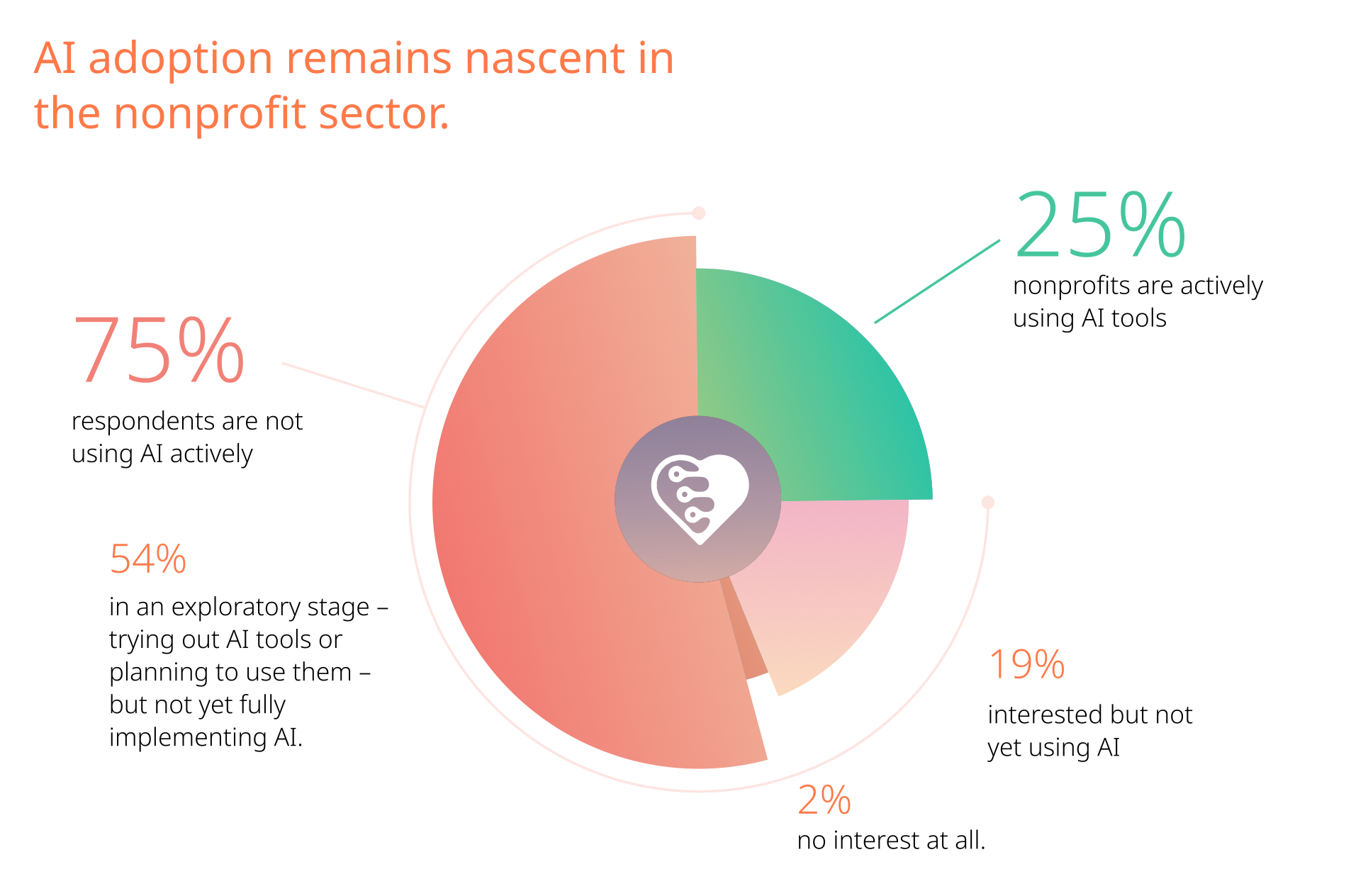
Image Source: The State of AI Literacy in Social Impact 2025
Read that last set again. Almost every organization surveyed is using, testing, or at least interested in AI. Outright resistance is rare. This is not a sector dragging its feet. It is a sector standing at the doorway, waiting for someone to show them in.
That gap between wanting and doing is the single biggest theme in the data, and it shows up everywhere else, too.
What Do Nonprofits Most Want to Use AI For?
When asked where AI could make the biggest difference day-to-day, nonprofits pointed to five practical jobs. None of them is futuristic. They are the unglamorous tasks that quietly eat a small team's week.
1. Communication and Storytelling
This was the runaway favorite, named by around 80% of respondents. Most nonprofits do not have a communications team, so writing newsletters, social posts, grant proposals, and impact stories falls to whoever has a spare hour.
AI can help draft it all. As one respondent put it, AI could help them "sound like a bigger organization."
Better storytelling helps highlight their impact, drive sentiment towards the causes they support, and opens doors to adequate fundraising, which makes this a smart place to start.
2. Impact Measurement and Reporting
Nearly half of the respondents flagged reporting as a top use case. Donor reports and evaluation documents can swallow weeks of staff time. AI can speed up data visualization, report writing, and outcome analysis, turning a dreaded chore into something closer to a strategic asset.
One respondent summed up the pain plainly: "Reporting takes weeks. AI could reduce that dramatically."
3. Fundraising and Donor Engagement
Teams see real promise in using AI to find and keep donors: smarter donor segmentation, personalized appeals, prospect research, and automated thank-you notes. For a two-person fundraising team, that kind of help can punch well above its weight.
4. Data Management and Analysis
Plenty of nonprofits are sitting on data they never have time to use. AI can clean up databases, pull patterns out of survey results, and surface insights that would otherwise stay buried. One respondent captured the frustration: "We have data, but no time to analyze it."
Download the report to access the entire analysis:
5. Training and Educational Content
From staff onboarding to volunteer guides to learning materials for the community, content creation is expensive and slow. AI can draft a first version of a training manual or a youth curriculum that staff then refine, helping small teams reach more people without ballooning costs.
The common thread: these are not moonshots. They are everyday pain points, and AI is being welcomed as a practical teammate rather than a shiny experiment.
Why Is AI Adoption in Nonprofits Still So Low?
If interest is this high, why are only a quarter of organizations actually using AI? The honest answer is that enthusiasm has not yet met support. The survey surfaced five clear gaps standing between intent and action.
- The awareness-to-action gap. Most know AI can help, but knowing has not become doing. Many teams are stuck in permanent "exploration mode."
- The implementation gap. Unclear starting points and thin hands-on experience leave organizations unsure of the first step. Nearly half report not having the right skills in-house.
- The community literacy gap. Most nonprofits want to bring AI literacy to the people they serve, but fewer than a quarter actually run programs that do it.
- The learning support gap. One-off webinars are not enough. 86% of nonprofits want training, yet most lack access to guided, hands-on help.
- The tools gap. Beyond skills, many simply do not have access to the more advanced tools needed to go deeper than basic content generation.
Download the report to access the entire analysis:
This pattern is not unique to Goodera's survey. A separate study by Nonprofit Tech for Good found that 60% of nonprofits say they lack the in-house expertise to even assess AI tools, and only 4% have a budget set aside for AI training.
And in TechSoup and Tapp Network's research, only 24% of organizations had a formal AI strategy despite most actively exploring the technology. The barrier is rarely interesting. It is almost always guidance, skills, and time.
Is AI Literacy Becoming an Equity Issue?
Yes, and nonprofits see it coming. The most forward-looking finding in the survey is that organizations do not just want AI for themselves. They want it for their communities because they worry about who gets left behind if they do not.
- 76% of nonprofits said the communities they serve want AI literacy programs.
- 87% see clear value in extending AI literacy to those communities.
The logic is simple. If AI skills are about to shape who gets hired, who gets ahead, and who gets heard, then leaving vulnerable groups out of the AI conversation risks widening gaps that already exist. Nonprofits would rather get ahead of that than clean it up later.
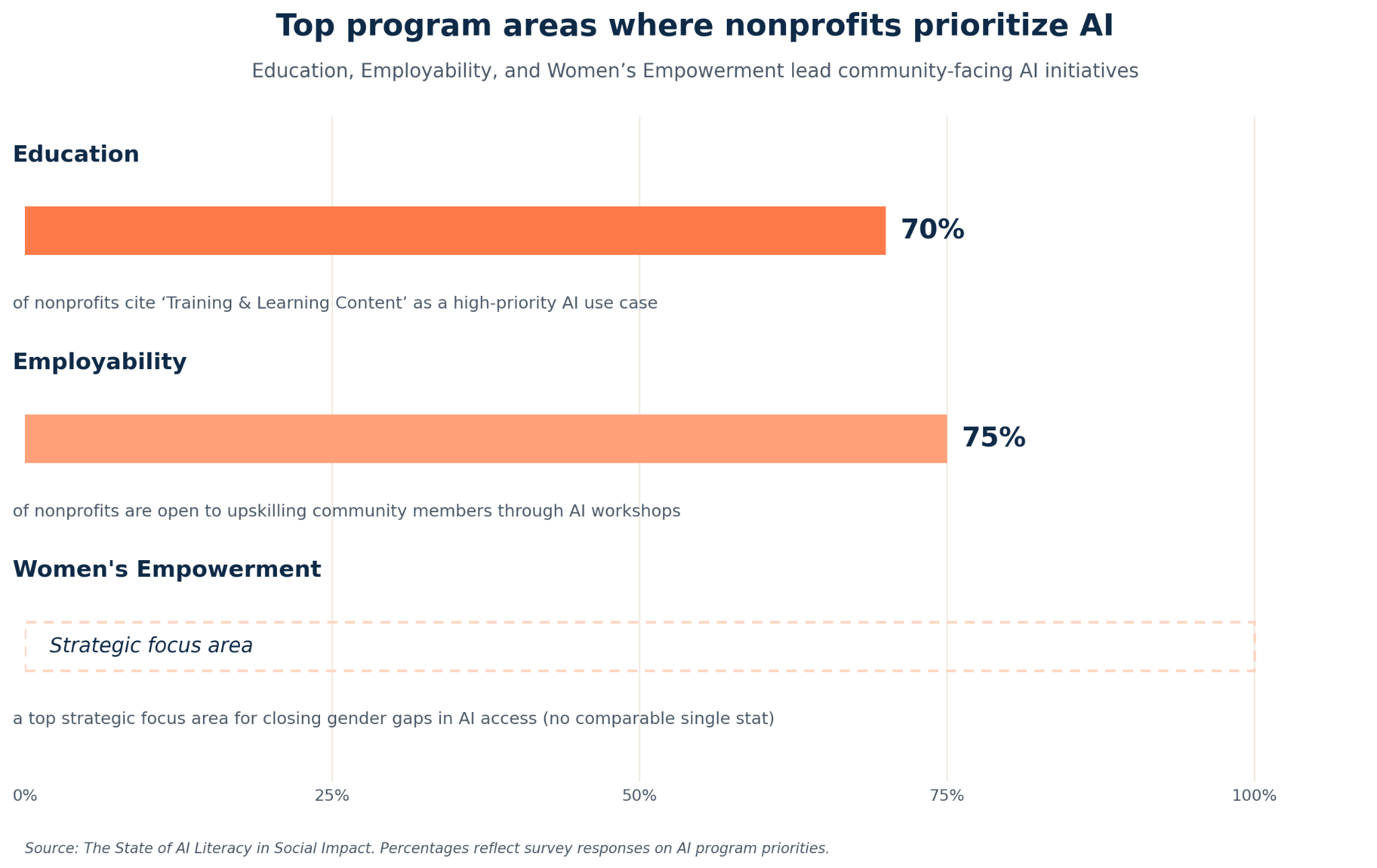
Three program areas stood out as the front lines for community-facing AI.
1. Education
Nearly 70% of respondents named training and learning content as a high-priority AI use. Organizations want to fold AI tutoring, content creation, and personalized learning into their programs, and they increasingly treat AI literacy as a basic part of preparing students for the future.
One respondent put the stakes bluntly: "If our students do not learn AI, we are preparing them for a world that no longer exists."
2. Employability
Job-training nonprofits see AI as a direct route to better livelihoods. More than three-quarters are open to upskilling community members through AI workshops, building AI skills into vocational and entrepreneurship programs so job seekers can keep up with a fast-changing market.
3. Women's Empowerment
Organizations focused on women and girls plan to use AI to close gaps in technology access and opportunity, through awareness workshops, tailored learning content, and tools that help amplify women's voices. For these teams, AI skills are quickly becoming a question of fair access to economic opportunity.
What Kind of AI Training Do Nonprofits Actually Want?
Not another webinar. The data is clear that nonprofits want practical, guided, hands-on learning, ideally with someone in their corner who has done it before. Passive courses and one-time talks do not build real confidence.
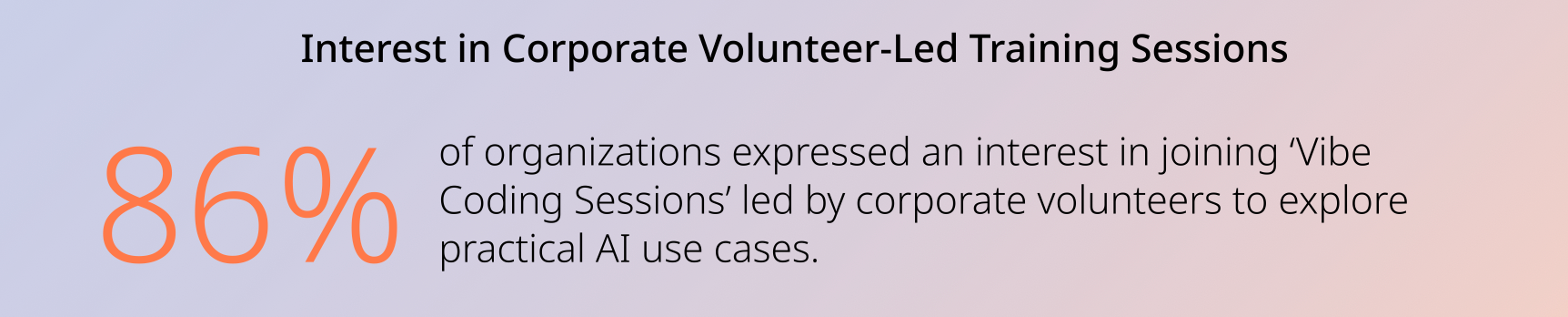
This is where corporate volunteers come in. 86% of organizations said they would join "Vibe Coding Sessions" led by corporate volunteers to explore real AI use cases together. That is a striking level of demand for peer-to-peer, learn-by-doing support, and it points to an obvious match: companies have employees with exactly the AI skills nonprofits are missing.
Goodera, as a managed volunteering service, sits right in that gap, connecting skilled corporate volunteers with nonprofits that want hands-on help rather than another slide deck. The appetite is already there. What the sector needs is structure around it.
ALSO READ:
How Can Nonprofits Move From Interest to Implementation?
The survey closed with four priorities that, taken together, form a simple playbook for any nonprofit ready to stop exploring and start doing. If you are wondering where to begin, start here.
- Choose hands-on, guided training over self-paced courses. Workshops, mentoring, and applied practice build confidence far faster than videos you watch alone. Pair your team with people who can answer questions in real time.
- Extend AI literacy beyond your staff. Bring youth, job seekers, and families into the learning so the benefits reach the community, not just the back office.
- Start small with high-impact uses. Pick one painful task (drafting content, cleaning data, building learning materials, basic automation) and prove the value before scaling. A tiny win builds the case for the next one.
- Build partnerships for the long haul. Lean on universities, corporate volunteers, funders, and tech providers for tools, mentorship, and sustained training. AI literacy is a relationship, not a single event.
The organizations that follow this path tend to avoid a trap the wider sector is already falling into. In one 2026 benchmark of 346 nonprofits, 92% were using AI in some way, yet only 7% reported major improvement, an "efficiency plateau" caused by scattered, one-off use with no shared system behind it. Starting small is good. Starting small with a plan is what actually moves the needle.
The Bottom Line
The state of AI literacy in social impact is a story of readiness that’s currently shackled by the lack of a road map. Nonprofits believe AI can be a force multiplier for their mission, and they are right. What they are missing is not motivation but support: guided training, practical first steps, and partners willing to learn alongside them.
The gap between interest and implementation is real, yet bridgeable. With hands-on learning, community-centered education, and cross-sector partnerships, nonprofits can move from "we know AI could help" to "AI is helping us right now."
As one respondent said, what the sector needs most is "a safe place to understand AI without judgment." Building those spaces is the work in front of all of us.
Frequently Asked Questions
1. What is the current state of AI adoption in nonprofits?
Adoption is early, but interest is high. In Goodera's survey, only about 25% of nonprofits actively use AI tools, while 71% want to use it for efficiency, and nearly all are at least exploring it. The sector is enthusiastic and ready, but most teams lack the skills, guidance, and time to implement AI consistently.
2. What do nonprofits use AI for most?
Communication and storytelling top the list, named by around 80% of respondents. Other common uses include impact reporting, fundraising and donor engagement, data analysis, and creating training or educational content. These are everyday tasks that small teams struggle to keep up with.
3. What is the biggest barrier to AI adoption in the social impact sector?
A shortage of practical guidance and in-house skills, not a lack of interest. Nearly half of nonprofits say they do not have the right skills internally, and most want hands-on training rather than one-off webinars. Funding and access to advanced tools are close behind.
4. Why does AI literacy matter for the communities nonprofits serve?
Because AI skills are starting to shape access to jobs, education, and opportunity. 76% of nonprofits say their communities want AI literacy programs, and 87% see value in providing them, largely to make sure vulnerable groups are not left behind as the technology spreads.
5. How can a small nonprofit start using AI without a big budget?
Start with one high-impact, low-cost task such as drafting communications or cleaning up data, and use free or low-cost tools. Then bring in hands-on support, like corporate volunteers, and build from a small, proven win rather than trying to transform everything at once.
6. How can corporations support AI literacy in the nonprofit sector?
Corporations can fund AI training programs, donate vetted tools with licenses, sponsor AI literacy workshops for nonprofit staff, and offer skills-based volunteering to help implement AI systems. Since only 25% of nonprofits actively use AI today, employer-led capacity building closes a critical gap. Pairing technical volunteers with mission teams turns curiosity into usable workflows for fundraising, operations, and beneficiary services.
7. What are the main ethical risks of using AI in social impact work?
Key risks include biased volunteer or beneficiary matching, privacy breaches of sensitive community data, over-automation of care work, and impact-washing when AI outputs are shared without verification. Nonprofits serve vulnerable populations, so errors carry higher stakes than in commercial contexts. Ethical use requires transparent data practices, disclosure of model limitations, and clear boundaries on where automation is inappropriate.
8. What is AI literacy in the context of nonprofit organizations?
AI literacy is the ability of nonprofit teams and the communities they serve to understand, evaluate, and use AI tools confidently, safely, and in ways that create mission value. It goes beyond knowing that AI exists to include prompt design, output verification, ethical judgment, and awareness of data risks. Literate teams can decide when AI helps and when human expertise must lead.
9. How should nonprofits govern AI tools to protect beneficiaries?
Effective governance combines human-in-the-loop review of AI outputs, written data-sharing agreements with vendors, disclosure of model limitations to staff and partners, and regular audits for bias. Sensitive beneficiary information should never enter public AI tools without consent and redaction. A named accountability owner, even in small teams, ensures decisions about automation are documented rather than made ad hoc.
10. Why is AI adoption in nonprofits still in an exploratory stage?
The survey found 54% of nonprofits are exploring AI and 19% are interested but have not started, largely because of limited budgets, unclear use cases, and a shortage of technical staff. The sector is curious and hopeful but not yet equipped. Sustained funding, peer learning networks, and vendor partnerships that address mission-specific needs are needed to move exploration into daily practice.