Why Are Employee Resource Groups Important for Corporate Volunteering Programs

Ask anyone running a volunteering program what their biggest internal challenge is when designing a volunteering program, and the answer is almost always the same: figuring out which causes the company should support, and how to get more employees to actually participate. Both problems are genuinely hard to solve from the top down. But they become significantly more manageable when Employee Resource Groups (ERGs) are meaningfully integrated into the program architecture.
ERGs contribute to successful corporate volunteering programs by serving as the intelligence layer, the trust network, and the cause-alignment engine that central CSR teams alone cannot replicate. They surface authentic community priorities, connect companies to vetted nonprofit partners, and create participation pathways for employees who might not otherwise volunteer. When structured well, ERG-integrated volunteering programs tend to see stronger participation and stickier engagement than programs that treat ERGs as an afterthought.
The Untapped Potential of ERGs in Driving Strategic Cause Alignment
Understanding the Purpose and Scope of ERGs
Employee Resource Groups are voluntary, employee-led communities built around shared identities, lived experiences, or common interests. Their primary functions are creating belonging, supporting professional development, and championing employee advocacy from the bottom up. They are distinct from the committees set up by HR, and they are not CSR subcommittees either.
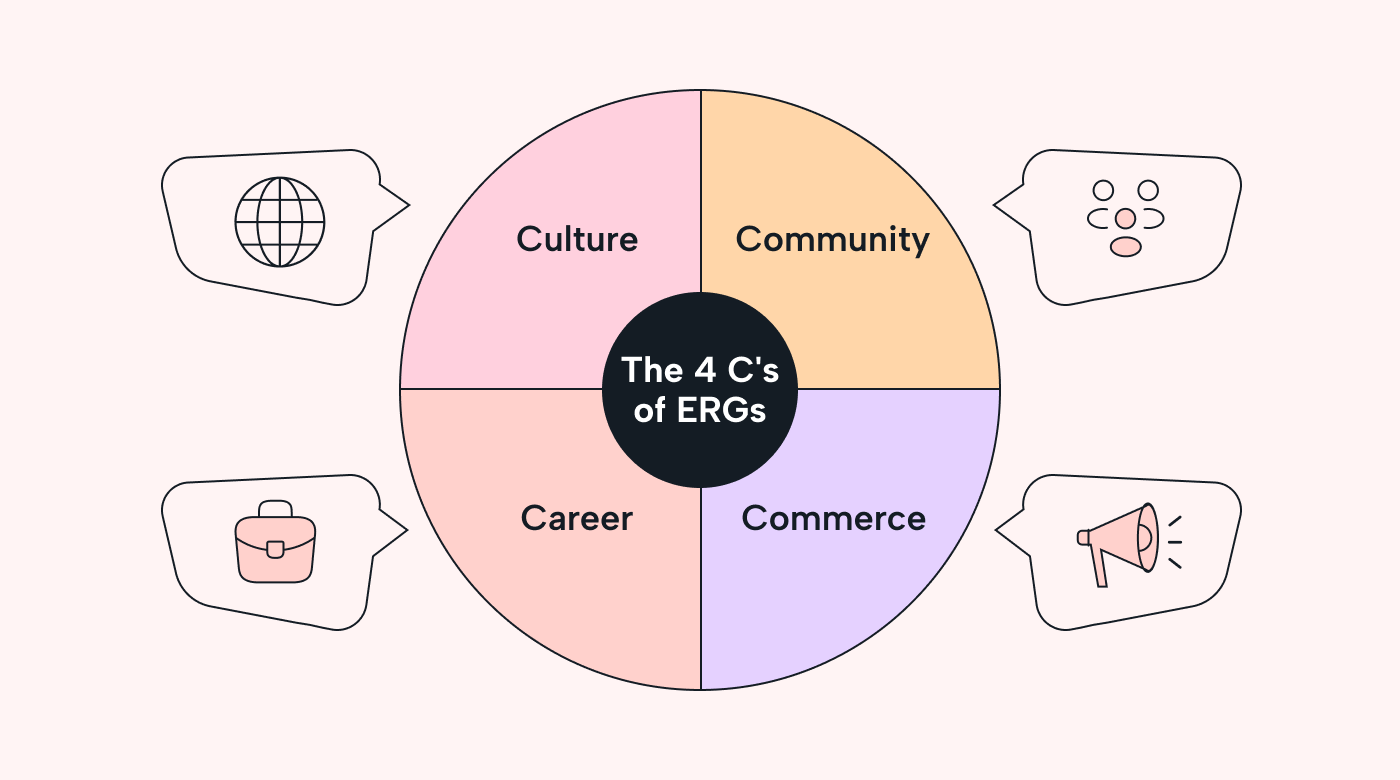
The 4 Cs of ERGs. Image via Motion.
Unlike top-down HR initiatives, ERGs operate independently of mandated corporate governance. This structural autonomy allows members to freely bring their whole selves to work and build organically tight-knit circles of trust. They are genuinely employee-driven, which is precisely what makes them valuable to a volunteering program that needs to be authentic.
It is just as important to be clear about what ERGs are not expected to do on their own.
To maximize the impact of ERGs, the most successful corporate volunteering programs establish a clear division of labor that honors the leaders' time. Rather than tasking ERG leads with administrative burdens like event logistics, budget management, or legal vetting of nonprofits, companies achieve better results by providing central operational support. When a dedicated CSR team handles the complex heavy lifting, ERG leaders are freed from operational friction.
This intentional boundaries-first design safeguards volunteers from burnout, ensuring their energy is spent where it matters most: driving community connection and championing the cause. Their scope in volunteering primarily ranges from cause identification and nonprofit connection to event co-design and volunteer recruitment within their communities. Each of those contributions is meaningful and distinct.
In this collaborative framework, ERG leaders serve as cultural advisors who align volunteer causes with the genuine passions of their community. Meanwhile, the corporate volunteering program acts as the facilitating backbone. This healthy partnership allows ERG leaders to focus entirely on storytelling, advocacy, and inspiring their peers, turning corporate volunteering programs into a sustainable, employee-led movement.
Current Landscape of Modern ERGs
The scale of ERGs in corporate America is significant. According to McKinsey, cited by MentorCliq's 2024 ERG Research Report, 90% of Fortune 500 companies have ERGs today. The number of companies forming ERGs has grown by 35% over the past five years, and on average, 25 to 30% of employees in ERG-enabled organizations actively participate in at least one group.
These numbers represent a substantial, organized, and motivated internal community that sits inside most large companies, often underconnected to the volunteering programs operating alongside them. A Gartner HR Research Report highlights that trust and a shared purpose are the core pillars of a modern, authentic Employee Value Proposition (EVP).
Parallel data from McKinsey & Company underscores this impact, revealing that employees participating in effective ERGs report significantly higher workplace belonging than their peers. That level of organizational trust is rare, and it makes ERGs a uniquely credible channel for driving high-impact volunteering participation across a company.
In an industry article co-authored for the Association of Corporate Citizenship Professionals (ACCP), Alexandra Dailerian, VP of Impact and Inclusion at Comcast, highlighted the inherent strength of these grassroots groups, writing that, "ERGs are typically aligned to a shared identity, background, or experience as those individuals work to lead programming that informs and amplifies the histories of their communities."
The Five Ways ERGs Make Corporate Volunteering Programs Stronger
- ERGs Solve the Cause-Selection Problem
One of the most consistent strategic bottlenecks in corporate volunteering is answering the question: which causes should we support? Companies that answer this from the top down often end up with cause portfolios that reflect leadership preferences rather than the communities their employees actually come from or care about.
Mapping ERG Focus Areas to High-Impact Volunteering Actions
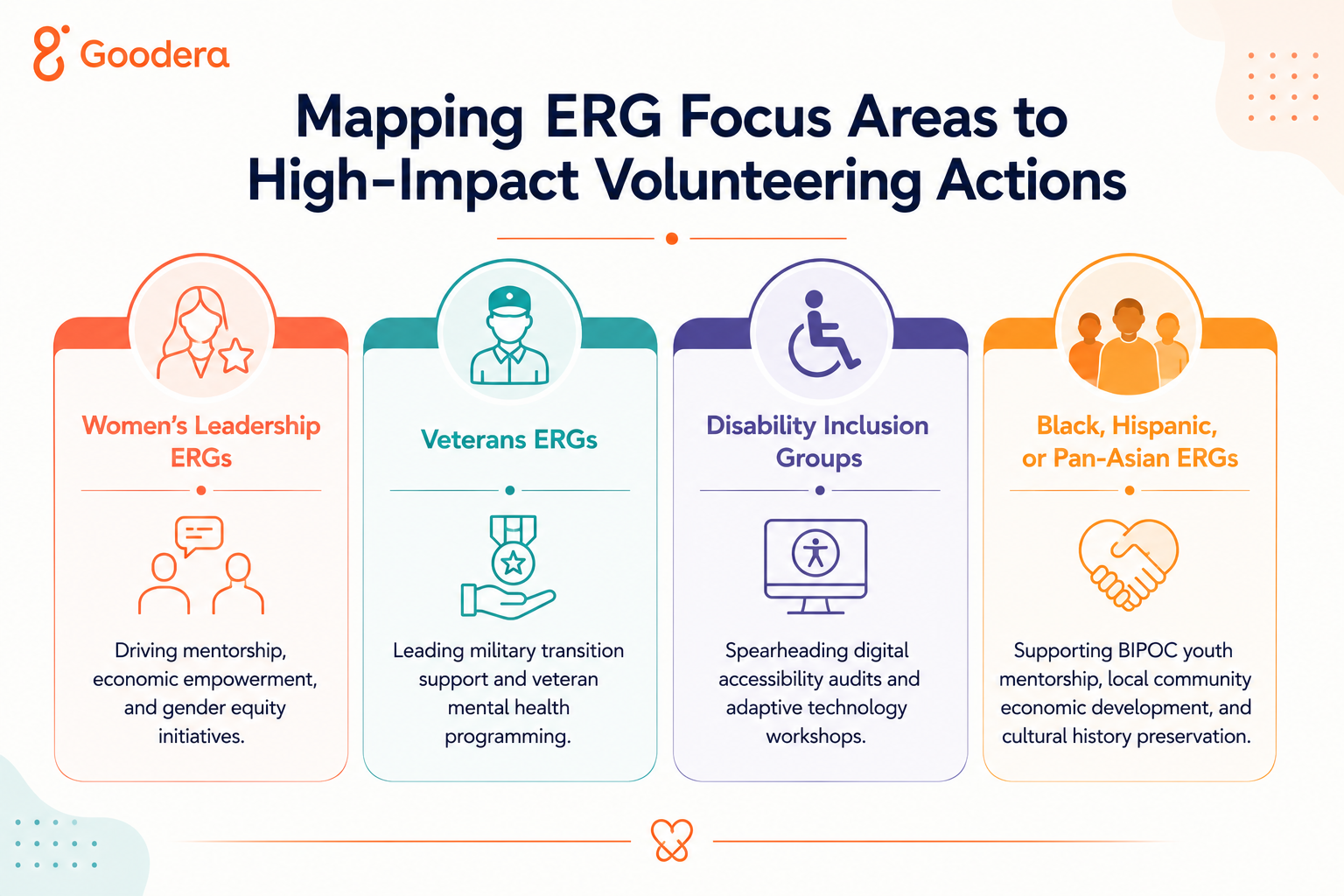
ERG Focus Areas and the Related Volunteering Activities
- Women's Leadership ERGs: Driving mentorship, economic empowerment, and gender equity initiatives.
- Veterans ERGs: Leading military transition support and veteran mental health programming.
- Disability Inclusion Groups: Spearheading digital accessibility audits and adaptive technology workshops.
- Black, Hispanic, or Pan-Asian ERGs: Supporting BIPOC youth mentorship, local community economic development, and cultural history preservation.
Each ERG, by its very nature, is already aligned to a cause area. Formalizing that alignment into the volunteering program design removes the guesswork entirely.
According to Percent Pledge, one of the clearest structural recommendations for companies integrating ERGs into philanthropic programs is to treat community impact as a core pillar of every ERG charter, because it "simplifies your workplace philanthropy strategy" and gives you a defensible, employee-rooted answer to which causes your company supports.
- ERGs Bring Vetted Nonprofit Relationships to the Table
Finding nonprofit partners that align with a company's goals, employee interests, and local communities can take significant time. Employee Resource Groups (ERGs) can often accelerate that process because many already have established relationships with community organizations connected to the causes they support.
These relationships provide more than introductions. ERG members can offer firsthand insight into an organization's mission, community impact, volunteer experience, and local reputation. That context helps CSR teams evaluate potential partners more efficiently and design volunteering activities that are relevant to both employees and the communities they serve.
Many organizations formalize this process by inviting ERGs to nominate nonprofit partners annually or contribute to a shared nonprofit directory. This creates a growing pool of trusted organizations that can support future volunteering campaigns while reducing the effort required to source and vet new partners.
- ERGs Expand Volunteer Participation Across Diverse Employee Segments
Corporate volunteering programs often activate a core group of highly engaged employees and struggle to meaningfully expand from there. ERG-integrated volunteering creates a specific solution to this problem: the ally participation pathway.
When a disability inclusion ERG designs and leads an accessibility-focused skills-based volunteering project, it becomes a natural entry point for any employee who cares about disability equity, regardless of whether they are an ERG member. That extends the participation pool without requiring a generic company-wide call to action. Employees who feel a connection to the cause are more likely to show up, stay engaged, and return for future opportunities.
Data from GivingForce underscores the critical role corporate purpose plays in talent management, revealing that 82% of employees state that workplace volunteer programs directly influence their decision to stay with their current employer. By positioning ERGs as the primary channel to deliver these highly valued opportunities, companies can strategically target their most diverse talent segments and proactively reduce voluntary turnover.
ERG-aligned volunteering, which creates a closer connection between cause and personal identity, likely amplifies that retention effect because participation is intrinsically motivated rather than organizationally prompted.
- ERGs Make Volunteering Programs More Culturally Relevant Across Geographies
Global volunteering programs face a recurring challenge: initiatives designed at headquarters frequently feel disconnected from the specific communities where regional employees live and work. A program designed around urban US nonprofit ecosystems does not translate automatically to employees in Bengaluru, São Paulo, or Warsaw.
ERGs in different geographies carry local community knowledge that a central program management team cannot replicate from a distance. A regional ERG in Southeast Asia will know which local organizations are doing meaningful work, which cultural observances matter to the communities their colleagues come from, and how volunteering activities should be framed and scheduled to maximize participation among local employees. That cultural specificity is what makes a global volunteering program feel refreshingly genuine.
Goodera's own experience powering ERG engagement across 100+ countries confirms this. ERG-curated volunteer opportunities, where the cause and nonprofit are identified by ERG members with direct community knowledge, consistently generate stronger participation and satisfaction scores than centrally designed programs pushed out globally with no local adaptation.
- ERG Leaders Develop Through Volunteering, and the Company Benefits
Running a volunteering initiative within an ERG requires exactly the same capabilities that corporate L&D programs spend significant resources trying to build: project scoping, stakeholder communication, cross-functional influence, budget oversight, and impact measurement. ERG leaders who run volunteering programs are developing those skills in real, high-stakes environments with genuine organizational and community consequences.
This creates a feedback loop that benefits the entire company. ERG volunteer coordinators build competencies that show up in their performance, their career progression, and their cross-functional relationships.
According to Goodera’s comprehensive analysis on Skills-Based Volunteering Best Practices, applying professional expertise to community initiatives significantly elevates operational efficiency, with 85% of nonprofits reporting a measurable increase in long-term organizational capacity. For ERG leads, navigating and architecting these high-yield consulting environments provides a unique leadership sandbox that builds critical problem-solving and cross-functional skills.
Companies that formally recognize ERG volunteering leadership within their talent development frameworks, rather than treating it as extracurricular, capture this development value directly. Those that do not leave significant leadership development ROI on the table.
The Cross-ERG Collaboration Multiplier
Why Single-ERG Volunteering Has a Ceiling
When volunteering initiatives are designed and delivered within the boundaries of a single ERG, their reach is naturally limited to that ERG's member base plus the allies it can attract. For smaller ERGs in particular, this creates a ceiling on both the number of volunteers deployed and the variety of skills brought to a nonprofit partner.
A single ERG running a single volunteering project is still valuable. But it is not operating at the scale or impact depth that becomes possible when multiple ERGs collaborate.
How Cross-ERG Volunteering Unlocks Scale and Depth
When two or three ERGs co-design and co-deliver a volunteering initiative around a shared or adjacent cause area, the participation pool expands significantly and the nonprofit receives a more diverse, complementary set of professional skills.
Consider a cross-ERG economic empowerment initiative where a Latinx ERG, a Women's Leadership ERG, and a Veterans ERG partner to support small business development nonprofits in their communities. The combined volunteer pool is larger than any single ERG could generate. The skill sets brought in, spanning finance, HR, marketing, and strategy, are more varied. And the shared initiative creates cross-ERG relationships among employees who might never otherwise work together.
Comcast provides a concrete reference point for how this works at scale. According to Comcast's SEC proxy filing for FY2024, the company supports nine ERGs with approximately 36,000 members across 250 chapters, and each ERG receives annual funding as well as the opportunity to receive further financial support specifically for cross-ERG events designed to bring collaborative programming to all employees. That structural investment in cross-ERG collaboration, not just individual ERG operations, is what enables their volunteering program to reach beyond any single community.
The Challenges to Get Right
- Keeping Volunteering Aligned With ERG Missions
As volunteering programs scale, there is a natural drift risk: ERGs begin to be mobilized for whatever volunteering project is most visible or most urgent for the broader program, rather than for projects that connect meaningfully to their specific community and original mission.
An LGBTQ+ ERG recruited to staff a general food drive because "everyone helps with the food bank" is not doing ERG-integrated volunteering. It is doing ERG-mobilized logistics, which produces neither the authentic participation nor the community connection that makes ERG-led volunteering distinctive.
The protection against this drift is very simple and structural. Every ERG should have a defined cause alignment and volunteering charter that is agreed upon with the CSR team annually. Volunteering requests that fall outside that alignment should be routed to the broader employee volunteering program rather than assigned to an ERG by default. Mission alignment is essential, and is what makes the participation genuine.
- Measuring ERG-Specific Volunteering Impact
Measuring the impact of ERG-integrated volunteering requires metrics that are more specific than most aggregate volunteer tracking systems capture. Total volunteer hours are a useful program-level number, but they do not tell you whether ERG-led volunteering is actually working.
The metrics that do tell you that are more specific. ERG member participation rate (what percentage of an ERG's members actually volunteered in a given period) reveals engagement within the community. Ally participation rate (how many non-members joined ERG-led volunteering events) reveals the program's reach beyond its core membership.
Nonprofit partner satisfaction scores specifically for ERG-sourced engagements reveal whether the community intelligence ERGs bring is producing better partnership outcomes. And qualitative feedback from ERG leaders on whether the volunteering activity felt aligned with their mission reveals the drift risk described above.
Goodera's ERG metrics guide notes that lower attrition among ERG members is also a meaningful downstream indicator for programs where volunteering is well-integrated into ERG activities. The connection between purposeful engagement and retention is well-established, and ERG-aligned volunteering is one of the cleaner ways to create that purposeful engagement at scale.
Building the ERG-Volunteering Integration: A Practical Framework
Scaling a corporate volunteering program through ERGs requires moving past ad-hoc collaborations and toward a structured architecture. The following five-step framework gives you a clear way to pair employee-led passion with the operational muscle to back it up, ensuring your initiatives are both authentic and sustainable.
Step 1: Map Your ERGs to Cause Areas
Begin by conducting a structured mapping exercise with each ERG. Ask each group to identify the two or three cause areas most closely connected to their community and mission. Document these alongside the ERG's geographic concentration, member size, and professional skill profile. This becomes the foundation for every subsequent integration decision, from nonprofit partner selection to volunteering opportunity design.
Step 2: Surface Nonprofit Relationships Already Inside Your ERG Community
Send a structured survey to ERG leaders and members asking two questions: Do you personally volunteer with or have a professional connection to a nonprofit aligned with your ERG's cause area? And would you be willing to introduce that organization to the company's volunteering program? The responses will surface a pipeline of pre-vetted nonprofit partners faster and more reliably than any research process the CSR team could conduct independently.
Step 3: Define a Dedicated Volunteering Charter for Every ERG
Work with each ERG to define a one-page volunteering charter that specifies their cause alignment, their target nonprofit partner category, their volunteering format preference (in-person, virtual, or both), their annual volunteer hour goal, and the types of professional skills their members are most able to contribute. This charter becomes the basis for the CSR team's annual volunteering calendar for each ERG and prevents the mission drift described earlier.
Step 4: Design for Both Members and Allies
When designing each ERG-led volunteering initiative, explicitly build an ally participation pathway. This means listing the event as open to all employees in internal communications, framing the cause in terms that speak to ally motivations (solidarity, learning, cross-community connection), and making it easy for non-members to register and show up without needing to join the ERG first. The distinction between "ERG-led" and "ERG-exclusive" is the design choice that determines whether participation stays small or scales across the organization.
Step 5: Protect ERG Leaders From Delivery Overload
ERG leaders are typically unpaid, managing their full-time roles alongside their ERG responsibilities. Adding volunteering program delivery to that load without structural support is a reliable path to burnout. The practical protection is to separate the ERG's community leadership role from its volunteering program coordination role, and to ensure that program management support (logistics, nonprofit communication, impact tracking) sits with the CSR team or a platform partner, not with the ERG leader.
This is the design principle behind how Goodera structures ERG volunteering engagements: the ERG provides the community knowledge, the cause alignment, and the participant recruitment. Goodera handles the end-to-end operational execution, from nonprofit matching and event logistics to impact reporting and post-event surveys. That division protects ERG leaders from overload while ensuring the program runs well.
Companies Doing This Well
How Goodera Powers ERG-Led Volunteering at Scale
Goodera works with 500+ global businesses to build and execute end-to-end volunteering programs across more than 100 countries and 50+ cause areas. The platform's approach is specifically designed around the ERG partnership model: ERG communities bring their cause priorities and community knowledge, while Goodera provides the operational infrastructure, nonprofit network of 50,000+ partners, and impact measurement tools that translate ERG intent into documented community outcomes.
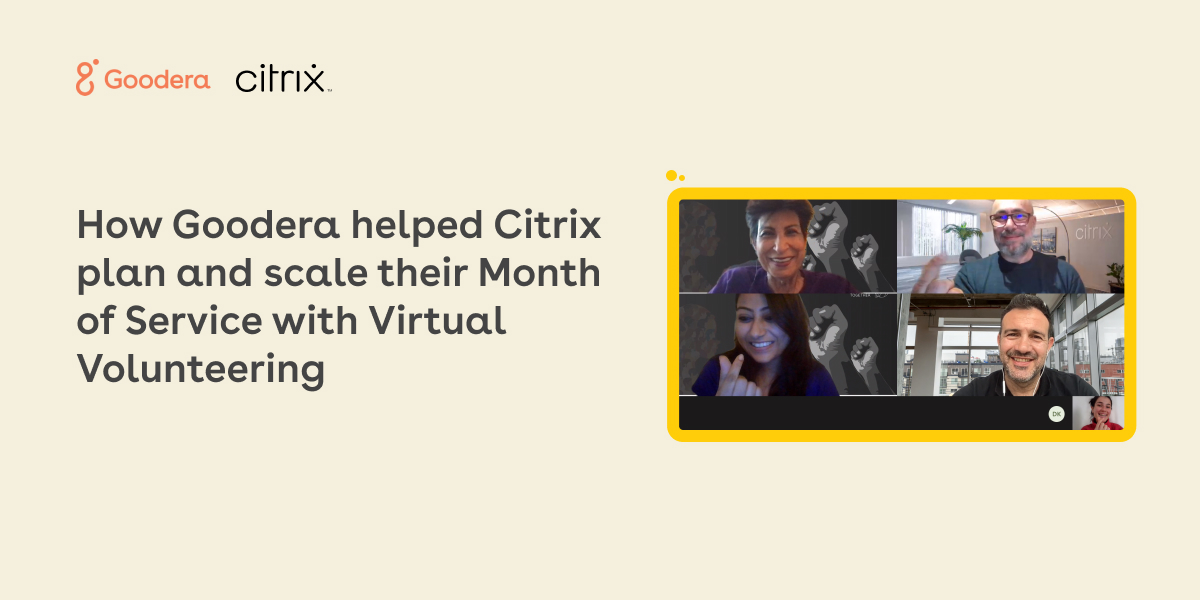
Goodera x Citrix
A prime example of this model in action is a global campaign Goodera architected for Citrix during their Month of Service. By aligning 60 tailored virtual volunteering activities with core enterprise ERG pillars like social equity, accessibility alongside STEM education, the program produced measurably higher cross-functional engagement and stronger cross-ERG relationships across their global workforce.
The experience confirmed what Goodera's ERG clients consistently report: volunteering, when it is genuinely cause-aligned and well-supported operationally, is among the most effective tools available for building the ERG engagement and community that drives long-term participation.
Explore Goodera's ERG volunteering solutions and the full catalog of cause-aligned volunteering opportunities to see how this model works in practice.
Comcast's ERG-Integrated Volunteering Model
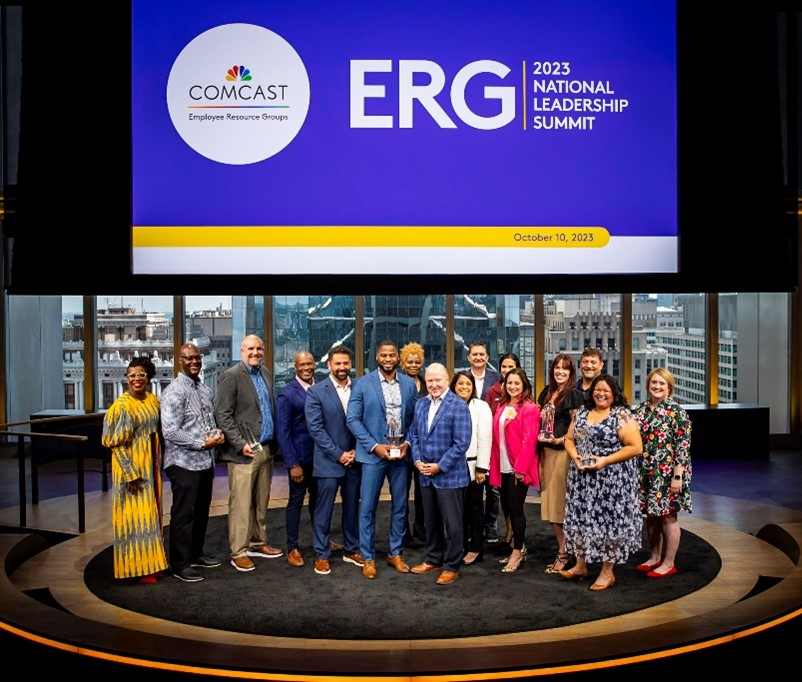
Comcast ERG National Leadership Summit 2023. Image via X.
Comcast's approach is one of the most structurally rigorous examples of ERG-volunteering integration at enterprise scale. The company supports nine ERGs with approximately 36,000 members across 250 chapters, with each ERG receiving annual funding and dedicated cross-ERG event support according to their FY2024 SEC proxy filing.
The volunteering dimension of their ERG program is anchored within their Team UP employee-engagement initiative, which generated over 220,000 volunteer hours from more than 25,000 employee volunteers in 2023 alone. What makes Comcast's model notable is not just the scale, but the methodical investment in cross-ERG programming, which is funded separately and specifically to encourage collaboration across ERG communities. That design choice is what prevents the single-ERG ceiling from limiting the program's reach and impact.
Intuit's ERG Volunteering Architecture

Intuit’s Employee-Led ERG Groups. Image via Intuit.
Intuit's model demonstrates how to embed volunteering into ERG identity at a charter level rather than treating it as an add-on. The company currently operates 15 employee-led ERGs across six countries, and community volunteering is explicitly part of every ERG's charter. The Intuit diversity page states directly: "They also actively volunteer in their communities, which is an important part of their charters."
This design means that ERG membership carries an inherent expectation of community engagement rather than making volunteering optional for ERG members. The practical result is clearly visible. Intuit's Military Network uses their We Care and Give Back volunteer time off hours to volunteer with Operation Gratitude for deployed military personnel.
The Latinos Network connects community members to TurboTax resources for Spanish-speaking customers and supports financial literacy programs aligned with economic empowerment causes. As noted in Intuit's We Care and Give Back corporate responsibility page, employees receive up to 40 hours of paid volunteer time off annually, creating the time protection that makes ERG volunteering participation realistic rather than aspirational.
In a Nutshell
The two hardest problems in corporate volunteering, identifying causes and driving attendance, cannot be solved by a central team alone. Your Employee Resource Groups hold the answers because they understand the issues that resonate deeply with your workforce. They bring pre-existing nonprofit relationships that take months to build and possess the peer influence to engage quiet colleagues. The critical pivot requires shifting from treating ERGs as a workforce to mobilize, to treating them as design partners.
In this framework, ERGs provide the cause and insight, while the central team manages logistics to prevent leader burnout. When executed correctly, participation expands past the usual core and nonprofit partnerships strengthen through authentic, pre-existing trust. ERG leaders cultivate tangible professional skills, while cross-group collaboration achieves a reach no single team could replicate alone. This synergy requires a foundation of clear cause maps, defined charters, and metrics far beyond total volunteer hours.
Frequently Asked Questions
What is the difference between an ERG and a CSR team in the context of corporate volunteering?
ERGs are voluntary, employee-led communities built around shared identity or interest. CSR teams are typically professional functions responsible for designing and managing the company's social impact strategy. In a well-integrated volunteering program, these two operate as complementary partners: ERGs supply community intelligence, cause alignment, and participant networks, while CSR teams provide program infrastructure, nonprofit vetting, impact measurement, and operational support.
How many ERGs does a company need before integrating them into a volunteering program?
There is no minimum number. Even a single ERG can meaningfully contribute to a volunteering program by providing cause alignment and nonprofit connection within its community. That said, the cross-ERG collaboration benefits described in this guide become available only when multiple ERGs exist and are willing to co-design initiatives. Most enterprise companies with 500 or more employees have anywhere from 6 to 15 ERGs, per the Verbate 2025 ERG Resourcing Report, giving them significant raw material for a cross-ERG volunteering architecture.
How do you prevent ERG leaders from burning out when they take on volunteering program responsibilities?
The clearest protection is role separation: ERG leaders own the cause alignment, the community relationships, and the participant outreach, while operational execution sits with the CSR team or a platform partner. Giving ERG leaders a named operations point of contact, a clear scope of what they are and are not responsible for, and explicit acknowledgment of their contribution in performance and recognition frameworks significantly reduces burnout risk.
Can small companies with small ERGs still benefit from ERG-volunteering integration?
Yes. The benefit of ERG-volunteering integration is not proportional to ERG or company size; it is proportional to cause alignment quality and community trust. A 30-person ERG that has a genuine relationship with a local nonprofit and can recruit 20 engaged volunteers for a well-scoped project is producing more durable impact than a 300-person ERG mobilized for a generic event with no cause connection.
How do you measure whether ERG-integrated volunteering is working?
The most useful metrics are: ERG member participation rate (the percentage of ERG members who volunteered in a given period), ally participation rate (non-members who joined ERG-led events), nonprofit partner satisfaction specifically for ERG-sourced engagements, and qualitative feedback from ERG leaders on mission alignment. Aggregate volunteer hours remain useful for program-level reporting but are insufficient for assessing ERG integration effectiveness on their own.
What causes are most commonly aligned with ERG volunteering programs?
The cause areas most commonly associated with ERG-led volunteering include racial equity and economic empowerment (Black Employee Networks, Latinx ERGs), gender equity and women's leadership (Women's ERGs), LGBTQ+ youth and housing support (Pride ERGs), accessibility and disability advocacy (disability inclusion ERGs), veteran employment and mental health (Veterans ERGs), and youth education and workforce development (Early Career ERGs). Each of these has a corresponding nonprofit ecosystem that ERG members often already know from personal community involvement.
Should volunteering be mandatory for ERG members?
Ideally no. ERGs are voluntary structures, and their effectiveness depends on authentic, self-selected participation. Making volunteering mandatory within an ERG would contradict the foundational principle of voluntary membership and is likely to reduce overall engagement. The better design is to embed volunteering into ERG charter as an expected activity while giving members genuine flexibility in how and when they participate.
How do you get ERGs and CSR teams to collaborate effectively when they have historically operated independently?
The most effective bridge is a shared annual (or quarterly, depending on your company) planning process where ERG leaders and CSR teams co-develop the volunteering calendar, cause alignment map, and nonprofit partner list together. This gives ERG leaders visibility into how their communities fit within the broader program, gives CSR teams direct access to ERG community knowledge, and creates shared accountability for outcomes. Starting with one joint pilot initiative before building out a full integration is a lower-risk way to test the collaboration dynamic.
How does ERG-integrated volunteering affect ESG reporting?
ERG-integrated volunteering programs produce outcomes across several ESG reporting dimensions. They generate documented volunteer hours and community impact metrics for GRI (Global Reporting Initiative) 413 (Local Communities) disclosures.
They provide evidence of cross-cultural and inclusive program design that supports human capital disclosures under SASB and CSRD frameworks. And the cause alignment between ERG communities and nonprofit partners supports the authenticity of social impact claims in ESG narratives, which increasingly matters to auditors and stakeholders reviewing those disclosures.
What is the first step a CSR leader should take to begin integrating ERGs into their volunteering program?
Conduct a structured ERG audit. Meet with each ERG lead, ask them to identify their top two cause areas, surface any existing nonprofit relationships within their community, and assess their current capacity and interest in co-designing a volunteering initiative.
That audit typically takes one to two weeks, longer if you're auditing several ERGs at once and produces a clear picture of where the strongest integration opportunities exist. Starting with one or two ERGs where cause alignment, nonprofit relationships, and leadership enthusiasm are all present is a more sustainable entry point than attempting a full company-wide integration simultaneously.