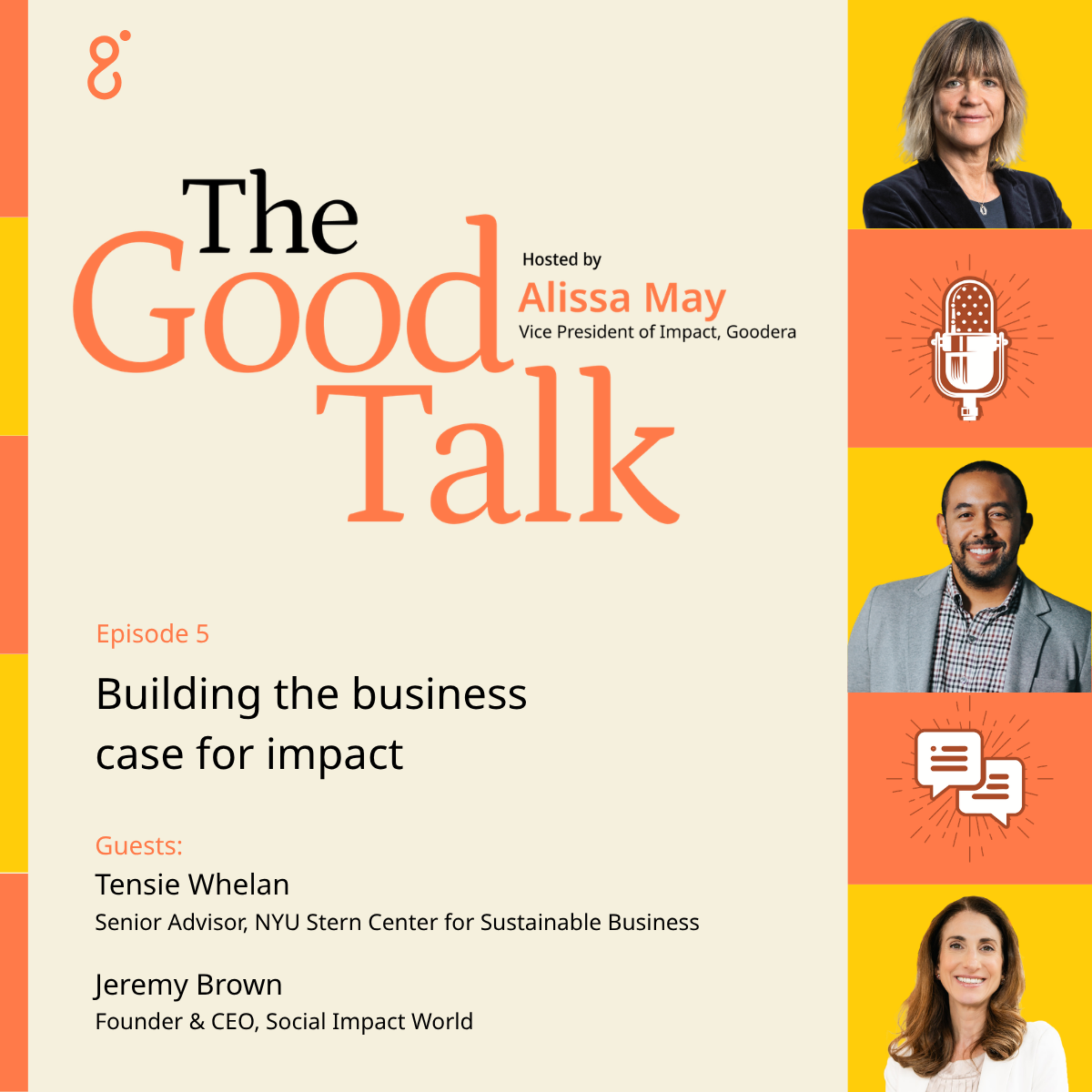
Building the Business Case for Impact


In this episode, Alissa May sits down with Tensie Whelan, founding director of the NYU Stern Center for Sustainable Business and creator of the ROSI (Return on Sustainability Investment) framework, alongside Jeremy Brown, founder of Social Impact World, to explore one of the defining challenges facing sustainability and corporate social impact leaders today: proving business value in an increasingly skeptical environment. Drawing on decades of experience across nonprofits, academia, and corporate engagement, the conversation examines why sustainability initiatives often struggle for executive buy-in, not because they lack impact, but because practitioners fail to communicate in the language of business and finance. Tensie shares how her work at the Rainforest Alliance revealed measurable financial benefits across supply chains, from higher agricultural productivity and lower operating costs to stronger brand value and supply chain resilience, ultimately inspiring the creation of the ROSI framework to quantify sustainability's financial returns. Jeremy complements this perspective by reflecting on the evolution of employee volunteering as a strategic business tool, explaining how community engagement strengthens culture, improves retention, and creates more meaningful employee experiences than traditional team-building activities.
The discussion also explores the growing need for cross-functional fluency inside organizations. Both guests argue that sustainability, CSR, and social impact professionals must develop stronger business acumen and learn to frame their work around financial outcomes, risk reduction, productivity, talent retention, innovation, and long-term enterprise value rather than relying solely on mission-driven arguments. They examine why finance teams often struggle to recognize sustainability's contribution, while sustainability practitioners frequently lack the financial vocabulary needed to build internal credibility. Through practical examples, including employee engagement, workforce productivity, operational efficiency, and emerging research on intangible value creation, the conversation demonstrates how better measurement can transform sustainability from a perceived cost center into a strategic business investment.
Finally, the episode looks ahead to the future of responsible business in an AI-driven economy. Tensie discusses the hidden costs of workforce reductions and overreliance on automation, arguing that companies often overlook the financial value created by employee purpose, trust, and organizational culture. Jeremy adds that many organizations are already reconsidering aggressive AI-driven workforce cuts as they recognize the irreplaceable role of human judgment and relationships. The conversation closes with an optimistic outlook for 2026, emphasizing that the companies most likely to succeed will be those that embed sustainability into core business strategy, remain focused despite external noise, invest in measuring business outcomes alongside societal impact, and equip social impact leaders with the financial skills needed to influence executive decision-making.
Alissa: What is one ritual or tradition that matters to you?
Tensie: Breaking bread with family.
Jeremy: Punctuality. It's something I hold to strongly — showing up on time signals respect for everyone in the room.
Alissa: What's your go-to comfort food?
Jeremy: Definitely rice. I'm a quarter Japanese, and my mom made rice for every meal growing up. Whenever I have it now, I'm transported straight back to childhood. Jasmine rice is probably my go-to, but I don't discriminate.
Tensie: Dark chocolate, any kind. Though if I'm showing my good side — oatmeal with nuts and fruit, every single morning, even in summer. When I was running Rainforest Alliance we received chocolate samples from around the world constantly. I had an entire file cabinet full of them. Very dangerous.
Alissa: What is one lesson in your career that you keep having to relearn?
Tensie: In a management role, making sure you spend time with your best performers, not just your worst. I always want to help the people who are struggling, and I put too much time into that. It's something I keep learning and relearning.
Jeremy: Patience. As much as you might want something to happen tomorrow, that's rarely how it works. Learning to be patient — without losing momentum — is something I come back to constantly.
Alissa: What is your favorite productivity hack or tool you're using right now?
Jeremy: AI, without question. As a solo founder, it's been invaluable for everything from copy editing to ideation. I don't have employees to bounce things off of, so AI has become a genuine thinking partner.
Tensie: Before going into any meeting or conversation — even ones you didn't design — figure out the one thing you want to get out of it. Even as a junior person in a meeting run by someone else, ask: what is one thing I can make happen here? It creates discipline and helps you leave every interaction having gained something. I've trained a lot of people in this and it works every time.
Alissa: Finish this sentence: In 2026, the companies that will stand out in sustainability and social impact are the ones that…
Tensie: Have embedded it in business strategy and are driving better financial as well as societal performance.
Jeremy: Are able to put blinders on and block out the noise. No matter what external pressures they're facing, the companies that succeed this year will be the ones that stay focused on their strategy and why it matters.
Alissa: You've both taken very different paths into this work. How did you end up where you are today? Tensie, let's start with you.
Tensie: I grew up in New York City with two do-gooders — my father worked at the Museum of Natural History, my mother in criminal justice reform. We also had a farm in Vermont, so nature was always part of my world. I went into environmental work through World Wildlife Fund, then moved to Sweden as associate editor of an environmental journal, then to Latin America as a journalist covering environment and development. That's where I got deeply interested in the connection between sustainable livelihoods and environmental protection — how do you ensure people make a good living while also protecting the resources they depend on?I came back to the States and eventually landed at Rainforest Alliance as president, which was a perfect fit because the whole focus was on doing both: biodiversity conservation and sustainable livelihoods, using market forces to drive transformation. We grew from a four-million-dollar organization to fifty million, working in sixty countries.What frustrated me over time was that even when I could talk to CEOs about marketing or field-level work, when I tried to make the business case for sustainability, they'd essentially say, 'You're just an environmentalist.' So I thought — there's a huge business case here that nobody is tracking. When I left Rainforest Alliance, I was invited to teach at NYU Stern, and I said I'd do it if I could build the Center for Sustainable Business. That's what we've been doing since: helping current and future business leaders embed sustainability at the core of business strategy.
Alissa: Jeremy, how about you?
Jeremy: My story starts in 2011 when I graduated college. I joined a large San Francisco tech company with a lot of resources — and not once did we ever give back. No donations, no volunteering. It just wasn't discussed.Then I moved to a Series A startup where an executive had come from Salesforce and brought that giving-back culture with him. My very first week, we went out to volunteer in the San Francisco Presidio, pulling weeds. It gave me a chance to connect with colleagues outside the office in a completely different way. We kept doing it — soup kitchens, more outdoor cleanups — and I realized two things: it made sense as a business, and volunteering is genuinely great for team building.That led me to ask: what can I do to encourage more companies — especially startups — to give back? In 2014 I started Startups Give Back, organizing volunteering events that combined networking and community service. I was still working full-time in tech, but also running meetups and moderating panels for social impact leaders. The audiences kept growing, and in 2019 I decided to build an annual conference: Social Impact World. Then 2020 happened. I pivoted to an online community, and as we came back in-person, it evolved into something much larger.
Alissa: The narrative around social impact, sustainability, and business value has shifted significantly over the last decade. What has actually changed, and where do things feel stagnant?
Tensie: In 2019 there was a real shift toward stakeholder capitalism — moving away from short-term shareholder extraction toward creating value for everyone. That lasted about two minutes. We also had a surge in ESG investing, but a lot of ESG reporting metrics are process-based, not performance-based or impact-based. There are real problems with how those ratings are assigned. And then with the current administration actively attacking sustainability, companies are green-hushing and stepping back.With all that said, there are hundreds of thousands of professionals working in sustainability and social impact, and there are real, urgent business reasons to be focusing on material issues. Decarbonization is ultimately about reducing exposure to climate risk. I see more imperative around the issues — but a lot of pressure not to internalize them or align them with business strategy.
Jeremy: From my lens, what I'm seeing is a change in the practitioners themselves. There's a lot of uncertainty in social impact roles, and the conversation has shifted to: how do you drive business value through impact? How do you become a strategic operator within your business? The focus is on moving away from just running programs and initiatives toward firmly understanding the business side and marrying the two. That's what this field needs to grow, be respected, and be seen as an actual business discipline. I'm genuinely excited about where that conversation is headed.
Alissa: A 2025 ACCP survey found that 51% of social impact professionals are being asked to directly tie their work to business value. Does that surprise you?
Jeremy: I'm surprised it's not higher, honestly. When I put myself in the shoes of a CEO, their job is to build the business. Anything that doesn't serve that is ripe for getting cut — and that's exactly what we're seeing. For practitioners, this is actually a good thing. If you can articulate how your impact work helps the business while still doing great work in the community, your role becomes stickier. A function that isn't embedded in the business is easy to eliminate when times get tough.
Tensie: I agree completely. Consumers across demographics are purchasing sustainably marketed products. Our research at NYU Stern shows those products growing five times faster than conventional ones, at a 27% premium on average, now representing over 25% of total CPG and responsible for 44% of growth in the category. Companies that invest in sustainability and social impact can access better talent, more loyal customers, and stronger investor relationships — while also reducing risk. But the case has to be made in business language.
Alissa: You developed the ROSI framework at NYU Stern to give practitioners a clear, defensible path to making the business case. Can you walk us through it — and are there gaps you still see?
Tensie: ROSI stands for Return on Sustainability Investment. We've identified nine value drivers that link sustainability to better financial performance: operational efficiency, employee productivity and retention, innovation and growth, risk mitigation, sales and marketing benefits, and more. What we do is map by industry and value chain which specific sustainability strategies drive financial performance and how.Take circularity. When you reuse materials, you buy less virgin input, reduce waste disposal fees, use less water and energy, become less reliant on global supply chains, and reduce your exposure to tariffs. Renault in Europe is already putting 40% of used car components back into new cars. If other automakers were doing that, they'd have 40% less exposure to the tariffs that caused billions in write-downs.Or take decarbonization. Installing LED lighting in factories reduces energy costs and exposure to price volatility, lowers your exposure to carbon fees, cuts maintenance costs in half, and can reduce incident rates due to better lighting. That's a social benefit that also generates financial performance — but companies look only at the upfront cost and say it's too expensive.We've done this work in agriculture, automotive, apparel, real estate, energy, banking, and private equity. The consistent finding: sustainability is just good management.
Alissa: We're seeing a culture of repeated layoffs and people being treated as disposable. Is the argument that sustainability attracts better talent still holding?
Tensie: The accounting is deeply broken here. Regretted turnover is not tracked. Training and investment in people is treated as an expense, not an investment. You can depreciate technology and get tax advantages on capex, but not people. So the incentive structure pushes companies toward outsourcing, offshoring, and automation.Here's a concrete example: one major company hires tens of thousands of people each year to fill a far smaller number of positions. It takes a month to train someone. After a month, they leave. Customer satisfaction is among the lowest in the industry. And nowhere in their financials can you find what it costs to run that cycle — the hiring, the free product given away as apologies, the customer attrition. Instead, the headline is: we pay our workers a low wage.We worked with REI — a company known for purpose and sustainability — and assessed the financial benefit of that positioning specifically for them. It translated to about $40 million annually, roughly 5% of payroll, in reduced turnover costs and higher productivity. That's a real number from an intangible investment. Companies that chase cheap and replace people with AI without understanding those hidden costs will face a talent pipeline crisis.
Jeremy: I'm actually starting to see the reverse happen for some of those companies. They're beginning to regret the cuts they made because AI, while genuinely useful, really can't replace people in many instances. The pendulum swings.
Alissa: What are you actually seeing land well with executives? And what falls completely flat?
Jeremy: Employee engagement through volunteering is landing. Most companies default to happy hours or bowling, but they don't explore volunteering as a genuine team-building tool. What I heard over and over when building Startups Give Back was that volunteering created a depth of connection between colleagues that you simply can't get at a happy hour.B2B impact partnerships are also landing. Monday.com, Morgan Stanley, and Snap formed a partnership because their practitioners met at a conference and realized they were all working on youth education in silos. Combining resources to solve a systemic problem together — and the marketing value of being publicly aligned with companies of that caliber — that's a story executives understand.Stanley 1913 also did something interesting: their first social impact product collection, working with an organization called Nest that supports artisans around the world. The collection featured artwork from those artists. From a business perspective, you have a product that's also telling a powerful story. Practitioners going beyond standard volunteering and grantmaking into product and partnerships is something I'm genuinely excited about.
Tensie: Supply chain partnerships and building resilience through sustainability is resonating. Moving from a transactional supplier relationship to a collaborative one where you're jointly solving challenges — that matters to leadership. Customer demand, both B2B and B2C, is also driving decisions. Companies that have made their own climate commitments need their suppliers to provide sustainable options, so that creates pull through the value chain.Risk is trickier. While leadership talks about risk, they're less likely to invest against a downside than toward an upside. Human nature is to think, 'It won't happen to us.' So risk framing tends to unlock less investment than an upside opportunity. Frame it as competitive advantage, not just exposure mitigation.
Alissa: Given all the evidence, why does the internal fight still feel so difficult for most practitioners?
Tensie: Every single company — even sophisticated ones — is not tracking this data. When we go into a company, they don't have it. We have to go find it with them. What people are doing instead is talking in the language of greenhouse gas emissions, waste reduction, or employee wellbeing — all genuinely important — but then not translating it into the language of business. Decarbonization becomes energy cost savings and lower maintenance costs. Employee wellbeing becomes productivity and retention, which becomes X in cost savings. That translation doesn't happen, and so sustainability gets treated as something separate.ESG compliance makes this worse, not better. Those metrics are process and output based, not performance and outcome based. An apparel company that asks, 'Do you have a policy on chemical use?' gets the same score as a company that's developed a bio-based dye that creates competitive advantage, reduces worker illness, and lowers water and energy costs. The compliance frameworks reward reporting, not results.
Jeremy: The same challenge exists on the social impact side. We report volunteer hours and dollars donated. But what does 40 volunteer hours actually mean for the business? Executives ask that question and practitioners often can't answer it. The job now is to be an educator — to go on listening tours across departments, understand what each function is on the hook for, and then explain how impact work supports those goals. The practitioners I see succeeding are the ones doing exactly that.
Alissa: How are you thinking about the balance between data and story? It feels genuinely hard to do both well.
Jeremy: You absolutely need both, and the story amplifies the data. One of the best examples I've seen is the San Francisco-Marin Food Bank. After a volunteering shift, the shift lead told us how many pounds of food we'd packed — impressive number. But he didn't stop there. He told us how many people that food would serve in the community that quarter. That one additional layer changes everything. The data gives you the scale; the story gives you the emotional connection to why it matters.
Tensie: I agree — and I'd add a third element: the strategic implication. We did a ROSI project with McDonald's and Carrefour looking at beef supply chains in Brazil. The question was whether to require sustainable agriculture practices from suppliers, on top of deforestation-free requirements. What we found was that sustainable agriculture drove a ninefold increase in profitability for ranchers through improved productivity, reduced input costs, and lower risk — plus reduced greenhouse gas emissions by 20% and better quality beef. For the buyers, a premium product with lower supply chain risk.We had great individual stories about the farmers, and strong data. But the key was pulling out the strategic lesson: deforestation-free is table stakes risk mitigation, but sustainable agriculture is transformational. Both McDonald's and Carrefour continued to commit to both requirements. That's what happens when data, story, and strategic implication come together.
Alissa: Fast-forward to 2030. If we get this right, what does the relationship between purpose and business strategy look like?
Jeremy: Corporate impact will be a valued, respected business discipline with the same strategic weight as marketing, operations, or sales. Practitioners will have a seat at the table. They'll be seen as people who understand both the business side and the societal side and can integrate the two to drive the business forward while helping solve systemic community problems.
Tensie: And I'd add: business needs to move away from a model of extracting value from everyone and everything around it. That model only works in the short term. Right now, sustainability and social impact sit off to the side because much of the organization is focused on maximizing extraction — with a mistaken belief that this is what investors want and what's best financially. In five years, I hope investors, leadership, regulators, employees, and customers all recognize that business is in the business of creating value for a wide range of stakeholders, in addition to generating profit — not instead of it. Sustainability and social impact become core to decision making, strategy, management, and performance.And there's a reason for hope: we've been socialized for about 80 years to shop purely on price, but that's not a permanent human condition. Before that, people evaluated products on value — artisanship, durability, what they represented. There's no reason we can't shift back toward value that includes sustainability, social impact, and the things that matter over the long term.
Alissa: What do you consistently see companies getting wrong, and what would you tell them to stop doing?
Jeremy: Not embedding impact into the business. It has to happen, and the how matters enormously. Practitioners need to understand not just that integration is important but what it actually looks like in practice — how you connect your work to every function in the building.
Tensie: Stop treating sustainability and social impact as separate from the business — as a nice-to-have rather than a must-have. Start treating it as part of business strategy, start collecting data on its financial as well as societal impacts, and use that data in your decision-making the same way you would any other business function. That's the shift.

.png)
.png)


