Types of Volunteering: In-Person vs. Virtual vs. Hybrid Volunteering

Volunteering can look different depending on who’s taking part, where they work, and the causes they care about. One team might spend a morning restoring a local park, while another mentors students online or combines remote and in-person activities to support a community project. Each offers a different way to make a difference.
For companies planning their volunteering calendars, the question is which formats and activities make the most sense for their workforce and the communities they support. Industry trends, employee demographics, participation rates, and event-level data can help answer that question.
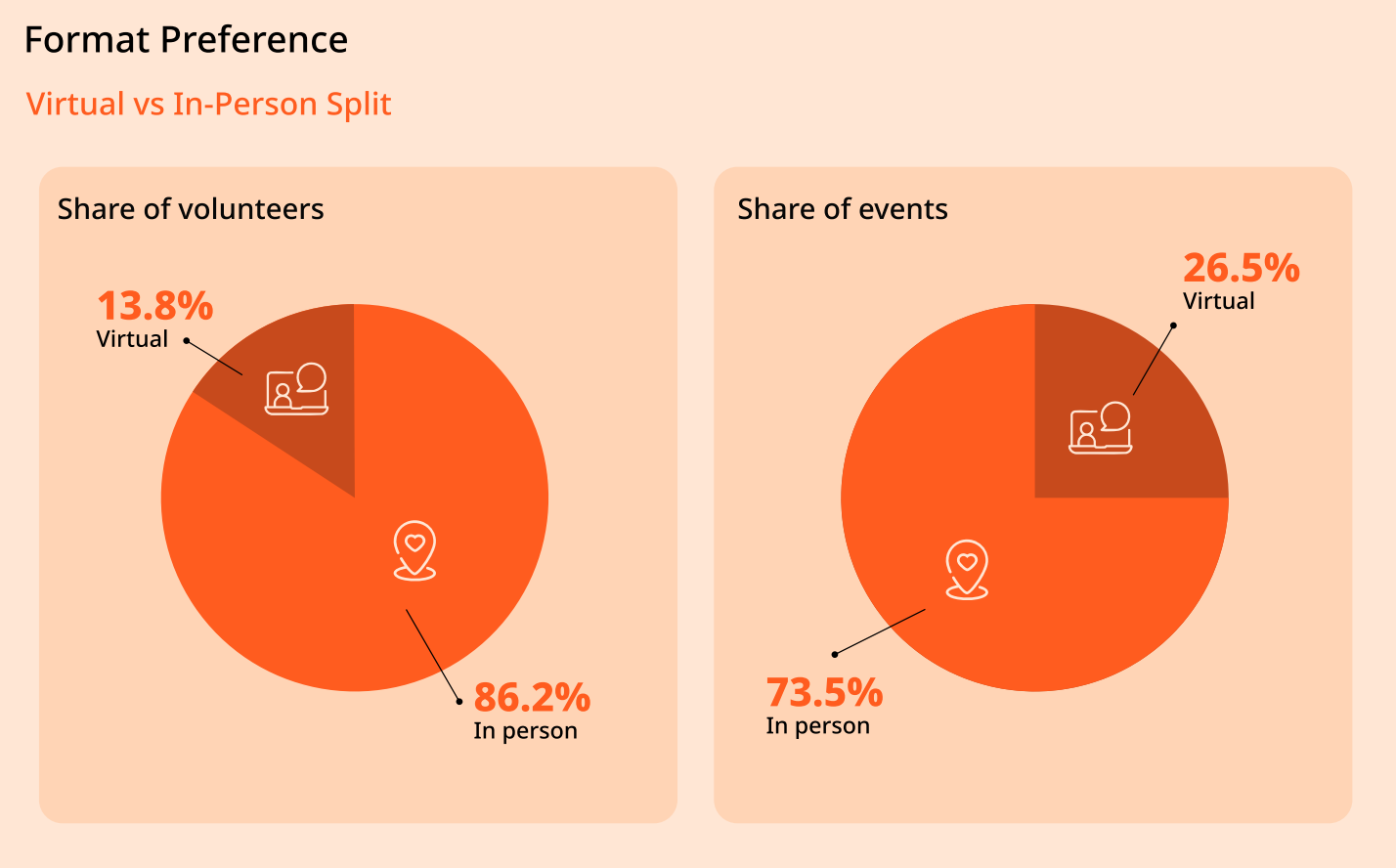
Goodera’s Volunteering Quotient (VQ) Report 2026 offers one useful starting point. When both in-person and virtual options were available, 86.2% of volunteers chose in-person activities, while 13.8% chose virtual ones. Virtual activities, meanwhile, accounted for 26.5% of scheduled events.
These figures offer a useful perspective on how event planning and employee participation can differ, and why it helps to look at the data alongside your own workforce’s needs.
In this guide, we’ll explore the three main volunteering formats, the different categories of volunteer work within them, examples of each, and how to choose the right mix for your team.
What Are the Different Types of Volunteering?
Corporate volunteering can take place in three formats: in-person, virtual, and hybrid. These formats describe how employees participate. In-person volunteering brings people together at a physical location, virtual volunteering lets them contribute remotely, and hybrid volunteering combines both.
Within each format, employees can take part in different types of volunteer work, such as hands-on community service, skills-based projects, mentoring, or micro-volunteering. The same activity can often be adapted to suit different formats, depending on the nonprofit’s needs and the resources available.
For example, employees supporting a literacy nonprofit could volunteer in person by reading with children at a local school, volunteer virtually by recording audiobooks, or take part in a hybrid initiative by recording stories remotely and joining an in-person book drive.
The cause stays the same, but the way employees contribute changes.
What Is In-Person Volunteering?
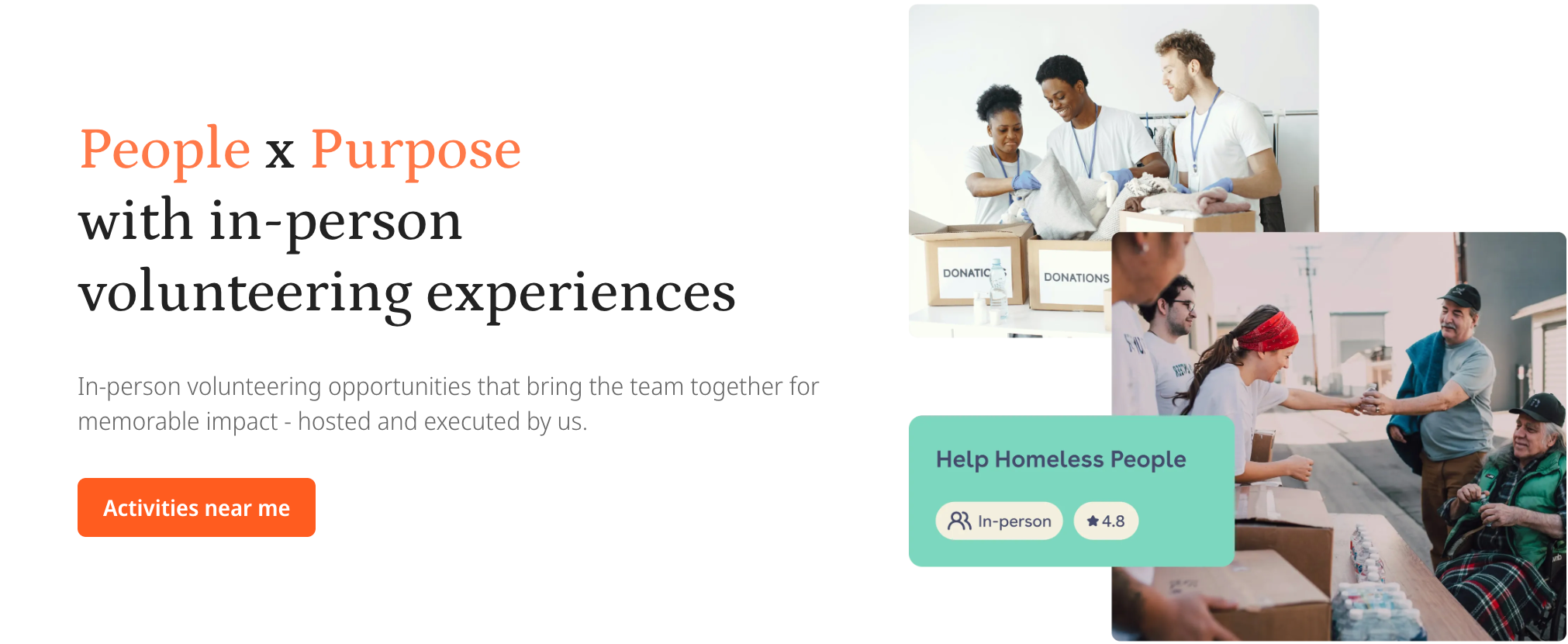
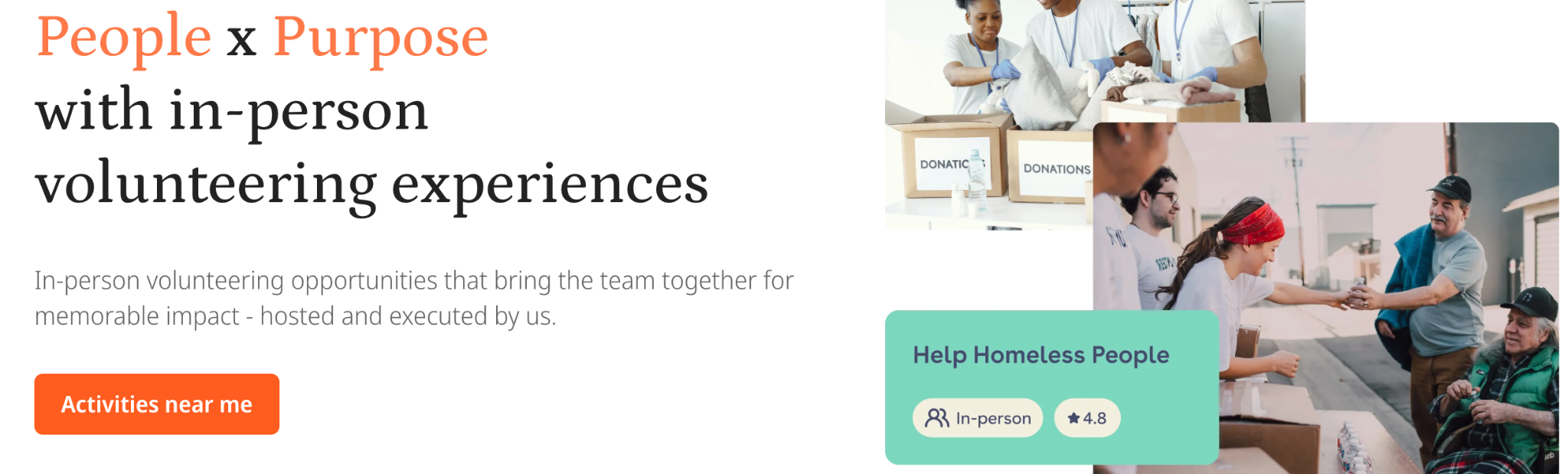
In-person volunteering is any activity where employees are physically at the site of the work. That includes serving at a food bank, building a playground, packing kits at an office station, mentoring in a classroom, or cleaning a beach. The team is together, the nonprofit is present, and the result is visible by the end.
It is the format employees choose most often when given the option, and the one that delivers team-building alongside impact. Its limits are logistics: a date, a place, transport, and everyone in the same city. Our catalog of in-person volunteering opportunities covers the range, from two-hour office activities to full-day site builds.
What Is Virtual Volunteering?
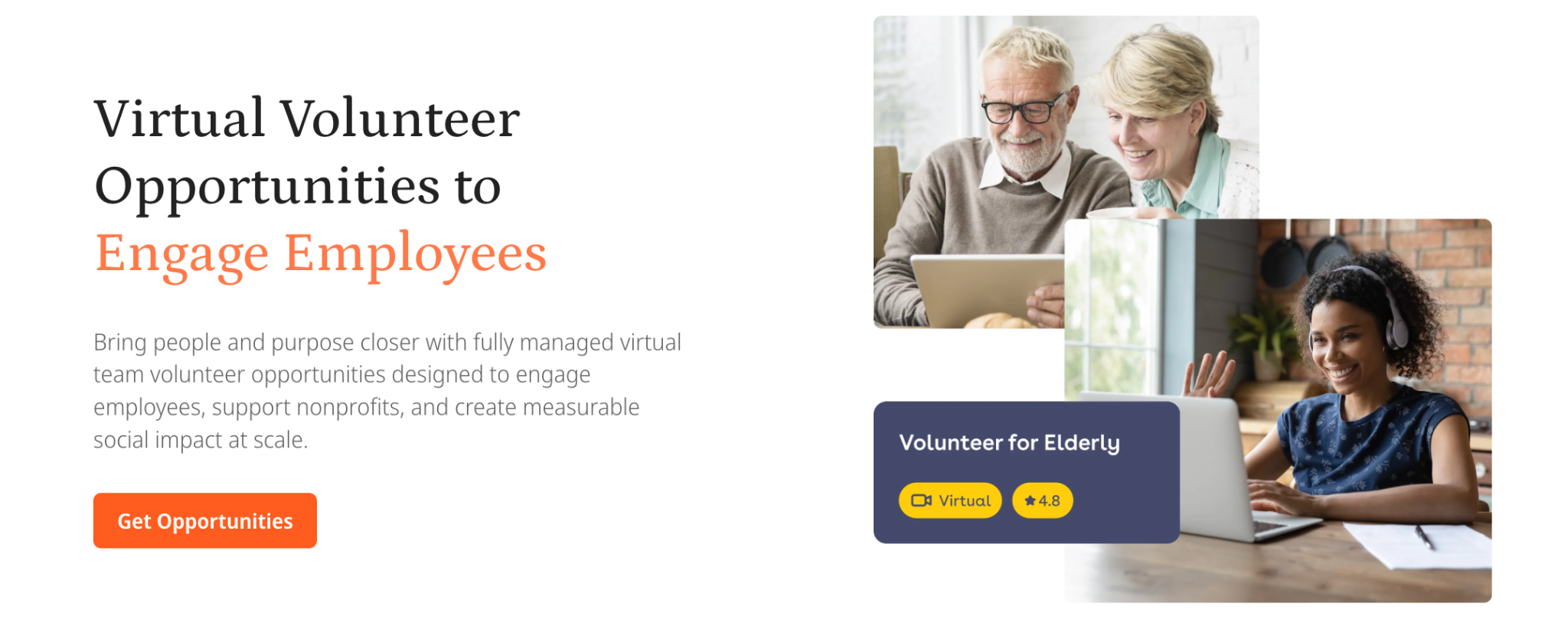
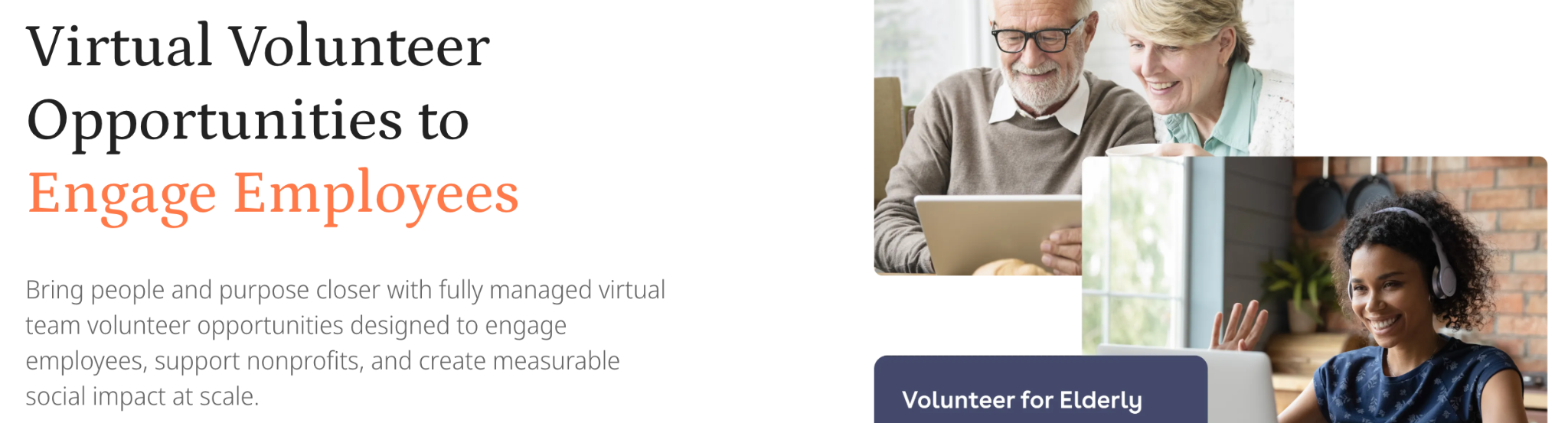
Virtual volunteering is any activity completed online or remotely, with no physical presence at the nonprofit. Examples include recording audiobooks for children, building STEM flashcards, translating documents, reviewing a nonprofit’s website, mentoring a student over video, or writing letters that are scanned and sent.
Its strength is reach. A virtual activity can run across time zones and include employees who never set foot in an office. Its weakness is that it competes with every other tab on a laptop, so participation depends on how well the activity is hosted. Our virtual volunteering activities are run live by a host for that reason.
What Is Hybrid Volunteering?
Hybrid volunteering combines in-person and virtual elements in a single activity or campaign. The most common form is a kit-based project: materials are shipped to employees at home or set up at an office station, everyone builds the same thing during a hosted video session, and the finished kits are collected and delivered to the nonprofit by a local team.
Hybrid solves the problem distributed companies face: one campaign, one date, one story, with employees in the office and at kitchen tables taking part together. It takes more coordination than either format alone, which is why it works best with a partner managing logistics.
What Are the Main Categories of Volunteer Work?
By activity, volunteer work falls into six categories: hands-on service, skills-based volunteering, micro-volunteering, mentoring and tutoring, event and campaign volunteering, and board service. Each category can run in-person, virtually, or as a hybrid, and each asks something different of the volunteer.
- Hands-On Service
Hands-on service is physical work with a direct result: sorting donations, serving meals, planting trees, packing hygiene kits, painting a classroom. It needs no special skill, which makes it the most accessible category and the usual entry point for first-time volunteers.
In-person is the natural format, but hands-on service runs virtually through kit-at-home activities, and it is the backbone of most hybrid campaigns.
- Skills-Based Volunteering
Skills-based volunteering puts an employee’s professional expertise to work for a nonprofit: a marketer rewriting a donor appeal, a developer fixing a website, an accountant setting up a budget template. It delivers more value per hour than any other category, because nonprofits rarely have those skills on staff.
It runs well in any format and especially well virtually, since the work is usually on a laptop anyway. Our guide to skills-based volunteering benefits, examples, and best practices explains how to scope a project,
- Micro-Volunteering
Micro-volunteering is a task that takes minutes rather than hours and needs no commitment beyond the task itself: writing one letter, tagging photos for a research project, recording a two-minute audio message, answering a survey for a nonprofit. The individual contribution is small; the point is that hundreds of people can make it.
It is the most virtual-friendly category and the one that reaches employees who would never sign up for a half day. Our guide to micro-volunteering covers how it works and why it has grown so fast.

- Mentoring and Tutoring
Mentoring and tutoring pair an employee with a student or job seeker over time: career conversations, resume reviews, reading practice, STEM help, interview coaching. It is the category with the deepest individual impact, and the one that most depends on consistency.
It works in person or over video, and many programs now run it as a hybrid, with an in-person kickoff followed by virtual sessions. It suits employees who want a relationship rather than an event.
- Event and Campaign Volunteering
Event and campaign volunteering is tied to a date or a drive: a Day of Service, Earth Day, a holiday gift collection, a company-wide week of giving. The activity itself may be hands-on or skills-based; what defines the category is the shared moment.
Campaigns are where hybrid formats earn their keep, because one theme can run in every office and home on the same week. Goodera’s campaign calendar maps the year’s moments to activities in each format.
- Board Service and Long-Term Commitments
Board service and long-term commitments are the smallest category by headcount and the largest by hours: serving on a nonprofit board, a standing advisory role, a year-long mentoring commitment. They suit senior employees and those who want governance experience.
Most board work is now hybrid by default, with in-person meetings a few times a year and virtual work between them. Companies usually support it with volunteer time off rather than organized events.
Which Types of Volunteering Do Employees Choose?
Given a choice, employees pick in-person. Goodera’s VQ Report 2026 found that 86.2% of volunteers chose in-person activities when both formats were available, while virtual accounted for 13.8% of volunteers. The planning side looked different: virtual formats made up 26.5% of scheduled events.
What does this mean for your volunteering program?
In-person activities attracted a larger share of volunteers relative to the number of events organized. Use this as a benchmark, not a reason to phase out virtual volunteering. Review registration and attendance data for each format in your own program to see which activities attract participation, then adjust your calendar based on employee preferences, work arrangements, and the needs of the communities you support.
Two practical conclusions. First, if you have remote employees, keep virtual on the calendar, but run it as an event rather than a link. Second, if you want participation to rise, put more of your budget into in-person and hybrid, because that is where employees are already telling you they want to be.
How Do In-Person, Virtual, and Hybrid Volunteering Compare?
Side by side, the three formats trade reach for depth. Use the table to match a format to the outcome you need, then check the categories above for which activities fit.
The last row is where you start. Match the format to the moment, not to the office you happen to be sitting in.
Some Fun Facts About Volunteering Formats
A few points worth keeping in the back pocket.
- Virtual volunteering is older than video calls. The United Nations Volunteers program launched its Online Volunteering service in 2000, two decades before most companies tried a virtual event.
- Hybrid is a format, not a compromise. A kit built at home and delivered in person reaches more people than either format alone and produces a single, countable result for the nonprofit.
- The schedule and the sign-up sheet disagree. In Goodera’s VQ Report 2026, virtual was 26.5% of scheduled events and 13.8% of volunteers. The gap is the clearest argument for rethinking how virtual events are run, not whether to run them.
- Skills-based work travels best. It is the one category that loses almost nothing when it moves online, because the work was going to happen on a laptop anyway.
What Are Some Examples of Volunteering Activities for Teams?
The examples below are drawn from activities Goodera runs with nonprofit partners. Each is tagged by category so you can see how the same type of work changes shape across formats.
- In-Person Volunteering Examples
- Sorting and packing at a food bank (hands-on service)
- Building a playground or refreshing a school (hands-on service, team day)
- Running a resume clinic at a community center (skills-based)
- Reading with students at a local school (mentoring and tutoring)
- Assembling hygiene kits at an office station (hands-on service, micro-volunteering)
- Beach or park cleanup on Earth Day (event and campaign)
Browse more on our in-person volunteering opportunities page or, for activities built around a shared day, our team-building volunteering page.
- Virtual Volunteering Examples
- Recording audiobooks for hospitalized children (micro-volunteering)
- Creating STEM flashcards for underserved students (hands-on service, virtual)
- Reviewing a nonprofit’s website for accessibility (skills-based)
- Career mentoring over video with a job seeker (mentoring and tutoring)
- Translating educational materials into a second language (skills-based)
- Writing letters to isolated older adults, scanned and delivered (micro-volunteering)
Browse more on our virtual volunteering activities page.
- Hybrid Volunteering Examples
- A company-wide kit build during a giving week: materials shipped to remote staff and set up at office stations, assembled together on a hosted call, delivered by a local team (hands-on service, event and campaign)
- A mentoring program with an in-person kickoff and monthly virtual sessions (mentoring and tutoring)
- A skills-based project scoped on-site with the nonprofit and delivered remotely over four weeks (skills-based)
- A letter-writing campaign where remote employees write and an office team assembles and hand-delivers the packages (micro-volunteering, event and campaign)
Which Type of Volunteering Fits Your Team?
Match the format to where your people are, what they can do, how much time they have, and what your partner needs. Four questions get you there.
1. Where Are Your Employees?
If most of your workforce shares a location, in-person should be the backbone. If they are distributed across cities or countries, hybrid gives you one campaign that reaches all of them. If a meaningful share is fully remote, virtual activities with a live host keep them in the program rather than watching it from the sidelines.
2. What Skills Do They Have?
A company full of engineers, marketers, and analysts has skills nonprofits cannot buy. Skills-based volunteering, in any format, puts those to work. A workforce in frontline or operational roles may find more energy in hands-on service and team days, where the result is physical and shared.
3. How Much Time Can They Give?
Employees with volunteer time off (VTO) can take half days for in-person events. Employees without it, or with packed schedules, are better served by micro-volunteering and short virtual sessions they can fit between meetings. Our VTO policy guide covers how to make the hours available.
4. What Does Your Nonprofit Partner Need?
Ask before you pick. A shelter may need hands and a Saturday. A small nonprofit may need a website and a donor database far more than another volunteer day. Your employee resource groups often already know which partners need what, and they are a good place to start the conversation.
Key Takeaways
The calendar and the sign-up sheet told different stories. Here is how to make them agree.
- There are three formats and six categories. In-person, virtual, and hybrid are where volunteering happens. Hands-on service, skills-based work, micro-volunteering, mentoring, campaigns, and board service are what happens. Any category can run in any format.
- Employees choose in-person when they can. Goodera’s Volunteering Quotient (VQ) Report 2026 found that 86.2% of volunteers chose in-person when both formats were offered, while virtual was 13.8% of volunteers against 26.5% of scheduled events.
Note: This doesn’t mean one size fits all. The actual participation and preferences would differ by industry, locality, team demographics, and preferences. You should run an internal poll, analyze historical numbers on event formats, and check employee preferences before you set your calendar. - Virtual is not the problem; unhosted virtual is. Live hosting, a clear task, and a visible result close most of the gap. Micro-volunteering and skills-based projects are the categories that work best online.
- Hybrid is how distributed companies get one program. A kit built at home and at the office, delivered by a local team, gives everyone the same campaign on the same date.
- Match format to the moment. In-person for team days and flagship events. Virtual for global reach and quick tasks. Hybrid for campaign weeks. Decide by where your people are, what they can do, how much time they have, and what your partner needs.
Goodera plans and runs all three formats, with live hosts for virtual sessions, on-the-ground teams for in-person events, and logistics for hybrid campaigns, for companies working with 50K+ nonprofits across 100+ countries. Explore our in-person and virtual volunteering activities, or read the VQ Report 2026 for the full data on what employees choose.
Frequently Asked Questions
1. What Are the Main Types of Volunteering?
By format, the main types of volunteering are in-person, virtual, and hybrid. In-person volunteering happens at a physical site such as a food bank, school, or park. Virtual volunteering is completed online or remotely, with no physical presence at the nonprofit. Hybrid volunteering combines both in one activity, such as a kit built at home and delivered by a team in person. By activity, volunteer work also falls into categories such as hands-on service, skills-based volunteering, micro-volunteering, mentoring, event volunteering, and board service.
2. What Are the Different Types of Volunteering for Employees?
Employees can take part in hands-on service such as packing kits or serving meals, skills-based volunteering that uses their professional expertise, micro-volunteering tasks that take minutes, mentoring and tutoring over time, event and campaign volunteering tied to a date such as a Day of Service, and long-term commitments such as nonprofit board service. Each of these can run in person, virtually, or as a hybrid, which is why most corporate programs offer a mix rather than a single type.
3. What Are the Categories of Volunteer Work?
The six common categories of volunteer work are hands-on service (physical work with a direct result), skills-based volunteering (professional expertise applied to a nonprofit’s needs), micro-volunteering (short tasks with no ongoing commitment), mentoring and tutoring (one-to-one support over time), event and campaign volunteering (activities tied to a date or drive), and board service and long-term commitments (governance and advisory roles). The category describes what the volunteer does; the format describes where.
4. What Are Some Examples of Volunteering Activities?
In-person examples include sorting at a food bank, building a playground, running a resume clinic, and cleaning a beach. Virtual examples include recording audiobooks for children, creating STEM flashcards, reviewing a nonprofit’s website for accessibility, and mentoring over video. Hybrid examples include a company-wide kit build with materials shipped to remote staff and delivered by a local team, or a mentoring program with an in-person kickoff and virtual sessions. Goodera’s in-person and virtual activity catalogs list hundreds more by cause and format.
5. What Is the Difference Between In-Person and Virtual Volunteering?
In-person volunteering puts employees physically at the site of the work, together with their team and the nonprofit, and usually takes two to eight hours including travel. Virtual volunteering is done online from wherever the employee is, usually in 30 minutes to two hours, and reaches remote and distributed staff that in-person events cannot. In-person delivers more team-building and visible impact per event; virtual delivers more reach. Goodera’s Volunteering Quotient (VQ) Report 2026 found that 86.2% of volunteers chose in-person when both were offered.
6. What Is Hybrid Volunteering?
Hybrid volunteering combines in-person and virtual elements in a single activity or campaign. The most common form is a kit-based project: materials are shipped to employees at home or set up at an office station, everyone builds the same thing during a hosted session, and a local team collects and delivers the finished kits to the nonprofit. It gives distributed companies one campaign, one date, and one result, with employees in the office and at home taking part together.
7. Which Type of Volunteering Do Most Employees Prefer?
In-person. Goodera’s Volunteering Quotient (VQ) Report 2026 found that when both formats were available, 86.2% of volunteers chose in-person activities, while virtual accounted for 13.8% of volunteers even though virtual formats made up 26.5% of scheduled events. The gap suggests companies are scheduling more virtual events than employees want to attend, and that virtual works best when it is hosted live with a clear task, rather than sent as a self-serve link.
8. What Is Micro-Volunteering?
Micro-volunteering is a volunteering task that takes minutes rather than hours and requires no commitment beyond the task itself, such as writing one letter, recording a short audio message, tagging photos for a research project, or completing a survey for a nonprofit. The individual contribution is small; the value comes from many people doing it. It is the most virtual-friendly category and reaches employees who would not sign up for a longer event.
9. Which Type of Volunteering Works Best for Remote Teams?
Hybrid and virtual. Hybrid campaigns, where kits are shipped to remote employees and built together on a hosted call before a local team delivers them, give remote staff the same activity and date as colleagues in the office. Virtual activities with a live host, such as recording audiobooks or building STEM flashcards, work well for teams spread across time zones. Skills-based projects also translate well to remote work, since the tasks happen on a laptop regardless of location.
10. How Does Goodera Support In-Person, Virtual, and Hybrid Volunteering?
Goodera plans and runs volunteering in all three formats. In-person events come with vetted nonprofit partners, materials, and on-the-ground teams. Virtual activities are hosted live by trained facilitators, in 30+ languages, with materials shipped where kits are involved. Hybrid campaigns combine both, with one date and one result across offices and homes. Participation data from every format flows into Benevity automatically. Goodera works with 50K+ nonprofits across 100+ countries.