Alzheimer's Awareness Week

Alzheimer's disease rarely affects just one person. It changes the lives of families, friends, caregivers, and colleagues, often long before a formal diagnosis. As more people take on caregiving responsibilities while balancing their careers, the impact of dementia is becoming increasingly visible in the workplace.
That is why Alzheimer's Awareness Week provides an important opportunity for organizations to build understanding and support. Beyond raising awareness, the week encourages workplaces to educate employees, reduce stigma, recognize the challenges faced by caregivers, and strengthen partnerships with organizations working in dementia care and research.
For CSR, HR, and People teams, it is an opportunity to turn awareness into meaningful action. Whether through employee education, volunteering with dementia-focused nonprofits, fundraising campaigns, caregiver support initiatives, or workplace policy improvements, organizations can use the week to support both employees and their communities. This guide explores why Alzheimer's Awareness Week matters, key dates to know, and practical ways your team can build a meaningful campaign this year.
When is Alzheimer's Awareness Week Celebrated?
Unlike many workplace observances, there is no single global Alzheimer's Awareness Week. Awareness campaigns are organized by national Alzheimer's organizations and advocacy groups, so the timing varies by country. This can create confusion for global organizations planning a single campaign across multiple regions.
Regional Observances
In the United States, the Alzheimer's Association observes Alzheimer's & Brain Awareness Month throughout June, encouraging supporters to "go purple" and take part in local walks and fundraising events.
In Canada, the Alzheimer Society leads a national Alzheimer's Awareness Month every January, with a coordinated day of action on January 28, 2026, under the Forget No One campaign.
In the United Kingdom, the Alzheimer's Society runs Dementia Action Week, scheduled for May 18 through May 24, 2026, focused on encouraging people to act on the early signs of dementia. Globally, Alzheimer's Disease International coordinates World Alzheimer's Month every September, anchored by World Alzheimer's Day on September 21.
Planning for a Global Workforce
If your organization operates across multiple countries, consider aligning your primary campaign with the observance that is most relevant to your largest employee population or business footprint. You can then adapt key messages, volunteer opportunities, or educational content for teams in other regions during their local awareness campaigns.
This approach keeps your global messaging consistent while allowing employees to participate during the observance that is most recognized in their country.
Choosing the Right Week for a Global or Distributed Workforce
For a company with offices in more than one country, the practical move is to pick the observance that matches where most employees or clients are based, then build a lighter-touch version of the same content for other regions during their own local week.
A global technology or professional services firm might run a full skills-based volunteering push during the June US observance and a shorter awareness and caregiver resource campaign in January for Canadian teams and in May for UK teams. This staggered approach also spreads planning effort across the year instead of concentrating it into a single, high-pressure week.
Why This Observance Belongs on Every CSR Calendar
Alzheimer's disease already sits closer to your workforce than most CSR planning documents acknowledge, and the numbers back that up clearly.
The Scale of the Problem Sitting Inside Your Workforce
An estimated 7.4 million Americans age 65 and older are living with Alzheimer's in 2026, according to the Alzheimer's Association's 2026 Alzheimer's Disease Facts and Figures report, and that figure is projected to rise to nearly 13 million by 2050. Behind those patients stands an even larger group: nearly 13 million Americans currently provide unpaid care for someone with Alzheimer's or another dementia, contributing more than 19 billion hours of care in 2025 alone, valued at over $446 billion.
Health and long-term care costs tied to dementia are projected to reach $409 billion in 2026. Given those numbers, it is statistically likely that caregivers, or people worried about their own cognitive health, are already sitting in your all-hands meetings.
The Business Case for Employers: Retention, Trust, and Employer Brand
Supporting employees through this issue is not only compassionate, but it is also good workforce strategy. Vanessa Okwuraiwe, a principal at Edward Jones, told the U.S. Chamber of Commerce Foundation in March 2025 that companies that prioritize caregiver-focused policies tend to see higher retention and satisfaction, along with increased productivity and reduced absenteeism.
Edward Jones backs this with action, extending its strategic alliance with the Alzheimer's Association through 2030 following an earlier five-year, $25 million commitment that began in January 2021. A well-designed Alzheimer's Awareness Week program signals to current and prospective employees that a company's stated values around well-being and family care extend into concrete support.
The Hidden Workforce: Employees Who Are Already Caregivers
Every organization has a quiet population of working caregivers, and most CSR teams underestimate its size until they start asking questions.
Recognizing the Signs of Caregiver Strain on a Team
The signals are often subtle rather than dramatic. A previously punctual employee starts arriving late or leaving early on a recurring basis, a strong performer becomes harder to reach during certain hours, or someone quietly declines travel and after-hours commitments they once accepted without hesitation.
According to the Alzheimer's Association, as reported by AARP Colorado in 2025, 69 percent of working caregivers report rearranging their schedule, cutting their hours, or taking unpaid leave to manage caregiving responsibilities. Jim Herlihy, a spokesperson for the Alzheimer's Association of Colorado, described these caregivers as "the unsung heroes" carrying a heavy load largely out of view of their employers.
Workplace Policies That Support Caregiving Employees
Recognizing caregiver strain only matters if it is followed by concrete policy support, and this is where Alzheimer's Awareness Week can serve as a natural launch point for benefits that should exist year-round.
Flexible Scheduling and Compassionate Leave
Predictable flexibility, such as the ability to shift start times or work remotely on specific days, allows caregivers to manage medical appointments and unpredictable symptom episodes without using up vacation time. Compassionate or caregiver leave policies, distinct from standard sick leave, give employees dedicated time for caregiving duties without having to disclose every personal detail to a manager.
Employee Assistance Programs Built for Dementia Care
Generic Employee Assistance Programs often fall short here because dementia caregiving involves legal, financial, and long-term care questions that a standard counseling session cannot fully address. Partnering with organizations like the Alzheimer's Association, which operates a free 24/7 Helpline, gives employees a specialized resource that complements a general EAP rather than replacing it.
Building a Corporate Volunteering Program Around Alzheimer's Awareness Week
With the business case and the caregiver reality established, the next step is designing activities that employees will actually want to join.
Skills-Based Volunteering Ideas
Skills-based volunteering tends to create a deeper connection to the cause than a single afternoon event, and it also gives employees a chance to apply expertise they already have.
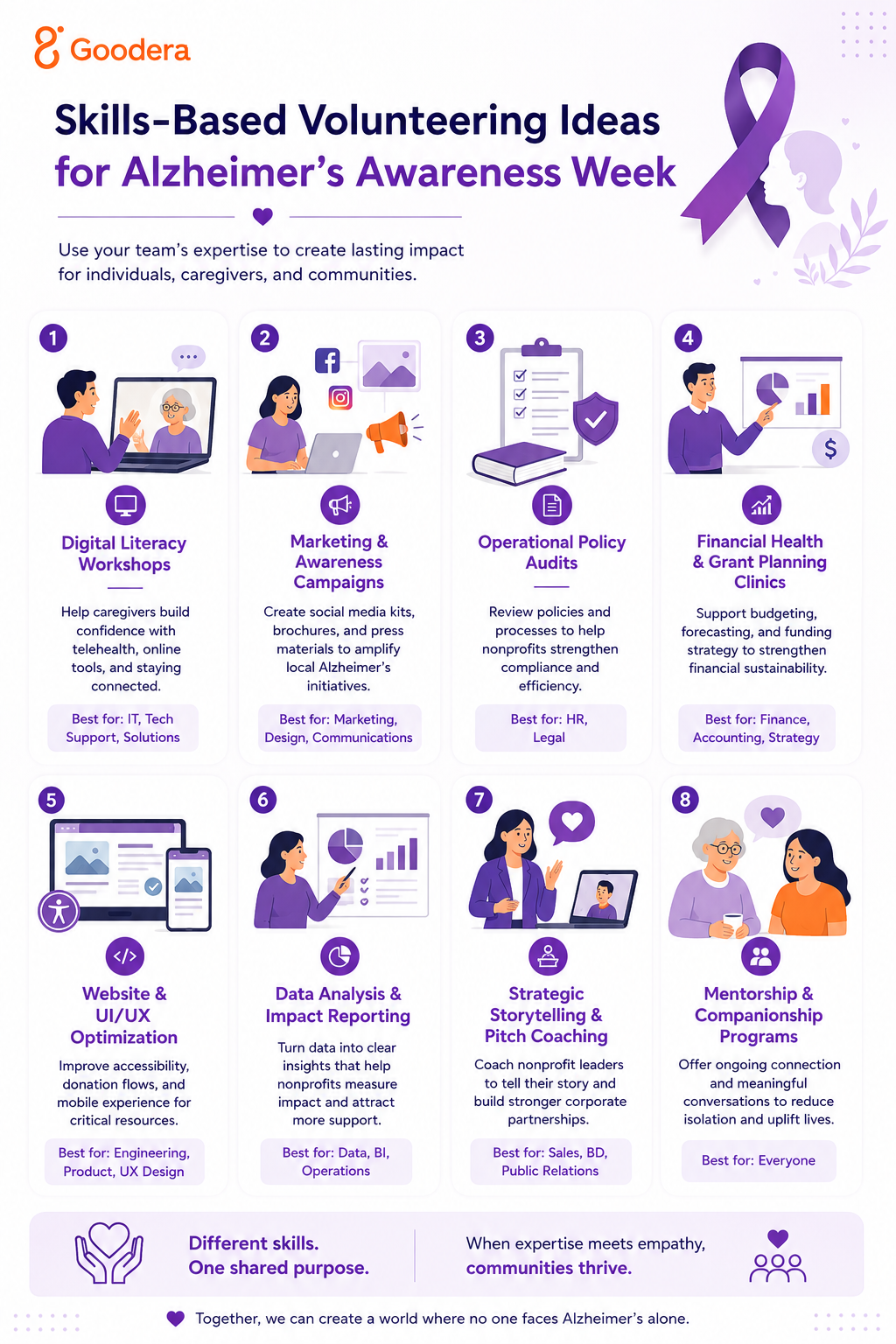
1. Digital Literacy Workshops for Elderly Caregivers
- Target Team: IT, Customer Support, or Tech Solutions.
- The Project: Employees host virtual or hybrid training sessions for older caregivers. They teach them how to navigate telehealth platforms, manage online pharmacy portals, and safely use video communication tools to stay connected with family and healthcare providers.
2. Marketing and Awareness Campaigns for Regional Charities
- Target Team: Marketing, Design, and Communications.
- The Project: Teams design a localized social media toolkit, draft press release templates, or create updated promotional brochures for local memory cafes and support groups that lack the budget for professional creative services.
3. Operational Policy Audits for Nonprofit Staff
- Target Team: Human Resources and Legal.
- The Project: Volunteers review internal operations manuals, volunteer onboarding guidelines, or remote-work policies for smaller dementia advocacy organizations, ensuring their administrative frameworks are compliant, modern, and efficient.
4. Financial Health and Grant Planning Clinics
- Target Team: Finance, Accounting, and Corporate Strategy.
- The Project: Finance professionals partner with local respite care centers to audit their annual budgets, optimize their cash flow tracking, or build structured financial forecasting models for upcoming grant applications. They can also host workshops or one-on-one sessions covering topics such as power of attorney basics, long-term care cost planning, or navigating Medicare and Medicaid, always in coordination with a licensed nonprofit partner to keep the guidance appropriate and compliant.
5. Website Optimization and UI/UX Audits
- Target Team: Engineering, Product Management, and UX Design.
- The Project: A focused hackathon where tech teams audit local Alzheimer’s association websites to improve accessibility, streamline the donation checkout flow, and optimize mobile responsiveness for users seeking urgent resources. Engineering and design teams can build simple digital tools for local memory care facilities, such as accessible photo and music libraries for reminiscence therapy, or streamlined intake forms that reduce administrative burden on care staff.
6. Data Analysis and Impact Reporting
- Target Team: Data Analytics, Business Intelligence, or Operations.
- The Project: Volunteers clean up anonymized intake data or survey responses from caregiver support groups, turning raw numbers into clean, visual impact reports that the nonprofit can use to secure future funding.
7. Strategic Storytelling and Pitch Coaching
- Target Team: Sales, Business Development, or Public Relations.
- The Project: Employees run workshops for nonprofit leaders on how to deliver a concise, compelling pitch to corporate donors, refining their presentation decks and storytelling techniques to secure larger corporate partnerships.
8. Mentorship and Companionship Programs for Isolated Seniors
- The Project: Regular video or phone companionship programs, run in partnership with organizations that vet and train volunteers appropriately, help address social isolation among people in early-stage cognitive decline.
Beyond these three, teams can also consider data analysis support for local Alzheimer's chapters preparing grant applications, communications volunteers helping nonprofits sharpen their outreach materials, and HR professionals offering resume and career coaching sessions for family caregivers reentering the workforce after a caregiving pause.
Traditional Fundraising and Awareness Activities Done Well
Traditional activities remain valuable when they are designed with intention. Joining an established event such as the Alzheimer's Association's Walk to End Alzheimer's or The Longest Day gives employees an immediate, credible structure to rally around.
CNO Financial Group and Bankers Life offer a useful reference point here: their 23rd annual Forget Me Not Days fundraiser, run as a National Team for The Longest Day, raised more than $376,000 in 2025 alone, part of over $8.2 million contributed since 2003, according to the Alzheimer's Association. Matching employee donations dollar for dollar and letting internal teams choose their own fundraising activity rather than mandating one format, both tend to increase participation.
A Sample Planning Timeline for CSR & Social Impact Teams
A workable timeline starts eight to ten weeks out with partner selection and executive sponsorship, moves to internal promotion and registration four to six weeks out, confirms logistics and communicates practical details two weeks out, runs the activities during the observance week itself, and closes with a follow-up communication and impact recap within two weeks after.
Designing Brain Health Programming Into Employee Wellness
Alzheimer's Awareness Week also offers a natural opening to fold brain health into an existing wellness strategy rather than launching something entirely separate.
Cognitive Health Workshops as a Retention and Engagement Tool
There is now solid research suggesting volunteering itself carries measurable well-being benefits that other wellness interventions have struggled to match. Building a brain health workshop series, covering topics like sleep, nutrition, and cognitive exercise, alongside a volunteering component gives employees both the information and meaningful action in one program.
Partnering With Neurologists and Local Chapters for Credibility
Credibility matters enormously with health content, so workshops are best co-hosted with a licensed neurologist, geriatrician, or a trained representative from a recognized organization such as the Alzheimer's Association rather than written entirely in-house. Local chapters often have community educators who are already equipped to deliver Association-approved presentations on brain health and risk reduction at no cost, which also strengthens the nonprofit relationship your volunteering program depends on.
Common Challenges
Even well-intentioned programs run into predictable friction points, and naming them early makes it easier to plan around them.
- Getting leadership buy-in is frequently the first hurdle. According to analysis on strategic execution published by Harvard Business School Online, corporate initiatives often fail to gain traction when managers do not visibly engage in them, as employees prioritize supervisor behavior over company-wide mandates. A highly verifiable alternative to top-down mandates is to secure active manager participation, ensuring the initiative is actively modeled from the top down and recognized across middle management to build true psychological safety and alignment.
- Aligning the cause with business relevance is another common friction point, particularly for companies without an obvious connection to health or aging. Framing the tie in through employee well-being and caregiver support, rather than forcing an artificial brand connection, tends to resolve this naturally.
- Limited capacity among already stretched teams can slow momentum, especially for smaller CSR functions managing multiple observances throughout the year. Leaning on an established partner, such as a local Alzheimer's Association chapter or a volunteering management platform, reduces the administrative load considerably.
- Employees who are personally affected by the topic may find the subject matter emotionally difficult, which calls for sensitivity in how invitations and messaging are framed.
Language and Etiquette Training for Dementia-Friendly Workplaces
Word choice carries significant weight in this space. Brief, optional training on person-centered language, such as saying "a person living with Alzheimer's" rather than defining someone by their diagnosis, helps employees engage respectfully whether they are volunteering externally or supporting a colleague internally. The Alzheimer's Association's Dementia Friends style training programs, available through many local chapters, offer a ready-made resource for this rather than requiring a company to build its own curriculum.
Measuring and Reporting the Impact of Your Campaign
A strong Alzheimer's Awareness Week program deserves measurement that goes beyond attendance counts.
Metrics That Matter for CSR and ESG Reporting
Useful metrics include total volunteer hours contributed, funds raised and matched, number of employees who accessed caregiver resources or the Helpline referral, and participation rates broken down by department or region to identify where engagement is strongest. Longer term, retention data offers a more compelling business case than activity counts alone.
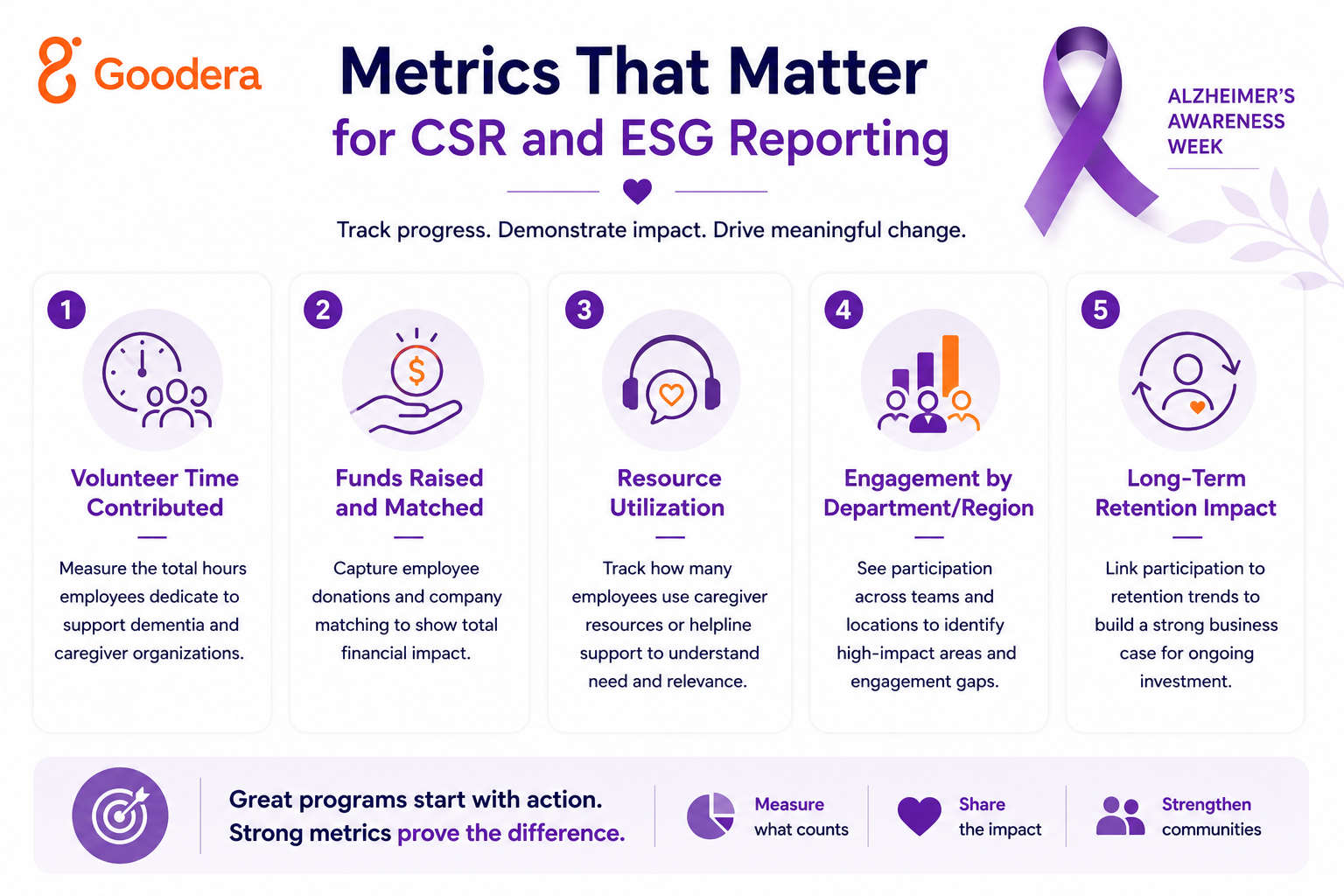
Metrics to track for Alzheimer's Awareness Week
- Total Volunteer Hours: Quantifies the collective time employees spend supporting dementia and caregiver charities to measure overall community investment.
- Funds Raised and Matched: Tracks direct employee donations alongside corporate matching contributions to calculate the total financial impact delivered to the cause.
- Resource Utilization Rates: Measures the number of employees accessing caregiving tools or helpline referrals to gauge internal need and program relevance.
- Engagement by Department: Breaks down participation data across different teams and regions to identify where organizational support is strongest.
- Long-Term Retention Data: Correlates volunteer participation with employee turnover rates over time to build a data-driven business case for future initiatives.
Connecting Volunteering Outcomes to Sustainable Development Goals
For companies reporting against the UN Sustainable Development Goals, Alzheimer's Awareness Week activities map naturally onto SDG 3, Good Health and Well-Being, through brain health and caregiver support programming, and onto SDG 10, Reduced Inequalities, through efforts that address the disproportionate caregiving burden carried by women and lower-income families. Framing the week's outcomes within this language helps CSR teams integrate the campaign smoothly into an existing annual sustainability report rather than treating it as a standalone initiative.
How Companies Are Approaching Alzheimer's Awareness Week Today
Programs naturally look different depending on company size, and that variation is worth planning for rather than resisting.
Patterns From Small Teams, Mid-Size Companies, and Global Enterprises
Smaller organizations tend to succeed by picking one focused activity, such as a single team fundraising walk or a lunchtime brain health talk, and promoting it well rather than spreading limited resources thin. Mid-size companies often layer in an employee resource group or wellness committee to help sustain momentum beyond the single week. Large global enterprises typically run a hub-and-spoke model, with a central campaign framework and toolkit that regional offices adapt to their local Alzheimer's calendar dates and nonprofit partners.
Two real-world examples illustrate what sustained commitment looks like. Edward Jones has maintained a multi-decade relationship with the Alzheimer's Association, recently extended through 2030, that combines financial commitment, associate-led fundraising through Walk to End Alzheimer's, and support for the Association's 24/7 Helpline. CNO Financial Group and its Bankers Life brand have run their Forget Me Not Days campaign for 23 consecutive years, showing that a recurring, well-branded internal tradition can outperform a series of disconnected one-off events over time.
A Readiness Checklist for CSR and HR Teams
Turning everything above into action starts with a short, practical checklist rather than another lengthy strategy document.
A 30-Day Countdown for Program Planning
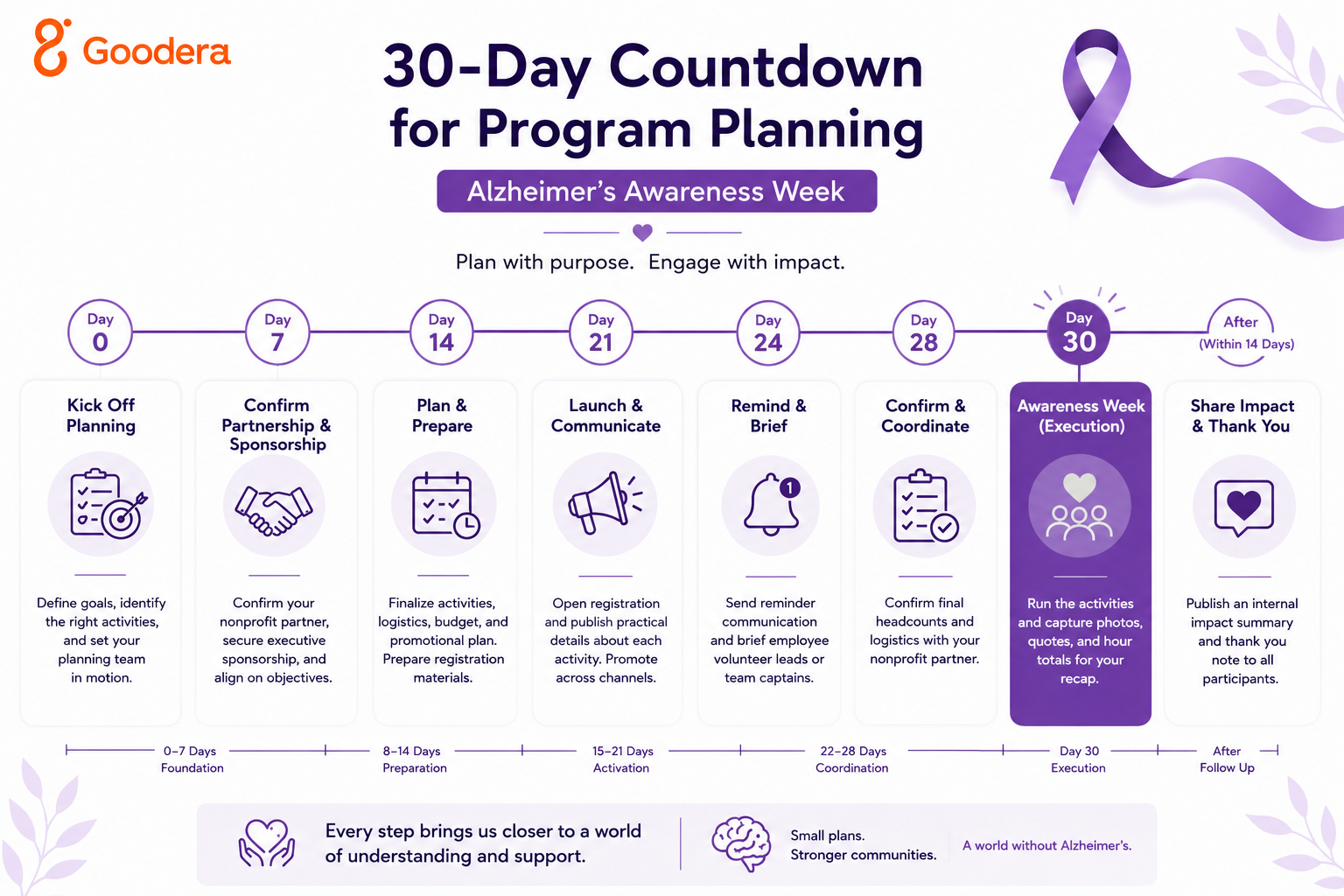
30-days countdown for program planning
At 30 days out, confirm your nonprofit partner, secure executive sponsorship, and select your primary activity or activities. At three weeks out, open registration and publish practical details about each activity. At two weeks out, send a reminder communication and brief any employee volunteer leads or team captains. At one week out, confirm final headcounts and logistics with your nonprofit partner. During the week itself, run the activities and capture photos, quotes, and hour totals for your recap. Within two weeks after, publish an internal impact summary and thank you note to participants.
Organizations and Partners Worth Contacting First
Local memory care facilities, senior centers, and area agencies on aging are often open to volunteer partnerships, particularly for companionship or technology projects. A volunteering management platform can also help centralize signups, track hours, and generate the reporting data needed for ESG disclosures.
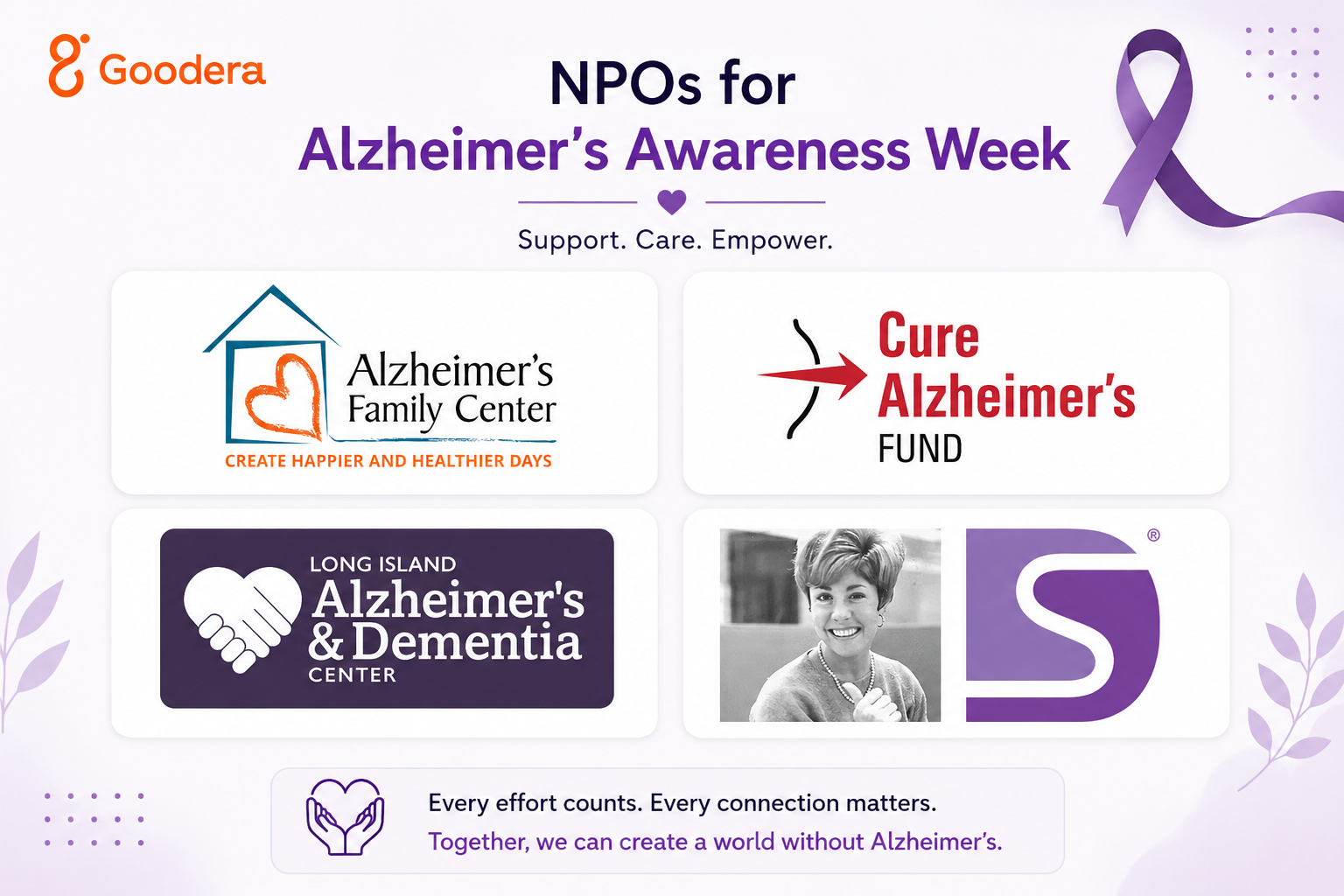
NPOs to work with for Alzheimer’s awareness week
1. Cure Alzheimer’s Fund
- What They Do: This organization focuses exclusively on funding targeted, early-stage scientific research aimed at preventing, slowing, or reversing the disease. They operate on a venture philanthropy model where the board of directors covers all administrative expenses, ensuring that 100% of all other donations go directly toward research.
- Impact Numbers: Since its inception in 2004, the Cure Alzheimer's Fund has distributed over $175 million to leading global scientists. In its most recent fiscal reporting, the fund scaled its operations to deploy a record $38.3 million in a single year, supporting 167 research grants and 187 investigators across the biomedical field.
2. Alzheimer's Disease Resource Center (Long Island)
- What They Do: Acting as a local "one-stop-shop" and localized affiliate of CaringKind, this center supports the specific needs of families navigating dementia across Long Island. They provide stage-specific adult day care programs, emergency respite resources, educational training, and specialized transportation.
- Impact Numbers: The Alzheimer's Disease Resource Center directly serves a region where roughly 1 in 8 seniors lives with the condition, giving Nassau and Suffolk counties some of the highest dementia rates in the United States. The center handles thousands of support touches annually, anchoring local caregiver support groups and managing critical, free educational conferences.
3. Alzheimer's Family Center
- What They Do: Based out of a state-of-the-art facility in Southern California, this specialized clinical day care facility focuses on multi-stage dementia care. They provide tailored care management plans, geriatric nutrition, behavioral health services, and respite programs to reduce the emotional and physical strain placed on family care partners.
- Impact Numbers: The center coordinates over 10,400 hours of intensive care management for patients and caregivers, completes over 10,800 door-to-door transit trips for vulnerable seniors, serves over 36,000 specialized geriatric meals, and provides critical information or memory checkups to over 1,400 individuals experiencing cognitive changes.
4. Dementia Society of America
- What They Do: This is a leading national non-medical advocacy organization focused on enhancing the daily quality of life for individuals living with all forms of dementia. They dedicate their resources to public education, community-facing toolkits, non-medical intervention programs, and continuous national care advocacy.
- Impact Numbers: Led by founder Kevin Jameson, the Dementia Society of America actively drives baseline research and public sentiment tracking, notably surveying over 1,460 care stakeholders in a national registry project to demonstrate that 82% of Americans agree individuals can live meaningful lives with non-medical support, using the data to successfully advocate for increased national training and localized resource funding.
In a Nutshell
Alzheimer's Awareness Week works best when it is treated as a bridge between two things CSR teams already care about, employee well-being and community impact, rather than as an isolated calendar entry. The dates vary by country, so choosing the right week for your workforce and building a lighter version for other regions keeps a global program coherent. Supporting the caregivers already inside your organization, offering a genuine mix of skills-based and traditional volunteering, and measuring outcomes against retention and ESG metrics turn a single week into evidence for the rest of your CSR strategy.
Frequently Asked Questions
1. What Is Alzheimer's Awareness Week?
It is a designated period, timed differently across countries, when organizations and employers raise awareness of Alzheimer's disease and dementia, support caregivers, and encourage participation in fundraising or educational activities connected to Alzheimer's charities.
2. When Is Alzheimer's Awareness Week in 2026?
Timing depends on the region. The UK's Alzheimer's Society runs Dementia Action Week from May 18 to May 24, 2026, Canada's Alzheimer Society leads Alzheimer's Awareness Month throughout January with a national day of action on January 28, 2026, and the US observes Alzheimer's & Brain Awareness Month throughout June.
3. What Is the Difference Between Alzheimer's Awareness Week and World Alzheimer's Month?
Alzheimer's Awareness Week or Month refers to country specific campaigns run by national Alzheimer's societies, while World Alzheimer's Month is a global initiative coordinated by Alzheimer's Disease International every September, anchored by World Alzheimer's Day on September 21.
4. How Can a Company Get Involved Without a Large Budget?
Low-cost options include hosting a lunchtime education session with a local Alzheimer's chapter representative, organizing an internal fundraising walk or step challenge, sharing caregiver resources through internal communications, and offering employees paid time to volunteer at an existing community event rather than building a new one from scratch.
5. What Are Good Corporate Volunteering Activities for Alzheimer's Awareness Week?
Strong options include skills-based clinics such as financial or legal guidance sessions for caregiving families, technology projects supporting memory care facilities, companionship programs for isolated seniors, and participation in established fundraising events like Walk to End Alzheimer's or The Longest Day.
6. How Do You Support Employees Caring for a Family Member With Alzheimer's?
Effective support combines flexible scheduling and dedicated caregiver leave, access to specialized resources like the Alzheimer's Association's 24/7 Helpline alongside a standard Employee Assistance Program, manager training to recognize signs of caregiver strain, and a workplace culture where employees feel comfortable disclosing caregiving responsibilities without concern about their career progress.
7. What Color Represents Alzheimer's Awareness?
Purple is the color widely associated with Alzheimer's awareness campaigns, commonly used in fundraising materials, apparel, and social media content during related observances.
8. How Does Corporate Volunteering Around Alzheimer's Awareness Week Benefit Employees?
Research presented by Dr. William Fleming of Oxford University's Wellbeing Research Centre found that volunteering was linked to measurable improvements in stress, mood, and job satisfaction among the practices studied, alongside stronger team relationships and a greater sense of purpose at work.
9. How Should Companies Measure the Success of an Alzheimer's Awareness Campaign?
Useful measures include total volunteer hours, funds raised, employee participation rates by department, engagement with caregiver resources, and long-term indicators such as retention among participating employees, which can then be connected to ESG and SDG reporting frameworks.
10. What Should Companies Avoid When Planning Alzheimer's Awareness Activities?
The main pitfalls are treating the week as a purely symbolic gesture without any follow-up policy support, skipping coordination with a credentialed Alzheimer's organization, and using language that defines individuals by their diagnosis rather than centering their identity as a person first.