World Food Day 2026: A Corporate Playbook

Before morning light breaks, a parent sits at a kitchen table quietly working through trade-offs no one should have to make: balancing the cost of a full grocery trip against an overdue utility bill, or deciding which meal to skip so their children have enough to eat for the school day ahead. Thousands of miles away, a smallholder farmer looks out over a field struck by unpredictable weather, wondering how to stretch a depleted harvest through the coming season.
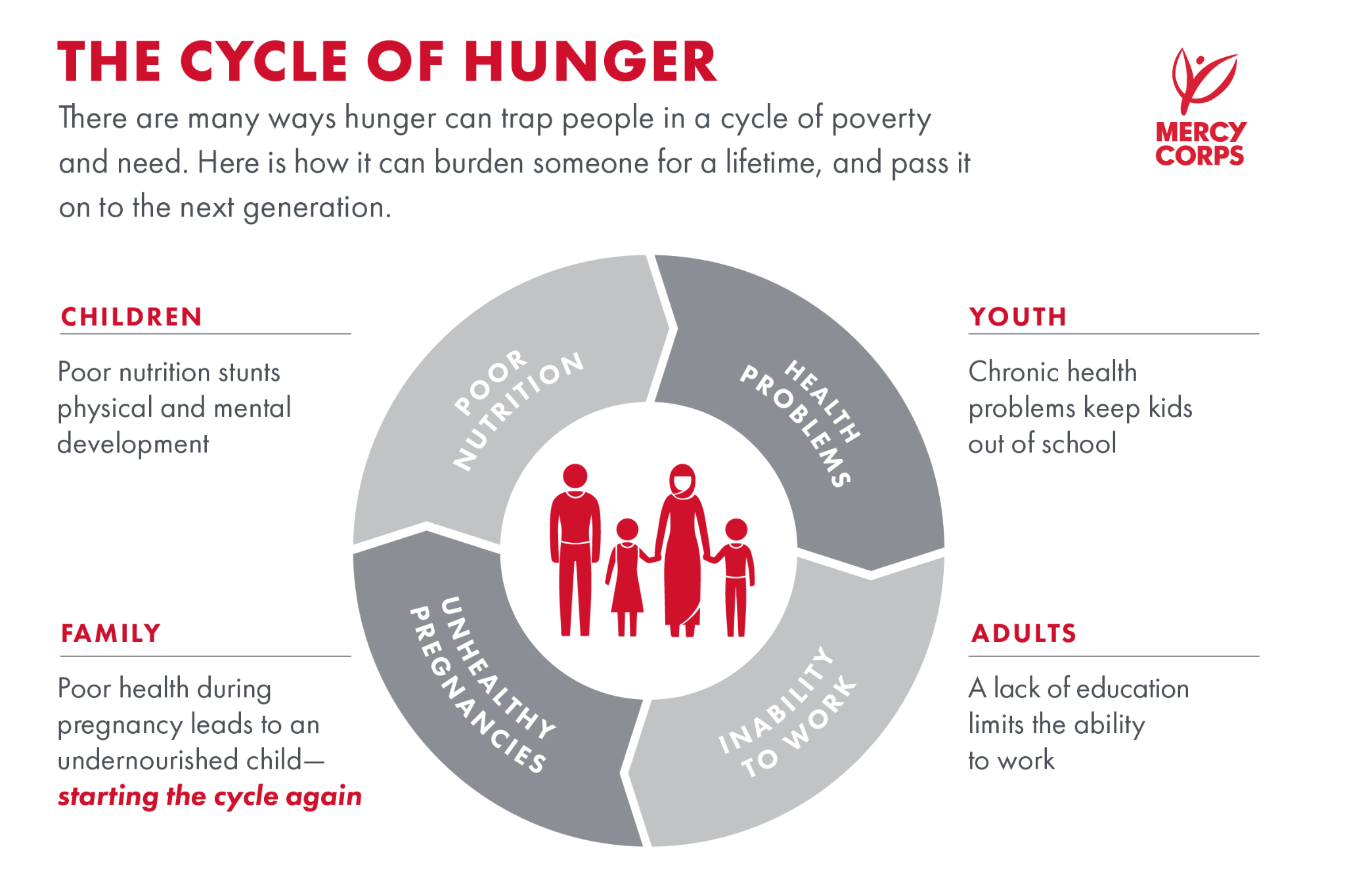
Hunger rarely reveals itself only in headline-grabbing crises. More often, it lives in these subtle, daily compromises. It is the strain on a child trying to focus in class on an empty stomach, the anxiety of a caregiver managing a tight monthly budget, and the loss of dignity that comes when basic nourishment feels uncertain. Food insecurity touches lives in rural agricultural villages and bustling urban neighborhoods alike.
Every year around mid-October, corporate teams across the globe quiet their usual Slack channels to host meal-packing drives, organize community kitchen shifts, and share local food bank links. These moments reflect a genuine, collective drive to show up for communities in need.
World Food Day on October 16, 2026, centered around the theme "Innovate today. Nourish tomorrow." offers an ideal opportunity to build on that momentum and design lasting, high-impact relief programs. Global hunger touched 645 million people in 2025, according to the newly released State of Food Security and Nutrition in the World report, so the stakes for getting this right are not abstract.
This guide walks through the history behind the day, the numbers your leadership team will want to see, five active nonprofits worth partnering with, and a practical framework for building hunger relief into your company's culture.
The Story Behind World Food Day and Why October 16 Matters
World Food Day marks the founding of the Food and Agriculture Organization of the United Nations on October 16, 1945, an agency created in the aftermath of a war that left millions without reliable access to food. Understanding that origin helps explain why the day carries weight with governments, multilateral agencies, and increasingly, the private sector.
How a Hungarian Agriculture Minister Started a Global Movement
The observance itself is younger than the Food and Agriculture Organization. At the organization's 20th General Conference in November 1979, member states voted to formally establish World Food Day, an idea championed by Dr. Pál Romány, Hungary's Minister of Agriculture at the time.
His proposal reflected a simple conviction: hunger needed a fixed date on the world's calendar, not just a line item in agricultural policy documents. Since 1981, the Food and Agriculture Organization has assigned a new theme to the day every year, and more than 150 countries now mark it in some form, from school programs to corporate volunteering drives.
In his remarks marking Food and Agriculture Organization's 75th anniversary on World Food Day 2020, then Director-General QU Dongyu put the core tension plainly. "The world produces more than enough food to feed everyone," he said. "Yet nearly 700 million people still go hungry." That gap between abundance and access remains the throughline of every World Food Day since.
This Year's Theme: Innovate Today, Nourish Tomorrow
The Food and Agriculture Organization has confirmed the 2026 theme as "Innovate today. Nourish tomorrow.," and the campaign is intentionally broad in what it counts as innovation. Scientific breakthroughs qualify, but so do policy reform, entrepreneurship, education, cultural knowledge, and traditional farming practices passed down through generations.
For a corporate audience, that framing is useful. It means your company does not need a laboratory or a patent to participate meaningfully. Skills-based volunteering, supply chain donations, and smarter employee engagement programs all fit within the spirit of this year's theme.
The State of Global Hunger in Numbers Every Company Should Know
Numbers move budget conversations in a way that awareness campaigns alone rarely do. Before pitching a World Food Day program to leadership, it helps to walk in with figures that are current, sourced, and specific to your audience.
The Global Picture in 2026
The State of Food Security and Nutrition in the World 2026 report, jointly published by Food and Agriculture Organization, WFP, UNICEF, WHO, and IFAD, found that 645 million people faced hunger in 2025, or about 7.8 percent of the global population.
That figure has declined for three consecutive years, down from 673 million in 2024 and from 8.6 percent in 2022. Progress is uneven, however. Africa now carries the highest absolute number of hungry people at roughly 309 million, narrowly surpassing Asia's estimated 292 million, and the report notes that 2.1 billion people are estimated to have been moderately or severely food insecure in 2025.
Máximo Torero, Food and Agriculture Organization's Chief Economist, summarized the findings at the report's July 2026 launch in Rome. "The latest estimates indicate that 7.8 percent of the global population was undernourished in 2025, equivalent to 645 million people... which means in terms of numbers, that there has been a reduction of 40 million between 2024 and 2025," he said.
He also added that "the numbers remain approximately 50 million higher than in 2015, when the SDGs were adopted." That caveat matters for any company weighing whether hunger relief still deserves a place in its CSR portfolio, since the trend line is positive but the underlying need has not gone away.
A separate but related indicator, the World Food Program's 2026 Global Outlook, estimated that 318 million people entered the year facing crisis levels of food insecurity or worse, a distinct measure that tracks acute, often conflict-driven emergencies rather than chronic undernourishment.
Together, the two data sets tell a fuller story: steady long-term progress against chronic hunger, alongside a parallel and growing burden of acute crises that require immediate humanitarian response.
Food Insecurity Closer to Home: The American Reality
For companies headquartered or operating in the United States, domestic data carries particular weight with employees and boards alike. According to USDA figures cited during a November 2025 broadcast interview, 47.4 million people in the United States lived in a food-insecure household in 2023. That represents roughly 13.5 percent of households, or about one in seven, up from 10.5 percent in 2020.
Claire Babineaux-Fontenot, CEO of Feeding America, has spoken candidly about how this reality is often invisible once the most visible symptoms fade from view. Reflecting on renewed pressure at food banks in late 2025, she noted that demand had climbed even higher than during the pandemic's peak, driven partly by households that do not qualify for federal nutrition programs at all. It is a reminder that food insecurity in wealthier economies often hides in plain sight, tucked into paychecks that do not stretch far enough rather than in visible lines outside a shelter.
Why World Food Day Belongs on Every Corporate Calendar
CSR leaders rarely need convincing that hunger relief matters morally. The harder conversation, especially with finance and executive stakeholders, is making the operational and reputational case.
The Business Case for Hunger-Focused CSR
Consumer sentiment has shifted in ways that are now well documented. The 2019 Aflac Survey on Corporate Social Responsibility found that 77 percent of consumers are motivated to purchase from companies committed to making the world a better place. Employee retention tells a similar story from the inside.
According to Goodera’s research, structured corporate volunteering programs are associated with a 6.1 percent year-over-year reduction in turnover and up to 39 percent lower overall attrition, proving that active, purpose-driven programs serve as a powerful workforce retention strategy. This connection is further reinforced by a Columbia Business School field experiment, which linked corporate volunteering directly to lower turnover and reduced workplace stress.
The business framing extends beyond a single company's walls. Cindy McCain, Executive Director of the UN World Food Program, has argued that hunger is increasingly a business risk as much as a humanitarian one. "Feed them now or fight them later," she said in a May 2026 interview, pointing to the connection between food insecurity, instability, and the operating conditions companies depend on in markets around the world.
Where Food Security Fits Into ESG and GRI Reporting
Hunger relief programs are not just goodwill gestures anymore. They map cleanly onto established reporting frameworks that boards and investors already track. The Global Reporting Initiative's GRI 413 standard covers a company's impact on local communities, while GRI 401 addresses employment-related disclosures that intersect with volunteer time off policies.
Companies that already publish sustainability or ESG reports can fold hunger-focused volunteering and giving into these existing structures rather than building a separate reporting track from scratch, which keeps the effort proportional to the outcome.
Five Active Nonprofits Leading the Fight Against Hunger
Choosing the right nonprofit partner shapes everything downstream, from the kind of volunteering your teams can do to how cleanly the results map onto your reporting. These five organizations are active, vetted, and structured to work with corporate partners at different scales.
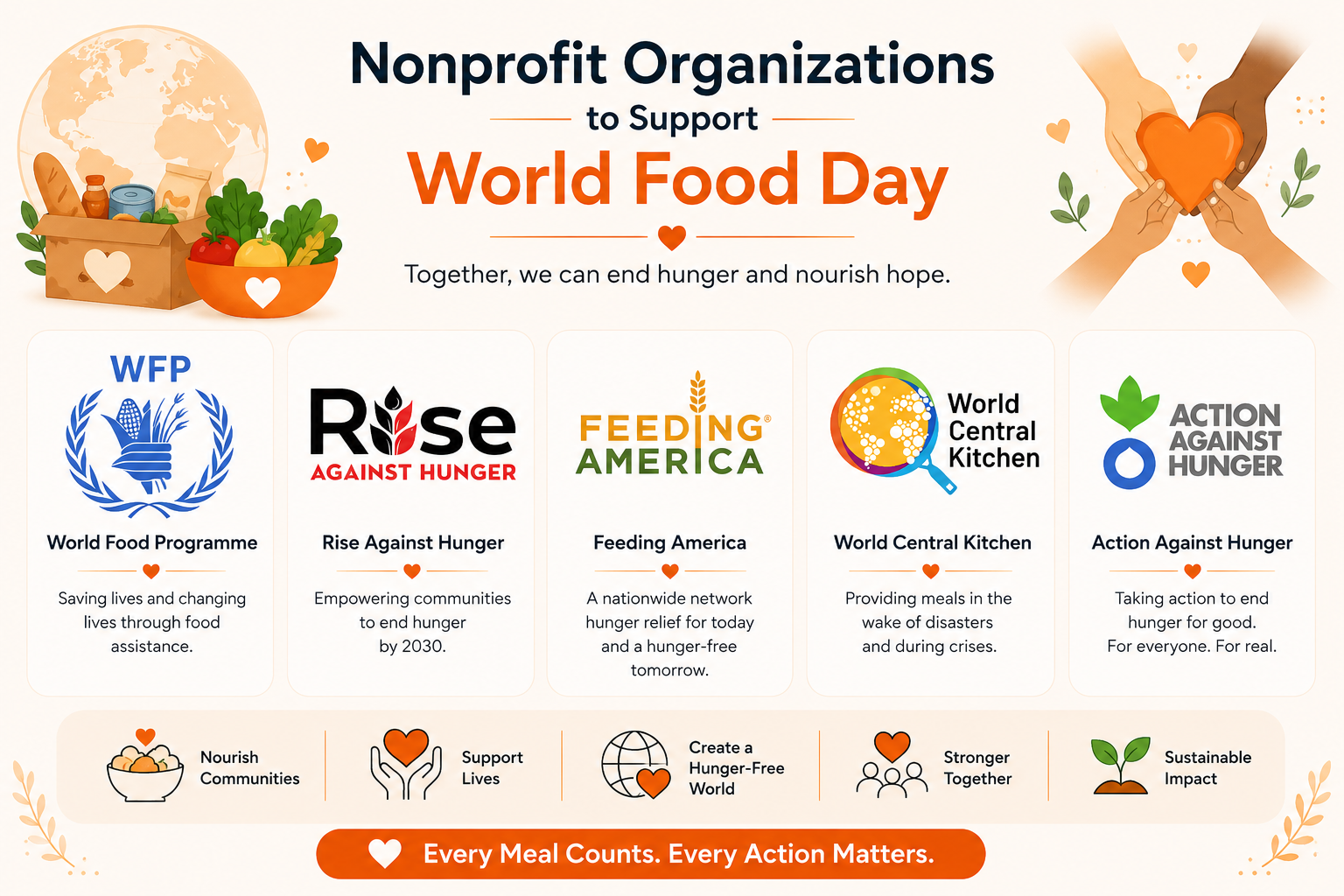
Nonprofit Organizations to Support on World Food Day
- Feeding America
Feeding America operates the largest domestic hunger relief network in the United States, connecting more than 200 member food banks with over 60,000 food pantries, meal programs, and partner agencies nationwide.
The organization sources donations from farms, manufacturers, retailers, and government programs, then routes food to communities based on local need. Corporate partners including General Mills, Kroger, and Costco work with Feeding America on cause marketing, product donations, and employee volunteer days at regional food bank warehouses.
- Action Against Hunger
Action Against Hunger has spent more than 45 years fighting malnutrition and its root causes, and the organization currently operates in more than 50 countries across Africa, the Middle East, Asia, and Latin America.
Its corporate partnerships team builds tailored employee engagement, volunteering, and cause marketing programs, and the food and hospitality sector alone has raised more than 11 million pounds through initiatives like Love Food Give Food. Hospitality group IHG Hotels and Resorts partners with the organization on child malnutrition screening as part of its community outreach work.
- World Central Kitchen
Chef José Andrés founded World Central Kitchen in 2010 after responding to the Haiti earthquake, and the organization has since become a first responder for food assistance during natural disasters, humanitarian crises, and armed conflicts around the world. Andrés has spoken about the operational realities of scaling emergency food response.
"World Central Kitchen started with a simple idea at home with my wife Patricia: when people are hungry, send in cooks. Not tomorrow, today," he said, highlighting the drive to bypass delay and deliver immediate food relief despite the heavy operational logistics involved. Companies can support World Central Kitchen through disaster response funding, in-kind logistics support, and employee giving campaigns tied to specific crisis responses.
- Rise Against Hunger
Founded in 1998, Rise Against Hunger has built its corporate engagement model around hands-on meal packaging events, where employee teams assemble nutritious, shelf-stable meals that are then shipped to school feeding programs and crisis relief efforts worldwide.
The organization has packaged more than 540 million meals to date and holds a four-star Charity Navigator rating. Longtime partner Zambrero has donated more than 90 million meals through its ongoing Plate 4 Plate program, illustrating how a sustained cause marketing partnership can compound in impact over several years.
- The UN World Food Program
The World Food Program is the largest humanitarian organization addressing hunger globally, operating across dozens of countries to deliver emergency food assistance, school meal programs, and resilience-building support. Its 2026 Global Outlook estimated that 318 million people entered the year facing crisis levels of food insecurity, underscoring the scale at which the World Food Program works.
Companies typically engage with the World Food Program through direct funding, logistics and supply chain partnerships, and employee giving campaigns tied to specific emergency appeals, given the agency's scale and its role as a UN implementing partner.
Practical Ways Companies Can Mark World Food Day
The right activation depends heavily on where your workforce sits, how distributed your teams are, and what kind of engagement resonates with your culture. Most companies find success mixing at least two of the three approaches below.
Hands-On Volunteering for In-Office Teams
Meal packaging events remain one of the most reliably high-participation activities available, since they require no prior experience and produce a visible, countable output within a single afternoon. A typical session runs 60 to 120 minutes and can package 10,000 to 50,000 meals depending on team size. Pairing the event with a short talk from the receiving food bank adds context that pure logistics work can lack, and local food bank shifts or gleaning programs that rescue surplus produce work well for teams that prefer ongoing engagement.
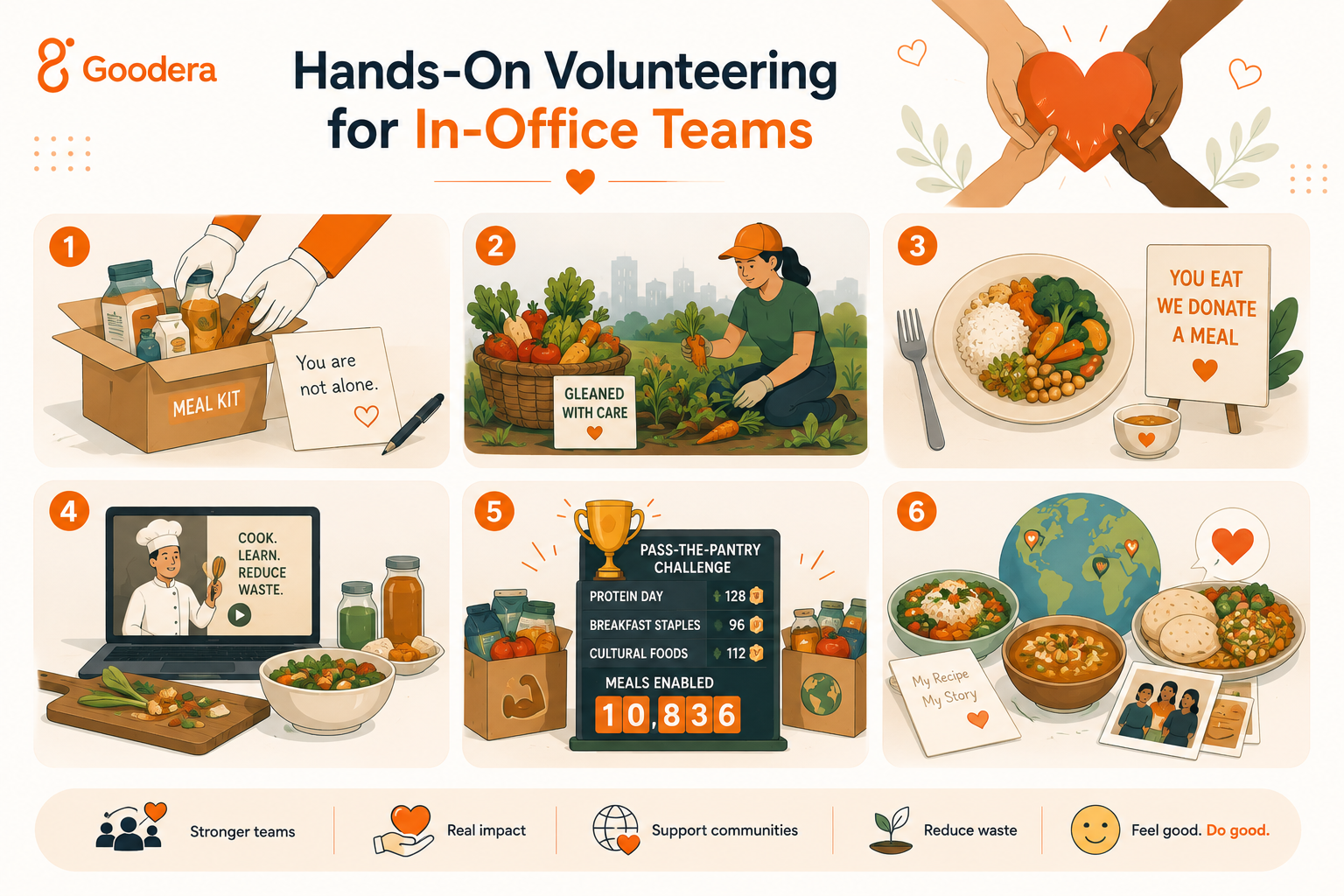
1. "The Meal in a Box" Assembly & Note-Writing Hour
Instead of traditional warehousing, bring the assembly line directly into your office commons or cafeteria. Partner with a local food bank to set up stations where employees pack non-perishable weekend meal kits for school-age children facing food insecurity ("backpack programs"). To add a personal touch, include a dedicated station where employees write handwritten notes of encouragement or draw cards to tuck into each kit.
2. Crop Harvest & Urban Gleaning Days
Take employee volunteering outdoors by partnering with local farms or urban agriculture non-profits for a produce gleaning shift. Teams spend 2–3 hours harvesting excess fruits and vegetables that farmers cannot commercially sell due to minor cosmetic flaws. It’s physically active, highly social, offers immediate tangible impact (tracking output in total pounds harvested), and directly addresses food waste at the agricultural level.
3. "Plate-for-Plate" Cafeteria & Office Kitchen Takeover
Turn the daily office lunch into a cause-marketing event. Work with your workplace facilities team or catering partners to designate a specific World Food Day Featured Lunch. For every featured meal purchased by an employee on October 16th, the company matches it with a direct meal donation through a partner network like Feeding America or World Central Kitchen. For remote workers, provide a digital food delivery voucher with an automated corporate meal-match attached.
4. Interactive "Zero-Waste Cooking" Live Masterclass
Host a hands-on, live-streamed cooking session led by a local chef or culinary non-profit focused on upcycled ingredients and reducing home food waste. Employees follow along in the office kitchen or from their home setups using a pre-provided ingredient kit or grocery checklist. The focus is purely experiential and educational, learning simple techniques to stretch household food budgets while reducing waste and ending with a shared team meal.
5. The "Pass-the-Pantry" Inter-Departmental Challenge
Turn food drives on their head with a gamified, friendly competition between teams or office floors. Instead of collecting generic canned goods, departments compete to fill specific meal categories needed by local food pantries (e.g., "Protein Day," "Breakfast Staples," "Cultural Heritage Foods"). Set up a real-time visual tracker in the lobby (or a digital leader board for hybrid teams) that tracks total items donated and converts the tally into total meals enabled.
6. Culinary Heritage & Cultural Storytelling Potluck
Celebrate global food security by exploring food culture directly within your workforce. Invite employees, both in-office and remote, to share a dish, recipe, or family story that represents their cultural heritage or a childhood comfort food. In-office teams hold a community potluck, while remote employees submit recipes and photos to a digital company cookbook. Tie the event to a corporate donation for every recipe shared to a global relief partner like the UN World Food Program.
Explore more ideas in Goodera’s Hunger Action Month Guide:
Skills-Based and Virtual Engagement for Distributed Teams
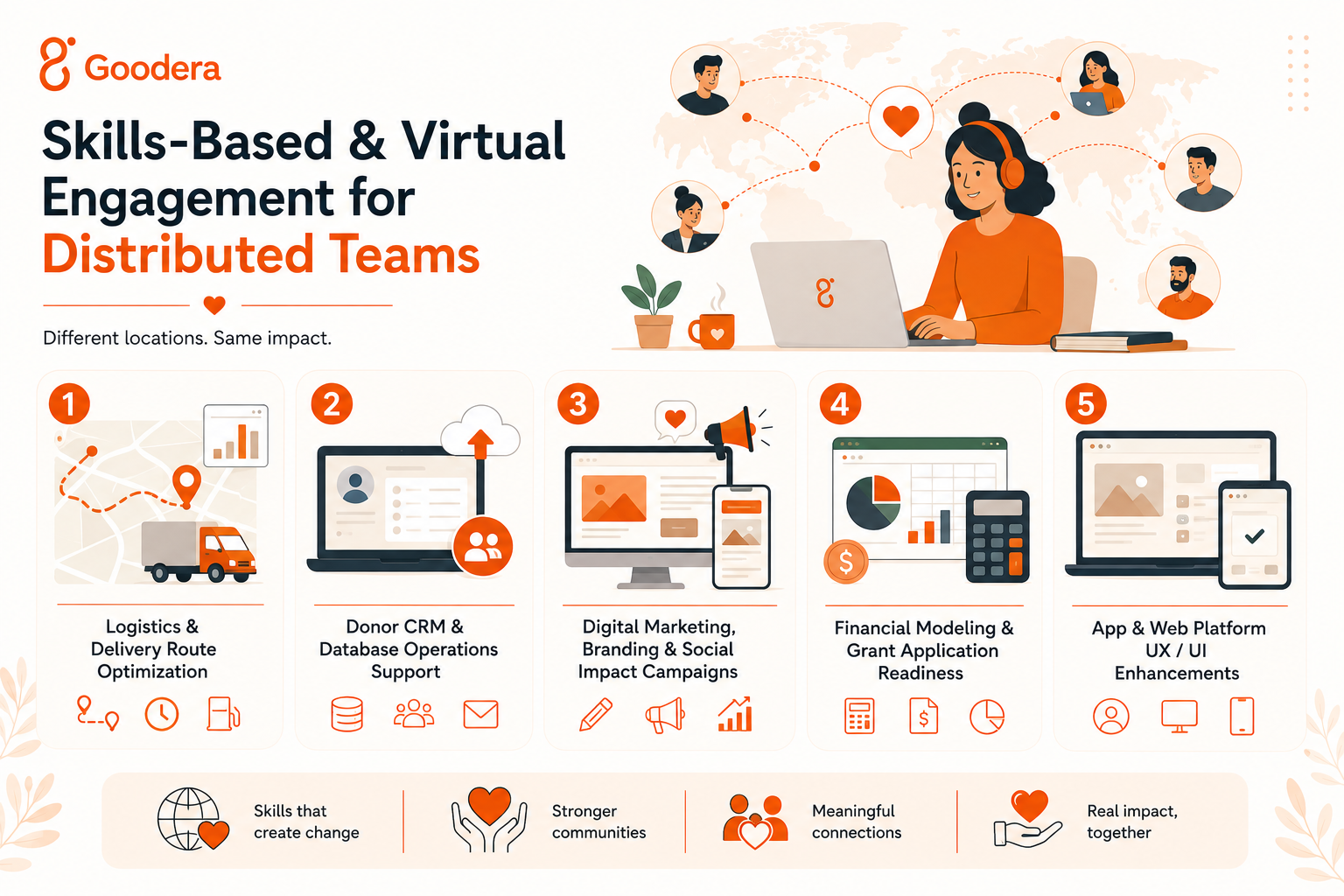
Remote and hybrid teams can contribute meaningfully without ever setting foot in a warehouse. Skills-based projects, such as optimizing a food bank's delivery routes, building a donor CRM, or designing fundraising materials, typically run four to twelve weeks and deliver value that smaller food-rescue nonprofits often cannot access through traditional volunteer shifts.
Virtual meal-sponsorship models let employees fund meals during a live-streamed packing event happening elsewhere, keeping global teams connected to one activation across time zones.
Skills-based volunteering ideas for teams
Here are 5 impactful, skills-based volunteering ideas designed specifically for remote and hybrid teams to support hunger-relief non-profits:
- Logistics & Delivery Route Optimization
- Skill Sets: Operations, Data Analysis, Supply Chain
- Project: Help local food rescue non-profits optimize their collection and distribution routes. Volunteers analyze drop-off schedules, geographic clusters, and driver routes to cut transit time and fuel costs, allowing fresh produce to reach community centers faster.
- Donor CRM & Database Operations Support
- Skill Sets: IT, Salesforce, Database Management, Systems Administration
- Project: Audit, clean, or configure donor databases for community food banks. Volunteers build custom workflows, set up automated donor thank-you sequences, or migrate legacy spreadsheets into modern CRM platforms to help non-profits retain donors more effectively.
- Digital Marketing, Branding & Social Impact Campaigns
- Skill Sets: Graphic Design, Copywriting, Social Media Strategy, SEO
- Project: Create reusable digital marketing toolkits for regional hunger initiatives. Volunteers design campaign assets, write email marketing templates for annual fundraising drives, or optimize website landing pages to increase recurring digital donations.
- Financial Modeling & Grant Application Readiness
- Skill Sets: Finance, Accounting, Business Analysis
- Project: Assist smaller non-profits with financial forecasting, unit-cost modeling (e.g., calculating the exact cost per meal served), or preparing financial reporting templates required to secure competitive government and foundation grants.
- App & Web Platform UX/UI Enhancements
- Skill Sets: UX/UI Design, Front-End Web Development
- Project: Audit and refine the digital user experience for non-profit platforms, such as volunteer signup portals, food pantries' online intake systems, or interactive food-location maps, making them intuitive and accessible for both clients and volunteers.
Workplace Giving, Matching Gifts, and Cause Marketing
Matched giving campaigns tend to produce the highest dollar impact per hour of program management time, since a single matching commitment multiplies every employee donation without added logistics. Cause marketing tied to a specific product, similar to the retail promotions Feeding America runs with grocery partners, extends World Food Day's reach beyond employees to customers. Gift card and cash donation drives are increasingly preferred over canned food collection, since purchasing power stretches further and preserves choice and dignity for recipients.
Turning One Day Into a Year-Round Food Security Strategy
A single day of activity generates goodwill, but a recurring calendar of engagement is what actually moves retention, brand perception, and community outcomes over time. The companies that get the most out of World Food Day treat it as an anchor point within a longer program rather than a standalone event.
Building a Recurring Volunteer Calendar Around Hunger
National Hunger Awareness Month in June and Hunger Action Month in September both pair naturally with an October World Food Day activation, spreading hunger-focused engagement across the calendar instead of compressing it into a single week. Seasonal moments, including summer break when school meal programs pause and the winter holidays when food bank demand typically spikes, offer additional windows for smaller, targeted campaigns that keep the cause visible year-round.
Partnering Long-Term Instead of Showing Up Once a Year
Nonprofits consistently report that predictable, recurring support is more valuable to their planning than a single large but unpredictable event. A multi-year partnership with one or two hunger-focused organizations, built around a shared calendar of volunteering, funding, and skills-based projects, allows both sides to invest in deeper collaboration, from co-branded campaigns to jointly authored impact reports.
This continuity also gives CSR teams a stronger story to tell internally, since year-over-year comparisons only mean something when the underlying partnership stays consistent.
Measuring and Reporting the Impact of Your Hunger Initiatives
Impact measurement is where many otherwise strong CSR programs lose momentum internally, simply because the data collected does not map cleanly onto what leadership and employees actually want to see.
Metrics That Matter to Leadership and Employees Alike
Output metrics, including meals provided, pounds of food rescued, dollars donated and matched, and volunteer hours logged, remain the easiest figures to collect and the clearest to put in a quarterly report. Leading programs pair those numbers with outcome-level data where possible, such as household food security scores tracked by a nonprofit partner over time, since outcome data tells a richer story about whether the underlying need is actually shrinking.
Employee-facing communications benefit from a different lens entirely: a short story from a partner nonprofit's frontline staff, paired with a single striking statistic, tends to land better internally than a dashboard full of cumulative totals ever will.
1. Output Metrics (Quantitative Standard)
Quarterly Reports & Dashboards
- Meals Delivered & Rescued: Total count of meals provided and total pounds of surplus food diverted from landfills.
- Resource Contributions: Total corporate dollars matched and total employee volunteer hours logged.
2. Outcome & Impact Metrics (Leadership Lens)
Annual & Board-Level Review
- Household Security Improvement: Percentage shift in food security scores among program participants, tracked alongside partner non-profits.
- Capacity Expansion: Number of new community access points or distribution sites sustained through corporate funding.
3. Employee & Narrative Engagement Metrics
Internal Communications & Stories
- Story-to-Stat Ratios: A single frontline narrative (e.g., a family supported) paired with one focused datapoint (e.g., "100% of weekend food gaps covered in local schools").
- Participation & Retention Rates: Departmental participation percentages and turnover reduction rates among active volunteers.
Wrapping It Up
World Food Day 2026 arrives at a moment when the data genuinely supports cautious optimism, with global hunger declining for a third straight year, even as hundreds of millions of people still go without reliable access to food. That combination of progress and persistent need is exactly the kind of story that gives a CSR program room to grow rather than simply repeat itself.
Whether your company starts with a single meal-packing afternoon or commits to a multi-year partnership with one of the organizations above, the theme this year is a fitting prompt: innovate today, in whatever form your team can realistically sustain, so that the numbers keep moving in the right direction tomorrow.
If your team is ready to plan a World Food Day activation or build a longer-term hunger relief calendar, connecting with an experienced volunteering partner can help translate that intent into a program your employees will actually want to join.
Frequently Asked Questions
1. When is World Food Day 2026?
World Food Day falls on October 16, 2026, marking the anniversary of the Food and Agriculture Organization's founding in 1945.
2. What is the official theme for World Food Day 2026?
FAO has confirmed the 2026 theme as "Innovate today. Nourish tomorrow.," which highlights scientific, policy, and cultural innovation in building more resilient food systems.
3. How many people worldwide face hunger right now?
The FAO's State of Food Security and Nutrition in the World 2026 report estimates that 645 million people faced hunger in 2025, down from 673 million the year before.
4. How many people in the United States are food insecure?
USDA data cited in late 2025 puts the figure at 47.4 million people in food-insecure households as of 2023, or about 13.5 percent of households nationwide.
5. Why should companies participate in World Food Day rather than leaving it to nonprofits?
Corporate participation brings funding, volunteer labor, logistics expertise, and public awareness at a scale most nonprofits cannot generate alone, and it also strengthens employee engagement and brand trust among socially conscious consumers.
6. What is the difference between chronic hunger and acute food insecurity?
Chronic hunger, tracked by FAO's SOFI report, reflects long-term undernourishment tied to poverty and access, while acute food insecurity, tracked by WFP's Global Outlook, captures crisis-level emergencies often driven by conflict or disaster.
7. Which nonprofits are considered reliable partners for World Food Day activations?
Feeding America, Action Against Hunger, World Central Kitchen, Rise Against Hunger, and the UN World Food Program are all active, established organizations with structured corporate partnership programs.
8. What kind of volunteering works best for remote or distributed teams?
Skills-based projects, virtual meal-packing sponsorships, and matched giving campaigns allow distributed employees to contribute meaningfully without requiring in-person attendance.
9. How can companies measure the impact of a World Food Day program?
Track output metrics like meals provided, volunteer hours, and dollars donated, and where possible, pair them with a nonprofit partner's outcome data, such as household food security improvements over time.
10. How does hunger-focused CSR connect to broader ESG reporting?
Volunteer hours and community investment map onto established frameworks like GRI 413 for local community impact and GRI 401 for employment-related disclosures, letting companies fold hunger relief into existing sustainability reports.