Employee Giving: A Detailed Guide to Starting A Workplace Giving Program

Most executives don't need to be convinced that giving back matters. What they need is a clear answer to a simpler question: Is giving back to the community worth the investment?
The short answer is yes, and the data makes a strong case.
According to the Goodera Volunteering Quotient Report 2026, companies with structured volunteering programs see 2.6x higher participation in giving back to the community initiatives, a clear signal of stronger employee engagement. That engagement directly ties to retention. In fact, a study highlighted by PA Life Magazine found that 92% of employees are more likely to stay longer at companies that actively support workplace volunteering, citing a stronger sense of purpose and loyalty.
Now consider the cost of losing that talent. Replacing an employee can cost 50% to 200% of their annual salary, contributing to over $1 trillion annually in the U.S. due to turnover, lost productivity, and disengagement.
Put together, the equation is simple: investing in giving back to the community doesn’t just build impact outside the organization, it reduces costly attrition inside it.
The Real Cost of Not Having a Workplace Giving Program
Before making the case for what a workplace giving program can do, it helps to understand what its absence quietly costs.
The biggest gap shows up early. New hires are most vulnerable to turnover in their first year, with attrition rates ranging from 25% to 40%, often driven by weak onboarding and a lack of meaningful engagement. This is exactly when companies have the most to gain, and the most to lose.
Now layer in the impact of purpose-driven programs. According to a recent survey, employees who participate in CSR and volunteering initiatives are twice as likely to feel satisfied with their career growth and loyal to their organization, reducing the likelihood of early exits. Companies with strong volunteering programs report 39% lower attrition overall, with newer employees benefiting the most through a stronger sense of purpose and alignment.
The math here is hard to ignore. Without a workplace giving program, companies risk losing employees at the exact moment they are most likely to leave, missing a proven opportunity to build loyalty and reduce attrition.
Beyond retention, there’s also a brand impact that continues to grow in importance. Organizations that invest in giving and volunteering consistently see higher motivation, stronger engagement, and better retention, all of which contribute to a more credible, purpose-driven brand in the eyes of employees, customers, and investors alike.
Five Decisions to Make Before You Launch
A workplace giving program launched without a clear structure tends to drift into irrelevance within 18 months. The companies that sustain high participation and real impact make these five decisions deliberately, before the first campaign goes live.
Decision 1: What Is This Program Actually For?
This sounds obvious, but it's where most programs go wrong. Is the primary goal employee retention? Community impact? Brand reputation? Talent attraction? The answer shapes everything: which causes you support, how you measure success, how you talk about it internally, and how much budget you allocate. You don't have to choose just one goal, but you do need a primary one. A program trying to be everything to everyone usually achieves very little for anyone.
Decision 2: Who Chooses the Causes?
The companies with the highest employee participation have largely stopped pre-selecting a short list of charities and started letting employees drive cause selection. Benevity's platform allows employees to nominate causes they feel passionate about and drive giving campaigns and volunteer opportunities around those causes. The shift from "the company chooses" to "employees choose" is one of the single biggest levers for participation. When employees see their nominated cause on the giving platform, they don't just donate. They recruit their teammates to do the same.
Decision 3: What Is the Matching Structure?
This is the decision that moves the most money. Matching gifts effectively double the impact of every employee donation, but the match ratio and cap matter significantly for participation rates. Higher match caps drive stronger engagement. A matching cap at $1,000 drives roughly 12% employee engagement. Caps from $1,001 to $10,000 push that to around 18%. Caps above $10,000 can see participation reach 40%. Even a modest increase in your match ceiling meaningfully changes behavior. Pick a number you can sustain year over year rather than one that looks impressive in year one and disappears in year two.
Decision 4: How Will Employees Give?
The more pathways available, the broader the participation. Not every employee can write a check. Some have professional skills that nonprofits need. Some can spare three hours on a Saturday but not three hundred dollars in December. A well-designed program offers payroll giving for recurring small donations, one-time giving for campaigns, volunteer time tracking, volunteer grants that convert hours into dollars, and skills-based contributions for those who want to give their expertise rather than their paycheck. Build the architecture wide, then let employees find their own entry point.
Decision 5: Who Owns This Internally?
Programs with a named internal owner, someone with a real budget, a quarterly calendar, and the authority to make decisions, sustain at a significantly higher rate than committee-managed initiatives. The owner doesn't need to be full-time on this. They need to be someone who genuinely cares about the work and has the organizational credibility to get things done. That combination matters more than their title or their department.
Building the Business Case for Your Leadership Team
If you're preparing to bring a proposal to your executive team, here's how to frame it in language that lands.
1. Retention Is the Strongest Business Case for Workplace Giving
If you strip this down to outcomes, workplace giving programs are fundamentally a retention strategy.
Data from the Goodera Volunteering Quotient Report 2026, based on ESG disclosures from 240 companies, shows that organizations with structured volunteering programs see 2.6x higher employee participation in giving back initiatives. That level of participation is more than a feel-good metric; it’s a proxy for engagement, and engagement is one of the strongest predictors of retention.
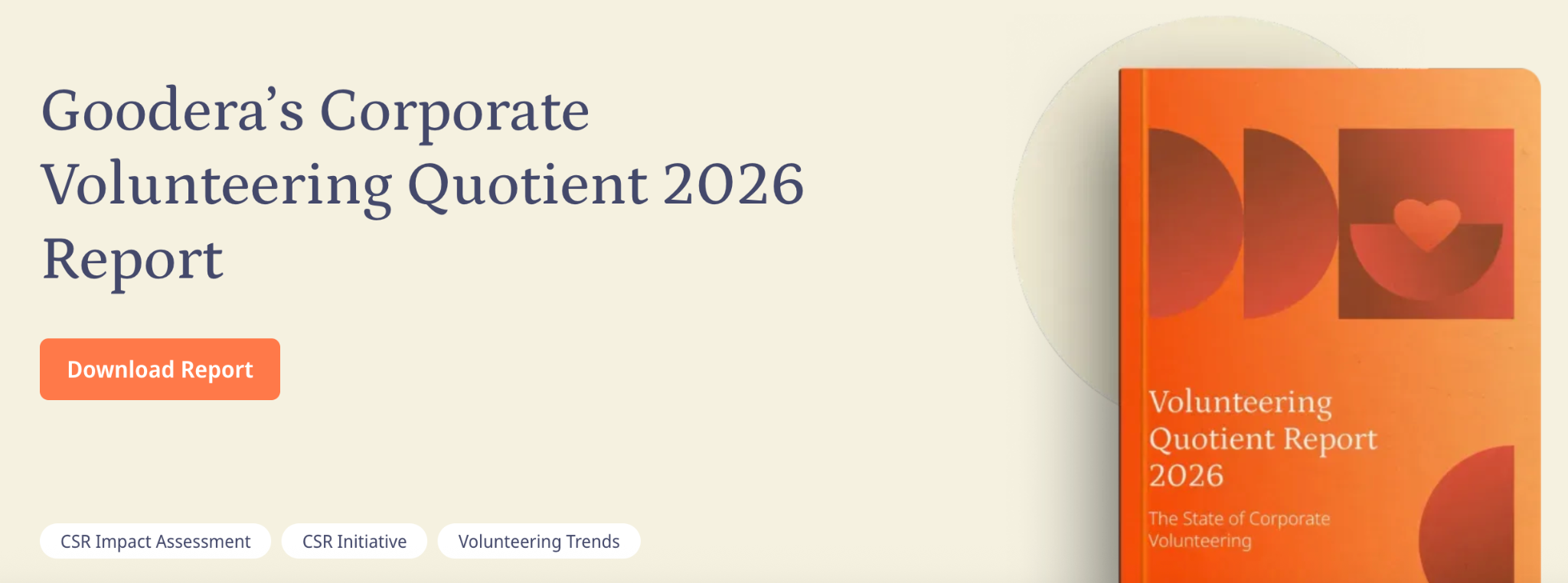
There’s also a clear downstream effect. Structured volunteering programs are linked to a 6.1% year-over-year reduction in turnover, as employees feel more connected to company values and more invested in their work, especially during the early stages of their tenure.
When you pair that with broader workforce data, the impact becomes more concrete. As discussed before, employees who engage in CSR and volunteering are twice as likely to feel satisfied with their career growth and loyal to their organization, while companies with strong programs report up to 39% lower attrition overall.
Now apply that to your own numbers. If replacing an employee costs 50% to 200% of their annual salary, even a modest reduction in turnover quickly translates into significant savings.
At that point, the question isn’t whether workplace giving is worth it, it’s how much attrition you’re willing to absorb without it.
2. Show the Talent Acquisition Angle
Companies with defined workplace giving programs are attracting Gen Z during their job search with measurable success. With Gen Z now comprising a growing share of the workforce and Millennials firmly in mid-career, purpose-driven benefits aren't a nice-to-have. They're a competitive differentiator in a tight talent market.
3. Present the Engagement Multiplier
Employee engagement is already on your leadership team's dashboard. Give them the link they may not have made yet: companies with strong corporate purpose programs consistently outperform on engagement scores, and engaged teams show 21% greater profitability, according to Gallup's long-running research. A giving program isn't a separate initiative. It's an engagement strategy with charitable upside.
4. Anchor the Ask to a Pilot
If full program investment feels like a large leap, propose a 90-day pilot with one matching component, one campaign, and one volunteer day. Measure participation, gather employee feedback, and return with data. Pilots earn trust. Trust earns budget.
Choosing the Right Workplace Giving Platform
Once leadership is aligned, the infrastructure decision becomes the most practical one. The only costs of starting a corporate giving program may be the employee giving software you use to execute the campaign, unless your company wants to start a foundation or new nonprofit organization. That makes platform selection more consequential than most people realize at the outset.
The right employee giving software does five things: it makes giving frictionless for employees, automates matching gift processing, connects employees to a broad base of vetted nonprofits, tracks volunteer hours and grants, and generates the impact reports that justify continued investment to leadership.
For organizations focused specifically on building stronger fundraising and donation campaigns, dedicated fundraising tools can also help streamline campaign management, donor engagement, and fundraising operations.
Here's how the major options break down:
Goodera
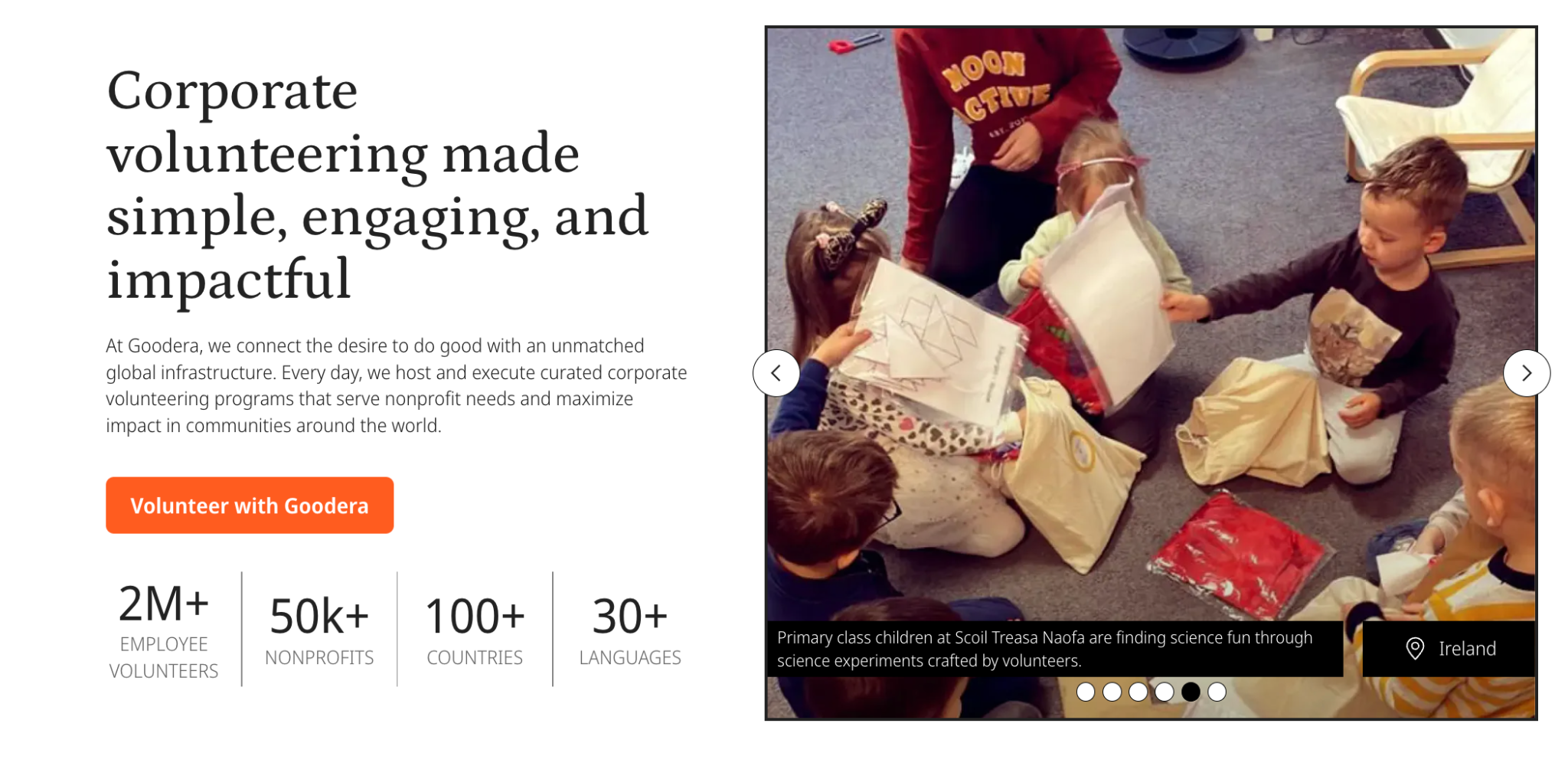
Goodera is designed to help organizations run structured volunteering and giving programs at scale, particularly across distributed and global teams. While many platforms focus primarily on donations, Goodera centers on volunteering as the core engagement driver, with giving integrated into the same experience.
Here’s how it works in practice:
1. End-to-End Corporate Volunteering Infrastructure
Goodera supports the full lifecycle of volunteering programs, from design to execution and tracking. It connects companies with a curated global network of nonprofit partners across focus areas like education, climate action, hunger, and employability.
- Pre-built and customizable volunteering experiences
- On-ground, virtual, and hybrid formats
- Coverage across 100+ countries and 1000+ cities
This reduces the need for companies to source, vet, and coordinate with nonprofits independently.
2. Structured Programs That Drive Participation
The platform is built around structured engagement rather than one-off activities. Programs are designed to encourage consistent participation through:
- Thematic campaigns aligned with key moments in the year
- Skill-based volunteering tied to employee expertise
- Team-based experiences that fit into workplace culture
This approach contributes to the higher participation rates highlighted in Goodera’s Volunteering Quotient Report 2026.
3. Integrated Giving and Volunteering
Goodera brings together donations, volunteering, and smaller engagement actions in one system. Employees can:
- Volunteer their time
- Support vetted nonprofits financially
- Take part in simple actions that build ongoing engagement
For organizations, this creates a more cohesive program instead of separate initiatives running in parallel.
4. Impact Measurement and Reporting
The platform includes built-in tracking to help organizations understand participation and outcomes.
- Dashboards for volunteer hours and engagement levels
- Breakdowns by cause, geography, and program type
- Data that can be used for internal reporting and stakeholder updates
5. Managed Execution Support
Goodera combines software with operational support, which is a key differentiator.
- Dedicated program managers
- Coordination with nonprofit partners
- End-to-end event execution
This reduces the internal effort required from HR or CSR teams and helps ensure programs run consistently.
6. Designed for Distributed and Ongoing Programs
Goodera is particularly suited for organizations that need to run recurring programs across multiple locations and teams. It supports:
- Consistent experiences across geographies
- High-frequency campaigns rather than one-time events
- Centralized oversight with localized execution
This makes it easier to maintain momentum and participation over time, especially in large or globally distributed workforces.
Some other platforms to explore:
Benevity
Benevity is the enterprise standard for large, global programs. It supports payroll giving, donation matching, volunteer time tracking, and access to over two million vetted nonprofits worldwide. Its analytics layer is the most sophisticated in the category, making it the right choice for organizations that need to report program impact across regions, business units, and causes. The tradeoff is implementation time and cost. Plan for a three-to-six-month rollout and a meaningful annual contract.
Double the Donation
Double the Donation solves specifically for matching gift automation, which is valuable if unclaimed matching dollars are your primary problem. It verifies employee eligibility automatically, sends match reminders, and integrates with most major payroll and fundraising platforms. For organizations that already have giving infrastructure but are leaving match dollars on the table, this is a focused and highly effective solution.
Millie
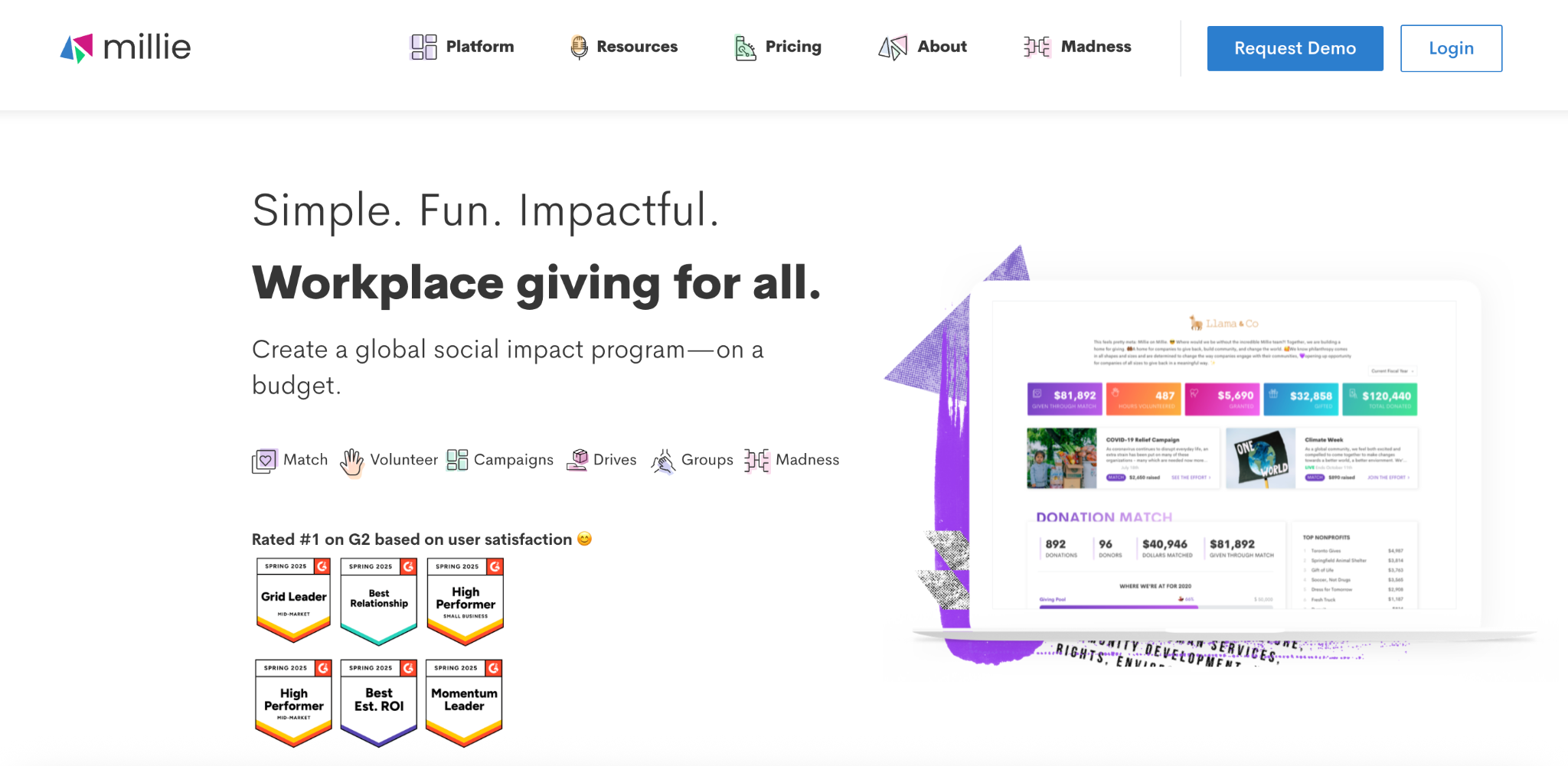
Millie is built for mid-market companies that need something functional and fast to launch. It's a platform you can go live on in days rather than months, with a clean employee-facing interface and solid matching and volunteer tracking capabilities. It won't have the reporting depth of Benevity, but for a first program, it removes the barriers that cause most launches to stall.
YourCause
YourCause from Blackbaud is the right choice for organizations already in the Blackbaud ecosystem, particularly those managing complex grantmaking alongside employee giving. Its reporting is detailed, and its integration with Raiser's Edge is seamless.
One principle applies regardless of which platform you choose: the best employee giving software is the one your employees will actually open. A platform with 200 features and a 12-click donation process will consistently underperform a simpler tool that works cleanly on a mobile phone in under 60 seconds.
What Company Giving Looks Like in Year One
For leaders building from scratch, here's a realistic first-year framework that doesn't require a large team, a massive budget, or a six-month implementation.
1. Months 1 to 2: Foundation
Choose your platform and configure it. Set your match ratio and cap. Decide whether you're opening cause selection to employee nominations or starting with a curated list of three to five vetted nonprofits. Brief your leadership team and identify your internal program champion. Draft your internal communications plan.
2. Month 3: Soft Launch
Introduce the program at an all-hands. Keep the message simple: here's what we're doing, here's how to participate, here's what happens when you do. Don't overwhelm with features. Pick one action, such as setting up a recurring payroll donation, and make that the single ask.
3. Months 4 to 6: First Campaign
Run a time-bounded campaign tied to a cause your employees nominated or one tied to a relevant awareness month. Set a specific goal, such as 500 donations or $25,000 raised, and track it publicly. Show a live progress bar. Share impact updates from the nonprofit partner. Run the campaign for four weeks, not four months.
4. Months 7 to 9: Volunteer Component
Add a volunteer day or skills-based volunteering opportunity. Work with your platform or a nonprofit partner to identify a project that matches your team's skills to a real organizational need. Debrief afterward and capture the story: who went, what they did, what changed.
5. Months 10 to 12: Impact Report and Year 2 Planning
Compile your first year of data: participation rate, total donations, matching funds deployed, volunteer hours logged, and nonprofits supported. Share it with leadership and with employees. Use what you learned to shape the second year. The companies that sustain great programs treat the first year as a learning exercise, not a performance.
The Workplace Philanthropy Moment We're In
That shift is important context for any leader building a program right now. Employees are not disengaged from giving. They're more engaged than ever, and they're directing their energy toward causes that feel immediate, local, and real. The companies best positioned to capture that energy are the ones with infrastructure in place: a platform that works, a match that's been communicated, and a culture where giving is visible and normalized.
ERGs are seen as trusted groups within organizations, and allowing them to lead giving campaigns, be involved in granting decisions, and drive volunteer opportunities is a powerful lever for impact programs, according to Benevity's 2025 State of Corporate Purpose Report. If your organization already has active ERGs, involving them in program design from the beginning isn't just inclusive. It's strategically smart. ERG-led campaigns consistently outperform top-down campaigns on participation.
The window to build this well is now. Employees are ready. The platforms exist. The business case is clear. What most programs are missing isn't enthusiasm or budget. It's a decision to start.
Workplace philanthropy done well is not a line item in the CSR budget. It's a lever for retention, engagement, talent attraction, and community trust, all operating simultaneously from a single investment. The companies that understand this are building programs with the same rigor they bring to benefits design, compensation strategy, and culture initiatives.
The decision to start is the hardest part. After that, it's simply a matter of building one layer at a time, measuring what you learn, and letting your employees show you what they're capable of when they're given the tools to show up.
Start there.
Questions Senior Leaders Ask Most
1. How much does it cost to launch a workplace giving program?
The cost varies significantly depending on platform and program scope. Entry-level platforms like Millie start at a few thousand dollars per year. Enterprise platforms like Benevity are priced based on company size and program complexity and typically involve a more significant annual contract. The matching gift budget is separate and should be sized based on your employee population and your target participation rate. A common starting point for mid-sized companies is a 1:1 match with a $500 annual cap per employee, scaling up as participation data justifies the investment.
2. What is a realistic employee participation rate in year one?
For a first program with active promotion and a clear matching component, 10 to 20% participation in year one is a realistic and respectable target. Companies that see higher rates in year one typically have one thing in common: visible leadership participation. When the CEO shares what cause they supported and why, participation follows.
3. How do we measure the success of our employee giving program?
Track three things consistently: participation rate (the percentage of employees who give or volunteer at least once), matching gift utilization (the percentage of eligible match dollars actually claimed), and total community impact (dollars donated, hours volunteered, nonprofits supported). Over time, add retention data for program participants versus non-participants. That comparison will be your most compelling metric in any budget conversation.
4. How do we get employees to actually use the giving platform once it's live?
Promotion is the answer, and most programs dramatically underpromote. Mention the platform in onboarding. Remind employees of the match in the run-up to giving season. Have managers share their own participation in team meetings. Run time-bounded campaigns with visible progress trackers rather than leaving the portal open and unannounced. The platform won't sell itself.
5. What's the single biggest mistake companies make when launching a giving program?
Underinvesting in communication. Most companies spend 90% of their energy choosing a platform and 10% telling employees it exists. The ratio should be closer to 50/50. A simple platform that's actively promoted will always outperform a sophisticated platform that nobody knows about.
Frequently Asked Questions
1. What is Employee Giving and how does it work?
Employee Giving refers to workplace programs that let staff donate money, time, or skills to nonprofits, often with company support. Common formats include matching gifts, payroll deduction, Volunteer Time Off (VTO), and dollars-for-doers grants. Structured programs strengthen workplace culture while amplifying charitable impact, connecting employees to the causes they care about most.
2. What are the main types of Employee Giving programs?
Ten formats are common: matching gifts, payroll deduction, Volunteer Time Off, dollars-for-doers, employee-directed grants, group fundraising, board service allowances, cause-of-the-quarter drives, product donations, and sabbatical placements. Matching gifts and VTO remain the most popular entry points, while dollars-for-doers converts volunteer hours into company contributions to nonprofits chosen by staff.
3. Why does Employee Giving improve employee retention?
Companies with strong volunteering programs report 39% lower attrition, according to the Goodera VQ Report 2026. New hires are most vulnerable in year one, with 25-40% turnover rates. Employee Giving builds emotional connection to the employer's mission, offsetting replacement costs that run from 50 to 200% of annual salary in the United States.
4. How do corporate matching gift programs work?
Matching gift programs pair every employee donation dollar-for-dollar with a company contribution to the same nonprofit. Employees submit a receipt through an internal platform, and the employer routes matched funds to the chosen charity. Caps typically range from $1,000 to $10,000 per employee annually. Microsoft Employee Giving has made matching a benchmark for corporate philanthropy.
5. What is Volunteer Time Off (VTO) and how many hours do companies offer?
Volunteer Time Off is paid leave that employees use for nonprofit service without dipping into vacation days. Companies typically start with 8-16 hours annually and scale to 40 hours or more. Salesforce famously offers seven paid days through its 1-1-1 model, while Patagonia supports extended environmental leave for conservation projects.
6. How can companies measure the success of Employee Giving?
Track three core metrics: participation rate, total dollars raised or matched, and the retention delta between participants and non-participants. Layer in volunteer hours logged, nonprofit reach, and the program's own Net Promoter Score. According to the Goodera VQ Report 2026, structured programs achieve 2.6x higher participation than ad-hoc, one-off giving efforts.
7. Which companies have the best Employee Giving programs?
Salesforce pioneered the 1-1-1 model, dedicating 1% of equity, product, and employee time to communities. Deloitte Impact Day mobilises the whole firm annually, Microsoft matches donations up to $15,000 per employee, and Patagonia offers extended environmental leave. These benchmark programs pair generous financial commitments with visible executive sponsorship and clear measurement.
8. How should a company launch its first Employee Giving program?
Start modestly with 8-16 hours of VTO, a matching gift cap, and a tracking platform to log participation. Secure executive sponsorship early so leaders model the behaviour. Pilot one cause-of-the-quarter drive, measure participation and dollars, then iterate. Communication cadence matters more than initial scale, keeping enrolment consistently above ad-hoc program benchmarks.
9. What are common mistakes companies make with Employee Giving?
Frequent pitfalls include launching without executive modelling, failing to track participation, offering VTO on paper while blocking calendars in practice, and limiting nonprofit choice to a short shortlist. Programs also stall when matching caps go unpublicised. Employees engage more when the program feels transparent, employee-directed, and integrated into performance conversations rather than treated as an HR side project.
10. How can Goodera help scale an Employee Giving program?
Goodera designs and operates end-to-end Employee Giving programs across 100+ countries, combining vetted nonprofit partnerships, virtual and in-person volunteering, matching gift administration, and impact reporting on a single platform. Companies use it to launch VTO, dollars-for-doers, and group fundraising campaigns while tracking participation, dollars, and retention outcomes against industry benchmarks.