Blood Cancer Awareness Month: Workplace Guide

Blood Cancer Awareness Month is observed every September in the United States to raise awareness of leukemia, lymphoma, myeloma, and other blood-related cancers. Congress designated September as National Blood Cancer Awareness Month in 2010, and the observance now covers more than 100 types of blood cancer, with a focus on early diagnosis, research support, and patient empowerment.
For companies, this is one of the more overlooked health observances on the corporate calendar, even though cancer affects a significant number of employees and their families.
In fact, as per CDC, 72% of large employers report seeing a higher prevalence of cancer among their workforce and their families. The broader impact is equally striking. More than 1.85 million new cancer cases were reported in the United States in 2022, and over 613,000 people died from cancer in 2023, underscoring why workplace awareness and support matter throughout the year.
We built this guide to answer the questions we hear most often from HR, CSR, and employee engagement teams planning their September calendar: what the month is for, what the numbers actually say, and what a workplace campaign can look like beyond a single social post.
What Is Blood Cancer Awareness Month and Why Does It Matter
Blood Cancer Awareness Month exists to close a critical awareness gap. Although blood cancers are the third leading cause of cancer deaths in the United States, they remain far less recognized than many other forms of cancer.
A national survey commissioned by the Leukemia & Lymphoma Society found that 82% of adults were unaware of this fact, and awareness of specific blood cancers was even lower. While most respondents recognized leukemia, only 24% identified lymphoma and 12% identified myeloma as blood cancers.
The knowledge gap extends beyond the U.S. In the UK, more than half of adults couldn't name a single symptom of blood cancer, according to Blood Cancer UK (2026). Blood Cancer Awareness Month brings together patients, survivors, caregivers, healthcare providers, employers, and advocacy organizations to close this awareness gap, encourage earlier recognition of symptoms, and support continued investment in research.
Blood cancer is fundamentally different from solid-tumor cancers because it originates in the blood or bone marrow, the tissue responsible for producing blood cells. Unlike several other common cancers, there is currently no routine screening test for most blood cancers, making public awareness of symptoms and timely medical evaluation especially important.
That also makes education one of the most meaningful ways workplaces can contribute during Blood Cancer Awareness Month.
What Is the Blood Cancer Awareness Month Theme in 2026
Unlike some health observances that adopt a new campaign slogan each year, Blood Cancer Awareness Month does not have a single official global theme for 2026. Instead, organizations across the U.S. align their awareness efforts around three enduring priorities:
- Education: Helping people recognize symptoms such as persistent fatigue, unexplained bruising, bone pain, and recurring infections, which can often be mistaken for less serious conditions
- Early detection and research: Raising awareness of the importance of timely diagnosis while supporting research into better diagnostic tools and treatments, since routine screening is not available for most blood cancers
- Patient and caregiver support: Elevating the voices of people living with blood cancer, honoring survivors, and connecting patients and families with resources and support networks
The color most closely associated with the month is red. Red ribbons and red-themed campaigns are widely used to symbolize blood cancer awareness, making them an easy visual element for companies to incorporate into internal communications, Slack channels, email banners, or workplace signage.
One notable update for 2026 is that the Leukemia & Lymphoma Society (LLS) has rebranded as Blood Cancer United to better reflect the broad range of diseases that fall under the blood cancer umbrella. If your organization has referenced LLS in previous awareness campaigns or internal communications, it's worth updating those materials to reflect the new brand.
What Do the Latest Blood Cancer Statistics Tell Us
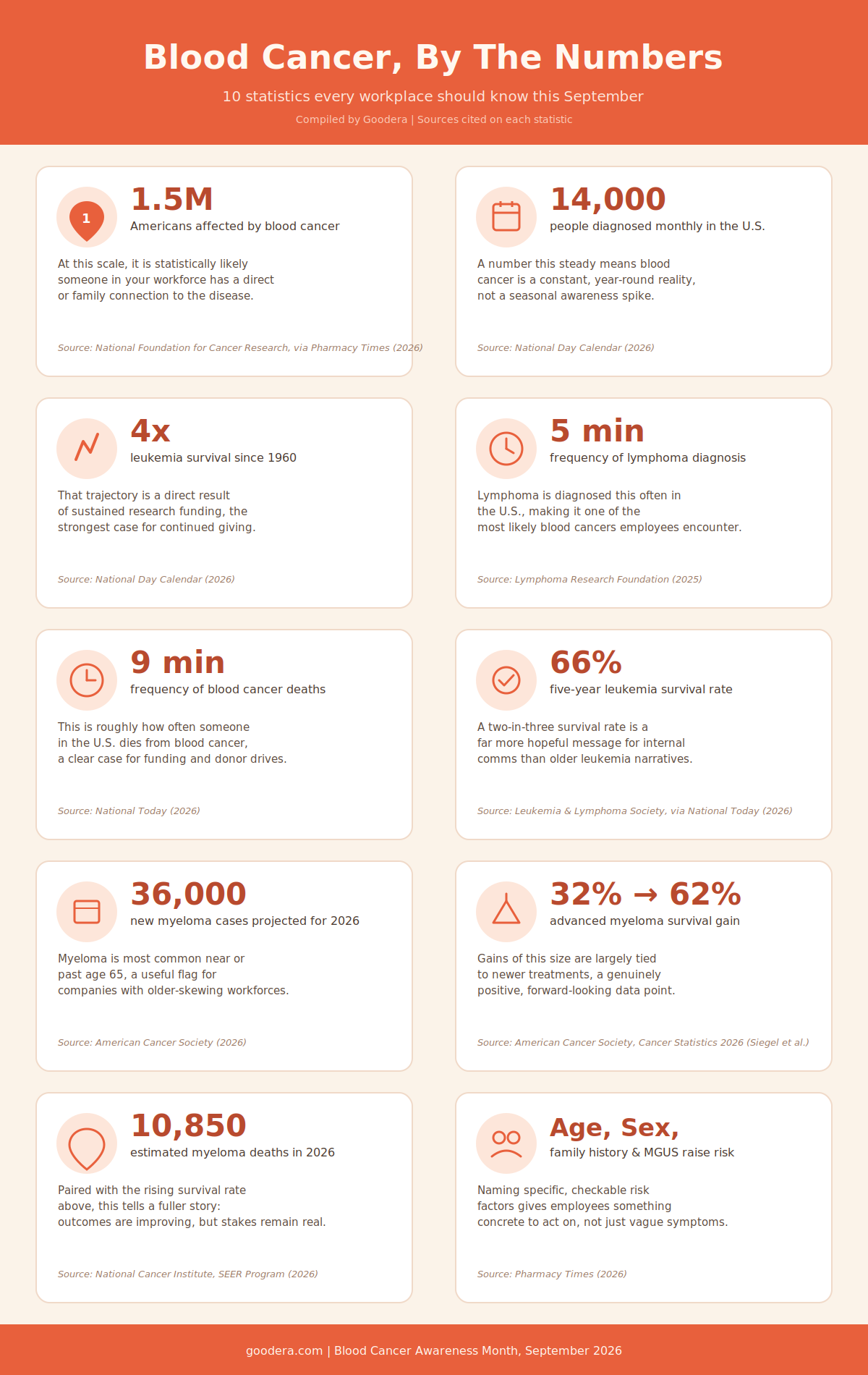
Numbers help make the business case for internal action, but they also help employees understand why this matters. Here's what the current data shows:
- 1.5 million Americans are affected by blood cancer, according to the National Foundation for Cancer Research, as cited in Pharmacy Times (2026). At that scale, it's statistically likely that someone in your workforce has a direct or family connection to the disease, which is reason enough to make September more than a token mention on the internal calendar.
- Monthly diagnoses hit roughly 14,000 people in the United States, per National Day Calendar (2026). A number that steady means blood cancer isn't a seasonal spike tied to awareness campaigns; it's a constant, year-round reality that a single September post can't fully address.
- Survival has quadrupled for leukemia patients since 1960, per the same National Day Calendar (2026) report. That trajectory is a direct result of sustained research funding, which is the strongest argument for why donation-based campaigns still matter even in a year with encouraging headlines.
- Five minutes is how often lymphoma, the most common blood cancer, is diagnosed in the U.S., according to the Lymphoma Research Foundation (2025). That frequency makes lymphoma one of the more likely blood cancers to touch an employee's immediate circle, which is worth naming explicitly in internal education materials.
- Nine minutes is roughly how often someone in the U.S. dies from blood cancer, per National Today (2026). Mortality data like this is what typically shifts a campaign's framing from generic awareness to a clearer call for funding and donor registration.
- Five-year survival rates for leukemia now sit at 66%, according to the Leukemia & Lymphoma Society, as cited by the same National Today (2026) report. A two-in-three survival rate is a meaningfully more hopeful message for internal comms than older, bleaker leukemia statistics still circulating in employee awareness.
- Myeloma cases are projected to reach about 36,000 new diagnoses in the U.S. in 2026, according to the American Cancer Society (2026). Since myeloma is most common in employees nearing or past age 65, it's a useful data point for companies with senior leadership populations or older-skewing workforces to flag in benefit communications.
- Survival jump rates for myeloma rose from 32% to 62% for advanced-stage diagnoses, per the American Cancer Society's Cancer Statistics 2026 report (Siegel et al., 2026). Gains of that size are largely attributed to newer treatments, giving campaigns a genuinely positive, forward-looking data point rather than a purely fear-based one.
- Myeloma deaths are estimated at 10,850 in the U.S. for 2026, according to the National Cancer Institute's SEER program (2026). Pairing this figure with the rising survival rate above tells a fuller, more balanced story: outcomes are improving, but the disease still carries real stakes worth funding further research against.
- Risk factors for blood cancer include advancing age, male sex, family history, and precursor conditions like MGUS (monoclonal gammopathy of undetermined significance), according to Pharmacy Times (2026). Naming specific, checkable risk factors, rather than vague symptom lists, gives employees something concrete to act on if they recognize their own risk profile.
These figures make one thing clear for employers: with over a million Americans affected, it's statistically likely that someone in your workforce is either living with a blood cancer, caring for someone who is, or has a family member who has. That's a strong internal case for why this observance deserves more than a single social graphic.
Best Blood Cancer Awareness Month Campaign Ideas for Workplaces
Companies planning a September campaign generally land on one of a few proven formats. Here's how to think about sequencing them across the month:
- Week 1 — Education kickoff: Share a short internal explainer (symptoms, the three main blood cancer types, and the "why September" story) through Slack, intranet, or a company-wide email. Keep it factual, not alarmist.
- Week 2 — Storytelling: If any employees are open to sharing a personal connection to blood cancer, a short internal spotlight (with consent) tends to outperform generic awareness content for engagement.
- Week 3 — Action window: This is where donation drives, matched-giving campaigns, or a bone marrow donor registration event typically sit.
- Week 4 — Close and report back: Share what the campaign raised or how many employees participated, and where the funds/registrations went. Closing the loop is what turns a one-off campaign into something employees expect and trust next year.
"From treatment advances to expanding education, Blood Cancer Awareness Month is a chance to reflect on how far patient care has come." — Lisa Hwa, APRN, CNP, DNP, MS, Cancer Nursing Today, September 2025
Goodera can help ideate, plan, and host the entire volunteering experience for you. Share your preferred cause and volunteering goals with us, and we will handle everything else.
What Blood Cancer Awareness Month Activities Can Employees Participate In
1. Wear Red Days
A "Wear Red" day is one of the simplest ways to spark conversation. Invite employees to wear red clothing or accessories, share photos on internal communication channels, and explain what the color represents. Pair the activity with a short educational message about blood cancer symptoms or current research, so employees leave with greater awareness, not just a photo opportunity.
2. Host a Lunch-and-Learn Session
Bring in an oncologist, hematologist, oncology nurse, researcher, or patient advocate to speak about blood cancers, early symptoms, treatment advances, or the patient journey. Many advocacy organizations offer volunteer speakers during September. These sessions help employees separate myths from facts while creating a safe space for questions that many people may never have asked before.
3. Organize a Bone Marrow Donor Registration Drive
For patients with leukemia and several other blood cancers, a bone marrow or stem cell transplant may be the best chance for a cure. Yet finding a compatible donor can be incredibly difficult, particularly for patients from underrepresented ethnic backgrounds. Hosting an on-site registration event or distributing at-home swab kits gives employees a simple way to join a donor registry and potentially save a life in the future.
4. Partner With a Local Blood Bank
Blood cancer patients often rely on regular blood and platelet transfusions throughout treatment. Organizing a workplace blood donation drive, or encouraging employees to donate individually throughout September, directly supports hospitals caring for cancer patients. Even a modest increase in donations can help address seasonal blood shortages.
5. Launch a Walking or Wellness Challenge
Encourage employees to walk, run, cycle, or stay active throughout the month while your company donates for every mile completed or participant who joins. Wellness challenges create an easy entry point for remote and hybrid employees, encourage healthy habits, and connect personal well-being with community impact.
6. Volunteer Your Professional Skills
Many blood cancer nonprofits need expertise beyond financial support. Employees can contribute through skills-based volunteering by designing awareness materials, analyzing data, developing websites, mentoring nonprofit staff, translating resources, or supporting marketing and communications projects. These contributions often create lasting organizational capacity, making them one of the highest-impact ways employees can volunteer.
7. Share Survivor and Caregiver Stories
If employees are comfortable doing so, invite them to share personal experiences with blood cancer through internal newsletters, fireside chats, or video messages. Storytelling helps humanize the observance, reduces stigma around serious illnesses, and reminds colleagues that blood cancer affects families, caregivers, and workplaces, not just patients.
8. Match Employee Donations
Many companies amplify employee generosity by matching donations made to trusted blood cancer charities during September. Donation matching not only increases the total funds raised but also encourages greater participation by showing that the organization is investing alongside its employees.
"Blood Cancer Awareness Month provides a special opportunity for organizations like Blood Cancer United to amplify our mission and free resources, reach more of those who need us, and help all blood cancer patients and their families feel empowered and supported."
— Gwen Nichols, Chief of Blood Cancer United, Pharmacy Times, 2026
How Can Companies Build a Corporate Blood Cancer Awareness Campaign
If you're starting from scratch, we'd recommend building the campaign in this order rather than jumping straight to "what should we post":
- Pick a giving mechanism first: Decide whether the campaign centers on direct donations, a donor registry drive, volunteering hours, or a mix before you build creative around it.
- Choose a partner nonprofit: Working with an established blood cancer organization gives your campaign legitimacy and gives employees a trusted place to direct their time or money.
- Set a measurable goal: A number (dollars raised, registrations completed, volunteer hours logged) gives you something concrete to report back on in week 4.
- Brief internal comms early: The lunch-and-learn, the wear-red day, and the email cadence all need lead time, especially for global teams across time zones.
- Track participation, not just spend: Employee participation rate is often a better long-term engagement signal than total dollars raised, particularly if you're trying to build a recurring giving culture.
Wrapping It Up
Blood Cancer Awareness Month is more than a date on the workplace calendar. It's an opportunity to educate employees about a disease that often goes unrecognized, support colleagues and families who may be affected, and contribute to research and patient care in tangible ways. Because most blood cancers don't have routine screening tests, awareness and early recognition remain some of the most powerful tools available.
For employers, the goal shouldn't be to run a one-day awareness campaign and move on. The most effective initiatives combine education, employee participation, and measurable action. A simple framework is to educate employees early in the month, create opportunities to volunteer or give back, encourage visible participation through activities like Wear Red Day or blood donation drives, and close the campaign by sharing the collective impact. Reporting participation, funds raised, donor registrations, or volunteer hours not only demonstrates transparency but also builds momentum for future health and volunteering campaigns.
Whether you're planning your first Blood Cancer Awareness Month campaign or expanding an existing one, focus on making it easy for employees to participate and meaningful for those affected. Small actions, when taken across an entire workforce, can increase awareness, strengthen workplace culture, and contribute to better outcomes for patients and their families.
Frequently Asked Questions
1. When is Blood Cancer Awareness Month?
Blood Cancer Awareness Month is observed every September in the United States. Congress designated it in 2010, and it has been marked annually since.
2. What is the ribbon color for Blood Cancer Awareness?
Red ribbons and red ampersands are the colors and symbols commonly associated with blood cancer awareness.
3. What are the three main types of blood cancer?
The three main types are leukemia, lymphoma, and myeloma, alongside other related conditions like myelodysplastic syndromes and myeloproliferative neoplasms.
4. Is there a specific day within Blood Cancer Awareness Month?
Yes. September 15 is recognized as World Lymphoma Awareness Day, marked by several advocacy organizations as a dedicated giving and awareness day within the broader month.
5. How many people are affected by blood cancer in the U.S.?
Over 1.5 million Americans are living with or in remission from a blood cancer, according to the National Foundation for Cancer Research.
6. Does blood cancer have a standard screening test?
No effective population-wide screening program currently exists for most blood cancers, which is part of why symptom education and early-detection advocacy remain central to the observance.
7. What is the difference between the Leukemia & Lymphoma Society and Blood Cancer United?
They're the same organization. The Leukemia & Lymphoma Society recently changed its name to Blood Cancer United to better represent the full range of blood cancers it supports, rather than just the two named in its former title.
8. What's a simple, low-budget way for a company to participate?
A company-wide "wear red" day paired with an internal educational email tends to be the lowest-effort, highest-visibility starting point, and can be layered with a donation drive as the program matures.
9. How can remote and hybrid employees participate in Blood Cancer Awareness Month?
Remote and hybrid teams can participate through virtual lunch-and-learn sessions, online fundraising campaigns, step challenges, skills-based volunteering, educational webinars, donation matching, and virtual bone marrow registry drives where eligible employees receive at-home swab kits. These activities ensure employees can contribute regardless of location.
10. How can companies measure the success of a Blood Cancer Awareness Month campaign?
Track metrics such as employee participation rate, volunteer hours, blood donations collected, donor registrations completed, event attendance, and engagement with internal communications. Gathering employee feedback after the campaign can also help improve future health awareness initiatives and demonstrate the broader impact on workplace engagement.
Frequently Asked Questions
When is Blood Cancer Awareness Month?
Blood Cancer Awareness Month is observed every September in the United States. Congress designated it in 2010, and it has been marked annually since.
What is the ribbon color for Blood Cancer Awareness?
Red ribbons and red ampersands are the colors and symbols commonly associated with blood cancer awareness.
What are the three main types of blood cancer?
The three main types are leukemia, lymphoma, and myeloma, alongside other related conditions like myelodysplastic syndromes and myeloproliferative neoplasms.
Is there a specific day within Blood Cancer Awareness Month?
Yes. September 15 is recognized as World Lymphoma Awareness Day, marked by several advocacy organizations as a dedicated giving and awareness day within the broader month.
How many people are affected by blood cancer in the U.S.?
Over 1.5 million Americans are living with or in remission from a blood cancer, according to the National Foundation for Cancer Research.
Does blood cancer have a standard screening test?
No effective population-wide screening program currently exists for most blood cancers, which is part of why symptom education and early-detection advocacy remain central to the observance.
What is the difference between the Leukemia & Lymphoma Society and Blood Cancer United?
They're the same organization. The Leukemia & Lymphoma Society recently changed its name to Blood Cancer United to better represent the full range of blood cancers it supports, rather than just the two named in its former title.
What's a simple, low-budget way for a company to participate?
A company-wide "wear red" day paired with an internal educational email tends to be the lowest-effort, highest-visibility starting point, and can be layered with a donation drive as the program matures.
How can remote and hybrid employees participate in Blood Cancer Awareness Month?
Remote and hybrid teams can participate through virtual lunch-and-learn sessions, online fundraising campaigns, step challenges, skills-based volunteering, educational webinars, donation matching, and virtual bone marrow registry drives where eligible employees receive at-home swab kits. These activities ensure employees can contribute regardless of location.
How can companies measure the success of a Blood Cancer Awareness Month campaign?
Track metrics such as employee participation rate, volunteer hours, blood donations collected, donor registrations completed, event attendance, and engagement with internal communications. Gathering employee feedback after the campaign can also help improve future health awareness initiatives and demonstrate the broader impact on workplace engagement.


.webp)