Goodera’s AIX: A 360° AI Program for CSR leaders, Nonprofits, and Volunteers

Every social impact leader knows the balancing act. You have nonprofits to support, volunteering programs to run, community needs to address, and outcomes to report. And somehow, there is never enough time or bandwidth to give each of these the attention it deserves.
Technology could help ease some of that pressure. AI, in particular, can take repetitive tasks off your team's plate, help nonprofits work more efficiently, and open up new ways to address community needs. But knowing where to start, which tools to use, and how to put them into practice is a different challenge altogether.
Most social impact teams we talk to are doing remarkable work with very little time, and AI could give some of that time back. Yet adoption remains low. Only 25% of nonprofits actively use AI tools, even though 76% say the communities they serve want AI literacy programs. That is a lot of potential waiting for the right support.
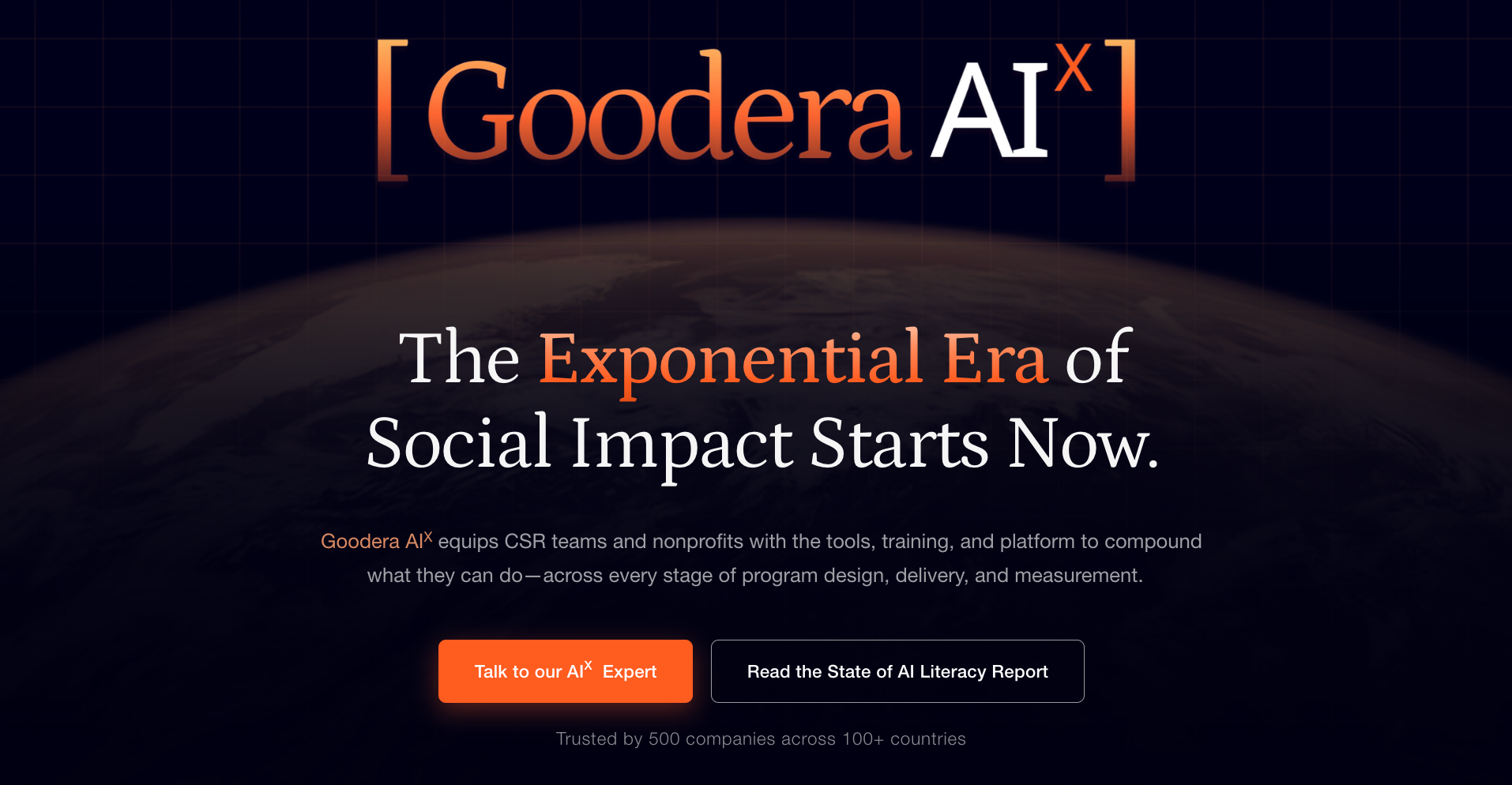
Goodera AIX is our answer: a 360° program that brings AI to CSR leaders, nonprofits, and volunteers, helping every team put it to work and scale social impact. In this guide, we break down what Goodera AIX is, how each part works, and how your team can get started.
What Is Goodera AIX?
Goodera AIX is a 360° program that stands on three pillars: Illuminate, Activate, and Integrate. Together, they cover learning, hands-on volunteering, and AI tools built into the Goodera platform. The goal is simple. We want every person in the impact ecosystem to do more good with the time and money they already have.
- Illuminate: build AI fluency through workshops, research, and masterclasses.
- Activate: run AI-native volunteering projects for every skill level.
- Integrate: weave AI into the platform, from matching to execution to impact reporting.
Who Is Goodera AIX For?
Goodera AIX is built for three groups, and each one gets something different.
- CSR leaders: smarter tools and a clear AI strategy for volunteering programs.
- Nonprofits: real AI capability, plus expert help when they need it.
- Volunteers: meaningful projects where they teach and use AI skills.
Why Does the Social Impact Sector Need AI Right Now?
Nonprofits and CSR teams are being asked to do more: reach more communities, run more programs, demonstrate measurable outcomes, and make limited resources go further. Yet much of their time still goes into the operational work behind that impact, from preparing reports and coordinating volunteers to managing data and communicating with stakeholders.
AI offers a way to make some of this work faster and more efficient. But adopting new tools is only part of the equation. Teams also need the skills to use them effectively, understand where they add value, and apply them responsibly in the context of social impact.
The urgency is reflected in the numbers. Here's what nonprofits, CSR leaders, and the wider workforce are telling us about the changing landscape, and what it means for the sector.
- Adoption is low. 75% of nonprofits are not actively using AI tools. This suggests most teams are still at the starting line, so a small first step can put you ahead. Start with one task, like drafting donor updates.
- Demand for training is high. 86% of nonprofits want hands-on AI training but lack access. Training that comes with a real person beside you is what this group is asking for. Pair staff with skilled volunteers.
- Efficiency is the main hope. 71% of survey respondents want AI for operational efficiency. Time saved on admin means more time for programs. Pick the most time-consuming report and test AI there first.
- Leaders are changing roles. 67% of CEOs are redesigning roles and career paths around AI collaboration. Boards will soon expect CSR teams to speak this language. Build basic AI fluency before you are asked for it.
- Skills are shifting. Employers expect 39% of workers’ core skills to change by 2030. Students need AI exposure early, and volunteers can give it to them.
What Gaps Are Holding Nonprofits Back From Using AI?
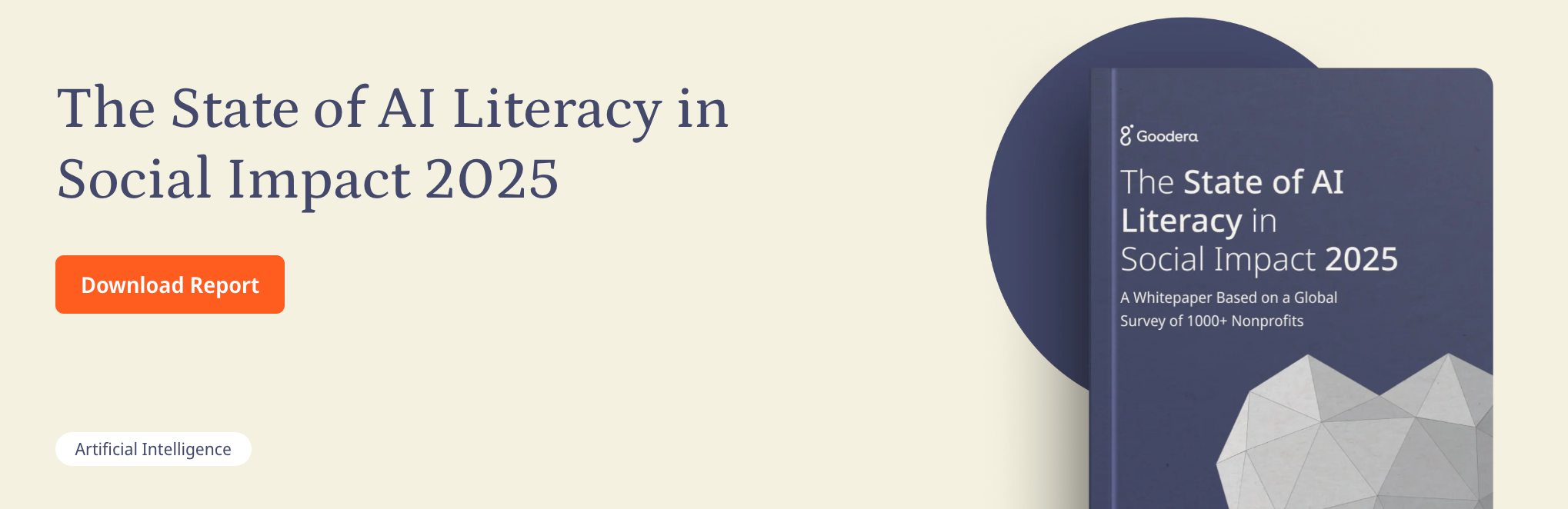
Goodera's survey of 1,000+ nonprofits across 30+ countries found that interest in AI is not the primary barrier to adoption. Nonprofits see opportunities to use these tools, but many lack the training, expertise, and practical support to put them to work.
Five gaps stand out:
- Awareness-action gap: Teams understand that AI could help, but struggle to identify where to begin or which applications are relevant to their work.
- Implementation gap: Nonprofits see the potential for greater efficiency but lack the technical know-how to integrate tools into everyday workflows.
- Community literacy gap: Communities want to learn about AI, but access to structured, practical learning opportunities remains limited.
- Learning support gap: Nonprofit teams often lack in-house AI expertise and need guidance from people who can help them experiment and learn.
- Functional competency gap: Even when teams have access to tools, they may not know how to use advanced features or apply them to specific organizational needs.
These challenges require more than access to software. Nonprofits need opportunities to learn, practice, and receive ongoing support. CSR teams, meanwhile, need a way to connect their employees' technical expertise with the needs of the communities they serve.
That's the thinking behind Goodera AIX.
Goodera AIX: Three Ways to Build AI Readiness Across Social Impact
Goodera AIX brings together three complementary approaches to AI adoption: building knowledge, creating opportunities for hands-on learning, and integrating technology into volunteering operations.
The program is organized around three pillars: Illuminate, Activate, and Integrate.
1. Illuminate: Build AI Literacy and Readiness
Access to AI tools does not automatically translate into meaningful adoption. Teams need to understand what these tools can do, where they fit into their work, and how to use them responsibly.
Illuminate addresses this through research, workshops, and expert-led learning opportunities for CSR leaders, nonprofits, and their teams.
AI and Volunteering Strategy Workshop
The AI and Volunteering Strategy Workshop helps CSR and social impact teams identify where AI can improve their volunteering programs.
Through design thinking, practical exercises, and real-world case studies, participants examine their existing workflows, identify opportunities for responsible AI adoption, and develop a practical pilot plan.
The workshop is designed around your organization's volunteering priorities, helping your team move from general interest in AI to specific applications worth testing.
State of AI Literacy in Social Impact 2025
Goodera's State of AI Literacy in Social Impact 2025 report examines how nonprofits are approaching AI adoption, the challenges they face, and the areas where they need support.
What Does the Research Tell Us About AI Opportunities in Nonprofits?
Goodera's research points to three areas where nonprofits see the greatest potential for AI:
- Communication and storytelling: This is the highest-priority use case. AI can help nonprofits develop communication materials and tell their stories more effectively, making it easier to share their work with donors, volunteers, and other stakeholders.
- Impact measurement and reporting: Nonprofits also see opportunities to use AI to organize information, analyze program data, and communicate outcomes. This could reduce the effort involved in documenting and demonstrating impact.
- Fundraising: AI can support fundraising communication and other resource mobilization activities, helping teams make better use of limited time and capacity.
The findings point to a practical starting point for adoption: focus on tasks where AI can ease existing workloads and deliver immediate value. For nonprofits, that means exploring applications within familiar functions before moving to more complex implementations.
However, the report also highlights a critical barrier: many organizations lack the in-house capacity, confidence, and guidance to implement these tools safely and effectively. Access to hands-on training and expert support will be essential to turning these opportunities into everyday practice.
Download the full State of AI Literacy in Social Impact 2025 report to explore the findings and recommendations.
AI 101 Masterclasses
For teams looking to build foundational knowledge, Goodera AIX also offers AI 101 Masterclasses. These expert-led sessions introduce participants to AI applications relevant to social impact, without requiring prior technical knowledge.
Topics include:
- Introduction to AI for social impact
- AI for program planning
- AI tools for volunteer engagement
- Responsible AI and its applications
The masterclasses are designed to help CSR professionals and volunteers understand the technology before applying it to their work. Check the Goodera AIX page for availability.
2. Activate: Turn Employee Expertise Into Community AI Learning
AI literacy needs to extend beyond corporate teams. Students and nonprofit professionals also need opportunities to understand the technology, experiment with it, and develop skills they can apply in their work and education.
Activate brings this learning into communities through AI-focused volunteering projects. Employees contribute their technical knowledge and professional experience, while students and nonprofit teams get guided opportunities to work with new tools.
Goodera AIX currently features projects across beginner, intermediate, and advanced skill levels.
2.1. AI Jam: Learn AI by Building With It
AI Jam is a hands-on volunteering program where students use intuitive, AI-powered tools to build games, chatbots, finance trackers, and app prototypes.
Participants do not need previous coding experience. Instead of simply learning about AI concepts, they get to experiment with the technology and create something of their own.
Employee volunteers act as mentors, helping students develop ideas, work through challenges, test their projects, and present their creations.
More than 1,000 students have already built projects using AI-powered tools through AI Jam.
A typical session follows three stages:
- AI workshop (30 minutes): Students receive an introduction to the tools, learn how the session will work, and form teams
- Build-a-game (100 minutes): Volunteers guide students as they brainstorm, build, test, and refine their games using vibe-coding tools
- Showcase (20 minutes): Teams present their projects and receive feedback from peers and mentors
The format gives students a practical introduction to building with AI while allowing volunteers to share their professional knowledge in an accessible way.
2.2. Pathway to Robotics: Introduce Students to Robotics and Coding
Pathway to Robotics gives students and employee volunteers 90 minutes to build, program, and test a working robot together.
Students work in teams to assemble path-following robots and explore the engineering concepts behind them. They learn how sensors, circuits, and coding logic influence a robot's movement, then test and improve their designs through friendly challenges.
The program has reached 4,945 students across 66 nonprofits, with 989 robots built across 70 cities.
For students who have had limited exposure to robotics or engineering, the experience offers a chance to work with physical technology, troubleshoot problems, and see how concepts from STEM subjects translate into something they can build themselves.
2.3. Other AI Volunteering Projects in the Goodera AIX Catalog
Beyond AI Jam and Pathway to Robotics, teams can choose from projects suited to different age groups, skill levels, and volunteering formats.
Some examples include:
The catalog also includes AI Scramble, a half-day volunteering format.
Project requirements, materials, and availability vary. CSR teams can explore the Goodera AIX activity catalog to identify suitable options for their workforce and community partners.
2.4. AI Lab: Help Nonprofits Apply AI to Their Work
AI literacy is equally important for nonprofit professionals who want to use these tools in their day-to-day operations.
The AI Lab brings AI-savvy employee volunteers and nonprofit teams together for practical learning. Rather than focusing exclusively on demonstrations, the engagement gives nonprofit staff an opportunity to experiment with tools and explore applications relevant to their responsibilities.
Participants work through guided exercises, explore potential use cases, and identify ways to incorporate AI into their workflows.
For example, a nonprofit team could explore how AI can help with:
- Drafting and adapting communication materials.
- Organizing information for impact reports.
- Developing fundraising and outreach content.
- Creating training and educational resources.
The objective is to help nonprofit professionals identify practical applications they can continue exploring after the volunteering session.
3. Integrate: Bring AI Into Everyday Volunteering Operations
AI literacy and community-focused volunteering address important parts of the adoption challenge. But CSR teams also need operational support to manage increasingly complex volunteering programs.
Integrate focuses on this need by bringing AI into the Goodera platform, supporting the volunteering process from opportunity discovery and planning to execution and reporting.
Two offerings sit within this pillar: Goody AI and Pro Bono AI.
3.1. Goody AI: Support CSR Teams Across the Volunteering Lifecycle
Goody AI is Goodera's AI concierge for CSR champions. It helps teams discover opportunities, plan activities, coordinate events, and access program insights.
It supports four stages of volunteering:
- Discover: Identify relevant volunteering opportunities based on organizational priorities, employee personas, and impact areas
- Register: Develop outreach materials to communicate opportunities and encourage employee registrations
- Execute: Keep track of event logistics and execution throughout the volunteering process
- Report: Generate customized dashboards around the metrics CSR teams need to monitor
For a CSR team coordinating volunteering across multiple locations, these capabilities can reduce the manual work involved in finding activities, communicating with employees, tracking event details, and compiling reports.
That leaves teams with more time to focus on nonprofit partnerships, program quality, and employee engagement.
3.2. Pro Bono AI: Connect Nonprofits With Technology Expertise
Nonprofits often have specific technical challenges but lack access to the expertise needed to address them. Pro Bono AI is designed to connect nonprofit organizations with AI experts from leading technology companies.
Nonprofits can submit their requirements and get matched with relevant experts. Sessions are available in 15-, 30-, and 60-minute formats, making it easier to seek focused guidance without committing to a lengthy engagement.
The expert's identity remains private until they accept a request, and the process is designed to take a nonprofit from submitting a requirement to connecting over a video call in a few steps.
For example, a nonprofit looking to improve its data management processes could seek guidance from an AI professional who understands relevant tools and workflows.
The goal is to make specialized expertise more accessible to organizations that might otherwise struggle to find it.
How Can CSR Teams Put Goodera AIX Into Practice?
A successful AI initiative does not have to begin with a large-scale transformation. CSR teams can start by identifying a specific need, choosing an appropriate learning or volunteering format, and building on what they learn.
Here is a practical way to approach it:
1. Understand where your nonprofit partners need support.
Start by speaking with your nonprofit partners about their existing workflows, challenges, and familiarity with AI. Goodera's State of AI Literacy report can also help identify common use cases and training needs.
2. Build a shared understanding within your CSR team.
Use the AI and Volunteering Strategy Workshop to identify relevant applications, establish responsible-use considerations, and outline a pilot. AI 101 Masterclasses can help build foundational knowledge across the team.
3. Match volunteering projects to employee expertise.
Identify employees with relevant technical skills and interests. Match them with projects based on the experience required, the time available, and the needs of participating nonprofits or students.
4. Choose a suitable community engagement.
For a first engagement, consider a beginner-friendly project such as Plushie, Data Detective Case, or Pathway to Robotics. For teams with more advanced technical capabilities, AI Jam and AI Lab offer opportunities for deeper involvement.
5. Review outcomes and identify the next opportunity.
Look at what participants learned, how nonprofit teams used the knowledge shared, and what could be improved in future engagements. Use these insights to plan the next activity or expand into more advanced projects.
This approach allows CSR teams to build AI initiatives around actual organizational and community needs rather than adopting tools or launching activities without a clear purpose.
What Do Volunteers and Nonprofits Gain From AI-Powered Volunteering?
AI-focused volunteering creates opportunities for both sides to learn and contribute. Employees get to share their professional expertise in a community setting, while students and nonprofit professionals gain access to knowledge and practical experience that may otherwise be difficult to find.
For employees, these engagements offer opportunities to:
- Apply their technical knowledge outside their usual work environment.
- Develop mentoring, communication, and facilitation skills.
- Explore emerging technologies through practical application.
- Contribute to improving AI literacy in their communities.
For nonprofits and students, the benefits include:
- Access to AI knowledge and technical guidance.
- Hands-on experience with tools and applications.
- Exposure to robotics, coding, and emerging technologies.
- Opportunities to explore how these skills can support education, work, and organizational development.
This approach also reflects the idea of co-volunteering with AI, discussed by social impact leader Caroline Barlerin in Goodera's podcast, The Future of Social Impact in the Age of AI.
In the conversation, Caroline describes how AI can reduce the time required for certain volunteering assignments. She gives the example of creating a job-readiness guide for a youth-serving nonprofit: a task that could take a volunteer eight to fifteen hours can become a focused 90-minute exercise with AI supporting the drafting process.
The volunteer still brings the critical thinking, experience, and judgment. The technology helps make the contribution more manageable.
That distinction is important. The goal is to use technology to make expertise more accessible while keeping human knowledge, relationships, and community needs at the center of the experience.
Frequently Asked Questions
1. What Is Goodera AIX?
Goodera AIX is a program that brings AI into corporate social impact through learning, volunteering, and technology. It has three pillars: Illuminate, which builds AI literacy; Activate, which offers AI-focused volunteering projects; and Integrate, which brings AI into volunteering operations.
2. Who Can Participate in Goodera AIX?
CSR and social impact professionals, corporate employees, nonprofit teams, and students can participate in different parts of Goodera AIX. CSR teams can attend strategy workshops, employees can volunteer as mentors, and nonprofits and students can participate in AI learning engagements.
3. What Are the Three Pillars of Goodera AIX?
Goodera AIX is organized around three pillars:
- Illuminate: Builds AI knowledge through research, workshops, and masterclasses.
- Activate: Connects corporate volunteers with students and nonprofits through AI-focused volunteering projects.
- Integrate: Uses AI to support volunteering operations through tools such as Goody AI and Pro Bono AI.
Together, these pillars address AI learning, community engagement, and operational adoption.
4. Do Volunteers Need AI or Coding Experience to Participate?
Not for every project. Beginner activities such as Plushie, Data Detective Case, and Pathway to Robotics introduce participants to relevant concepts through guided activities. AI Jam also does not require previous coding experience. Advanced engagements may require relevant technical expertise.
5. What AI Volunteering Projects Are Available Through Goodera AIX?
The Goodera AIX catalog includes Pathway to Robotics, AI Jam, Smart Greenhouse Kit, Plushie, Data Detective Case, Voice Device, DoodleBot, AI Lab, AI Clinic, and other activities. Projects differ in skill level, duration, format, and learning objectives.
6. How Long Do Goodera AIX Volunteering Projects Take?
Project durations vary by activity. Beginner projects generally take between 60 and 120 minutes. Pathway to Robotics takes approximately 90 minutes, while AI Jam is a three-hour engagement. Advanced activities such as AI Lab and AI Clinic have longer formats.
7. How Can Nonprofits Benefit From Goodera AIX?
Nonprofits gain access to AI learning opportunities, practical training, and technical expertise through Goodera AIX. Engagements such as AI Lab help nonprofit professionals explore how AI tools can support communication, impact reporting, fundraising, and data management. Pro Bono AI is designed to connect nonprofits with technology experts for focused guidance.
8. What Is the Difference Between Goody AI and Pro Bono AI?
Goody AI supports CSR champions with volunteering discovery, planning, event execution, and reporting. Pro Bono AI connects nonprofit organizations with AI experts from technology companies for focused guidance through 15-, 30-, or 60-minute sessions.
9. How Can CSR Teams Get Started With Goodera AIX?
CSR teams can begin by understanding their organization's AI readiness and the needs of their nonprofit partners. They can use the State of AI Literacy in Social Impact report, participate in the AI and Volunteering Strategy Workshop, and select a suitable volunteering project based on employee expertise and community learning needs.
10. How Does AI-Powered Volunteering Create Community Impact?
AI-powered volunteering gives employees opportunities to share technical knowledge with students and nonprofit professionals. Through guided projects, participants gain practical exposure to AI, robotics, coding, and related technologies. These engagements also help volunteers develop mentoring and facilitation skills while extending access to technical expertise in the communities they serve.