Employee Volunteering: How Do Companies Encourage Their Employees to Volunteer Their Time

It usually doesn't start with a policy.
It starts with a moment.
An employee logs off after a long day and joins a one-hour volunteering session. It's simple: a conversation with a student, a quick mentoring call, a small problem solved for a nonprofit. But something shifts. For that one hour, work feels different. More human. More connected.
The next day, they mention it to a colleague. A week later, a few more people sign up. Slowly, without any grand announcement, employee volunteering begins to take shape, not as a mandate, but as something people genuinely want to be part of.
This is where most companies get it wrong. They ask: How do employers encourage employees to volunteer? and jump straight to policies, incentives, and programs.
But the real question about employee volunteering is simpler, yet easily missed:
How do you encourage people to volunteer in a way that feels natural, not forced?
Because the best employee volunteering programs don't rely on pressure. They create the right conditions, where participation feels easy, meaningful, and worth coming back to.
The data shows what happens when they do. According to the Goodera Volunteering Quotient (VQ) Report 2026, which analyzed data from 3,000+ companies worldwide, workforce participation among companies tracked consistently over three years grew at a 19.7% CAGR. That's not a post-pandemic rebound. That's three consecutive years of compounding growth, driven by companies that got the conditions right.
And yet the median workforce participation rate still sits at just 25.6%. Companies running ad-hoc initiatives average 7.1% participation. Top performers with volunteering embedded into their culture hit 70%. That's a 10x gap between the companies doing this well and the companies doing it minimally, and it has almost nothing to do with employee motivation.
Employees who volunteer with companies that invest in the right infrastructure show up in the business numbers too. Cisco's data found that employees active on their volunteering platform were 12% less likely to leave and 13% more likely to be promoted. Companies that use all four volunteering accelerators see 3.1x higher participation than those that don't.
Download the report to know more about the volunteering accelerators in the corporate volunteering landscape.
Why Employee Volunteering Programs Underperform
Before building a case for what works, it helps to understand why most programs fall short.
The most common barriers to participation are time constraints, lack of awareness, and a mismatch between the causes offered and the ones employees actually care about, according to VolunteerHub's guide on encouraging employees to volunteer. None of these is insurmountable. All three are design problems.
Nearly half of the adults cited work commitments as a major barrier to their volunteer efforts, according to the UK Department for Culture, Media & Sport. When volunteering has to happen outside of work hours, on weekends, or at the cost of personal time, the calculus changes entirely for most employees. The fix is not to ask employees to want it more. It is to remove the structural barriers that make it harder than it needs to be.
ALSO READ: The Leadership Expectation Gap in Employee Volunteering

Individual volunteer opportunities are on the rise, jumping from 26% to 37% in 2025, as companies adapt to more flexible, personalized engagement options, according to the ACCP 2025 CSR Insights Survey. That shift toward flexibility is not accidental. It reflects what organizations have learned by watching participation rates respond to program design.
The most effective starting point for any organization trying to increase volunteer participation is a simple audit of what is making it hard. Most programs underperform not because employees don't want to give back, but because the path to participation has too much friction. Here are the three most common barriers and what the data says about removing them.
How to Encourage People to Volunteer: Start by Removing the Barriers
1. The Time Barrier
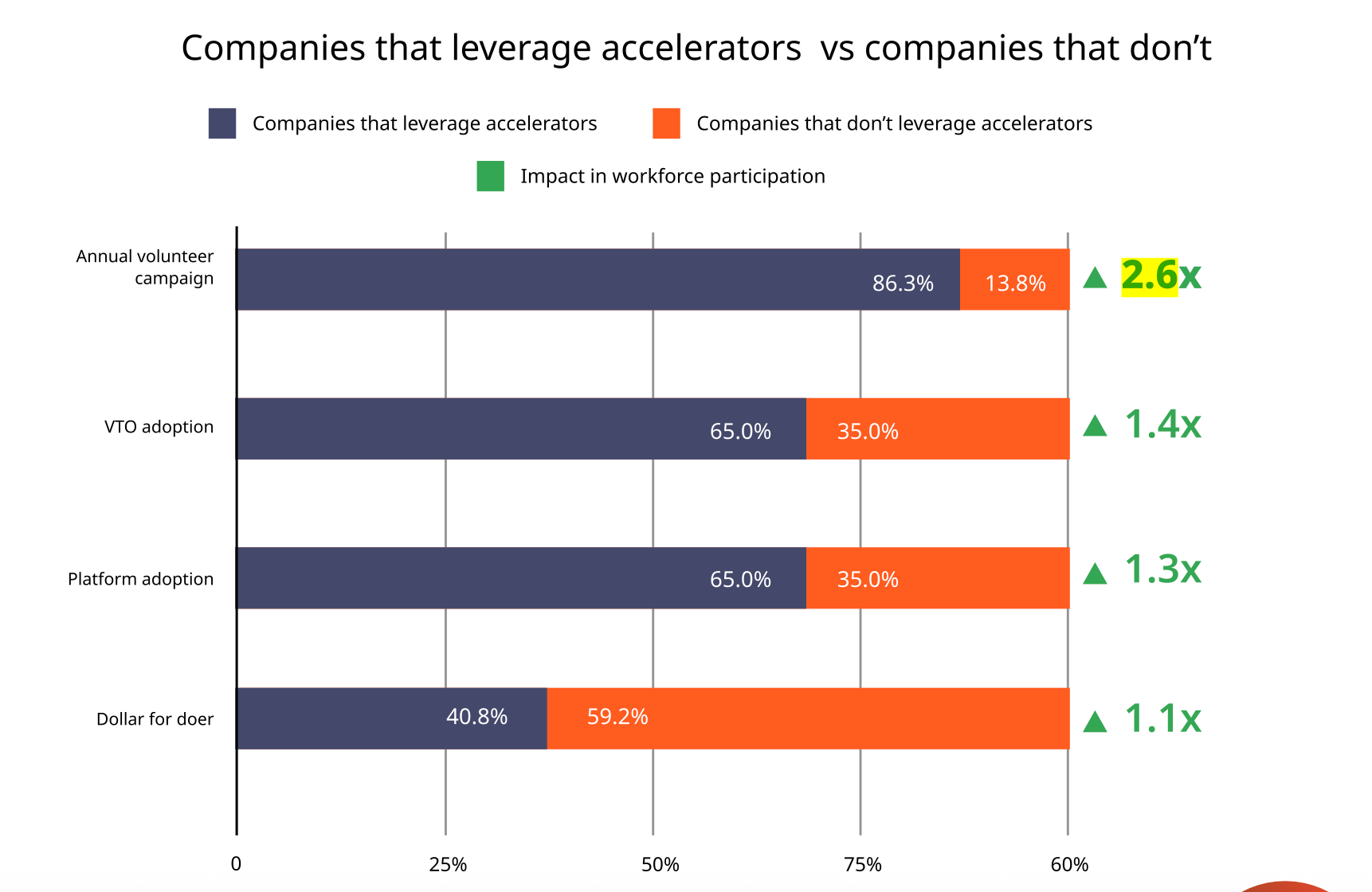
Time is the most commonly cited reason employees don't volunteer, and it's the most structurally solvable. The VQ 2026 report found that 65% of companies now have a defined Volunteering Time Off (VTO) policy, and those companies see 1.4x higher workforce participation than those without one. When employees have to use personal time to volunteer, it becomes a personal sacrifice. When it's a designated workplace benefit, it becomes a norm.
The difference between having a VTO policy and having a meaningful one matters too. Salesforce gives employees 56 hours (7 days) of paid VTO annually, and its employees logged 900,000 volunteer hours in FY25. The size of the allocation sends a signal about how seriously the company takes it.
ALSO READ: What is VTO or Volunteer Time Off?
What to do: If your organization doesn't have a VTO policy, that's the first structural fix. If it does, ask whether the allocation is generous enough to enable real commitment, not just a few symbolic hours a year.
2. The Awareness Barrier
Employees don't participate in programs they don't know exist. This sounds obvious, and it is. But most organizations underinvest in internal communications around volunteering and then misread low participation as low interest.
75% of millennials say they would volunteer more if they better understood the impact their contribution had, according to Deloitte research. The problem isn't apathy. It's visibility. Building a communication strategy that surfaces volunteer opportunities through onboarding, manager conversations, internal channels, and dedicated campaigns is as important as the program itself.
The VQ 2026 report reinforces this: annual volunteer campaigns drive 2.6x higher participation than passive, always-on programs. Not because the opportunities are better during a campaign, but because employees actually know about them.
What to do: Treat volunteering communications with the same rigor as any other internal campaign. Frequency, channel diversity, and manager involvement all matter.
3. The Relevance Barrier
Even employees who know about a volunteering program and have the time to participate will disengage if the opportunities don't connect to anything they personally care about.
A 2024 Deloitte survey of 1,000 U.S. office professionals found that employees who volunteer do so primarily for fulfillment and purpose (56%), community connection (55%), and improved morale (52%). None of those motivations are served by a narrow, pre-selected list of causes that employees had no hand in choosing.
The VQ 2026 data shows that child welfare and education accounts for 43% of volunteering events, and community welfare for another 24%.
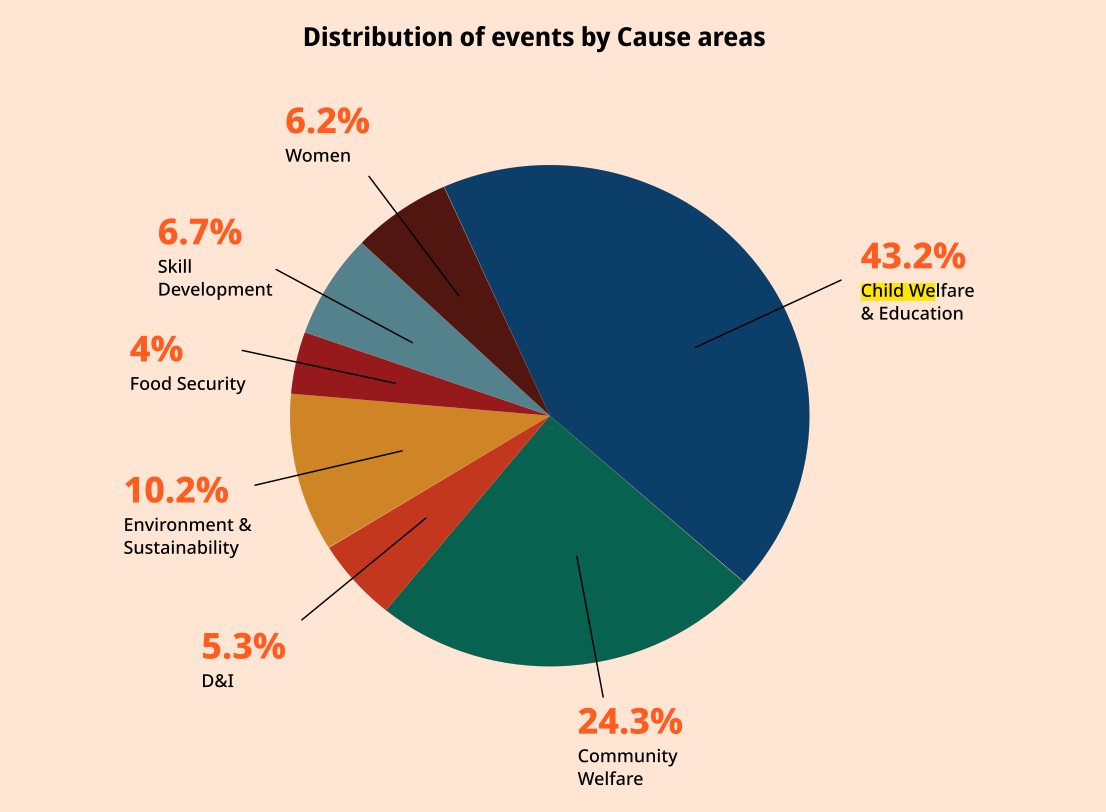
But the remaining third covers a diverse range: environment and sustainability, skill development, food security, and more. Programs that give employees room to pursue causes they genuinely care about see far stronger sustained engagement than those that prescribe a single approved option.
What to do: Offer a portfolio of cause areas, not a single default. Let employees propose causes that matter to them. The goal is a program that feels like a benefit, not a corporate mandate.
What Does a High-Performing Employee Volunteering Program Actually Look Like?
High-performing programs share four structural characteristics. The VQ 2026 data calls these volunteering accelerators, and companies that use all four see 3.1x higher workforce participation than companies that don't.
The four accelerators are:
- Annual volunteer campaigns
- A digital volunteering platform
- Volunteering Time Off (VTO)
- Dollars for Doers
Here's what the data says about each one.
How Much Does an Annual Volunteer Campaign Actually Move the Needle?
A lot. Annual volunteer campaigns are the single most powerful participation driver in the VQ 2026 data, delivering 2.6x higher participation in companies that run them versus those that don't. Adoption has also accelerated sharply, with 86.3% of companies now running a flagship campaign, up from 70.7% the previous year.
The reason campaigns work isn't complicated. A dedicated, time-bound moment creates cultural urgency that passive, always-on programs struggle to generate.
What a Well-Executed Campaign Looks Like: Amazon
Amazon's 2025 Global Month of Volunteering is one of the clearest examples of what campaign scale looks like in practice. Rather than relying on top-down mandates, Amazon empowered employees to identify local needs, partner with community nonprofits directly, and organize activities themselves.
The results:
- 134,000+ employees engaged globally during a single month
- 2,500+ organizations supported across 55 countries
- In India alone, 66,000 employees participated across 530 local events, directly impacting 136,000+ beneficiaries
The model combined on-ground, in-office, and virtual formats to ensure accessibility across a distributed workforce. Giving employees local organizing ownership, rather than scripting activities from headquarters, is what drove both scale and relevance.
Does Volunteering Time Off (VTO) Actually Increase Participation?
Yes, though the effect is more targeted than campaigns. Companies with a defined VTO policy see 1.4x higher workforce participation than those without one. About 65% of companies benchmarked in the VQ 2026 report have adopted VTO, making it a near-standard feature of mature programs.
VTO matters most because it removes the most common practical barrier: time. When employees have to use personal time to volunteer, participation becomes a personal sacrifice. When volunteering is a benefit, it becomes a workplace norm.
What Generous VTO Looks Like: Salesforce
Salesforce remains the most cited benchmark for VTO policy, and the numbers justify the reputation.
The policy: Employees receive 56 hours (7 days) of paid VTO annually.
The results:
- 900,000 volunteer hours logged in FY25
- 9.6 million cumulative service hours lifetime-to-date by early 2025
The Salesforce model works because the VTO is generous enough to enable sustained commitments (board service, week-long trips) rather than just occasional hours. Critically, taking VTO is treated as career-enhancing within the company's culture, not career-limiting.
How Do Digital Platforms Change Volunteering Participation?
The VQ 2026 report tracks platform adoption rising from 54.5% to 65% in a single year, and for good reason. Companies with a centralized digital platform see 1.3x higher participation than those without one. The mechanism is straightforward: platforms reduce the friction of discovery. When employees can find, register for, and track volunteer activities in one place, more of them actually do it.
What Enterprise-Grade Platform Deployment Looks Like: Cisco
Cisco's challenge was familiar: an 85,000-person global workforce and stagnant engagement. The company treated volunteering as a digital business transformation, with an 80% participation goal.
The strategy:
- Launched a single unified platform (in partnership with Benevity) for all global giving and volunteering
- Expanded choices to 100,000+ approved nonprofits in 22 languages
- Deployed a mobile app for on-the-go event discovery and hour tracking
The results:
- 86% employee participation rate achieved, sustained for six consecutive years
- 573,000 volunteer hours logged in FY25
- Employees active on the platform were 12% less likely to leave and 13% more likely to be promoted
- Active leaders saw 20% lower team attrition
The business case here extends well beyond CSR. Platform-enabled volunteering shows up in retention and promotion data.
What Is Dollars for Doers and Does It Work?
Dollars for Doers programs give employees a corporate grant for a nonprofit of their choice once they hit a volunteer hour threshold. The VQ 2026 data shows a 1.1x participation impact, which is the smallest multiplier of the four accelerators. But that framing undersells the real function: Dollars for Doers doesn't drive broad activation. It deepens engagement with the volunteers who are already committed.
How Verizon Uses It to Drive Sustained Commitment
Verizon's goal was 2.5 million cumulative employee volunteer hours by 2025. The challenge was converting casual, one-off volunteers into long-term community contributors.
The policy:
- 50-hour threshold to qualify for a grant (encouraging sustained engagement, not one-offs)
- $750 corporate grant unlocked at 50 hours
- Up to $1,500 annually for 100 hours of service
Setting a high hour threshold shifts employee behavior from a single event to long-term commitment. Nonprofits benefit twice: they receive highly dedicated volunteers and significant unrestricted cash grants.
What Role Do Champion Networks Play in Scaling Volunteering?
Champion networks are one of the most underutilized levers in corporate volunteering. A distributed network of employee volunteer champions, acting as local advocates, tailors global programs to regional needs and creates the peer influence that top-down communications rarely can.
Gallup research shows managers account for up to 70% of the variance in employee engagement. The same principle applies in volunteering: local ownership drives participation more reliably than central mandates.
ALSO READ: Champions: Culture Carriers, Not Just Coordinators

Which Industries and Company Sizes Volunteer the Most?
By Industry
According to the VQ 2026 report, workforce participation by industry breaks down as follows:
- Financials: 36.4% (up from 30.9% the previous year)
- Healthcare: 28.7% (up from 26.6%)
- Technology: 27.6% (up from 22.6%)
- Industrials: 18.4%
- Commercial & Professional Services: 15.5%
- Consumer: 11.4%
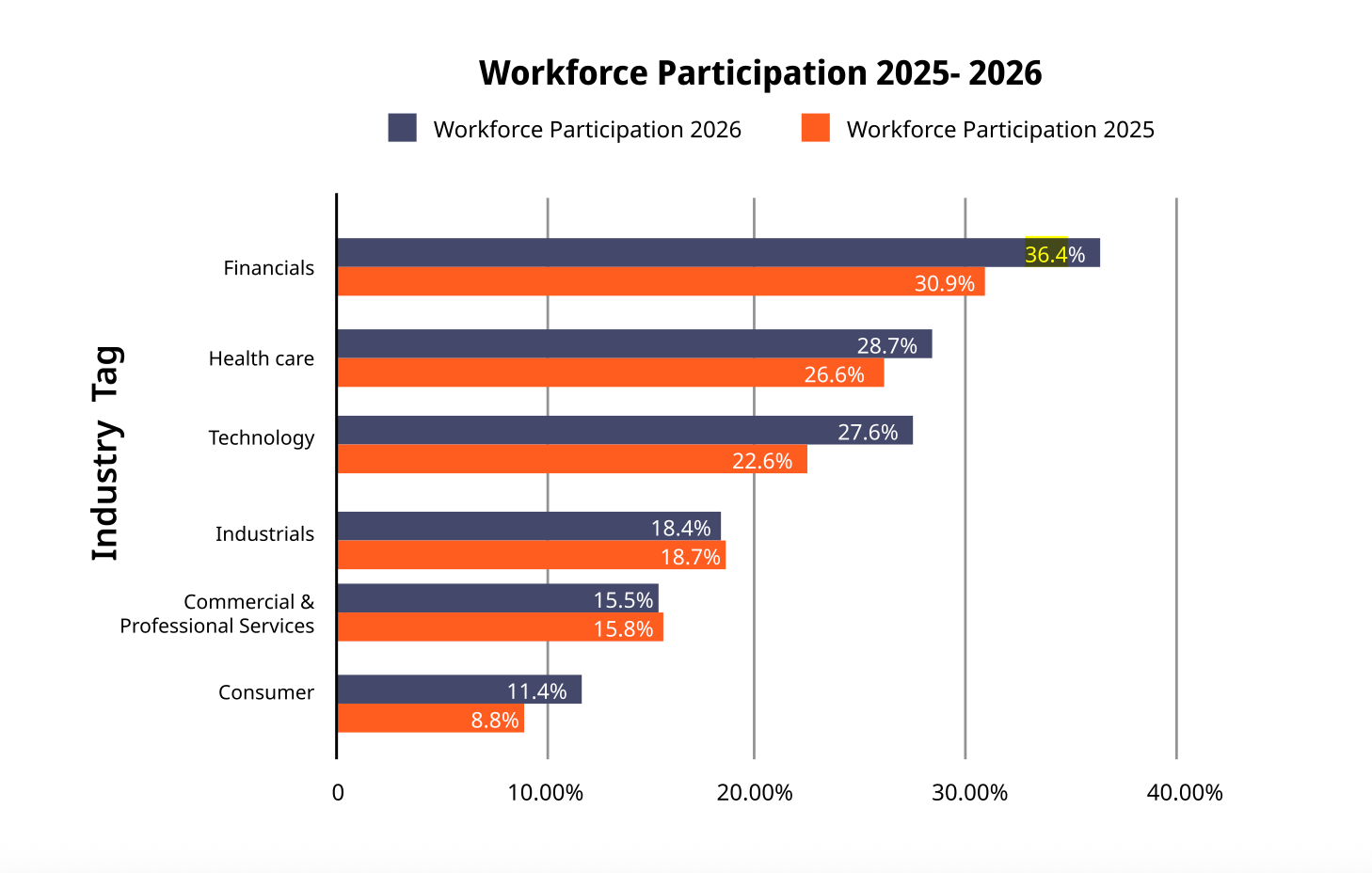
Financial services have led consistently and continue to pull further ahead. Technology's jump from 22.6% to 27.6% is one of the more notable year-over-year shifts.
By Company Size
Smaller companies participate at higher rates, though the VQ data shows improvement across all size segments:
- Under 5,000 FTEs: 48.0% (up from 27.8%)
- 5,000 to 10,000 FTEs: 33.9% (up from 29.9%)
- 10,000 to 50,000 FTEs: 23.9% (up from 20.2%)
- 50,000+ FTEs: 16.4% (up from 14.1%)
Smaller companies move faster because fewer coordination layers exist. Large enterprises can close the gap through champion networks, campaigns, and platform infrastructure. The data shows they are, slowly.
What Causes Do Employees Actually Want to Volunteer For?
Based on Goodera's analysis of 10,000+ events in 2025, employee preferences are concentrated but have clear seasonal patterns.
Full-year cause area distribution:
- Child welfare and education: 43% (up from 32% the previous year)
- Community welfare: 24% (up from 20%)
- Environment and sustainability: 10%
- Skill development: 6.7%
- Women: 6.2%
- Food security: 4%
Seasonal patterns to plan around:
- Q1: Women's causes spike 2.5x above average, driven by International Women's Day
- Q2: Environment and sustainability surges, anchored by Earth Month
- Q4: Food security initiatives jump 4.5x compared to Q3, driven by holiday giving
- Peak season overall: Q4 accounts for 33% of all events, followed by Q2 at 29%
If your program runs the same events year-round without a seasonal calendar, you're leaving engagement on the table.
What's Next for Corporate Volunteering?
The VQ 2026 report identifies two trends that are moving from emerging to mainstream.
Skills-Based Volunteering Is Becoming an L&D Strategy
Skills-based volunteering (SBV) is transitioning from a niche CSR offering to a core component of Learning and Development. 92% of business leaders agree that volunteering improves professional skills, and companies are increasingly categorizing SBV as experiential learning, used to build leadership, agility, and empathy in ways traditional training can't replicate.
ALSO READ: Empowering Communities Through Skills-Based Volunteering

AI Literacy Is Becoming the Defining Skills Gap for Nonprofits
Goodera surveyed 1,000+ nonprofits for the VQ 2026 report and found a significant gap between AI enthusiasm and AI adoption. 71% of nonprofits want to leverage AI for operational efficiency, and 76% said their communities want AI literacy programs. Yet only 25% of nonprofits report actively using AI tools. Corporate volunteers with technical expertise are in a uniquely strong position to close that gap.
ALSO READ: The AI Literacy Divide in Volunteering

How Should You Measure Whether Your Volunteering Program Is Actually Working?
Most programs measure outputs: hours logged, events held, and participation counts. These metrics capture activity, not impact. Goodera is leading an industry-wide initiative to develop a standardized Impact Measurement Framework that moves beyond activity data.
The framework works across three levels:
Outputs (immediate, from events):
- Employee participation rate
- Volunteer hours and lives impacted
Outcomes (mid-term, from sustained projects):
- Employee engagement scores
- Skills development levels
- Team collaboration measures
- Employee sense of purpose and belonging indicators
Impact (long-term, from programs):
- Employee retention rates tracked longitudinally
- Longitudinal skill improvement in communities served
If your current measurement stops at participation rate, you're only seeing a fraction of the value your program creates, and you're not building the business case that earns sustained investment.
How Do Employees Encourage Employees to Volunteer: The Peer Effect
Here is something that gets underweighted in most program design conversations. The most powerful encouragement for volunteering is not top-down. It comes from peers.
There are several practical ways to harness this peer effect:
1. Volunteer Champions: Identify employees who already volunteer enthusiastically and give them a recognized role as Volunteer Champions or ERG leads. These are not managers enforcing participation. They are peers modeling it, sharing stories, organizing team sign-ups, and bringing energy to the program that no communications campaign can manufacture.
2. Social Feeds and Impact Sharing: Companies that use social feeds to engage their employees in impact work see an approximate 50% increase in volunteer hours, according to Bonterra's 2025 Impact Report. When employees can see what their colleagues are doing, share photos from volunteer days, and post about the causes they care about through an internal platform, volunteering becomes visible, social, and self-sustaining.
3. Team-Based Volunteering: When volunteering is built into team experiences, participation tends to rise significantly. CarMax, for example, enables employees across locations to form small groups and plan volunteer activities with nonprofit partners, with additional support through the CarMax Foundation, leading to strong engagement.
Volunteering alongside colleagues creates a very different experience from going solo. It builds relationships, breaks down hierarchies, and creates shared moments that continue to resonate across teams long after the activity ends.
Final Thoughts
The companies building the strongest volunteer cultures are not doing anything magical. They are removing the barriers that make it hard. They are making it easy to find opportunities, easy to participate, and easy to see the difference it makes. They are letting employees lead where employees want to lead. And they are treating volunteering as a core expression of organizational values rather than a side activity that activates when someone has the bandwidth.
That is the whole formula. And it is more available than most organizations realize.
Frequently Asked Questions
1. How do companies encourage their employees to volunteer?
The most effective methods combine structural support with cultural reinforcement. Structurally: offer paid volunteer time off, volunteer grants, and a broad range of causes employees can choose from. Culturally: make volunteering visible through recognition, peer sharing, and leadership modeling. Companies using motivators like VTO, volunteer grants, and matching funds report up to 50% more volunteer hours per employee, according to YourCause. The combination of both structural and cultural investment consistently outperforms either alone.
2. What is the most effective way to incentivize volunteers at work?
The most consistently effective incentives are paid volunteer time off, volunteer grants that convert hours into nonprofit donations, and recognition programs that make volunteer contributions publicly visible. Employees who are well-recognized are up to four times more likely to be engaged, according to YourCause's volunteering incentives research, and that principle applies directly to volunteering behavior.
3. How do you get employees excited about volunteering, not just compliant?
Give them a real choice. Let them nominate causes. Let them lead team events. Let them see their impact in numbers that mean something. Allowing both company-created and employee-initiated volunteer opportunities increases participation by an average of 12x, according to Benevity's State of Corporate Volunteering 2024. Compliance comes from mandates. Excitement comes from ownership.
4. What is volunteer time off (VTO), and should we offer it?
VTO is paid time off that employees can use specifically for volunteering, without drawing from their personal or annual leave. It is the most direct structural commitment a company can make to employee volunteering. Berkshire Bank's 16-hour annual VTO offering directly contributes to its 80 to 100% employee participation rate, nearly three times the national average, according to YourCause. Companies offering paid time off for volunteering reached 28% in 2024, according to the SHRM Employee Benefits Survey, which means offering it remains a competitive differentiator.
5. How often should we run company-wide volunteering campaigns?
Company-wide volunteering events increase the employee participation rate to 2.5x on average compared to those without such events, according to Benevity's State of Corporate Volunteering 2024. Running one major campaign per year with a designated period of service, combined with ongoing access to individual and team opportunities throughout the year, produces the strongest sustained participation. The annual campaign creates momentum. The year-round infrastructure converts that momentum into habit.
6. How do we measure the success of an employee volunteering program?
Track three metrics consistently: participation rate (percentage of employees who volunteer at least once), volunteer hours logged per employee, and volunteer grant utilization rate. Over time, layer in impact outcomes from your nonprofit partners and cross-reference participation data with engagement survey scores and retention figures. Employees who work at corporations with volunteer programs are five times more engaged than their counterparts at businesses without equivalent programs, according to Bonterra's volunteering statistics. Those engagement gains will show up in your data if you are looking for them.
7. What is a good employee volunteering participation rate?
The median workforce participation rate across 240 companies in the VQ 2026 report is 25.6%. Top-performing companies with embedded volunteering cultures reach 70% participation. If your current rate is below 20%, your program likely lacks the structural accelerators (campaigns, VTO, platforms, champion networks) that consistently drive engagement. Between 20% and 40% is an established program with room to grow. Above 40% puts you in the top quartile globally.
8. What is the most effective way to increase employee volunteering participation?
The VQ 2026 data points to annual volunteer campaigns as the single highest-impact lever, delivering 2.6x higher participation. Companies using all four accelerators together (campaigns, platforms, VTO, and Dollars for Doers) see 3.1x higher participation than those using none. Champion networks are also highly effective for large organizations, as Arrow Electronics demonstrated with an 80% participation increase in one year through peer-to-peer influence.
9. How many volunteer hours per employee should a company aim for?
The median across the 240 companies in the VQ 2026 report is 6.2 hours per volunteer per year. Among the 76 companies tracked consistently over three years, that figure rose to 7.0 hours. Large enterprises with strong programs (50,000+ FTEs) averaged 6.4 hours per volunteer. The goal should be consistency over volume: employees who volunteer regularly at a sustainable pace produce better community outcomes and report higher well-being than those who binge-volunteer once a year.
10. How do you build a volunteering program for a large, distributed workforce?
The VQ 2026 data points to three essentials: a centralized digital platform to reduce discovery friction, a champion network to create local ownership, and an annual campaign to generate cultural momentum. Cisco's experience (86% participation sustained across 85,000 employees) and Arrow Electronics' 80% participation surge both demonstrate that large-scale programs require decentralized execution supported by centralized infrastructure. Top-down mandates alone don't move participation at enterprise scale.