Best Homeless Shelters In America: Organizations Making Real Impact

Homelessness in the United States has reached a level that’s hard to ignore. More than 770,000 people were experiencing homelessness on a single night in January 2024, according to the U.S. Department of Housing and Urban Development. That number has risen sharply in recent years, driven largely by a severe shortage of affordable housing and steadily increasing rents.
The impact is especially concentrated in states like California, New York, Florida, and Washington, where housing costs continue to outpace income growth.
What often gets missed is how complex the situation really is. For some, it’s the result of sudden financial shocks, job loss, or medical emergencies. For others, it’s tied to long-term challenges like untreated mental illness, substance use, or lack of access to affordable housing. There’s no single cause, which means there’s no single solution.
This is where homeless shelters play a critical role, not just as emergency spaces, but as structured support systems. The most effective organizations go far beyond providing a bed for the night. They offer meals, case management, mental health care, job training, housing placement, and long-term rehabilitation programs, all designed to help individuals move toward stability.
The impact is significant. Many leading shelters help thousands of individuals transition into permanent housing each year, while also providing millions of meals and essential services to those still in crisis. In cities with strong shelter networks, these organizations act as the backbone of the broader homelessness response.
In this guide, we’ll look at some of the best homeless shelters in America, focusing on major cities like New York, Chicago, Houston, and Los Angeles, and examine what they offer, how they operate, and the impact they create at scale.
Why Homeless Shelters Are Essential To Community Support Systems
A homeless shelter is not just a place to sleep. At its best, it is the first step in a structured journey toward stability, offering not just a roof, but a real plan forward.
What separates high-impact shelters from basic emergency housing comes down to five things:
- Holistic, wraparound services: The strongest organizations bundle shelter, meals, mental health support, substance use treatment, job readiness training, and case management under one roof. When people do not have to navigate six different agencies to get help, outcomes improve significantly. In 2024, homeless response workers served more than 1.1 million people in need, a 12 percent increase from the previous year, according to the National Alliance to End Homelessness.
- Proven housing placement rates: Data matters. Leading shelters track how many individuals transition from temporary shelter into permanent housing each year. Volunteers of America helps more than 2.5 million people annually across more than 400 communities nationwide. Placement rates are often the clearest indicator of how well a program actually works.
- Specialized programs built around real needs: Families with children, veterans returning from service, young adults aging out of foster care, and survivors of domestic violence all face different challenges. Organizations that design programs around those specific situations see far better results than those running a one-size-fits-all model. Targeted federal programs focused on veterans, for example, have helped drive a 55.6 percent reduction in veteran homelessness since 2010, according to VA Point-in-Time Count data.
- Strong community and government partnerships: The most effective shelters do not operate in isolation. They work alongside hospitals, workforce development agencies, housing authorities, and local employers to build real pathways out of homelessness. These partnerships are what turn a 30-day shelter stay into a long-term housing solution.
- Transparent, measurable impact: Organizations worth highlighting publish clear data on who they serve, how many move into housing, and what their funding supports. According to the HUD 2024 Annual Homelessness Assessment Report, homelessness in the United States reached 771,480 people in January 2024, the highest number recorded since data collection began in 2007.
Homeless shelters are truly the backbone of community support in this country. Without them, millions of people would have nowhere to turn during the hardest moments of their lives.
Best Homeless Shelters in New York City
New York City is home to the largest shelter system in the country. With more than 158,000 homeless New Yorkers counted in 2024, about one in five of the nation's homeless live in New York State, and New York has more year-round emergency housing beds than any other state in the country, at 127,759. That scale is staggering. But within it, a handful of organizations have been quietly doing extraordinary work for decades.
The Bowery Mission
Location: 227 Bowery, New York, NY 10002
Website: bowery.org
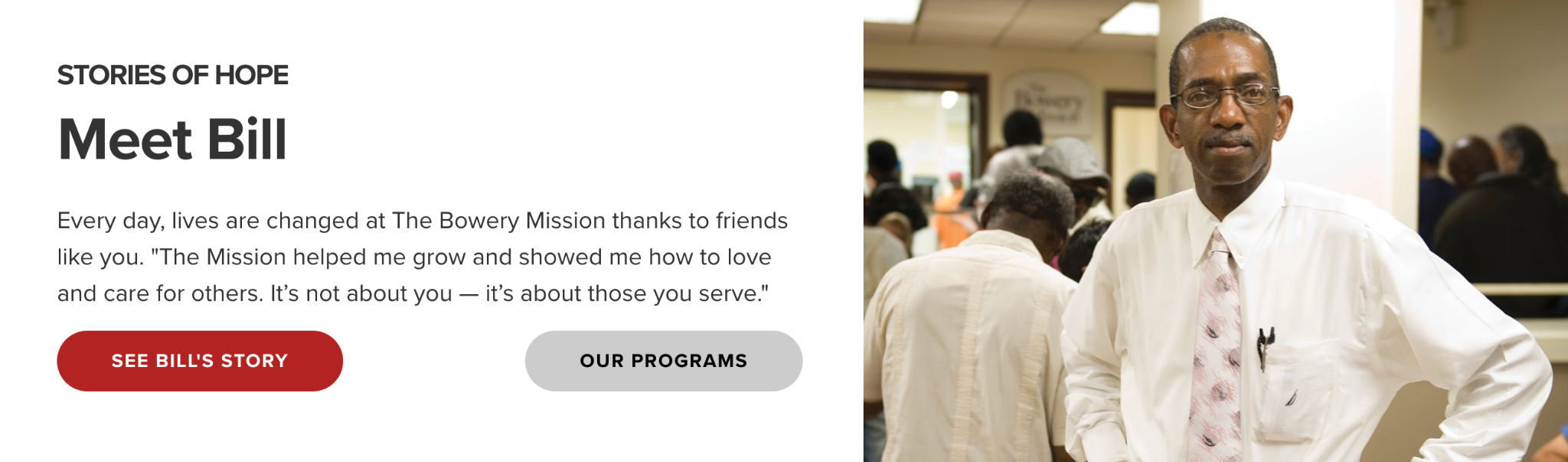
If you know anything about homelessness in New York City, you have probably heard of The Bowery Mission. Operating since the 1870s out of its home on the Lower East Side of Manhattan, this organization has become one of the most consistent forces in the city's fight against homelessness.
What makes it stand out is the breadth of what it offers. Walk through the red doors and you get meals, shelter, clothing, showers, case management, and access to long-term residential recovery programs. None of it is transactional. The approach is built around relationship and trust, meeting people where they are rather than where you think they should be.
The numbers back that up. In fiscal year 2024, the Bowery Mission served 400,000 meals, provided 65,000 nights of shelter, 40,000 emergency showers, and 27,000 articles of clothing across its programs. And the most recent fiscal year was even bigger: in fiscal year 2025, the Mission provided 430,000 meals, 78,000 nights of safe shelter, 25,000 articles of clothing, and 55,000 emergency showers.
Beyond emergency care, the Mission runs residential programs where men and women work toward employment, housing, and long-term recovery. Its Mont Lawn Summer Camp program even takes children from New York's most underserved neighborhoods to the Poconos for a week, one of those details that reminds you this organization is thinking about the whole person, not just the immediate crisis.
Coalition for the Homeless
Location: 129 Fulton Street, New York, NY 10038
Website: coalitionforthehomeless.org
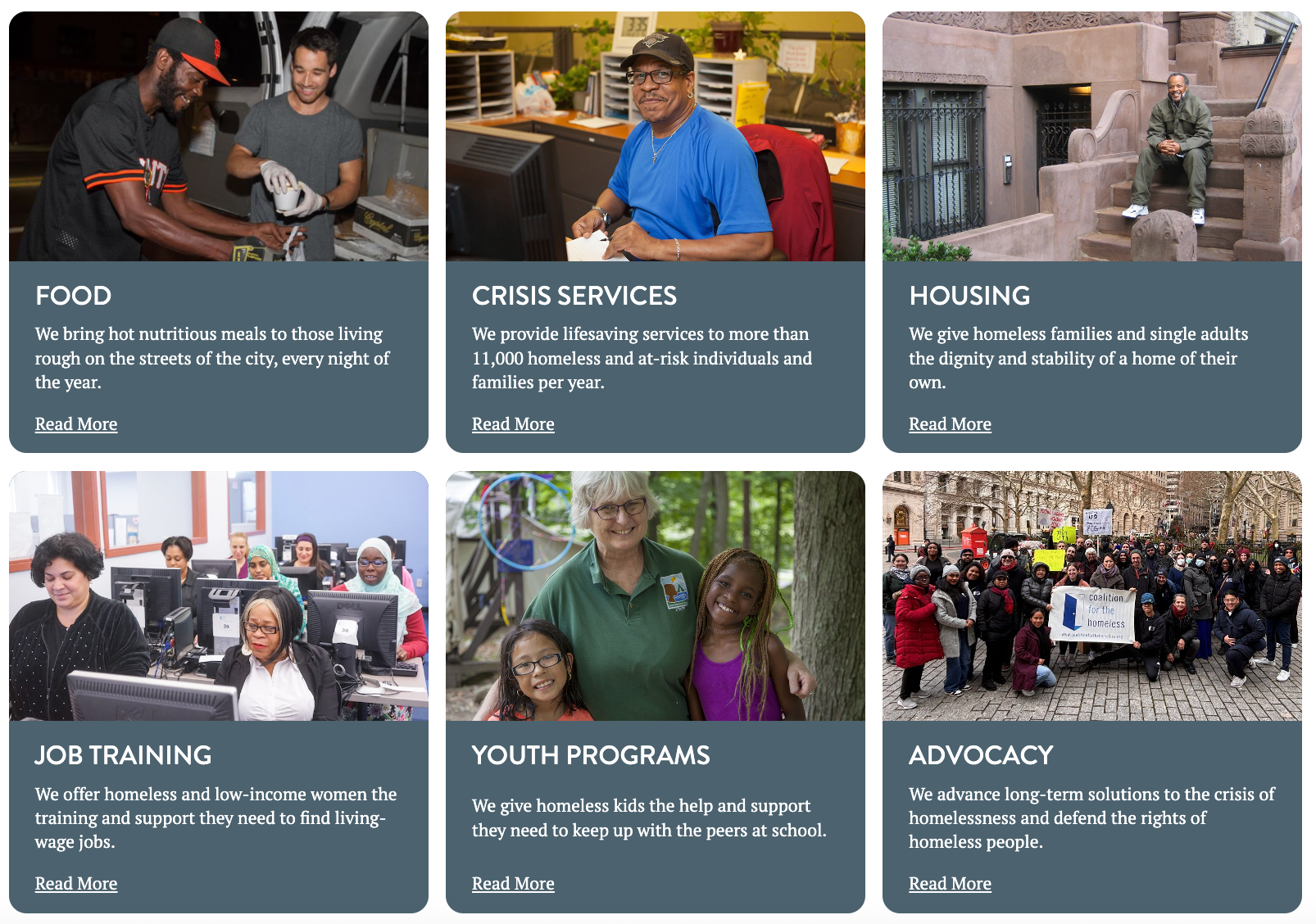
The Coalition for the Homeless holds a unique place in New York's story. It is the nation's oldest advocacy and direct service organization helping homeless individuals in New York City, and it operates on two tracks at once: direct services on the street and policy advocacy in the halls of government.
The Grand Central Food Program is probably its most visible effort. Running every single night of the year, it delivers more than 1,000 hot, nourishing meals to homeless and hungry people living on the streets, operating as the largest nightly mobile soup kitchen in the country.
But the Coalition does much more than feed people. Its Crisis Intervention Program helped nearly 9,000 individuals access safe shelter, secure benefits, and receive referrals to legal and mental health services in a single year. Its Keys Program helped 105 chronically homeless individuals with physical disabilities or mental illness obtain supportive housing. And its First Step Job Training Program provided job training and case management to 167 women interested in careers in human services.
The Coalition also runs Camp Homeward Bound, the first sleepaway camp in the country designed specifically for children experiencing homelessness, giving kids a summer experience that has nothing to do with survival and everything to do with just being a kid.
New York's legal Right to Shelter, won by the Coalition for the Homeless more than thirty years ago, has given more than one million homeless New Yorkers a way off the streets since 1981. Coalition For The Homeless That is the kind of systemic impact that outlasts any single program.
Best Homeless Shelters in Chicago
More than 58,000 Chicagoans experienced homelessness in 2024, a figure that is more than three times greater than what official city counts typically report, because so many people are sleeping in cars, couch surfing, or living in doubled-up situations that standard point-in-time counts miss entirely. The real crisis in Chicago is bigger than the headline numbers suggest.
Pacific Garden Mission
Location: 1458 South Canal Street, Chicago, IL 60607
Website: pgm.org
There is something almost hard to believe about Pacific Garden Mission. Founded in 1877 on Chicago's Near West Side, it is the oldest continuously operating rescue mission in the country and the largest homeless shelter in Chicago. Nearly 150 years later, it still has not closed its doors for a single night.
The Mission serves men, women, and children with shelter, hot meals, medical care, clothing, counseling, and substance use recovery programs. Its New Day Program walks men through a five-phase recovery process. Its Mothers and Children's Ministry provides shelter, food, counseling, and spiritual support for women and kids who often have nowhere else to turn.
Pacific Garden Mission meets the physical needs of Chicago's homeless 365 days a year, while also nurturing emotional and spiritual wellbeing through programs that help people beat addiction, restore families, and move toward stability.
It is also the home of Unshackled!, a radio drama that has been running since 1950 and is now translated into seven languages, broadcasting stories of people who found their way out of homelessness and addiction. It is an unusual thing for a shelter to do, and that is sort of the point. PGM has always thought beyond the bed.
The Night Ministry
Location: 4711 N. Ravenswood Avenue, Chicago, IL 60640
Website: thenightministry.org
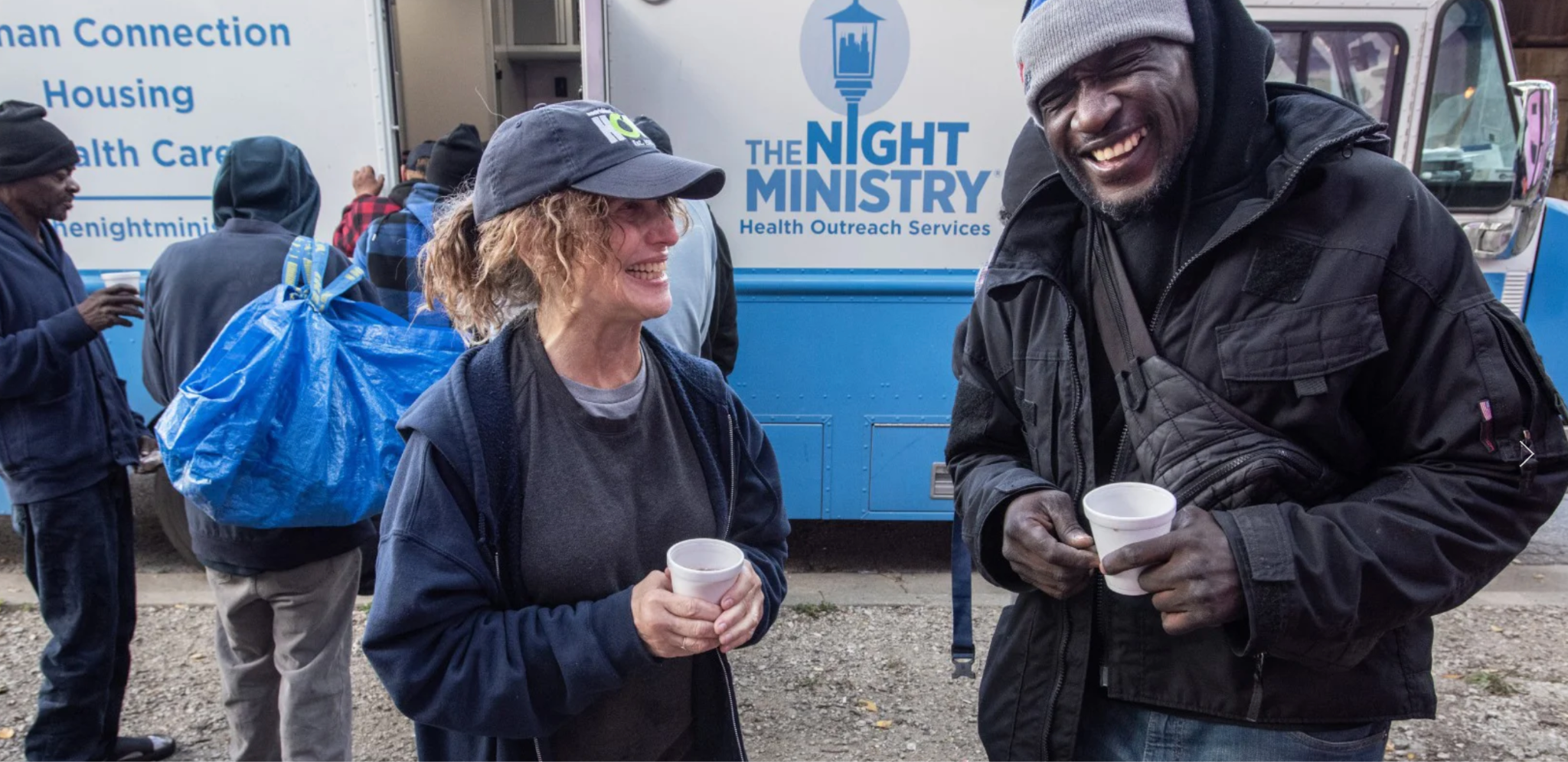
While Pacific Garden Mission focuses heavily on long-term residential programs, The Night Ministry fills a different and equally important gap: reaching people who are not yet ready to come inside.
The Night Ministry is a Chicago-based organization whose mission is to provide human connection, housing support, and healthcare to those who are unhoused or experiencing poverty, accepting each individual as they are and working alongside them to advocate for their immediate physical, emotional, and social needs.
Its Health Outreach Bus rolls through Chicago's neighborhoods six nights a week, bringing free basic medical care to people living in tent encampments, at CTA stations, and in other places most services never reach. It runs The Crib, an overnight emergency shelter for young adults ages 18 to 24, which has become a recognized model for youth shelters across the city. It also operates Open Door, a shelter for homeless youth ages 14 to 21.
The Night Ministry provides resources to hundreds of homeless people in encampments, in neighborhoods, and at Chicago Transit Authority stations on any given day, doing the kind of street-level outreach that makes it possible for other organizations to eventually bring people inside.
Best Homeless Shelters in Houston
Houston has taken a different approach to homelessness than most major American cities, leaning heavily into a Housing First model and building strong partnerships between shelters, government agencies, and healthcare providers. The results have been significant enough that Houston is now frequently cited as a national example of what coordinated response can look like.
Star of Hope Mission
Location: 2575 Reed Road, Houston, TX 77051 (Women and Family Center) and 1811 Ruiz Street, Houston, TX 77002 (Men's Development Center)
Website: sohmission.org
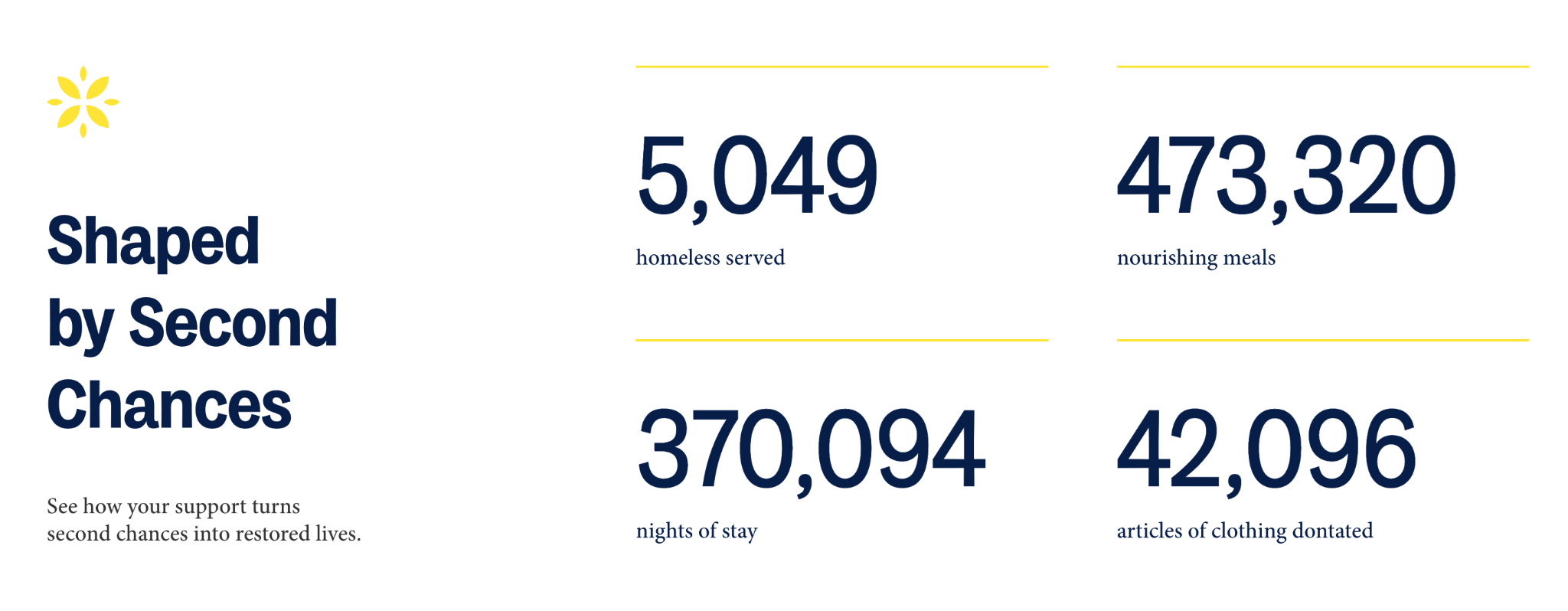
Star of Hope has been part of Houston's story since 1907, making it the city's oldest homeless shelter. Today, more than 3,000 people in Houston are experiencing homelessness on any given night, and Star of Hope is one of the most comprehensive organizations working to change that.
The Mission runs separate facilities for men and for women and families. Its Men's Development Center serves up to 275 men each night with shelter, meals, and care, and during extreme weather or high demand, opens its doors to 100 more. Its Women and Family Development Center offers a parallel experience for mothers, children, and families, including licensed early childhood care, after-school programs, substance use recovery, job training, GED programs, and one-on-one case management.
Star of Hope serves 15,000 meals every single week, which works out to more than 780,000 meals per year. That alone makes it one of the largest food programs attached to any homeless shelter in the country. But the meals are almost secondary to the broader program. The real goal is employment, stability, and independent living, and the organization tracks how many people exit into jobs and permanent housing each year.
For 118 years, Star of Hope has addressed the needs of hundreds of thousands of Houstonians in crisis, providing holistic programs and creative solutions that focus on their specific circumstances.
Best Homeless Shelters in Los Angeles
Los Angeles has one of the most visible and complex homelessness crises in the country. There are more than 75,000 people experiencing homelessness in Los Angeles, and unlike New York where most homeless individuals are sheltered, the majority in LA are unsheltered, living in tents, vehicles, and encampments throughout the city. That makes the work of LA's shelter organizations uniquely challenging and uniquely important.
Union Rescue Mission
Location: 545 S. San Pedro Street, Los Angeles, CA 90013
Website: urm.org
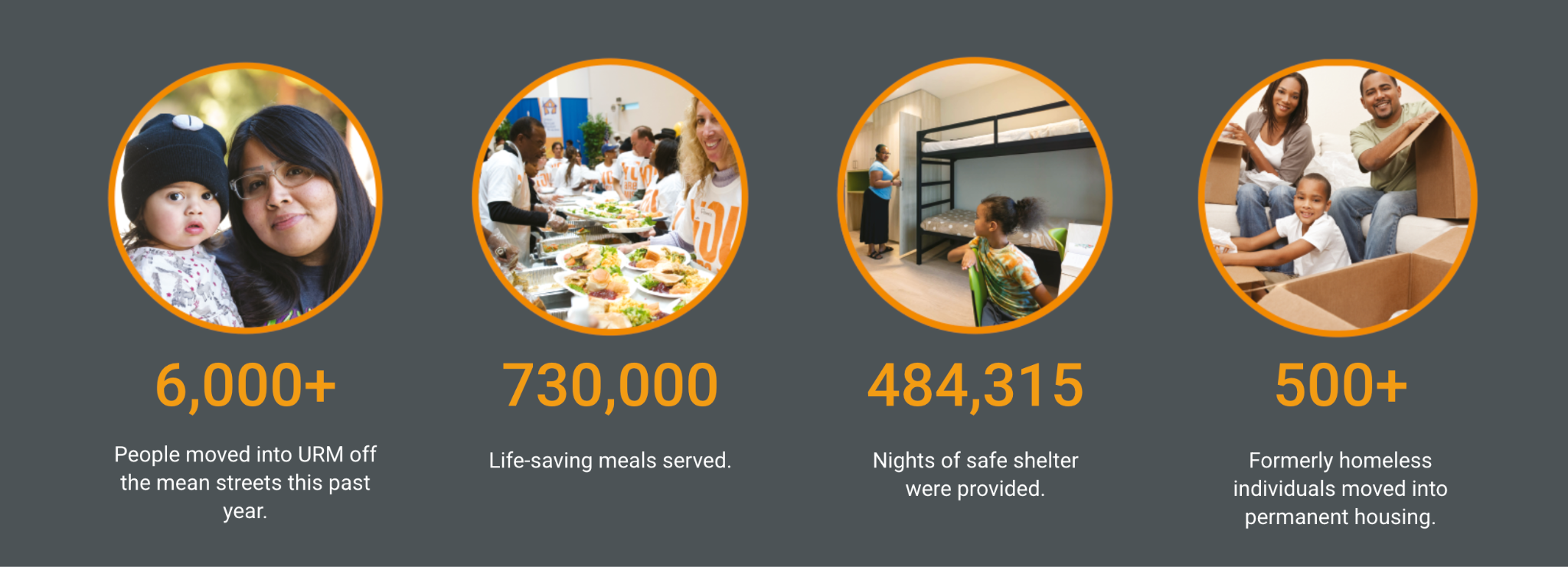
Union Rescue Mission sits at the heart of Skid Row, which is ground zero for homelessness in Los Angeles. Founded in 1891, URM is the oldest shelter in Los Angeles and the largest private homeless shelter in the United States, operating out of a 225,000 square foot facility.
The scope of what URM does is hard to summarize quickly. It offers emergency shelter, meals, medical and dental care, legal assistance, addiction recovery programs, job training, transitional housing, and long-term residential programs for men, women, children, and families. It is one of the only shelters on Skid Row that keeps families together rather than separating parents from children.
Union Rescue Mission welcomed over 6,000 individuals and families experiencing homelessness over the past year and maintains a commitment to never turn away a woman, child, or family. More than 70 percent of the people it serves are moms, dads, and kids, and it operates with zero government funding, relying entirely on private donations.
Beyond its Skid Row location, URM operates Hope Gardens Family Center in Sylmar, a 71-acre residential campus exclusively for women and families in long-term recovery, and Angeles House, a transitional facility for families that opened in 2022.
Location: 545 S. San Pedro Street, Los Angeles, CA 90013
Website: urm.org
Los Angeles Mission
Location: 305 East 5th Street, Los Angeles, CA 90013
Website: losangelesmission.org

A few blocks from Union Rescue Mission, the Los Angeles Mission has been serving Skid Row since 1936. It describes itself as a "Mission Without Walls," which is a good way to understand its approach. Rather than waiting for people to come to them, it meets people where they are through street outreach, community events, and partnerships with healthcare providers and workforce development agencies.
The Los Angeles Mission provides safe refuge to over 500 individuals and offers a full array of supportive services including emergency shelter, medical, mental health and dental care, bridge housing, residential rehabilitation, educational and vocational services, hot meals, clothing, and community outreach.
Its residential rehabilitation program is particularly notable. Rather than a short-term stay, it walks participants through a structured path toward employment and independent housing, with job skills training, financial literacy, counseling, and placement support built into the process.
How You Can Make a Difference
Reading about the scale of homelessness can feel overwhelming. But the organizations in this guide are proof that things can change, one person, one family, one community at a time.
Here are a few ways to get involved:
Donate directly. Every organization featured in this guide has a donation page. Even small, recurring donations help shelters plan programs and maintain staffing. A gift of $30 at Star of Hope, for example, provides a night of shelter to someone in need.
Volunteer your time. Most shelters actively need volunteers to serve meals, sort donations, provide professional skills, or mentor residents. Contact the shelter nearest to you directly to find out how.
Advocate in your community. Shelters can only do so much without policy support. Affordable housing, mental health funding, and workforce development programs all play a role in reducing homelessness at scale. Staying informed and engaged with local policy is one of the most powerful long-term contributions anyone can make.
Spread awareness. Sharing accurate information about homelessness helps reduce stigma and encourages more people to get involved. The more communities understand what shelters actually do, the more support those shelters receive.
Homeless shelters are truly the backbone of community support in this country. Without them, millions of people would have nowhere to turn during the hardest moments of their lives. The organizations featured here are doing work that is difficult, underfunded, and often invisible. They deserve our attention, our support, and our gratitude.
Frequently Asked Questions
What services do homeless shelters typically provide?
Most shelters go well beyond just providing a place to sleep. The strongest ones offer meals, showers, clothing, case management, mental health support, substance use recovery programs, job training, and help securing permanent housing. Some also run medical clinics, legal aid services, childcare, and education programs for children and adults.
How do homeless shelters help people find permanent housing?
Good shelters do not just provide temporary relief. They assign case managers who work with each individual to build a plan for stable housing. That often includes helping with rental applications, connecting people to housing vouchers, providing references for landlords, and offering follow-up support after someone moves out of the shelter system.
Are homeless shelters free to use?
In most cases, yes. Emergency shelters are typically free, especially for families, veterans, and individuals in crisis. Some transitional or long-term programs may ask for a small contribution once a person is employed, but access to emergency services is almost never conditional on payment.
How can I help a homeless shelter in my city?
The most consistent needs are financial donations, volunteer time, and in-kind donations like clothing, hygiene products, and non-perishable food. Many shelters also welcome skilled volunteers including nurses, counselors, job coaches, and legal professionals. Reaching out directly to the shelter you want to support is always the most effective first step.
What is the difference between an emergency shelter and transitional housing?
Emergency shelters provide immediate, short-term relief, typically for a few nights to a few weeks. Transitional housing is a longer-term arrangement, often lasting several months to a couple of years, designed to give people the stability and support they need to eventually move into permanent housing. Many of the organizations in this guide offer both.
Frequently Asked Questions
1. What is a Homeless Shelter and what does it provide?
A homeless shelter is a facility that offers temporary or transitional housing to people experiencing homelessness. Beyond a bed, effective shelters bundle meals, case management, mental health support, addiction recovery, job training, and housing placement. This wraparound approach helps residents move toward stable, permanent housing rather than cycling back to the streets after a short stay.
2. How many people experience homelessness in the United States?
According to the U.S. Department of Housing and Urban Development, more than 770,000 people were counted as homeless on a single night in January 2024, the highest figure recorded. Rising rents, a shortage of affordable housing, and financial shocks continue to push numbers up, with California, New York, Florida, and Washington seeing the largest counts.
3. Which are the largest and most trusted homeless shelter organizations in America?
Long-established national networks include Volunteers of America, which serves 2.5 million people annually across 400+ communities, along with Covenant House, The Salvation Army, and Union Rescue Mission. City-level coalitions also play a major role, such as the Coalition for the Homeless in New York, the Houston Coalition for the Homeless, and the Chicago Coalition for the Homeless.
4. Why do people become homeless in the first place?
Homelessness rarely has a single cause. Common triggers include job loss, medical emergencies, eviction, and family breakdown, often compounded by untreated mental illness, substance use, or domestic violence. Structural factors matter most: chronic shortages of affordable housing and rising rents mean a temporary financial shock can quickly push a household onto the street with no safety net.
5. What is the Housing First model and why is it considered effective?
Housing First is an approach that places people experiencing homelessness directly into permanent housing without requiring sobriety, employment, or treatment participation first. Support services are then wrapped around the tenancy. Multiple U.S. studies show it delivers higher housing retention, lower emergency-room use, and better long-term outcomes than shelter-only or treatment-first models.
6. How can Companies and Volunteers help their local homeless shelter?
Shelters welcome hands-on help year-round. Popular options include serving meals, assembling hygiene and winter kits, running resume and interview workshops, providing childcare during family respite events, and supporting holiday programming. Financial donations, in-kind goods such as toiletries and warm clothing, and skilled pro-bono services like legal aid or bookkeeping are equally valuable.
7. What metrics indicate that a homeless shelter is doing good work?
The strongest signals are outcome-based rather than bed counts. Look for placement rate into permanent housing, average length of stay, program retention, returns to homelessness within 12 months, and employment or income gains at exit. Reputable shelters publish these figures in annual reports and align with HUD's Continuum of Care performance standards.
8. Are there Homeless Shelters specifically for youth, families, or Veterans?
Yes. Specialized shelters serve populations with distinct needs. Covenant House focuses on youth and young adults aged 18 to 24, family shelters offer private rooms and childcare, and organizations partnered with the U.S. Department of Veterans Affairs run programs for Veterans. Domestic-violence shelters operate at confidential locations to protect survivors and their children.
9. How much does it cost to run a Homeless Shelter and how is it funded?
Operating costs vary widely, but a single shelter bed typically costs between $25,000 and $50,000 per year once staffing, meals, and case-management services are included. Funding blends federal HUD grants, state and city contracts, private philanthropy, corporate partnerships, and individual giving. Most shelters rely heavily on volunteers to stretch limited dollars.
10. How can Goodera help companies support Homeless Shelters at scale?
Goodera partners with national and community shelter organizations to run corporate volunteering programs at scale, including hygiene-kit assembly, career-readiness workshops, meal-prep drives, and virtual mentoring for youth aging out of shelters. Programs are measured on volunteer hours, kits delivered, and downstream beneficiary reach so companies can report meaningful social impact.