Giving Tuesday Ideas for Nonprofits 2026

Thanksgiving is a time to gather around the table, celebrate the bounty of life, and express gratitude for the people and moments that matter most. It's a season of abundance, reflection, and togetherness.
Giving Tuesday naturally follows that spirit. After the celebrations wind down, it offers a moment to look beyond our own tables and ask a simple question: How can we help ensure others experience that same sense of security, belonging, and hope? It transforms gratitude into action, encouraging individuals, families, businesses, and communities to share what they can with those who have less.
This spirit of generosity grows each year. Giving Tuesday 2025 raised $4 billion in just one day, with 38.1 million people participating across the United States–a 13% increase over the previous year. Since launching in 2012, the movement has expanded to more than 110 countries and inspired $22.5 billion in cumulative giving.
For nonprofits, those numbers represent an incredible opportunity, but, the opportunity rests with only those organizations that prepare well before December arrives. The strongest Giving Tuesday are built through weeks of audience engagement, compelling storytelling, clear campaign goals, and consistent donor communication.
This guide will do exactly that. Explore practical strategies for nonprofits to build a successful Giving Tuesday 2026 campaign, engage supporters before and after the big day, maximize donations, and create meaningful relationships that last well beyond the campaign.
If you work at a corporate setting and want to plan a successful Giving Tuesday campaign, check out this guide instead:
The Fundraising Landscape Has Changed. Giving Tuesday Matters More Than Ever.
Before getting into specific campaign ideas, the context is worth understanding, because 2026 is not a neutral year for nonprofit fundraising.
The 2025 federal budget reconciliation law introduced significant cuts to SNAP and other social programs, and capped charitable deductions for itemizers at 35%, which the Council on Foundations describes as likely to disincentivize major donors. At the same time, USAID's international development budget was cut by 83% in early 2025, removing a foundational source of funding for hundreds of nonprofits overnight.
What this means is that many donors who historically gave through workplace campaigns or government-linked vehicles are no longer doing so. Individual giving, driven by direct relationships between donors and organizations they trust, is becoming structurally more important.
That shift makes Giving Tuesday more valuable than ever. It is one of the few fundraising moments built around individual generosity and donor engagement rather than institutional funding. Public trust in nonprofits also remains high, and Giving Tuesday donors are among the most loyal in any nonprofit's donor base. In fact, 65% of Giving Tuesday 2024 donors gave again in 2025, compared with 52% of donors who gave at other points in the year—a retention advantage that has remained consistent for five consecutive years.
What the Data From 2025 Is Telling You
Before planning your campaign, it helps to understand what actually drove results in 2025. A few patterns stand out clearly.
1. Small-Dollar Donors Are the Base, Not the Exception
38% of Giving Tuesday 2025 gifts were under $50, and 60% were under $100, according to Givebutter platform data. This broad base of small-dollar participation is not a consolation prize. It is the health of your future donor pipeline.
Neon One reported that more than a quarter of their Giving Tuesday donors were new to the organizations they supported, and 48% of those donors gave again before year-end when properly stewarded.
2. Recurring Giving Is the Real Prize
GoFundMe Pro saw a 25% increase in new recurring giving plans on Giving Tuesday 2025. Recurring donors are roughly 10 times more valuable over time than one-time givers. A Giving Tuesday campaign that converts even a small number of one-time donors into monthly supporters creates compounding returns that far outpace any single-day total.
3. Volunteerism and Advocacy Are Growing Faster Than Dollars
Volunteering participation grew 20% on Giving Tuesday 2025, and advocacy participation grew 26%, both outpacing the 13% growth in dollars. This is important for small nonprofits especially: Giving Tuesday is not purely a fundraising day.
It is a generosity day, and people are actively looking for ways to give that are not financial. Build for that.
4. Acquisition Costs Are Rising, Making Peer-to-Peer More Critical
Nonprofit donor acquisition costs have jumped more than 200% since 2013. Paid advertising is increasingly expensive and increasingly unreliable for smaller organizations. The campaigns that consistently outperform are the ones powered by people, not budgets.
Peer-to-peer fundraising, supporter-led social sharing, and staff and board personal asks remain the highest-ROI acquisition channels available to nonprofits of any size.
Giving Tuesday Campaign Ideas for Small to Medium Nonprofits
Here is the thing about small and medium nonprofits on Giving Tuesday: the disadvantage most people assume exists rarely does, in practice. Large organizations often run generic campaigns that feel impersonal. A small nonprofit that knows its community deeply, tells a specific story, and asks personally tends to outperform its size.
These ideas are organized by what they require most: time, story, relationships, or technology.
You can join Goodera’s Nonprofit network to partner with 500+ corporate partners volunteering to make a difference:
Campaigns Built Around a Specific Goal
1. The "Fund One Thing" Campaign
Pick a single, concrete, fully-fundable item or outcome and make it the entire campaign. Not "help us continue our work" but "help us buy the van that gets 40 seniors to their medical appointments every week" or "help us fund the 12 tutoring sessions that close the gap for one student per year."
Specificity converts at higher rates than abstraction, every time. Set the dollar goal publicly, display a live progress tracker, and close the gap visibly throughout the day.
2. The Matching Gift Challenge
Secure a matching commitment from a board member, a local business, or a major donor before November 1. Then build your entire Giving Tuesday campaign around it. Mentioning a matching gift in a fundraising appeal can increase response rates by 71% and average donation amounts by 51%, according to Double the Donation research.
The match creates urgency, doubles perceived impact, and gives your communications a clear hook throughout the campaign. Even a modest match, $5,000 or $10,000, produces meaningfully stronger results than no match at all.
3. The "10 Donors in 10 Hours" Sprint
Useful for organizations with small but loyal bases: ask your existing donors to each recruit one new donor before noon. Give them the tools, a shareable link, a two-sentence description, and a suggested ask amount. Track progress publicly.
The mechanics are simple, the energy is high, and it turns passive supporters into active ambassadors for a defined window of time.
Campaigns Built Around Story
4. The Beneficiary Story Series
In the four weeks before Giving Tuesday, publish one short story per week featuring a real person whose life your organization has touched, with their permission. Keep it specific, human, and grounded in a single moment rather than a broad summary of outcomes.
Then on Giving Tuesday itself, link your donation ask directly to a continuation of that story. Donors who arrive on December 1 already knowing someone's name and face give at meaningfully higher rates than those meeting your organization for the first time.
5. The "Year in One Minute" Video
A 60-second video showing the faces, places, and moments of your year, no professional production required, shared across email and social on Giving Tuesday morning. The goal is authenticity.
Staff members speaking directly to camera, program participants captured with their knowledge and consent, a simple before-and-after. Video content consistently drives the highest engagement rates on Giving Tuesday social media campaigns, and a genuine 60-second clip from a small nonprofit outperforms a polished two-minute brand film from a larger one almost every time.
5. The Staff and Board Personal Ask
Ask every staff member and board member to personally reach out, by text, by phone, or by direct message, to five people they know and make a personal ask on Giving Tuesday. Not a forwarded email blast. A message that begins with their own name and why they work there.
Personal asks from trusted people consistently outperform any amount of broadcast communication, and for a small nonprofit, five personal asks per staff member at 10 people on your team produces 50 warm, personal conversations on a single day.
Campaigns Built Around Community
6. The Volunteer-as-Donor Campaign
Giving Tuesday is not just for financial donors. With volunteering growing 20% on the day in 2025, explicitly inviting your community to give their time alongside their money creates a broader participation base and brings in people who may become financial donors in subsequent years. Run a parallel volunteer sign-up alongside your donation ask. Track and celebrate both publicly throughout the day.
7. The Local Business Partnership
Approach two or three local businesses in October and ask them to participate in your Giving Tuesday campaign by promoting your donation link to their customers, matching purchases with a donation, or hosting a physical collection point.
Many small businesses are actively looking for community involvement opportunities and will say yes to a well-framed ask that requires minimal effort from them. Co-branded campaigns also extend your reach to audiences that would never encounter you through your own channels.
8. The Social Media Takeover
Ask a board member, a major volunteer, a program graduate, or a community partner to "take over" your social media for the day and share why they give and why they ask others to give. User-generated content from real community members consistently outperforms organizational posts in reach and engagement.
It is also more credible, which matters when donors are deciding between multiple organizations competing for attention on the same day.
Campaigns Built Around Technology
9. The Peer-to-Peer Fundraising Page Network
Give your most committed supporters their own personal fundraising pages through a platform like Donorbox, Givebutter, or Classy. Each page includes their personal story of why they support your organization, a donation link, and a goal.
Here’s a sample fundraiser page for your reference:
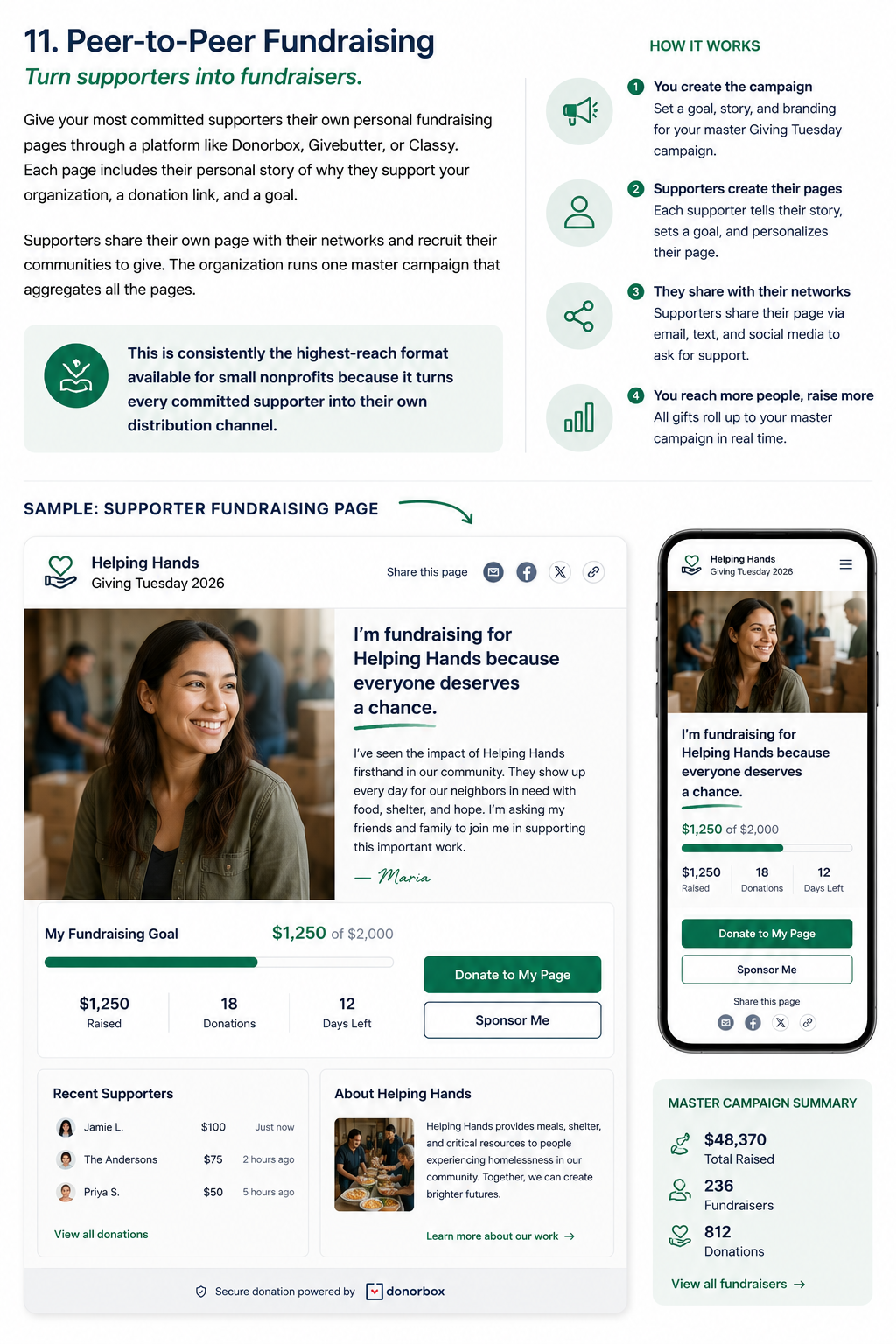
Supporters share their own page with their networks and recruit their communities to give. The organization runs one master campaign that aggregates all the pages. This is consistently the highest-reach format available for small nonprofits because it turns every committed supporter into their own distribution channel.
10. The Text-to-Give Setup
If you are not using text-to-give, Giving Tuesday is the moment to set it up. Digital wallets grew 82% year over year on Giving Tuesday 2025, and mobile giving broadly is now the default expectation for donors under 45.
The biggest advantage of text-to-give is that it removes friction. Instead of asking someone to remember your website, type in a long URL, or search for your donation page later, you can simply ask them to text a keyword (for example, GIVE to 12345) and be taken directly to a mobile-optimized donation form. When someone is inspired in the moment, every extra click reduces the likelihood they'll complete their gift.
This becomes especially valuable if you're hosting an event, community gathering, volunteer day, or church service around Giving Tuesday. Rather than directing people to "visit our website later," you can display your text-to-give number on presentation slides, posters, table tents, printed programs, social media posts, and even have your emcee invite attendees to donate in real time.
How to execute it
- Set up a dedicated text-to-give keyword (e.g., HOPE, MEALS, or GIVE).
- Link it to a fast, mobile-friendly donation page that supports Apple Pay, Google Pay, and other digital wallets.
- Include the number and keyword everywhere: event signage, presentation slides, volunteer T-shirts, social media graphics, email signatures, and printed materials.
- During live events, have your speaker pause for 30 seconds and invite attendees to take out their phones and give immediately.
- Use the same keyword consistently across all Giving Tuesday communications so donors remember it.
Even if your Giving Tuesday campaign is primarily digital, text-to-give gives supporters another low-friction way to respond in the moment. For many organizations, it captures donations that would otherwise be delayed, or forgotten altogether
11. The Recurring Gift Ask
Build a dedicated landing page for Giving Tuesday that leads with a monthly giving option rather than a one-time gift. Frame it around what $15 or $25 per month makes possible across a year, not what it produces on a single day.
New recurring giving plans grew 25% on Giving Tuesday 2025, and the long-term revenue value of a monthly donor vastly outweighs a one-time Giving Tuesday gift of even three times the size.
Giving Tuesday Ideas for Small Nonprofits With Limited Staff
These ideas are specifically calibrated for organizations with one to three staff members, where every hour matters and complexity is genuinely a barrier.
12. The One-Email, One-Story Campaign
If time, budget, or staff capacity limit what you can do this Giving Tuesday, start with one email. Make it personal, make it specific, tell one story, and ask one simple question: Will you give today? Send it to your entire database on Giving Tuesday morning, with a direct subject line like It's Giving Tuesday, and we need your help.
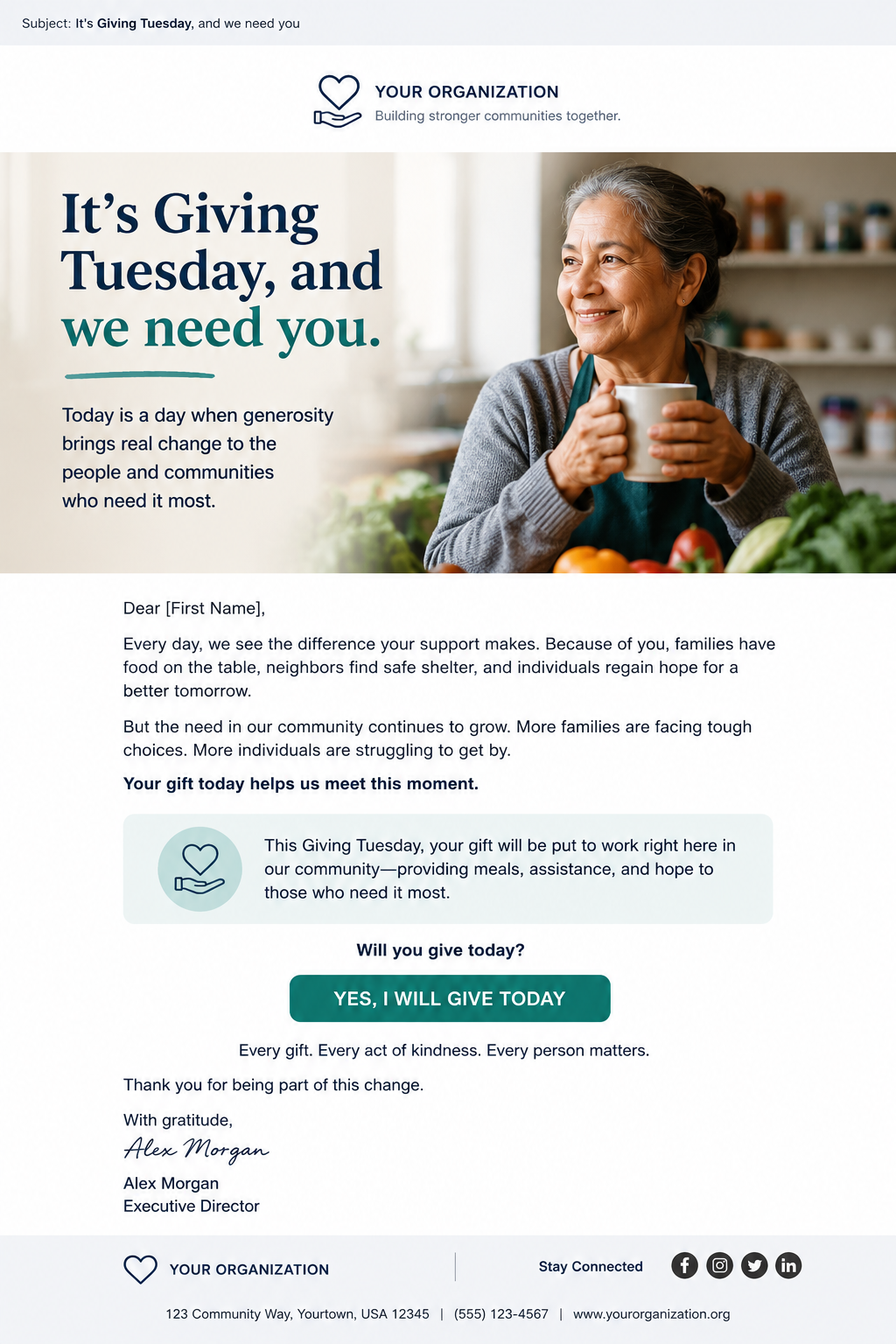
If you have the resources, include a compelling impact graphic or photo that reinforces your story. Strong visuals can make your appeal even more persuasive. But don't let the absence of polished creative delay your campaign.
A sincere, well-written email from your executive director will almost always outperform a beautifully designed message that lacks authenticity.
13. The Board-Funded Match
Before Giving Tuesday, ask your board collectively to pool a matching fund of any size. $1,000, $2,500, whatever is accessible. Then make this board-funded match the headline of your campaign. The mechanics are simple: someone gives $50, the match adds another $50.
The message is immediate: your gift is doubled today. This requires one ask to your board (which serves as its own engagement), one email to your database, and one social post series throughout the day.
14. The Existing Donor Re-Engagement Ask
For organizations with small acquisition budgets, Giving Tuesday is most efficiently spent re-engaging lapsed donors rather than acquiring new ones. Pull the list of donors who gave in 2024 or 2023 but have not given yet this year. Send them a personal, specific note: "You gave last year, and it made [specific outcome] possible. We'd love to have you back."
A re-engagement ask to a warm, lapsed donor converts at a significantly higher rate than a cold acquisition ask, costs nothing beyond staff time, and requires no new technology.
Building Your 2026 Giving Tuesday Timeline
The organizations that perform best on Giving Tuesday start earlier than almost everyone else. Here is a realistic planning arc for December 1, 2026:
By September 15: Decide on your campaign goal, your matching gift strategy, and your lead story. Secure the match commitment. Identify which donors you will ask to lead peer-to-peer pages.
By October 1: Set up your donation platform, peer-to-peer pages, and any text-to-give infrastructure. Begin the beneficiary story series on social media.
By November 1: Launch your pre-Giving Tuesday communications. Warm your email list with one story-led email per week. Brief your board and staff on their personal ask assignments.
November 15 to 30: Increase communication cadence. Share social proof (matching gift progress if you have it, stories of why others give), and begin your specific Giving Tuesday ask sequence.
December 1: Launch day. Send your morning email before 7am. Post your opening video. Update your progress tracker publicly throughout the day. Send a midday update. Close with an evening urgency email showing how close you are to your goal.
December 2 to 7: Thank every donor personally within 48 hours. Report your results with impact specifics. Convert first-time donors to recurring givers with a targeted follow-up ask.
Final Thoughts
December 1 is not the beginning of your Giving Tuesday campaign. It is the closing chapter of a story you started telling in October.
The nonprofits that raised the most in 2025 did not win because they had the biggest budgets or the most sophisticated technology. They won because they knew their community, told a specific and true story, asked personally, and made it easy to give. All of that is within reach of any organization, regardless of size.
Start now. The organizations who start in November are already behind.
Frequently Asked Questions About Giving Tuesday for Nonprofits
1. When Is Giving Tuesday 2026?
Giving Tuesday 2026 falls on December 1. It is always the Tuesday after Thanksgiving in the United States, which means it falls on the first or second Tuesday of December each year. Marking it on your calendar now and building your planning backward from December 1 is the most important first step.
2. How Much Do Small Nonprofits Typically Raise on Giving Tuesday?
It varies significantly by organization size, database health, and campaign quality, but 38% of all Giving Tuesday gifts in 2025 were under $50 and 60% were under $100, which tells you something about the realistic scale of individual transactions. Small nonprofits with fewer than 1,000 donors in their database commonly raise between $5,000 and $25,000 on Giving Tuesday with a well-run campaign. The single biggest predictor of results is how early and how personally you communicate with your existing community.
3. Do Matching Gifts Make a Real Difference for Small Nonprofits?
Yes, substantially. Mentioning a matching gift in a fundraising appeal can increase response rates by 71% and average donation amounts by 51%, according to research from Double the Donation. Even a modest board-funded match of $2,500 to $5,000 can meaningfully shift donor behavior, because it changes the psychology of the ask from "give to us" to "double your impact today."
4. Should Small Nonprofits Focus on New Donors or Existing Ones on Giving Tuesday?
Both, but with different strategies. Existing donors who have lapsed are the highest-converting audience available and require the least effort: a personal, specific re-engagement ask tends to convert at 20 to 30%. Peer-to-peer fundraising is the most cost-effective path to genuinely new donor acquisition, because your supporters do the distribution work using their own networks. Cold acquisition through paid advertising is expensive and increasingly unreliable for small organizations, and is rarely the best use of a limited Giving Tuesday budget.
5. Is Giving Tuesday Worth It for Very Small Nonprofits?
Yes, though with an important caveat. Giving Tuesday is worth it when it is treated as a community-building moment with fundraising attached, rather than purely a fundraising event. The donor relationships built on and around Giving Tuesday, particularly the 65% of Giving Tuesday donors who give again the following year, are worth more than the single-day total. Organizations that measure success only by December 1 revenue systematically undercount the value of the day.
Frequently Asked Questions
1. What is Giving Tuesday and why does it matter for nonprofits?
Giving Tuesday is a global generosity movement held on the Tuesday after Thanksgiving. Since launching in 2012, it has grown to 110+ countries and generated $22.5 billion in cumulative giving. For nonprofits, it is a coordinated moment to rally donors, engage volunteers, and secure workplace giving support amid tighter funding conditions caused by recent federal budget cuts.
2. When is Giving Tuesday 2026 and how should nonprofits prepare?
Giving Tuesday 2026 falls on December 1, the Tuesday after Thanksgiving. Nonprofits should begin planning in September, capturing donor stories and confirming corporate matches through October. The final weeks focus on scheduling social posts, briefing ambassadors, and testing donation pages so campaign day runs without technical friction on mobile or desktop.
3. How much money did Giving Tuesday raise in 2025?
Giving Tuesday 2025 raised $4 billion in a single day, with 38.1 million people participating in the United States, a 13% year-over-year increase. Since 2012, cumulative global giving has exceeded $22.5 billion across more than 110 countries. These numbers show that coordinated giving days consistently outperform standalone year-end appeals for most nonprofit organizations.
4. What are creative Giving Tuesday ideas nonprofits can try in 2026?
Effective Giving Tuesday ideas include hourly impact storytelling on social channels, matched-giving campaigns with corporate partners, peer-to-peer ambassador programs, livestreamed program showcases, and skills-based volunteering blitzes. Product donation drives, legacy giving asks, and community celebration events also work well, especially when paired with employer matching that multiplies each individual gift on the day itself.
5. Why is storytelling essential for a successful Giving Tuesday campaign?
Storytelling turns abstract missions into concrete outcomes donors can visualize. First-person accounts from beneficiaries, volunteers, and staff generate stronger emotional engagement than statistics alone. Nonprofits that release one authentic story every hour on Giving Tuesday sustain feed presence, build repeat visits to the donation page, and give ambassadors fresh content to share throughout the day.
6. How can nonprofits secure corporate matching partnerships for Giving Tuesday?
Corporate matching partnerships often start with existing donor relationships, board contacts, or workplace giving platforms. Nonprofits should approach companies in September with a clear match ratio, cap, and reporting plan. Matches of 1:1 or 2:1 can multiply Giving Tuesday revenue significantly, and many employers already run structured matching programs that employees can activate directly through their HR portals.
7. What is peer-to-peer fundraising and how does it drive Giving Tuesday results?
Peer-to-peer fundraising empowers supporters to create personal donation pages and raise funds within their own networks. On Giving Tuesday, an ambassador program of 20 to 50 committed advocates can extend campaign reach dramatically. Each fundraiser brings warm contacts who convert at higher rates than cold outreach, and personal stories drive stronger donor loyalty and long-term retention.
8. What digital tools help nonprofits run a Giving Tuesday campaign?
Popular digital giving platforms include Give Lively, GiveButter, and Classy, each offering low-friction donation forms, peer-to-peer pages, and livestream integration. These tools handle recurring gifts, employer match lookups, and real-time thermometers. Nonprofits should test checkout flows on mobile weeks in advance, since most Giving Tuesday donations now come from smartphone traffic.
9. When should nonprofits start planning their Giving Tuesday campaign?
Serious planning should begin in September, roughly 12 weeks out. October focuses on donor engagement and story capture, November confirms creative assets and email sequences, and campaign week emphasizes high-urgency asks. Post-campaign work runs December 1 to 15, covering thank-you outreach, impact reports, and stewardship touchpoints that convert one-time givers into recurring donors.
10. How should nonprofits thank donors and report impact after Giving Tuesday?
The 48 hours after Giving Tuesday matter almost as much as the day itself. Send personalized thank-you emails within 24 hours, publish an impact recap between December 1 and 15, and follow up with short videos from beneficiaries. Sustained stewardship in December turns single gifts into recurring donations and strengthens the donor relationships that offset shrinking federal funding.