The AI Literacy Divide in Volunteering: Who Gets Left Behind?

A few clicks. That’s all it takes for teams today to draft reports, spot trends, and even predict what customers will do next.
Across the same city, a CSR leader is trying to make a case for one shared AI license in a budget that already feels stretched. A few miles further, a nonprofit program manager is still matching volunteers to beneficiaries on paper because nobody has had the time or training to try anything else.
The real divide isn’t just who has the latest tools. It’s who has the AI literacy, time, and support to put those tools to work for the communities they serve. And right now, much of the social impact world is still standing on the other side of that gap.
AI is already changing how we search, work, and serve. In volunteering, it promises smarter matching, clearer impact data, and more personal ways for employees to give back. But almost everyone in this ecosystem, CSR teams, nonprofits, and communities, is trying to catch up at the same time. This isn’t just a tools gap; it’s an AI literacy gap, and it’s quietly shaping whose needs get understood, whose stories get told, and who gets heard in the future of social impact.
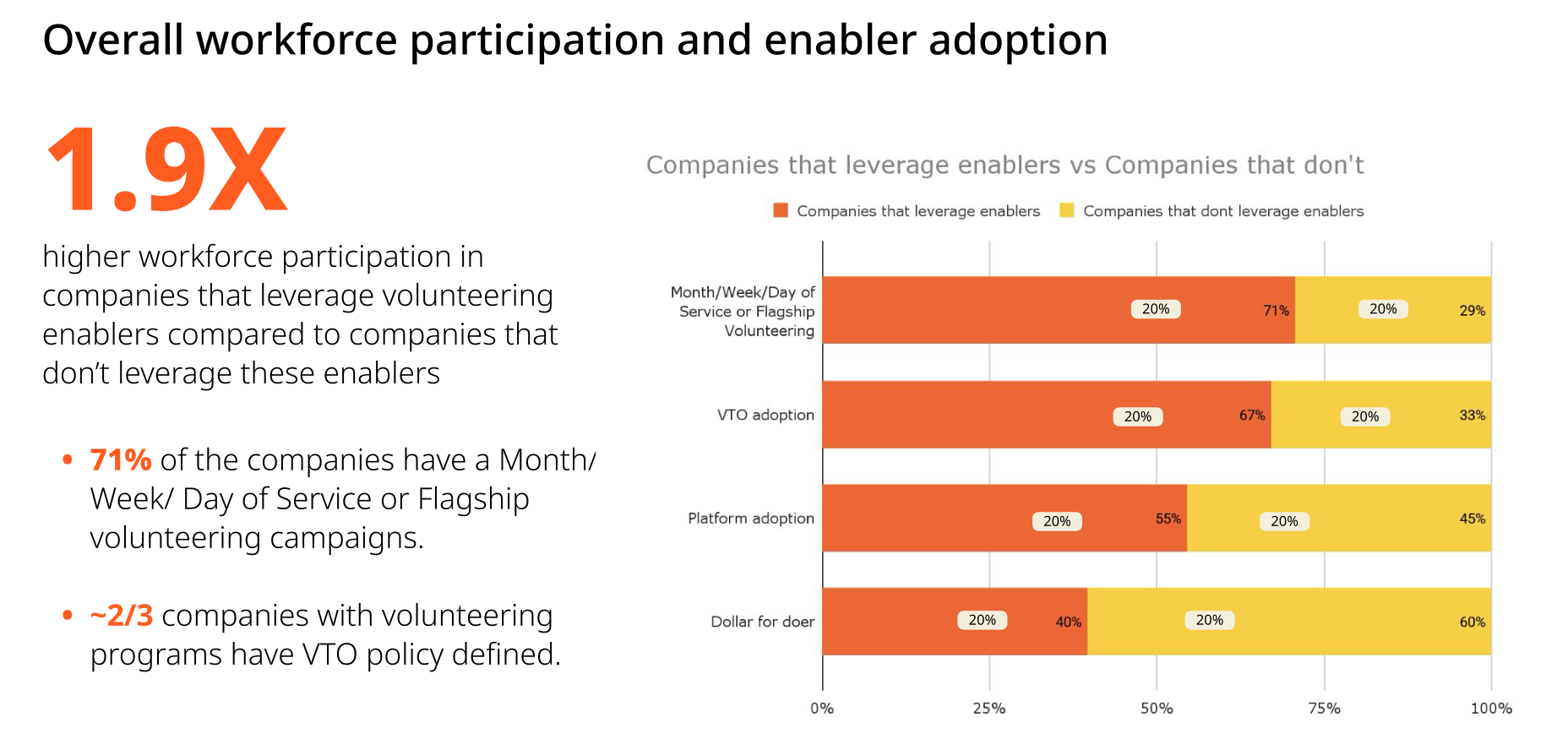
According to our Volunteering Quotient Report 2025, companies that integrate digital enablers, such as volunteering platforms, Volunteering Time Off (VTO) policies, or flagship campaigns, see 1.9 times higher workforce participation than those that don’t. Based on audited ESG data from 222 global enterprises, the report highlights that the adoption of digital and AI-driven enablers has grown by 20% year-over-year, signaling a clear shift toward technology-enabled volunteering.
But what happens when the world of advanced tech races ahead while the social-impact sector struggles to keep pace? If access to AI becomes the dividing line, imagine how large the gap in opportunity and influence could grow.
At Goodera, this question sits at the heart of our work: how do we make sure technology expands participation in volunteering, amplifies it? This piece is one step in that ongoing exploration.We’ll explore what the AI literacy divide really means for companies and nonprofits, why it matters now more than ever, and how leaders can ensure no one gets left behind.
What Is the AI Literacy Divide and Why Does It Matter in Volunteering?
When we talk about AI literacy, we’re not referring to coding or complex algorithms. It’s the ability to understand what artificial intelligence can do, when to use it, and how to use it responsibly. In volunteering and social impact, AI literacy means knowing how tools like data analytics, automation, and generative AI can help amplify a cause, whether by matching volunteers to the right opportunities, measuring outcomes more precisely, or automating repetitive tasks so people can focus on purpose more than process.
The AI literacy divide shows up when most of the world around social impact is fluent in AI, while the impact ecosystem is still catching up. Product, marketing, and operations teams in large companies are already working with advanced tools, data teams, and constant exposure to AI. CSR teams, nonprofits, and community organizations, meanwhile, are still trying to understand what AI means for their work, their beneficiaries, and their role in the future.
We can already see this gap in how nonprofits themselves talk about AI. In a recent Goodera survey of 300 nonprofits across our global network, we found that:
- Nearly 70% believe AI literacy is important for their beneficiaries
- Over 71% believe AI could help their organizations work more efficiently
And yet, over 88% cite limited funds, no access to tools, or lack of knowledge on where to begin as the biggest barriers to adopting AI.
For many nonprofits, the challenge isn’t willingness, it’s reach. Access to the right tools, funding, and training is what determines who gets to participate in this new, AI-powered phase of social impact.
Across many companies, teams already use AI to work smarter, streamline operations, generate insights, personalize engagement, and showcase data-backed results with ease. CSR teams and community nonprofits, without the same tools or training, risk falling behind in visibility, funding, and influence. This is exactly the gap volunteering is supposed to close.
That’s why AI literacy must start with a foundational understanding, not advanced technology. As Mahesh Yadav (Ex Meta, AWS, Google, and Microsoft) noted in Goodera’s AI for Impact masterclass:
“The biggest challenge isn’t building AI, it’s helping people understand what’s possible with it.”
It’s a simple but powerful reminder that AI literacy begins with clarity, the ability to define intent, set boundaries, and guide outcomes. For nonprofit teams, even learning how to communicate effectively with AI tools can unlock productivity and creative problem-solving, no tech background required.
This thought also came to life at a recent AI Hackathon at Goodera, where even non-tech teams learned how to build automations using ChatGPT and AI APIs.
In just 24 hours, participants from across departments, including admin and operations, developed real, working solutions to simplify volunteer management, match nonprofits to causes, and track event impact. It was proof that AI literacy isn’t about writing code; it’s about curiosity, collaboration, and the willingness to learn what’s possible.
How Unequal Access to AI Knowledge Affects CSR and Nonprofit Impact
Once you start looking for it, the AI literacy divide becomes easy to spot.. The same company that uses AI to plan campaigns, forecast demand, and fine-tune customer journeys is often running its volunteering program on spreadsheets and email threads.
CSR teams and their nonprofit partners rarely have the same dashboards, automation, or AI support. They lean on manual tracking and overstretched staff for data and storytelling. The barrier isn’t interest in AI, it’s time, exposure, and the support to learn how to use it well.
Meanwhile, many nonprofits, particularly smaller or community-led ones, are still operating without digital infrastructure or AI expertise. They depend on spreadsheets, manual tracking, and volunteers to manage data or storytelling. For them, the challenge isn’t resistance to AI; it’s a lack of exposure and resources to learn how to use it effectively.
This creates a ripple effect across the ecosystem:
- Limited understanding slows experimentation and innovation
- Slow adoption leads to missed opportunities for efficiency and engagement
- Missed opportunities reinforce dependency on better-resourced partners
In Goodera’s AI for NPOs webinar, Deepa Chaudhary, Founder, Grant Orb, summarized it well:
“When nonprofits don’t understand what AI can do for them, they don’t just lose efficiency, they lose voice.”

That imbalance runs through the whole volunteering chain. The business side can use AI to track performance and tell a strong data story; social impact teams and nonprofits often can’t. The divide isn’t in intent, but in capability. Data fluency now shapes whose impact is visible and whose stories stay unheard.
Who Gets Left Behind and How?
While tech-heavy companies scale rapidly with AI, the social impact sector risks being left behind. In the volunteering ecosystem, three groups feel the AI literacy divide most acutely: CSR leaders and ERGs, nonprofits, and communities. Among these, nonprofits and the communities they serve face the biggest barriers, as access to technology, knowledge, and infrastructure remains limited.
1. CSR Teams and ERGs: Not the First in Line
Even within companies, social impact teams are rarely the first to receive AI tools or budget for automation. Resources tend to flow first to revenue-generating functions like marketing, sales, and product teams, leaving CSR teams and employee resource groups (ERGs) to make do with existing processes. This limits their ability to innovate, experiment, or fully leverage AI for program design and reporting.
Consequences include:
- Delayed adoption: CSR teams may only access AI solutions after other departments have implemented them, slowing their ability to optimize volunteer programs.
- Limited visibility: Without advanced AI tools, CSR leaders cannot easily map community needs, forecast engagement, or analyze impact at scale.
- Missed innovation opportunities: Initiatives like predictive volunteer matching, dynamic cause mapping, or automated storytelling are often out of reach, keeping social impact programs behind the curve.
2. Nonprofits: Struggling to Keep Pace
Nonprofits operate on limited budgets and often lack tech infrastructure. Many cannot access AI tools that simplify administrative work, analyze volunteer data, or optimize program delivery. This leads to:
- Slower program delivery: Volunteer scheduling, donation tracking, and impact measurement remain manual.
- Missed insights: Lack of analytics prevents nonprofits from understanding trends in engagement or program outcomes.
- Limited capacity to innovate: Scaling services or experimenting with new program models is challenging.
3. Communities: The Ultimate Risk of Being Left Behind
Communities feel the impact most directly. When nonprofits cannot leverage AI, service delivery slows, programs are smaller, and tailored interventions are limited.
- Reduced access to services: Program reach and responsiveness suffer.
- Inequitable opportunities: AI tools that identify underserved groups or predict needs are unavailable, leaving some populations under-supported.
- Fragmented impact: Communities miss out on coordinated insights across organizations, limiting holistic solutions.
The Big Picture: A Two-Speed Ecosystem
Tech-heavy companies and their core business functions adopt AI quickly, gaining speed, insights, and visibility. Meanwhile, CSR teams, nonprofits, and the communities they serve lag behind due to limited access and support. Without shared tools, accessible AI solutions, and intentional resourcing, the social impact sector risks a two-speed volunteering ecosystem: one part scaling efficiently with AI, the rest struggling to maintain existing services.
The next challenge for every purpose-driven organization is making AI adoption equitable. Because the promise of technology in volunteering has never been about efficiency alone, it’s about connection, inclusion, and shared progress.
“Innovation moves faster than inclusion. And, if we’re not intentional, technology can deepen the very divides we’re trying to solve.”
— Deepa Choudhary, Founder, Grant Orb, spoke in Goodera’s AI for NPOs webinar
The Path Forward: Shared Understanding, Shared Velocity
Closing the AI literacy divide isn’t about making the social impact sector “as fast” as tech companies. It is about giving purpose-driven organizations a fair starting point in a world where AI is quickly becoming the new baseline for productivity, visibility, and decision-making. Right now, the divide is clear: tech companies move at the speed of innovation, while many community organizations move at the speed of available resources. Bridging that gap requires shared understanding, shared tools, and shared responsibility.
1. Share What You Know, Not Just What You Build
Tech teams are often five steps ahead simply because they live in environments where experimentation, prototyping, and AI adoption are everyday behavior. One of the most powerful ways to shrink the literacy divide is for these teams to share their knowledge in ways that don’t require tech backgrounds.
How this works:
- Open, hands-on demos
For example, walking a nonprofit team through how AI can draft grant applications, summarize long reports, or turn raw data into simple charts. The goal is to show real tasks they already struggle with, solved in minutes. - Sharing templates, prompts, workflows, or automation blueprints
This could look like ready-to-use email drafting prompts for volunteer coordination, prebuilt workflows for onboarding volunteers, or templates that automatically generate social media posts from event notes — no technical background needed.
- Providing safe “practice environments”
For instance, giving nonprofits sandbox access to an AI tool where they can upload dummy data, try automations, or test AI-generated content without worrying about mistakes, compliance issues, or breaking anything in their real systems.
Knowledge becomes equity when it’s accessible.
2. Fund Confidence, Not Just Capacity
Financial support is helpful, but confidence-building is transformative. When social impact teams feel comfortable experimenting with AI rather than intimidated by it, they adopt faster and more sustainably.
This could include:
- Sponsoring AI literacy workshops focused on simple, repeatable use cases.
- Pairing skilled employees with community organizations in long-term mentorship roles.
- Supporting nonprofits in mapping out where AI can meaningfully reduce effort across their operations.
The goal is not mastery. The goal is comfort, curiosity, and capability.
3. Start Small, Learn Fast, Scale What Works
For nonprofits and community organizations, the breakthrough is rarely a sophisticated AI system. It usually starts with one simple improvement that frees up time for frontline work.
That could mean:
- Using AI to draft emails or create basic visuals for social campaigns.
- Automating attendance sheets, volunteer registrations, or follow-up messages.
- Identifying one “AI champion” who experiments first and teaches the rest of the team.
4. Build With Accessibility at the Center
Purpose-built platforms can make a real difference by placing AI directly inside the tasks nonprofits already do every day. Instead of asking teams to learn new tools or change their workflows, AI quietly improves the processes they already use.
This includes:
- Automating repetitive administrative work.
- Providing dashboards that both corporates and nonprofits can use without technical training.
- Creating shared visibility that reduces imbalance between tech-rich and resource-constrained organizations.
5. A More Equitable Future of Volunteering
Because the future of volunteering cannot belong only to organizations with large tech teams or advanced digital infrastructure. It must reflect the needs and realities of the communities who rely on social impact programs and the nonprofits who serve them every day.
The promise of AI in volunteering is not better automation.
It is better access.
Not faster innovation.
But broader participation.
And the only way to get there is together.
Here’s a glimpse from our recent AI and Volunteering Summit, where leaders explored how technology and human connection can work hand in hand to shape the next chapter of corporate volunteering.
Key Takeaways
The AI literacy divide is no longer a distant concern; it’s a defining factor in who leads and who lags in the social impact ecosystem. But the good news is, closing the gap doesn’t require massive investment. It starts with awareness, intentionality, and small, consistent steps toward shared learning.
Risks of Inaction
- Decreasing collaboration: When one side advances faster, partnerships weaken.
- Limited visibility: Nonprofits without AI tools risk being left out of impact data and funding pipelines.
- Widening inequity: Communities without digital representation may receive less support and recognition.
Benefits of Early Intervention
- Higher engagement: Digital confidence translates to more active and informed participation.
- Better measurement: AI-enabled reporting creates more accurate, transparent impact tracking.
- Shared innovation: Cross-learning between CSR teams and nonprofits leads to scalable solutions for global challenges.
Quick Action Checklist
- Assess your team’s AI literacy: Use internal surveys or workshops to gauge comfort levels and knowledge gaps around AI tools and ethics.
- Identify gaps among nonprofit partners: Evaluate digital readiness and offer access to shared resources or co-learning programs.
- Pilot a digital literacy volunteering initiative: Encourage employees to mentor nonprofits in using AI tools for communications, analytics, or reporting.
- Build a responsible AI charter for your CSR program: Outline how data, automation, and AI will be used ethically and inclusively.
- Celebrate learning as impact: Track how digital skill-building contributes to long-term engagement and community resilience.
The organizations that take these steps today won’t just adapt to the future; they’ll help design it. Because in an AI-driven world, the most powerful impact is shared understanding.
Frequently Asked Questions
1. What are the challenges of AI literacy?
The biggest challenge of AI literacy is unequal access to tools, training, and time to learn. While most business functions today are surrounded by AI-enabled systems, social impact teams, nonprofits, and community groups often operate without the same resources or confidence to experiment. Tight budgets, language barriers, and fear of misuse add to the hesitation, even when tools are technically available. Bridging this gap will take shared learning, accessible training, and digital infrastructure designed for the realities of social impact work.
2. What is the gap in digital literacy?
The digital literacy gap reflects how unevenly people and organizations can use modern tools. In volunteering, it appears when the rest of the organization runs on advanced systems, while social impact teams and nonprofits often rely on limited or manual processes. This slows down collaboration and reporting. Building AI literacy helps level the field for the entire social impact ecosystem.
3. What is AI literacy?
AI literacy is the ability to understand what artificial intelligence can do, when to use it, and how to use it responsibly. It doesn’t mean learning to code or build algorithms; it’s about understanding the potential and limits of AI in everyday decision-making. In volunteering and social impact, AI literacy empowers CSR teams and nonprofits to use technology ethically for good: matching volunteers to causes, tracking outcomes, and communicating impact more effectively.
4. How can CSR programs improve AI literacy among nonprofits?
CSR programs can play a major role in bridging the AI literacy divide by offering training, resources, and mentorship to nonprofit partners. Companies can host AI learning workshops, fund digital upskilling programs, or provide access to shared platforms like Goodera’s Admin Hub to simplify data management and reporting. Encouraging employee volunteers, such as data scientists or analysts, to mentor nonprofits also helps build long-term confidence and capability.
5. Why is AI literacy important for volunteering?
AI literacy is becoming crucial for volunteering because it helps organizations engage more volunteers, measure impact more effectively, and personalize experiences at scale. With AI, CSR teams can match employees to the right causes, predict participation trends, and reduce administrative work, making volunteering programs more impactful. When nonprofits understand these tools, they can better collaborate with companies and attract more consistent support.
6. What role does Goodera play in promoting AI accessibility?
Goodera acts as an enabler of equitable, technology-driven volunteering. Through platforms like the Admin Hub, Goodera simplifies program management, automates reporting, and ensures that both corporations and nonprofits can operate on equal technological footing. Additionally, Goodera’s webinars and AI resource hub help CSR professionals and nonprofit teams understand and responsibly adopt AI for social good.
7. What are some examples of AI being used in volunteering?
AI is already being used to match volunteers to causes, forecast participation rates, and automate repetitive administrative tasks like registration or reporting. Some platforms use AI-driven sentiment analysis to assess volunteer feedback, while others use generative AI to craft impact stories and donor communications.
These applications save time, improve accuracy, and make programs more responsive to community needs. And the next wave of use cases is even more personalized and operationally powerful, such as:
- Automating community building by understanding different volunteer personas, interests, and motivations
- Mapping each volunteer’s experience to identify what they enjoy, what skills they want to use, or what causes they care most about
- Recommending the right events so every volunteer sees opportunities that match their needs, availability, and preferred formats
- Using an integrated platform to streamline operations and execution tracking, allowing teams to plan events, coordinate tasks, monitor progress, and track impact in one place instead of juggling multiple tools
8. How can nonprofits get started with AI responsibly?
Nonprofits can begin by identifying simple, low-cost AI applications that address real challenges, like automating reporting, analyzing volunteer feedback, or improving communication. They can explore free or nonprofit-friendly AI tools, join peer learning groups, and partner with CSR programs offering training or mentorship. The key is to start small, learn collaboratively, and maintain transparency and ethics in how AI is used.


.webp)

